Ethical Horizons: Navigating Project Management with AI Compassion
From the Ethics Bistro Blog
by Tara Leparulo,
Shenila Shahabuddin, Juan Posada Toro, Albert Agbemenu, Ming Yeung, Kannan Ganesan, Yannick Arekion, Witold Hendrysiak, Stelian ROMAN, Laszlo J. Kremmer MBA, CSPO®, CSM®, PMP®

We all tackle ethical dilemmas. Wrong decisions can break careers. Which are the key challenges faced? What are some likely solutions? Where can we find effective tools? Who can apply these and why? Dry, theoretical discussions don't help. Join us for lively, light conversations to learn, share and grow!
View Posts By:
Tara Leparulo
Shenila Shahabuddin
Juan Posada Toro
Albert Agbemenu
Ming Yeung
Kannan Ganesan
Yannick Arekion
Witold Hendrysiak
Stelian ROMAN
Laszlo J. Kremmer MBA, CSPO®, CSM®, PMP®
Past Contributors:
Dr. Deepa Bhide
Lily Murariu
Alankar Karpe
Bryan Shelby
Amany Nuseibeh
Mohamed Hassan
Fabio Rigamonti
Simona Bonghez
John Watson
Lissa Muncer
Valerie Denney
Majeed Hosseiney
Gretta Kelzi
Enrique Cappella
Rocio Briceno
Karthik Ramamurthy
Recent Posts
Professionalism Under Pressure: Choosing Respect When Conflict Escalates
The Credential Is a Promise: What Do Three Letters Really Say?
When the schedule slipped, so did accountability: Ethical reflections from an early ERP project - Part 2
When the schedule slipped, so did accountability: Ethical reflections from an early ERP project - Part 1
Do You Like to Pick and Choose Your Projects?
Categories
Aerospace and Defense,
Agile,
AI,
Ambassadors,
Artificial Intelligence,
Ask the Experts,
Behavior,
bottom line,
Business Acumen,
Business Ethics,
Business Ethics,
CEO,
CFO,
Change Management,
Chapters,
CIO,
code of conduct,
code of ethics,
Code of Ethics and Professional Conduct,
communication,
Conflict,
Construction,
courage honesty responsibility respect fairness,
Cultural Diversity,
Culture,
CxO,
Decision Making,
Decision-making,
Decision-making,
Digital Project Management,
Digital Transformation,
Diversity,
Do the right thing,
dugutalization project manager professionalism social media,
economy,
EDMF,
EMAG,
empathy,
Ethical Dilemma,
Ethical Leadership,
Ethics,
Ethics,
Ethics,
Ethics,
Ethics,
Ethics,
Ethics,
Ethics as a competence,
Ethics Bistro,
Ethics in Communication,
Ethics Insight Team,
Fairness,
fairness,
Governance,
Honesty,
honesty,
Human,
Information Technology,
Leadership,
Legal Project Management,
Legilsation,
Lessons Learned,
Negotiation,
Nexus,
Organizational Culture,
Organizational Project Management,
PMI Program Management,
PMI Talent Triangle,
PMIAA,
Portfolio Management,
Power Skills,
practitioner,
Product Management,
Professional Conduct,
professional conduct,
Professional Responsibility,
Professionalization,
professonal conduct,
Program Management,
Project,
Project Management,
project manager,
Regulatory,
research,
Respect,
respect,
Responsibility,
responsibility,
Risk Management,
Stakeholder Management,
Strategy,
Sustainability,
Team Assessment,
Teams,
Thought leadership,
tools,
Trust,
trust,
Values,
Values,
values,
Virtual Experience Series,
volunteers,
Ways of Working
Date
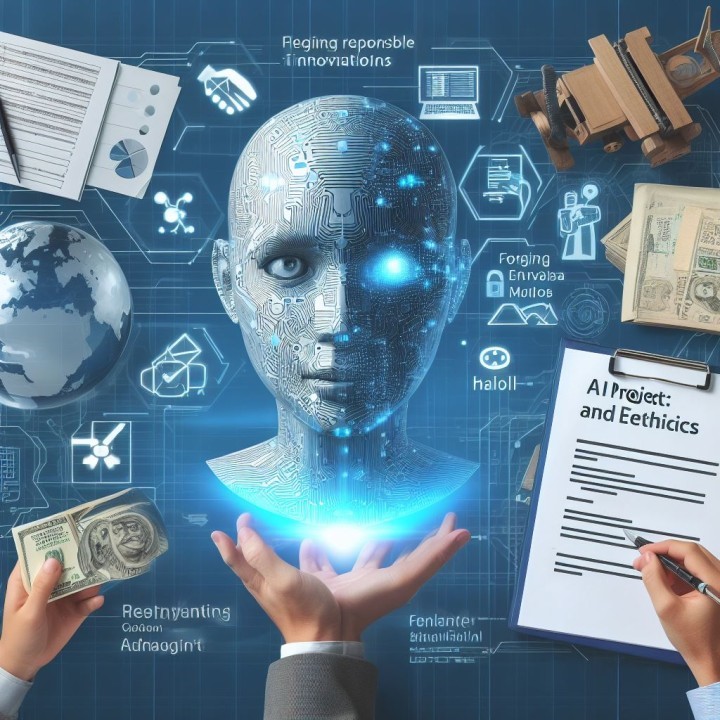
In the heart of Projectville, where projects pulsated with ambition, a seasoned project manager named Alex embarked on a transformative journey. This is a tale not just of innovation but of ethical leadership, where the integration of artificial intelligence (AI) became a beacon guiding projects through the ever-evolving landscape.
Setting the Ethical Stage:
Amidst the whirlwind of project complexities, Alex was entrusted with a groundbreaking initiative. The project was not just a quest for deliverables; it was a commitment to ethical project management. It was in this ethical context that AI emerged, promising efficiency without compromising on fairness and transparency.
AI as the Ethical Ally:
The introduction of AI was not merely a technological upgrade; it was a strategic decision to embed ethics into the project's DNA. The AI algorithms were programmed not just for optimal outcomes but for ethical considerations, fostering a culture of responsibility from the outset.
The Dilemma of Ethical Efficiency:
As the project unfolded, Alex encountered the delicate balance between efficiency and ethical considerations. The AI, equipped with its algorithms, made decisions that required scrutiny. The project manager grappled with the responsibility of ensuring that AI-driven efficiency did not compromise on fairness or diversity.
Illuminating Ethical Transparency:
In a pivotal team meeting, Alex chose transparency as the cornerstone of ethical leadership. The black box of AI decision-making was opened, and the team engaged in a candid discussion about the ethical implications. Transparency became the catalyst for fostering a shared understanding of AI's role in decision-making.
Collaboration as the Ethical Paradigm:
Recognizing AI not as a substitute but as an ethical partner, Alex advocated for a collaborative approach. The diverse team, each member embodying unique perspectives, collaborated harmoniously with AI. The result was not just efficient project outcomes but an ethical legacy that permeated the project's every fiber.
AI's Ethical Legacy:
As the project concluded, it left behind not just deliverables but an ethical legacy. Alex's leadership had infused a commitment to fairness, transparency, and collaboration. The ethical considerations, meticulously woven into the project's fabric, became a foundation for future initiatives.
Conclusion:
As the story of Alex unfolds, it reveals a deep truth: AI in project management goes beyond tasks; it's a guide through the ethical landscape. Alex's journey shows that in project management, where innovation and ethics blend, the process is as crucial as the outcome.
Now, let's ponder: Can we, like Alex, see AI as more than a tool? Can it be a force for ethical change, shaping a future filled with compassion and inclusivity? The story prompts us to ask: How can we use AI ethically to navigate not just projects but also the moral challenges in our work?
So, here's a question for you: How can AI be a compass for ethical choices in your projects?
Related to PMI's Code of Ethics and Professional Conduct:
This narrative aligns with PMI's emphasis on ethical conduct, reflecting the commitment to responsibility, fairness, and transparency in project management. AI's ethical integration resonates with PMI's principles, ensuring ethical considerations echo through every project.
References:
PMI Code of Ethics and Professional Conduct
PMI Ethical Decision-Making Framework
Posted
by
Shenila Shahabuddin
on: January 13, 2024 12:00 AM |
Permalink
Comments (15)
Please login or join to subscribe to this item

Luis Branco
CEO| Business Insight, Consultores de Gestão, Ldª
Carcavelos, Lisboa, Portugal
Dear Shenila
The topic you brought to our reflection and debate is very interesting.
Thank you for sharing and your opinions
I always thought that our alignment with the Principles was an inside-out process.
Your proposal comes in the opposite direction, from the outside in (AI controlling alignment with the Principles)
By the way, collaboration is a Value, not a Principle
@Luis
Thank you for your thoughtful reflection on the topic. I appreciate your perspective on the alignment with the Principles being an inside-out process, and it's interesting to consider the idea of external factors, particularly AI, influencing this alignment.
Your clarification on collaboration being a Value rather than a Principle is duly noted. It's essential to maintain accuracy in our terminology, and I value your contribution to the discussion.
Looking forward to further exploration and fruitful debates on this intriguing subject.

Ming Yeung
Professor (adjunct part time)| George Brown Polytechnic/Fanshawe College/Humber Polytechnic
Toronto, Ontario, Canada
Dear Shenila, thank you for sharing the timely topic. I would not view AI as more than a tool where I am still accountable for my deliverables/outputs/actions (even aided/supported by AI). And the collaboration remains valuable as the application of AI into the craft of project management continues to evolve.
@Ming
Thank you for your thoughtful insights and perspective on the topic. It's valuable to acknowledge that, despite the integration of AI, individual accountability for deliverables and actions remains a crucial aspect of project management.
Your viewpoint on AI as a tool that aids and supports rather than replaces human accountability resonates with the evolving nature of AI in project management. The ongoing collaboration between AI and project managers indeed adds value, enhancing the overall efficiency and effectiveness of the process.
As we navigate the dynamic landscape of project management with AI, diverse perspectives like yours contribute significantly to the ongoing conversation. I appreciate your engagement and look forward to further discussions.

Kwiyuh Michael Wepngong
 Community Champion
Financial Management Specialist | US Peace Corps
Yaounde, Centre, Cameroon

George Freeman
Thought Leader | Author | Architect|
Florida, United States
Shenila, this is an interesting posting that provokes (at least for me) some deep thoughts. Let me provide my challenge-based opinion and then ask you for some clarity.
If AI as we know it could have the following capacities:
- Abstraction and logic
- Learning, reasoning, and planning
- Creativity, critical thinking and problem-solving
- Understanding, self-awareness, and consciousness
- Emotional knowledge, sensations, and feelings (i.e., sentience)
And additionally, the underlying architecture, processes, and metadata (of said AI) would be held accountable through complete transparency; then, AI would have the ability to be considered more than a tool.
Primary thought: The characteristics and qualities presented in PMI’s Code of Ethics and EDMF require the abovementioned capacities plus a healthy dose of “context” if one expects ethical reasoning to occur in a given situation.
That said, what is your premise argument? In your conclusion, I’m interpreting (maybe wrongly) that you are implying that AI may be the answer to [A] Moral Challenges, [B] Compassion, and [C] Inclusivity. If this reading of mine is correct, it implies that sentient human ethical reasoning is a problem (regarding those three points) that needs a resolution, and that resolution is AI.
Your thoughts?
Shenila, a great blog and topic. This is going to be the situation in future as more and more AI gets going in PM. I think we need to think of a creating an ethical framework to support project managers. Each PM will have a different situation of his own. Regardless, ethical framework should remain the fabric on which sound and moral decisions will be made.
@George
Thank you for engaging in this thoughtful discussion! Your breakdown of AI capacities and the tie-in with PMI's ethical principles is insightful. My premise argument centers on AI being a potential ally in addressing moral challenges, fostering compassion, and promoting inclusivity, not as a replacement for human ethical reasoning but as a complement. The idea is to leverage AI's capabilities to enhance ethical decision-making, considering the nuances and complexities that may arise in the ever-evolving landscape. It's more about collaboration between human judgment and AI's capabilities, aiming for a synergy that elevates ethical standards rather than replacing them. Looking forward to your further insights!
@Deepa
Thank you for your thoughtful response! I completely agree with your perspective. Establishing a robust ethical framework tailored to the unique situations project managers encounter is crucial. It serves as a guiding force, providing a foundation for sound and moral decision-making. The dynamic nature of AI in project management necessitates a flexible yet principled approach to ethics. Let's envision a future where project managers, supported by a well-defined ethical framework, navigate the complexities with integrity and resilience. Your insights add great value to this ongoing dialogue!

Bryan Shelby
Retired| Retired and volunteering, having left "employment" behind!
New York, Ny, United States
Shenila, thank you for a fresh view of the role of AI in PM. A key question for me in this discussion is the "how" -- specifically, how "(t)he AI algorithms were programmed ... for ethical considerations." If ethical decision-making was easy, there would be no need for the EDMF. It would be interesting to hear from someone familiar with AI training/programming on how this might be accomplished.
Hello Bryan,
Thank you for engaging with the topic! You've brought up a crucial point regarding the "how" of programming AI algorithms for ethical considerations. Indeed, it's a nuanced process that requires a multidisciplinary approach.
The ethical considerations embedded in AI algorithms involve a combination of meticulous programming, robust frameworks, and ongoing evaluation. AI systems need to be designed with transparency, accountability, and fairness in mind. This often involves:
1. Diverse Stakeholder Involvement: Ensuring that the development team includes individuals with diverse perspectives and experiences to mitigate biases.
2. Ethics by Design: Incorporating ethical principles into the design phase, considering potential impacts on different user groups, and establishing safeguards against unintended consequences.
3. Continuous Monitoring: Implementing mechanisms for ongoing monitoring and evaluation to detect and rectify any ethical issues that may arise during the AI system's lifecycle.
4. Adherence to Standards: Following ethical guidelines and standards established by regulatory bodies and industry associations.
5. Explanability: Striving for transparency in AI decision-making processes to enable a clear understanding of how the system arrives at conclusions.
While these steps contribute to ethical AI development, it's an evolving field, and collaboration across disciplines is crucial for refining these practices.
Would love to hear more thoughts on this or any related experiences you might have!
Very interesting post. Thank you for sharing.
@Antonio
Thank you for your kind words! I'm glad you found the post interesting. If you have any thoughts or additional insights to share, feel free to join the discussion. Your input is valuable!
It is interesting to think about AI's ethical legacy.
@Barkev Daron
Absolutely! It’s a fascinating and important topic AI’s ethical legacy will shape not just technology, but the values and principles we carry into the future. I’m glad you found it thought-provoking, and I appreciate you joining the conversation!
Please Login/Register to leave a comment.
|
"The man who views the world at 50 the same as he did at 20 has wasted 30 years of his life."
- Muhammad Ali
|




