


Workforce Ethical Dilemmas in times of COVID-19


|
As Angela started her car, a thought crossed her mind on when she gets home, will she be greeted by her family? It was a disturbing thought and so she set it aside trying not to dwell on it. Why would they not? They have been always ready to greet her with a hug as soon as she arrived from her hectic hospital duty that almost left her lifeless. What will be different this time? She imagined her two year old Sally hugging her, and her husband John offering to park her car and make her coffee. She reassured herself nothing would be different and continued to drive. These are the thoughts and emotions of our healthcare workforce as they are working on the frontlines in the COVID-19 settings in the hospitals. While we are grateful for their dedicated service, some part of us is concerned if they are carriers for the virus, infecting the family when they get home. We are privy to the universal truth that the personal protective equipment as in gown, gloves, N95 respirator plus a face shield/goggles etc. are scarce. What does that leave our loved ones with? An exposure to the risk of contracting the virus at the hospital? Will they be carrying it back home? Cases are reported across the world around growing discrimination due to heightened fears and misinformation. Driven by authentic information, ethical behavior and health literacy, there is an urgent need to counter such prejudices and show empathy to these “warriors”. Yet another situation seen around ethical concerns is around resource allocation. During medical emergencies, it’s important to ensure that ethically appropriate treatments are delivered. In face of scarcity of resources in treatment of COVID-19 patients and shortages of life-saving equipment including ventilators and medications; healthcare personnel often face an ethical dilemma and are forced to make difficult choices for appropriate allocation of these limited health resources. In Italy, the Italian College of Anesthesia, Analgesia, Resuscitation, and Intensive Care (SIAARTI) has formulated the guidelines1 for the benefit of tackling such ethical challenges. Recently World Health Organization (WHO) has established an international Working Group on Ethics & COVID-19 in order to develop advice2 on key ethical questions that member states need to address. Let’s map these to PMI’s Code of Ethics and Professional Conduct and see how they fit.
We; as citizens; have a responsibility to ourselves and others to recognize these challenges that our near and dear ones who are front-ending the COVID-19 patients are facing. Let’s all be empathetic, responsible, respectful, honest and fair towards them and spread the word of ethical behavior in face of these challenges. Angela reached home to find Sally and John waiting for her with basket full of flowers that they were eager to shower on their “brave” mother/wife. Angela’s eyes were wet with tears as she approached her home, facing another ethical dilemma – As much as she wants to shower her family members with hugs and kisses, as much as she’s aware of the risk that she is exposing them to. If you were Sally, what would you do? References and helpful links
Names are changed to protect identity |

 The Code of Ethics and Professional Conduct by Project Management Institute with its four values (Responsibility, Respect, Fairness and Honesty) are all-inclusive and can be applied to any domain and situations. We urge readers to review these and keep themselves informed.
Effective communication in COVID-19 crisis needs responsibility, respect, fairness, and honesty.
Categories:
Ethics in Communication
Categories: Ethics in Communication
| Effective communication in COVID-19 crisis needs responsibility, respect, fairness, and honesty. Enrique Cappella, PMP.
Organizations and people are struggling to adapt to the new “normal” work environment and obtain high performance and quality. Working from home in a remote fashion using technology is becoming a powerful tool for business continuity. New concepts of teamwork and social interaction are emerging and the role of the Project manager as a Team Leader is changing. The challenge is to reduce the impact on the new policies (remote meetings, home working, etc.) to handle the coronavirus pandemic and its impact on performance and operations, however it is also an opportunity for preparing the teams to work on hybrid contexts (remote and face to face). The Hybrid Teams bring isolation of the members in remote environments at home or at a work location away from their social support and means a change for people and not all accepts such change. I assist organizations on Strategic Management and one of the Key Success Factors is building and maintain high performance teams that help the organization to achieve their expected results and contribute to the business strategy. Strategic management is already a challenge itself and it is now increased due to the need to protect people and obtain productivity from hybrid teams. It is a change for which not all leaders in the organization are ready for and this gap might impact negatively on team performance and achievement of targets and goals. I experienced recently the breaking down of a team in a global company. The team was built during the last 3 years, because its leader did not have the skills to communicate effectively the new way of working and to satisfy the team members expectations and needs. A global team of 5 people, running a critical role for the company, lost 3 members and the remaining 2 members are demotivated and their targets are not being achieved. Leaders need to be aware about their role in this new challenge brought by the global Corona Virus COVD 19. They need to prepare their teams to use new technologies, to adapt to the new reality, and to run meetings and control performance in a virtual fashion. The leader will not have the visual clues of motivation or conflict and need to be available to answer new questions from the team. The new leader needs to learn how to provide for constructive feedback and motivate people using a set of new tools provided by technology different from traditional face to face work schemes. Workers will feel that they are losing connections with the persons that help them during work hours and many will need to adjust their habits and discipline along with keeping self - motivated and work at home where distractions are permanent. The leader in my example above is not trained or skilled on interpersonal relationships and was not prepared to help the team members to become self-aware of their motivations and strengths needed to understand the change and how to prevent and manage their interpersonal conflict. And nothing was said in preparation to understand other member´s motivations and to learn a communication style for virtual high team performance. The result was that 3 members preferred to leave the company. Leaders need to develop a new set of values and behaviors and also they need to be honest to recognize that a new set of skills and competences are needed to help teams to overcome uncertainty and build trust and motivation to perform on the hybrid context. I had the opportunity to talk to the team members that left the company and the three of them decided to leave mainly because their manager (supposedly their leader) was not able to keep them connected to the organization. I remember the book “It’s the manager” I recently read by Clifton and Harter[i] which I recommend because it stresses the importance of the role that the manager plays to connect people. PMI Ethical Values helps leaders to remember that our team members are people that perceive threatens that will drive them into conflict if they don´t understand their leaders and the new challenges; and once they are in conflict, they will forget about the organization and might get to the point to think only about surviving. Leaders must keep in mind that people need to be Respected and treated Fairly to keep their well-being and also they need to become aware of the Responsibility to develop a new set of behaviors that will motivate and connect their team members. Leaders should be Honest with themselves and their teams about his/her strengths and weaknesses and develop team agreements that help them to build high performance teams.
[1] Clifton, Jim and Harter Jim, It´s the manager, Gallup Press, 2019. |
“To Do or Not To Do – That’s The Question” – A Whistle-blower's Dilemma
|
"The sign of a first-class mind is the ability to hold two opposing views at the same time and still retain the ability to function." - F. Scott Fitzgerald Mary seemed worried as she gulped her lunch and dashed off to her office. Nina, her lunch-buddy followed her to check if everything was okay with Mary. “Oh, this is quite challenging for me. I need courage to deal with the situation” Mary finally opened a window of her mind to Nina “What is bothering you?” - Nina “You have to keep this to yourself. Promise me. Tom is talking to one of our competitors around our top-selling product line and I happened to overhear their discussion. I was on my way to get a coffee for myself and as I stood near the vending machine, I could not help listening to the conversation, I was shocked at the details Tom was sharing. I talked to Tom and tried to sound him of my concern around doing this. He dismissed my concerns stating that he had not leaked any confidential details. I tried explaining the issue and the impact it may have but he clearly wasn’t listening to me. He tried to convince me that sharing some of this information is absolutely normal and that I should not be surprised at this behavior. As you know, Tom is my team lead and I fear this will result in some sort of retaliation” - Mary “Oh! This is a serious matter. You should inform the relevant compliance authorities about this. I hope you are aware of the laws that protect whistle-blowers. The compliance office in the organization is in-charge of such matters. Rob from the compliance office takes care of such matters. He and his team are authorized to investigate the matter and report to the higher compliance authorities” – Nina “Good to know. But, how will anonymity around such matters be maintained?” – Mary “That is protected at the beginning of the investigation but I guess the names may need to be public if deemed necessary as the investigation proceeds. However, the law itself protects whistle-blowers from retaliation. I don’t think you should worry about this.” – Nina
“How can I not worry? If my name is exposed, I know of how things can get difficult for me and may impact my career negatively. From being singled out as a whistle-blower, I am likely to face corporate retaliation, financial hardships and finally, impact on my personal and professional relationships. I may be fired from my job too. Is all this damage worth it?” “Well, I understand your concern. However, looking at things beyond you, reporting this matter to Rob is an ethical act to do. Not only will it save the reputation of our organization but will also get you some brawny points for blowing the whistle before it becomes too late. I am sure our team will hold you in highest regard for this act and you will serve as an example for many from our team members and organization. Don’t you think this outweighs your personal concerns? I am sure you are aware of the Project Management Institute’s Code of Ethics and Professional Conduct and the pmi.org/ethics webpages. These pages list a plethora of references containing great tools that might further assist you in taking a decision – you really need to look them up too. “To do or not to do, is the question and my friend, I am sure, you will choose “to do”” - Nina “Ok. But do you think these laws are operational or are they merely on paper”? – Mary sounded skeptical “We can check with Rob on it” – Nina’s assuring voice “Thanks Nina. That makes me feel better. I will see Rob at the earliest” – Mary This is a common challenge in the contemporary competitive world where cutthroat competition is fierce, ugly and threatens to destroy businesses. Many of us, intentionally or unintentionally find ourselves in situations that get us involved in similar whistle-blowing cases and then the question arise on “what do we do?” The question is at the core of an ethical dilemma, sleepless nights and uncertainty about the next steps, the implications on us as individuals, our well-being, our livelihood, our families, friends and loved ones. Will it be risky to be a whistle-blower? While our ethical compass directs us on what to do, the consequences might deter us, prior stories and the outcomes might determine how confident we are in the system, following the process and putting our trust in the compliance system that might or might not support us. Without any dearth of evidence, it has been shown that to be ethically correct is always the ideal and right thing to do. With codes around ethics and laws that protect whistle-blowers, those who wish to report such unethical or illegal acts can be assured that their interests and welfare will be protected. However, in this age of disruption where uncertainty around jobs looms large, what is way out? After about six months of the incident, the team heard that Mary had resigned with a note on facing some distress from her manager and the organization. Well that ended the matter of this specific case but did it really end the overall issue that Mary had raised? Have you ever come across this situation in your professional life so far? Would love to hear your thoughts. References and helpful links
Note: You can find a rich set of Ethics resources such as the PMI Code of Ethics and Professional Conduct, Ethical Decision Making Framework, Ethics-related Tools, etc., in many world languages at http://www.pmi.org/ethics. Names are changed to protect identity. |

 As per Oxford dictionary, a whistle-blower is a person who informs on a person or organization regarded as engaging in an unlawful or immoral activity. This is a guard against harmful and dishonest activities that can jeopardize the credibility and reliability of an organization. In this case, Mary is a whistle-blower and wishes to report Tom’s actions to the compliance officer.
Only YOU Can Do This
| Last summer, back in July 2019, I was attending one of the largest technology users’ conferences in sunny San Diego-California, where the last slide of the keynote opening speech caught my eye and I kept thinking about it until writing this blog.
Jack Dangermond (President and Owner of Esri) Closing note, Esri User Conference plenary session, July 2019, San Diego, California, USA As a professional project manager, my work is part of something much larger. It is about driving ideas successfully by turning them into reality, using people skills and capabilities in a timely fashion. This is what the new PMI’s PROJECT ECONOMY™ is all about, and this is the future of the profession. Being part of a larger system means that I am an active stakeholder, engaged in establishing the basis of a sustainable future, with its multiple faces: sustainable development, resilience, sustainable entrepreneurship, corporate social responsibility, etc. There is no doubt that, with the multilateral processes in place, and levels of support incorporated; it is eminent to always calibrate the relationships with the environment we are living in. It is becoming more imperative to design and implement an inclusive global thriving society to ensure a better future.
https://pixabay.com/illustrations/questions-who-what-how-why-where-1328466/ Saying that; and building on top of the fact that we are all already engaged to follow the trend; what could the drivers to realize a sustainable future? How to achieve this balance? What are the needed skills? What is the required level of maturity? Is it only about adopting the latest technologies and/or embark on a digital transformation journey? Is it enough to pursue more certifications in the field of innovation, change management, coaching, etc.?
While those are existential questions, perspectives of answers are different, and may vary from a context to another, from a culture to another, from a discipline to another, the most important common factor is the INDIVIDUALS themselves, with all what they possess in terms of own needs or goals, rights and responsibilities.
https://www.freepik.com/free-photo/rag-dolls- one-blue_948225.htm#page=1&query=individual&position=2 Back to the slide mentioned earlier at the start of this text; after reading many times the requirements of achieving a sustainable future, my attention went to “Compassion, Ethics and Hard Work”, where I found more clarity, and got the appropriate answers. These include:
https://depositphotos.com/stock-photos/ethical.html? qview=40855487 In my opinion, the answers above are what makes us READY for the challenges of realizing a sustainable future. As a project manager, how do you implement this your professional environment? How do we meet the standards that we set for ourselves? Is there any reference, in the project management profession to benchmark the decisions we make? YES, THERE ARE…. AND Only YOU Can Do This
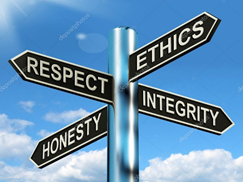
Please find below some useful links: PMI’s Code of Ethics and Professional Conduct |


Vital Work Venture Varies with Vickie’s Values
| Vickie was on the horns of a serious dilemma. It had almost made her miss the brilliant orange and red colors of the setting sun. A chilly breeze and the aroma of freshly brewed coffee from the pantry prompted Vickie to take a break. As she sipped on the steaming brew, her mind rewound events of the past few hours. Vickie was a successful senior project manager with a mid-size marketing firm in Nevada. She had been asked to lead a marquee client’s high-priority multi-million-dollar new product promotion campaign across radio, television, and multiple social media platforms. On most days, she would have been delighted and immediately accepted this project for its high career prospects. However, today, she had asked her manager Dominic for some time. He was surprised and not too pleased, but had reluctantly given her a couple of days to decide.
Why? The new product was from a company which sought to seize the opportunity of recreational cannabis being recently made legal in Nevada. Right from childhood, her parents had taught her the dangers of drug abuse. At college, Vickie had volunteered to help students avoid and deal with drug addiction. She now volunteered with a local hospital which helped people recover from the effects of addiction. Leading the project to success would accelerate her career. However, a recreational marijuana marketing project went totally against her long-held values! Realizing she needed help, Vickie reached out to Rishi, a favorite professor from college. He had taught her several courses in her Ethics minor. The professor immediately responded to her request for a call in the evening.
Vickie replied that she felt very strongly against drug abuse and addiction. She wasn’t sure about the other questions and promised to get back to Rishi the next day. Soon after, she recalled that, as a PMI member, she needed to follow the Code of Ethics and Professional Conduct. She realized that she had a responsibility to her employer to perform assigned work provided it was legal. She had to honestly disclose her moral conflict. Vickie’s manager needed to respect her strongly held values. Was there a way she could work with Dominic to find a fair solution? Speaking to Rishi the next day, Vickie explained her thought process. Was she thinking on the right lines?
He suggested that she openly express the dilemma to her manager and explain the consequences to the project. She could request that the project be led by a peer. The best outcome would be if her manager agreed. If not, she would have to make a difficult decision. The professor also asked her to also consider other win-win options. That evening, Vickie explained to her manager how her strong beliefs about drug abuse could subconsciously affect the project. Dominic appreciated her honesty but said that she’d been specifically chosen for her project management skills. No one else in the firm had that level of expertise, and so the project would still suffer! Vickie suggested that instead of leading the project, she would be happy to contribute her technical expertise by actively assisting and mentoring another project manager. The win-win option was readily accepted. Vickie worked hard to support Ivonne, the new project manager. Fast-forwarding to eleven months ahead: The marketing project achieved all objectives, and was declared an unqualified success!
How did you handle it? Do you agree with Vickie’s strategy? Would you have done anything differently? Please share your experience and views in the comments section!
Note: You can find a a rich set of Ethics resources such as the PMI Code of Ethics and Professional Conduct, Ethical Decision Making Framework, Ethics-related Tools, etc., in many world languages at http://www.pmi.org/ethics |
 Thinking long and hard, she still couldn’t decide.
  Over Skype, Vickie explained her dilemma in detail. After patiently listening to her, Rishi asked:
 Rishi felt that if she agreed to lead the project, it would be virtually impossible to completely ignore her deep-rooted beliefs. As professional as she tried to be, her subconscious bias could certainly to affect her leadership. Her team would perceive this, and the project would suffer.
 Have you faced a similar dilemma?

