


When Structural Drift Becomes Consequential


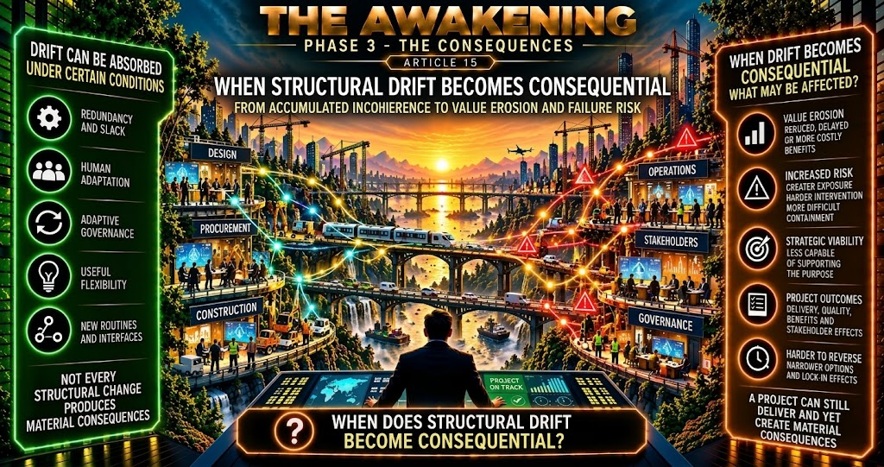 From Accumulated Incoherence to Value Erosion and Failure Risk The project is still delivering. Milestones are still being reached. Problems are still being solved. People are still carrying integrative work. Trade-offs are still being managed. Exceptions are still being absorbed. The project may even appear successful. And yet something may have changed. Decisions that once preserved flexibility now constrain what can happen next. Dependencies that once required coordination now determine which options remain possible. Workarounds that once solved local problems have become conditions on which other parts of the project depend. Responsibilities remain formally clear, but the conditions required to exercise them have changed. People continue to preserve coherence, but doing so requires increasing attention, coordination or intervention. None of these conditions necessarily means that the project is failing. But they create the final question of this phase: When does structural drift become consequential? More precisely: Under what conditions does accumulated systemic incoherence begin to affect value, risk, strategic viability or project outcomes? Drift Is Not Failure Article 11 introduced structural drift as a hypothesis. It asked whether a project system can gradually change as effective integrative capacity becomes insufficient relative to the volume, velocity or complexity of its material interdependencies. But drift is not failure. A project can change structurally and continue to perform. It can develop new routines. Redistribute coordination. Create informal interfaces. Rely more heavily on particular people. Accept temporary inconsistencies. Defer reconciliation. Adapt governance mechanisms. Change how authority is exercised. Some of those changes may increase resilience. Some may preserve useful flexibility. Some may be efficient responses to uncertainty. Others may create burdens or dependencies that matter later. The existence of drift therefore tells us very little by itself. The relevant question is not: Has the project changed? It is: What consequences, if any, are being created by the way the project system has changed? Consequence Requires a Mechanism It is tempting to construct a simple sequence: insufficient integrative capacity → structural drift → incoherence → failure But that sequence would assume precisely what this phase has been trying to investigate. Each relationship requires its own mechanism. Insufficient integrative capacity may contribute to structural friction without producing structural drift. Structural drift may occur without producing material incoherence. Incoherence may exist without affecting value. A project may absorb substantial incoherence through redundancy, adaptation, human judgment or available slack. And poor outcomes may occur for reasons unrelated to integrative capacity. So Article 15 cannot ask merely whether a project with structural drift later performed poorly. It must ask: What changed in the system, how did that change alter consequential relationships, and through what plausible mechanism did those altered relationships affect value, risk, viability or outcomes? Without that mechanism, temporal sequence is not causal explanation. What Does “Consequential” Mean? Not every consequence matters equally. A new meeting is a consequence. Additional coordination is a consequence. A delayed decision is a consequence. A workaround is a consequence. Additional cognitive effort is a consequence. But Article 15 is concerned with a stronger threshold. When does what has been happening inside the project begin to affect something materially important? That may include: Value because expected benefits are reduced, delayed, transferred or made more costly to realize; Risk because exposure increases, intervention becomes harder, or consequences become more difficult to contain; Strategic viability because the project becomes less capable of supporting the purpose or strategic conditions that justified it; or Project outcomes because delivery, quality, benefits, stakeholder effects or other material results are affected. These categories may overlap. They are not offered as an exhaustive taxonomy. They identify different ways in which internal systemic conditions may become consequential beyond the friction through which they first appeared. Value Erosion Is Not the Same as Project Failure A project does not need to fail before structural incoherence matters. It may deliver what was specified while producing less value than expected. It may reach a milestone while narrowing the benefits that remain achievable. It may remain within budget while transferring cost elsewhere. It may satisfy one stakeholder while creating consequences for another. It may meet scope while weakening operational usability. It may deliver an output while making the intended outcome more difficult to achieve. This distinction matters because traditional project signals may remain acceptable while the value relationship is deteriorating. So the relevant question is not simply: Did the project succeed or fail? It is: Did the evolving project system alter the conditions under which intended value could be created, preserved or realized? That is a different test. Local Success Can Coexist With Systemic Loss This returns us to one of the earliest tensions in THE AWAKENING. A local decision can be legitimate. A team can meet its objective. A supplier can satisfy its contract. A workstream can deliver its output. A manager can act within authority. And yet the combined consequences can still be unfavorable for the project system. This is not because local success is irrelevant. It is because local success and system-level value are different units of evaluation. Consider a technical optimization that improves performance but increases operational complexity. A procurement decision that reduces acquisition cost but limits future adaptability. A schedule recovery action that preserves a milestone but reduces testing opportunity. A governance decision that accelerates approval but reduces the time available to surface consequential interdependencies. Each decision may be defensible within its own frame. The systemic question is whether their combined consequences remain coherent with what the project is trying to achieve. Structural drift becomes relevant when the relationships among such decisions change in ways that materially alter that coherence. Accumulated Incoherence Does Not Mean Accumulated Error The phrase accumulated systemic incoherence needs care. It does not mean that the project has accumulated a growing list of mistakes. Nor does it require individual decisions to have been wrong. Article 5 already established the possibility that locally legitimate decisions can become globally incoherent. Article 13 added a temporal dimension: unresolved material interdependencies may remain connected to later decisions and commitments. Article 14 added another possibility: people may preserve observable coherence through integrative effort that is not fully visible in formal mechanisms. Accumulated incoherence therefore refers to something narrower than accumulated error. It concerns the possibility that relationships among decisions, dependencies, responsibilities, commitments and adaptations become progressively less compatible with one another or with the conditions required to preserve project-level coherence. That possibility still requires evidence. The number of decisions is not evidence of accumulation. Complexity is not evidence of incoherence. Change is not evidence of drift. And drift is not evidence of damage. The Threshold May Depend on the Remaining Capacity to Absorb Projects can absorb a great deal. People resolve conflicts. Teams adapt. Managers intervene. Buffers absorb variability. Contingency absorbs uncertainty. Governance mechanisms escalate exceptions. Stakeholders renegotiate expectations. Technical architectures accommodate change. Informal relationships bridge gaps. This capacity to absorb disturbance may explain why structural friction does not immediately become visible as poor performance. But absorption is not necessarily unlimited. The relevant question may therefore be: When does the project system lose sufficient capacity to absorb, reconcile or redirect the consequences of its own internal incoherence? That threshold could arise for different reasons. The volume of consequential interdependencies may increase. Available attention may decrease. Options may narrow. Reversibility may decline. Slack may be consumed. Key people may become overloaded or unavailable. Commitments may become harder to change. External conditions may shift. Or several of these may interact. None should be assumed to be necessary. But they suggest that consequence may depend not only on the existence of incoherence, but also on the remaining capacity of the system to absorb it. Option Space Matters Article 13 asked whether deferred integration can become more consequential as subsequent decisions and commitments reduce reversibility or increase connectedness. That question becomes particularly important here. A project may tolerate an unresolved interdependency while several alternatives remain available. The same unresolved relationship may become much more consequential after contracts are signed, interfaces are fixed, systems deployed, stakeholders committed or operational dependencies established. The underlying issue may not have changed. The available response may have. This suggests a possible mechanism: Systemic incoherence → continued commitments → narrowing option space → reduced ability to reconcile consequences → greater material exposure But this sequence is only a hypothesis. Narrower option space is not automatically harmful. Commitment is necessary for projects to progress. Irreversibility is not inherently poor design. And preserving options indefinitely may itself destroy value. The relevant question is whether the remaining option space is sufficient for the consequences the system may still need to reconcile. Risk Can Increase Before Failure Appears Failure is an outcome. Risk concerns exposure before the outcome is known. That distinction matters. Structural drift may become consequential by changing exposure even when no adverse outcome has yet occurred. A project may become more dependent on one person. More sensitive to one interface. More difficult to reverse. More reliant on an assumption. More vulnerable to delayed information. More dependent on successful human compensation. More exposed to a decision whose consequences propagate across multiple parts of the system. None of these conditions proves that failure will occur. But they may change the distribution or materiality of possible consequences. The relevant question is therefore not: Has something already gone wrong? It is: Has the evolving configuration materially changed what the project is exposed to, how consequences could propagate, or how effectively the system could respond if they did? That is a risk question rather than a failure claim. Strategic Viability Can Change While Delivery Continues Projects do not operate in a frozen strategic environment. Markets change. Technology changes. Regulation changes. Stakeholder expectations change. Organizational priorities change. New information changes what is valuable. A project configuration that remains internally capable of delivering may nevertheless become less aligned with the conditions that justified the project. This creates a difficult attribution problem. If strategic viability deteriorates, is that because the project system drifted? Or because the external environment changed? Or because strategy itself changed? Or because the project failed to detect and integrate those changes quickly enough? These are different explanations. Structural drift should not become a convenient label for every case in which a project becomes strategically questionable. The stronger question is: Did the way the project system evolved materially reduce its ability to recognize, interpret or respond to changes that were relevant to continued strategic viability? Only then does integrative capacity become a plausible part of the explanation. Consequences Can Be Transferred Article 13 established that burden may persist through transfer rather than through visible continuation of the original issue. The same principle applies to consequences. A project may preserve schedule by transferring effort to operations. Preserve budget by reducing maintainability. Preserve local performance by increasing coordination elsewhere. Preserve delivery by accepting future remediation. Preserve one stakeholder's value while reducing another's. Preserve current flexibility by increasing future exposure. The project itself may therefore continue to look successful while consequences appear somewhere else. This creates an attribution challenge. Where should we look for the consequence? If evaluation stops at the project boundary, transferred consequences may disappear analytically even though they remain real organizational consequences. But widening the boundary indefinitely creates the opposite problem. Almost every project can be connected to distant consequences. So the relevant boundary must remain tied to material causal relationships and legitimate project objectives, obligations and affected interests. System thinking requires broader boundaries. It does not justify unlimited attribution. Failure Is Not a Single Event Even the word failure requires care. A project can fail to meet a milestone. Fail to deliver an output. Fail to realize intended benefits. Fail to remain strategically viable. Fail to protect a stakeholder interest. Fail to adapt when assumptions change. Or deliver successfully while producing consequences that undermine the value it was intended to create. These are not equivalent. Article 15 therefore should not treat project failure as a single binary endpoint. Nor should it redefine every value shortfall as failure. The relevant analytical question is: Which material outcome was affected, relative to what objective, obligation or legitimate expectation, and through what mechanism? Without that specificity, “failure” explains very little. The Project May Still Look Healthy One of the most difficult possibilities is that consequence and visibility may not occur at the same time. The system may continue to produce acceptable indicators while dependencies deepen. Human intervention may continue to resolve emerging conflicts. Workarounds may continue to function. Buffers may still exist. Options may still be sufficient. The consequences may therefore remain contained. This does not establish that deterioration is occurring beneath the surface. Nor does it establish that successful compensation necessarily delays observable consequences. Those possibilities require evidence. But it does mean that: Absence of visible failure is not, by itself, evidence that the relationships supporting project performance remain unchanged. This is as far as Article 15 should go without stronger evidence. Whether successful compensation can systematically increase the interval between the emergence of systemic deterioration and observable consequence remains an open hypothesis. It should not be assumed. Consequence May Be Nonlinear Another possibility must remain open. The relationship between incoherence and consequence may not be proportional. A project may absorb several unresolved tensions with little observable effect. Then one additional commitment, dependency or external change may alter the consequences substantially. That does not necessarily mean a hidden threshold exists. Nor does it justify describing every late-stage problem as a tipping point. But linear reasoning may be insufficient. The effect of an unresolved interdependency may depend on what else has happened around it. The consequence of losing a key person may depend on how concentrated contextual knowledge has become. The consequence of a delayed decision may depend on how much option space remains. The consequence of one local optimization may depend on other optimizations already embedded elsewhere. The relevant question is therefore: Do consequences arise from individual conditions independently, or from interactions among conditions that have become mutually reinforcing or increasingly difficult to reconcile? That distinction matters for both explanation and intervention. Early Friction May Be a Signal, but Not a Diagnosis The working hypothesis for this phase was: Insufficient integrative capacity may become visible first through structural friction, deferred trade-offs, accountability misalignment and narrowing option space rather than immediate project failure. The previous articles examined parts of that possibility. Article 11 examined structural drift. Article 12 examined accountability misalignment. Article 13 examined deferred integration and persistent burden. Article 14 examined human integrative work and compensation. Article 15 can now ask what evidentiary value these conditions may have. But the answer cannot simply be yes. Structural friction may arise from legitimate adaptation. Deferred trade-offs may preserve option value. Accountability tension may reflect temporary transition. Narrowing option space may represent necessary commitment. Human compensation may be effective integrative capacity. None is a failure signal by definition. Their significance depends on mechanism, persistence, materiality, interaction and context. So the phase hypothesis survives only in a bounded form: These conditions may provide earlier evidence of changing systemic relationships, but none can independently establish insufficient integrative capacity or predict project failure. That is a much more defensible proposition. The Counterfactual Still Matters Suppose a project experiences value erosion. How do we know that structural drift contributed? We need to ask: What would reasonably have happened if the relevant integrative relationships had been recognized and reconciled differently? Would value still have declined? Would the same exposure have existed? Would strategic viability still have changed? Would the same outcome have occurred because of external conditions, technical uncertainty, market change, execution failure or another cause? This is difficult. Projects do not provide experimental controls. But without some counterfactual reasoning, attribution becomes retrospective storytelling. A bad outcome followed structural drift. Therefore structural drift caused the bad outcome. That inference is not sufficient. The mechanism and credible alternatives must survive. Alternative Explanations Must Survive Poor project outcomes may result from many causes. Technical failure. Unrealistic objectives. Resource constraints. External shocks. Market change. Regulatory intervention. Supplier failure. Poor execution. Weak leadership. Inadequate expertise. Strategic error. Stakeholder conflict. Simple uncertainty. Bad luck. And combinations of these. Some of these may themselves interact with integrative capacity. But they should not be relabelled as integration problems merely because integration is the focus of this series. That would make the theory absorb every failure and therefore explain none of them well. The discriminating question is: Can a plausible mechanism connect insufficient integrative capacity, through identifiable changes in project relationships or response capacity, to the material consequence being examined, relative to credible alternative explanations? If not, the consequence should not be attributed to insufficient integrative capacity. Structural Drift Is Not Necessarily the Cause There is another possibility. Structural drift may be a response to deteriorating conditions rather than their cause. Teams may create informal coordination because uncertainty increased. Authority may redistribute because the environment became more volatile. Workarounds may proliferate because external change invalidated the original design. People may carry more integrative work because the project entered a difficult transition. In such cases, drift and poor outcomes may share a common cause. Or drift may actually reduce the severity of those outcomes. This is an important adversarial test. Observed sequence is not enough. Even when structural drift precedes an adverse consequence, we must still ask whether it: Contributed to the consequence, Mitigated it, Merely accompanied it, or Was itself produced by the same underlying conditions. Without that distinction, causal attribution remains weak. When Does Drift Become Consequential? We can now formulate the question more precisely. Structural drift becomes consequential not merely when the project system changes, nor when friction appears, nor when people work harder. It becomes consequential when changes in the relationships through which the project operates can be plausibly connected to material effects on value, exposure, strategic viability or outcomes. That may occur when: material interdependencies are no longer recognized or reconciled with sufficient quality, reliability or timeliness; subsequent commitments make unresolved relationships harder to reconcile; responsibility remains while the conditions required for meaningful exercise weaken; human compensation becomes increasingly necessary to preserve acceptable performance; available capacity to absorb or redirect consequences declines; or combinations of these conditions materially change what the project can still achieve or withstand. These are not diagnostic criteria. They are possible mechanisms. No single condition is sufficient. And their presence does not establish causality. What Phase 3 Can and Cannot Conclude Phase 3 began with a question: What consequences may emerge when integrative capacity becomes insufficient relative to material interdependence? The investigation now supports several bounded propositions. 1. Insufficient integrative capacity need not become visible first as project failure. It may become visible through changing relationships, recurring friction, unresolved interdependencies, accountability misalignment, narrowing option space or increasing human integrative effort. But none of these conditions independently proves insufficiency. 2. Structural drift is not inherently dysfunctional. It may represent adaptation, resilience, redistribution or legitimate response to changing conditions. Its significance depends on what relationships change and what consequences follow. 3. Deferred integration can create persistent burden under some conditions, but persistence, accumulation and debt are not equivalent. A mechanism must connect deferral to later burden. 4. Formal responsibility can remain while the conditions required for meaningful exercise become insufficient. But responsibility-capability mismatch must be distinguished from ordinary difficulty, temporary constraint and other explanations. 5. Human integrative work can be part of effective integrative capacity or compensation for its insufficiency. Observable behaviour alone may not distinguish the two. 6. Successful compensation may preserve performance while making underlying insufficiency harder to detect. This remains a working hypothesis, not an established general relationship. 7. Internal systemic conditions become consequential only when a plausible mechanism connects them to material effects on value, exposure, strategic viability or project outcomes. Temporal sequence or correlation is not enough. 8. Poor outcomes cannot be attributed to insufficient integrative capacity without credible alternative explanations and counterfactual reasoning. Integration must not become a universal explanation for project difficulty. What Phase 3 Cannot Establish Phase 3 does not establish that: distributed project systems necessarily lose coherence; structural drift necessarily follows distributed leadership; informal coordination indicates weak architecture; deferred integration is inherently undesirable; human compensation is evidence of dysfunction; narrowing option space is necessarily harmful; AI necessarily increases or reduces integrative capacity; structural drift predicts project failure; or insufficient integrative capacity is the primary explanation for poor project outcomes. Those claims would exceed what the inquiry can support. Phase 3 has instead established the analytical conditions under which the hypothesis can be investigated more rigorously. The Consequence Is Not the Starting Point It is easy to begin with failure. A project missed its objective. Value declined. Risk materialized. A strategy became unviable. Then we work backwards looking for explanations. But THE AWAKENING has taken the opposite route. It began with distribution. Then integration. Then local legitimacy and systemic coherence. Then the assumptions connecting roles, authority, accountability, control and human agency. Only after those relationships were separated did Phase 3 ask what their consequences might be. That sequence matters. Because failure does not tell us which architecture would have prevented it. And success does not tell us that the architecture was adequate. A project can succeed because its architecture was effective. It can succeed because people compensated. It can succeed because conditions were forgiving. It can fail despite strong integrative capacity. And it can fail partly because consequential relationships were not recognized or reconciled while meaningful intervention remained possible. The outcome alone cannot tell us which explanation is true. The End of Phase 3 The question that opened this phase was not: Does insufficient integrative capacity cause project failure? It was: What consequences may emerge when integrative capacity becomes insufficient relative to material interdependence? The answer is necessarily conditional. Consequences may emerge through changing dependencies, deferred reconciliation, accountability misalignment, reduced option space, human compensatory burden, changing exposure and declining capacity to absorb incoherence. But those mechanisms are neither universal nor independently diagnostic. They require evidence. They require boundary conditions. They require alternative explanations. They require counterfactual reasoning. And they require us to distinguish what the system contains from what it transfers, what it absorbs from what it resolves, and what merely changes from what becomes materially consequential. The working hypothesis can therefore be reformulated in a more disciplined form: Insufficient integrative capacity may become visible through structural friction, deferred trade-offs, accountability misalignment, narrowing option space and increasing dependence on human integrative effort before material effects appear in conventional project outcomes. That is not a prediction. It is not a universal sequence. And it does not establish that any one of those conditions indicates failure. It identifies where evidence may need to be sought before the final consequence becomes the only thing we can see. Because by the time incoherence becomes visible as failure, the most important question may no longer be why the project failed. It may be: What changed earlier in the system, while different outcomes were still possible? |
Posted on: October 05, 2026 05:02 AM
| Permalink |
Comments (1)
Implementation Is Not Realization
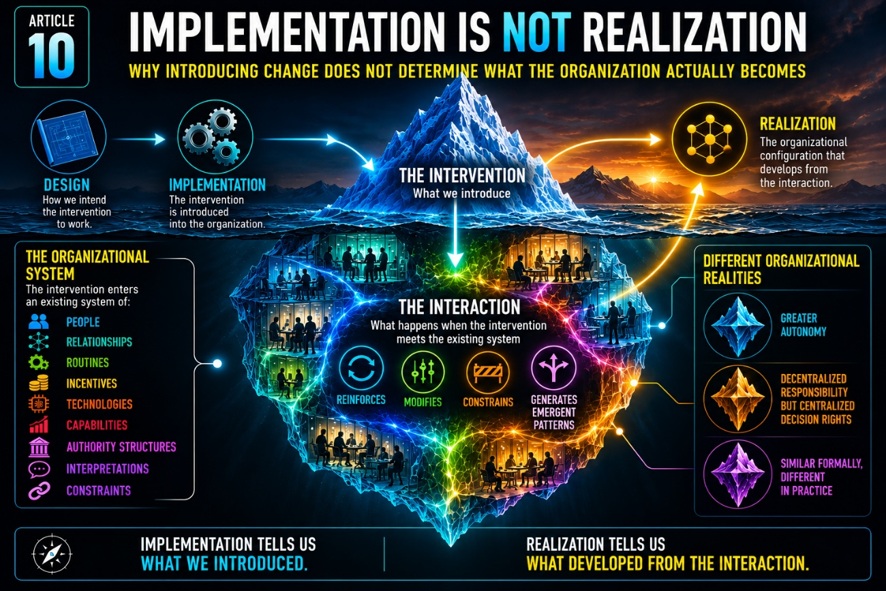 Why introducing change does not determine what the organization actually becomes Organizations often evaluate transformation by asking whether planned changes were implemented. Was the technology deployed? Was the process redesigned? Was the structure changed? Were new ways of working adopted? These are legitimate questions. But they answer only part of a more important question. What did those changes actually become once they entered the organization? Implementation tells us what was introduced. It does not necessarily tell us what was realized. That distinction matters because an organizational intervention does not enter an empty space. It enters an existing system of people, relationships, routines, incentives, technologies, capabilities, authority structures, interpretations and constraints. And once it enters that system, it interacts with what is already there. Those interactions may reinforce, modify or constrain the original intention — or produce something that looks similar to what was designed while functioning very differently in practice. Implementation introduces an intervention. It does not determine the organizational configuration that will be realized. What We Introduce Is Not Necessarily What We Get Consider a familiar transformation objective: Increase team autonomy. The organization may redesign roles, delegate responsibilities, reduce approval layers and formally empower teams to make more decisions. The change has been implemented. But what has been realized? Teams may genuinely acquire greater decision authority. Or responsibility may move downward while important decision rights remain centralized. Formal approvals may disappear while informal escalation continues. Managers may intervene less directly while digital monitoring increases. The same intervention - “increase team autonomy” - can therefore produce very different organizational realities. The difference cannot be understood simply by asking whether the intervention was implemented. We have to examine what happened when it encountered the existing system. Organizations Do Not Simply Receive Change The previous article established that organizations do not simply receive interventions. They respond to them through existing relationships, incentives, capabilities, authority structures and interpretations. That response matters here because the intervention is only one causal element in what follows. What is realized results from the interaction between the intervention and the system into which it is introduced. This is why apparently similar interventions can be realized differently across organizations — or even across different parts of the same organization. Implementation tells us that something entered the system. Realization tells us what developed from the interaction. Formal Change and Realized Change Are Different Objects This distinction becomes particularly important when transformation involves organizational architecture. A new organizational chart can be implemented. That does not tell us where authority actually resides. A process can be redesigned. That does not tell us how work is really performed when deadlines, exceptions and competing priorities appear. An AI system can be deployed. That does not tell us how humans will rely on it, challenge it, override it or reorganize their work around it. The formal intervention is observable. But so is the organizational reality that develops around it. And they are not the same object. Formal architecture describes what has been established. Realized architecture describes how the system actually operates. Without this distinction, transformation can appear complete on paper while producing a very different organization in practice. Adoption Is Not Realization Either There is another distinction we need to preserve. Implementation is not realization. But neither is adoption. A technology may be widely used. A process may be routinely followed. Teams may use the prescribed tools. All of this can demonstrate adoption. But adoption tells us that a practice has entered organizational behavior. It does not necessarily tell us what that practice is doing to the organization. An agile practice can be adopted while decision authority remains centralized. AI can become embedded in daily work while human approval continues to determine consequential decisions. So the progression is not necessarily: Design → Implementation → Adoption → Success because adoption itself is not the final organizational reality. The more important question is: What patterns of work, authority, coordination, learning and behavior are actually being produced? The Same Design Can Be Realized Differently The distinction becomes clearer when apparently similar designs produce different organizational configurations. Imagine two organizations reducing management layers and formally increasing team autonomy. In one, decision rights move closer to the work. Teams gain access to relevant information, managers provide context rather than routine approval, and governance establishes clear boundaries within which teams can act. In the other, layers are also removed and teams receive broader responsibilities, but important decisions remain centralized. Coordination shifts to digital systems, monitoring increases and people have fewer managers without necessarily gaining greater authority. On an organizational chart, both organizations may appear to have implemented the same transformation. What they have realized is not the same. The difference lies not simply in whether the design was implemented correctly. It lies in how the intervention interacted with authority, information, governance, capability and behavior. This is why transformation cannot be understood from design variables alone. We have to observe the resulting system. When Structures Disappear, Functions May Move There is another possibility. A visible organizational structure may disappear without the functions it performed disappearing with it. Suppose an organization removes a layer of middle management. The positions disappear. But what happens to the functions those positions performed? Coordination may move to teams. Monitoring may move to digital platforms. Information synthesis may move to AI. Some decisions may move upward. Others may move closer to the work. The structure disappeared. The functions did not necessarily disappear with it. This distinction matters because transformations are frequently described through visible structural changes: fewer layers, fewer roles, more automation, greater autonomy. But structures are only one place where organizational functions reside. A technological intervention illustrates the same principle. What begins as task automation may gradually alter the distribution of work, knowledge, coordination or influence across the organization. A technological intervention can become an organizational architecture. But we cannot infer that architecture simply from the technology introduced. To understand realization, we therefore have to follow the functions, not only the structures. A visible structural change can conceal a deeper functional redistribution. Realization Can Produce What Nobody Designed Not every consequential organizational pattern corresponds to an explicit transformation objective. Some patterns arise through interaction. A new process creates a workaround. The workaround becomes routine. The routine creates an informal coordination mechanism. That mechanism gradually becomes more important than the formal process. A new technology removes one bottleneck but creates another. Teams compensate. New dependencies form. Responsibilities migrate. Eventually, a practice that nobody formally designed becomes part of how the organization operates. This does not mean that organizational change is arbitrary. Nor does it mean that design is irrelevant. It means that design interacts with adaptation. The realized organization contains what was intentionally introduced, but it can also contain patterns that developed through the system's response to those interventions. This is where emergence becomes important. Emergence does not mean that outcomes have no causes. It means that some system-level patterns arise from interactions among elements and cannot be understood simply by inspecting any single intervention in isolation. What is realized can therefore be partly designed and partly emergent. Realization Is Not Evaluation One more distinction is necessary. Suppose an organization formally increases team autonomy and we subsequently observe that decision authority genuinely moved closer to teams. We now know something important about what was realized. We still do not know whether the result should be considered desirable or successful. That is a different question. Realization is descriptive before it is evaluative. To evaluate what was realized, we need criteria. We need to know for whom, at what level and over what period consequences are being considered. Those questions matter. But they are not the question of this article. Before evaluating what transformation produced, we first need to understand what it actually produced. Look for the Organization That Actually Exists This distinction changes what we need to observe during transformation. Implementation evidence asks whether the intervention entered the organization as intended. Was the technology deployed? Was the structure changed? Was the process introduced? These remain useful questions. But realization evidence asks something different. How is work actually being performed? Where do information, coordination and authority reside? Who can make, challenge or override consequential decisions? What capabilities and dependencies are developing? These questions direct attention away from the intervention alone and toward the organizational configuration developing around it. Implementation evidence tells us whether the intervention entered the organization. Realization evidence tells us what organizational reality developed around it. That requires us to look beyond formal structures and prescribed processes to examine the organization as it actually operates, including where functions have migrated and which relationships now shape its behavior. The system may have realized something different from what the transformation intended. Implementation Is Not Realization Organizations need to implement change. Without implementation, intentions remain intentions. But implementation should not be confused with the organizational reality that follows. So the critical question is not only: What did we implement? It is also: What did the system actually realize? Because introducing a change does not determine what that change becomes. Implementation describes the intervention. Realization describes the organizational configuration that develops through the interaction between that intervention and the system. But knowing what was realized still does not tell us whether it should be considered successful. The same realized change can have different consequences depending on what we examine, where we examine it, for whom and over what period. So another question follows: How should we evaluate what was realized? That is where we go next. Article 11 — The Same Change Can Succeed and Fail at the Same Time |
Posted on: October 04, 2026 06:40 AM
| Permalink |
Comments (1)
The Human Burden of Integrative Work
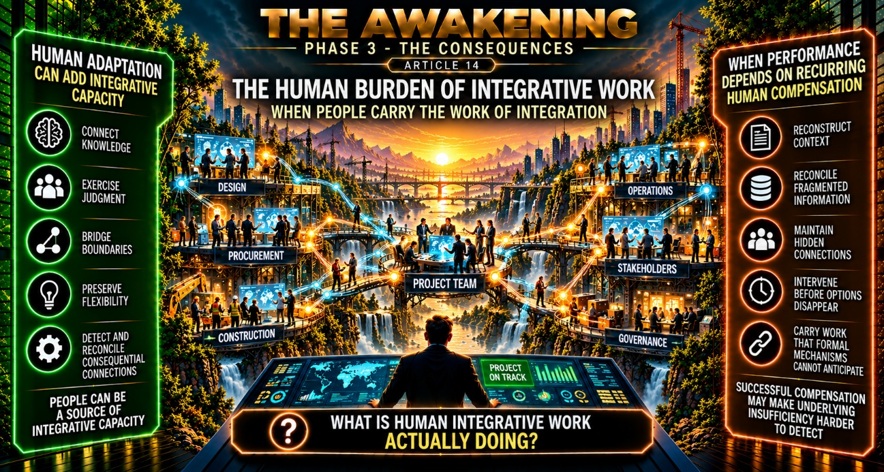 When People Carry the Work of Integration The project is still moving. Dependencies are being connected. Trade-offs are being reconciled. Information reaches the people who need it. Problems are noticed before they become failures. Teams coordinate across boundaries. Decisions that could have conflicted are somehow brought together. The system appears to be working. But perhaps the formal mechanisms are not doing all of that. Perhaps people are carrying part of the integrative work themselves. Someone remembers that two decisions made in different meetings are connected. Someone calls another team before approving a change. Someone translates between technical and operational language. Someone notices that the dashboard does not show the consequence that matters. Someone keeps track of an exception that exists nowhere in the formal process. Someone knows whom to contact when the escalation path is too slow. Someone repeatedly brings together information that the system keeps apart. None of this is necessarily a problem. It may be exactly what capable people in adaptive organizations should do. But it creates a difficult question: When does human adaptation strengthen the project system's integrative capacity, and when does it compensate for integrative capacity that has become insufficient? And another follows immediately: Can successful human compensation make architectural insufficiency harder to detect? People Are Part of the Architecture There is an immediate danger in framing the problem as: Architecture versus people. Organizations do not integrate themselves independently of human action. People interpret information. Build relationships. Exercise judgment. Notice weak signals. Translate across domains. Challenge assumptions. Escalate concerns. Resolve ambiguity. Connect knowledge that formal structures cannot completely anticipate. Informal coordination is therefore not automatically evidence that formal mechanisms have failed. It may be part of the architecture through which the project system actually works. That distinction matters. If every informal conversation, discretionary intervention or act of human judgment is treated as compensation for architectural weakness, then almost every functioning project could be diagnosed as architecturally deficient. That would make the hypothesis useless. The relevant question is not: Are people doing integrative work? Of course they are. The more demanding question is: What kind of integrative work are people doing, under what conditions, and what would happen if they stopped doing it? Human Adaptation Can Be Integrative Capacity Article 11 asked whether effective integrative capacity can become insufficient relative to material interdependence. But effective integrative capacity does not reside only in formal governance mechanisms. It may also exist in relationships, experience, judgment, routines, informal networks and the ability of people to recognize and reconcile consequential connections. A project manager who notices an interaction that no dashboard captured may be adding integrative capacity. A specialist who translates between two domains may be adding integrative capacity. A team that develops an informal coordination routine because formal processes cannot anticipate every interaction may be adding integrative capacity. A leader who recognizes that an escalation is formally unnecessary but systemically important may be adding integrative capacity. These actions should not automatically be interpreted as evidence that something is wrong. They may demonstrate that the system is adaptive. Indeed, a project configuration that attempted to specify every interaction in advance might become slower, more rigid and more expensive than the uncertainty it was designed to manage. So: Human adaptation can be part of effective integrative capacity rather than compensation for its absence. That proposition must be preserved throughout the inquiry. But Adaptation Can Also Become Compensation The same observable behaviours can have another explanation. People may be connecting information because formal interfaces repeatedly fail to do so. They may be translating because responsibilities and knowledge have become separated in ways that repeatedly make translation necessary. They may be attending additional meetings because consequential dependencies are otherwise missed. They may be maintaining private notes because organizational memory does not preserve the context required for later decisions. They may be checking work manually because automated or formal mechanisms cannot reliably identify the relevant relationships. They may be using personal networks because official escalation paths repeatedly arrive too late. They may be protecting downstream teams from consequences that the project configuration continues to generate upstream. From the outside, the project may still appear integrated. But part of that integration may now depend on recurring human effort required to compensate for limitations that the project configuration repeatedly reproduces. That creates a possible distinction: Human adaptation may add integrative capacity, or it may compensate for insufficient integrative capacity. And in practice, it may do both. The Same Behaviour Can Mean Different Things This is what makes the problem difficult. Consider two project managers who regularly speak with people outside formal meetings. One may be using professional judgment to enrich an already effective configuration. The other may be preventing repeated failures because existing mechanisms cannot connect the necessary information in time. The observable behaviour is similar. The systemic meaning is different. Consider two teams maintaining an informal cross-functional channel. For one, the channel may be a low-cost adaptation that improves responsiveness. For the other, it may be the only mechanism preventing incompatible decisions from propagating across the project. Again, the behaviour looks similar. The configuration underneath it may not be. So the presence of informal coordination cannot distinguish resilience from insufficiency. Nor can the amount of visible human effort by itself. The relevant question must reach beneath the behaviour: What function is the human effort performing, why is that effort necessary, and what happens to system performance when it is absent? A Counterfactual Becomes Important One way to examine that distinction is through a counterfactual. What would happen if that human integrative effort disappeared? Suppose the experienced project manager who routinely connects two functions leaves. Suppose the specialist who understands both the technical and operational implications is unavailable. Suppose the informal cross-functional meeting stops. Suppose people no longer maintain the unofficial spreadsheet that reconciles information from incompatible systems. Suppose the manager who repeatedly catches exceptions stops checking manually. Would the project system continue to recognize and reconcile the relevant material interdependencies with sufficient quality, reliability and timeliness? If yes, the human activity may have been supplementary. If performance deteriorates materially, the activity may have been carrying more of the system's effective integrative capacity than its formal mechanisms revealed. But even that does not establish architectural insufficiency. A resilient project configuration may deliberately rely on human discretion. Expertise may be intentionally embedded in roles. Informal coordination may be an efficient design choice. Redundancy may be deliberate. The counterfactual therefore identifies dependency. It does not by itself tell us whether that dependency is problematic. The Question Is Not Whether the Architecture Depends on People Every project system depends on people in some way. The stronger test is whether the dependency is: Recognized, Sustainable, Reproducible where necessary, Proportionate to the integrative requirement, and Supported by the authority, information, capability and opportunity required to perform the work. A system may legitimately rely on experienced judgment. But if only one person knows how several critical decisions connect, the issue is not that human judgment exists. It is that effective integrative capacity may depend on a fragile concentration of knowledge. A system may legitimately rely on informal coordination. But if people must continuously reconstruct information that formal mechanisms repeatedly fragment, the question becomes whether the coordination remains proportionate. A system may legitimately rely on discretionary intervention. But if successful outcomes require repeated exceptional intervention simply to preserve ordinary coherence, the meaning of “exceptional” becomes questionable. The relevant distinction is therefore not: Formal architecture versus informal human work. It is: Human work as a legitimate component of effective integrative capacity versus human work required to compensate for limitations that the project configuration repeatedly reproduces. Compensation Can Preserve Performance Suppose people compensate successfully. Dependencies are recognized. Trade-offs are reconciled. Customers receive the intended outcome. Milestones are achieved. Problems are contained. Performance indicators remain acceptable. From the perspective of observed outcomes, the system may appear healthy. And yet those outcomes may increasingly depend on additional human integrative work that is not visible in the formal mechanisms through which project performance is observed. This leads to the first working hypothesis of this article: Successful human compensation may preserve project performance while making an underlying insufficiency in effective integrative capacity harder to detect. The hypothesis is deliberately conditional. Successful compensation does not prove that such insufficiency exists. But if it does, successful compensation may make it harder to observe. That possibility matters because organizations often learn from visible deviations. Success Can Weaken the Signal If compensation prevents a deviation from becoming visible, the signal available for architectural learning may weaken. This creates a paradox. The more successfully people compensate, the less visible the underlying problem may become. A dependency is caught before it causes delay. The dashboard remains green. A conflict is resolved before escalation. The governance mechanism appears adequate. A workaround prevents rework. The process appears effective. A person absorbs additional coordination. The project appears efficient. Successful intervention may therefore remove the evidence that intervention was necessary. If this occurs repeatedly, the organization may observe: Acceptable performance without observing: The additional human effort required to produce it. That does not mean the architecture is necessarily weak. But it means observed performance alone may be insufficient evidence that the project's effective integrative capacity is sustainably supported. This is a potentially important learning problem. The better the compensation works, the weaker the signal that something in the system may need to change. Hidden Work Can Become a System Dependency Human integrative work may also become normalized. The extra call becomes routine. The unofficial spreadsheet becomes indispensable. The experienced manager is always copied. The specialist is invited to every decision because “she knows how everything fits together.” The team maintains a parallel process because the official one cannot capture what they need. None of these developments necessarily indicates dysfunction. Some may be efficient adaptations. But normalization can change visibility. What began as an exception may no longer be perceived as additional work. What began as temporary compensation may become an expected part of the role. What began as individual initiative may become a hidden dependency of the system. This creates another question: When does adaptive human effort become a condition on which acceptable system performance depends? That dependency may matter even when performance remains strong. The Burden Is Not Only Coordination Article 13 identified the possibility that unresolved integration may create persistent burden. When people absorb part of that burden, coordination effort is only one possible manifestation. There may also be cognitive burden. People must remember relationships that the system does not preserve. Maintain multiple mental models. Track exceptions. Reconstruct context. Anticipate downstream consequences. Distinguish important signals from noise. Switch repeatedly between domains. Carry unresolved questions across decision cycles. And remember not only what was decided, but why something remained unresolved. There may be attentional burden. What requires monitoring? What changed? Which interface is becoming consequential? Which assumption is no longer safe? Which decision needs to be revisited? There may be interpretive burden. What does this information mean elsewhere in the system? Who else needs to know? Does a local change alter a system-level trade-off? There may be relational burden. Who must be contacted? Which boundary needs to be crossed? Whose trust is required to surface a concern? Who can influence a decision when formal authority sits elsewhere? And there may be temporal burden. People must intervene while intervention can still matter. These are overlapping manifestations, not an exhaustive taxonomy. The burden is therefore not simply: More meetings. It may be the continuing human work required to preserve consequential connections across a distributed project system. But More Human Effort Is Not Necessarily Excessive Burden Again, the hypothesis needs a boundary. Complex projects require cognitive effort. Leadership requires attention. Integration requires communication. Professional judgment requires interpretation. Collaboration requires relationships. None of this becomes an architectural problem merely because it consumes human capacity. The relevant question is not: Are people working hard to integrate the project? It is: Is the human effort required to preserve coherence proportionate, sustainable and intentionally supported by the project configuration, or is acceptable performance increasingly dependent on compensatory effort that the configuration neither makes visible nor reliably sustains? That distinction protects the argument from turning ordinary professional work into evidence of systemic deficiency. Compensation May Create Fragility A project may perform well because particular people are unusually capable. They know the history. They understand several domains. They recognize weak signals. They have trusted relationships. They know which formal rule can be interpreted flexibly and which cannot. They know whom to call. That can be an enormous source of resilience. But it can also create concentration risk. If integrative performance depends disproportionately on a small number of people, the project may become vulnerable to: absence, turnover, overload, competing priorities, loss of attention, or changes in context that exceed those individuals' capacity. Again, the existence of key people is not evidence of poor architecture. Expertise is naturally unevenly distributed. The stronger question is: Would the project system retain sufficient integrative capacity if those individuals were temporarily unavailable or replaced by equally competent people who did not possess the same accumulated relationships and contextual knowledge? That is a test of system dependence, not a criticism of expertise. Compensation Can Consume the Capacity Needed Elsewhere Human attention is finite. Time spent reconstructing fragmented context cannot simultaneously be used elsewhere. Attention devoted to repeated reconciliation is unavailable for other forms of judgment. Experienced people repeatedly bridging interfaces may have less capacity for strategic interpretation, learning, stakeholder engagement, innovation or anticipation. This does not mean every coordination activity creates an opportunity cost worth eliminating. But if compensatory integrative work expands, another consequence becomes possible: The system may preserve visible coherence by consuming human capacity that would otherwise be available for other valuable work. The cost of insufficient integrative capacity may therefore appear not only in additional effort. It may appear in what capable people no longer have sufficient capacity to do. That is a different form of burden. And potentially a less visible one. Compensation Can Also Build Capability The argument must now turn against itself. Human adaptation is not merely a cost. People learn by resolving ambiguity. They develop judgment by encountering trade-offs. They build relationships through cross-boundary work. They acquire system understanding by connecting consequences. They become better at recognizing patterns because they have repeatedly had to interpret them. The same integrative work that consumes capacity may also develop capability. That creates another tension. Removing human integrative work because it appears inefficient could eliminate opportunities through which people develop the judgment the system later needs. Conversely, preserving unnecessary manual work merely because it provides learning would also be difficult to justify. So the question cannot be reduced to: How much human effort can we eliminate? It must also ask: What capabilities are being exercised or developed through that effort, and what happens to those capabilities if the work is redesigned, automated or removed? This connects the human burden question to a broader issue: the project system must not only perform today. It may also need to preserve or regenerate the capabilities required to govern tomorrow. AI Can Reduce the Burden and Change It AI may reduce some forms of human integrative work. It may identify dependencies. Retrieve relevant context. Connect information across systems. Track assumptions. Detect inconsistencies. Summarize changes. Surface anomalies. Maintain organizational memory. Model downstream consequences. And reduce the need for people to manually search, remember and reconcile information. That may genuinely increase integrative capacity while reducing unnecessary human burden. But the burden may also change rather than disappear. People may need to determine whether the relationships identified by AI are materially relevant. Challenge recommendations. Interpret ambiguous contexts. Resolve competing values. Decide when automated reconciliation should be overridden. Monitor dependencies created by the AI-enabled workflow itself. And recognize situations the system was not designed to detect. There is therefore no general reason to assume: Automation of integrative work = reduction of human integrative burden. Nor should the opposite be assumed. The relevant question is: Which integrative functions are being reduced, which are being transformed, which are being transferred, and which new forms of human judgment or oversight are being created? Human Presence Is Not the Same as Human Capacity Article 10 distinguished human presence in a decision system from meaningful human intervention capacity. The same distinction matters here. A project may formally retain human review. But if people are overloaded by coordination work, fragmented information and repeated exception handling, their ability to exercise judgment may weaken. They remain present. They remain accountable. They may retain formal authority. But the human capacity required to recognize, question or intervene may become constrained. This creates a connection between the consequences examined across this phase. Insufficient integrative capacity may generate compensatory human work. Compensatory work may consume attention. Reduced attention may weaken the conditions under which other responsibilities can be meaningfully exercised. That is a possible mechanism. It is not yet a demonstrated causal chain. Each relationship must survive separately. Adaptation or Compensation? We can now return to the central distinction. Human adaptation may strengthen integrative capacity when it: Responds flexibly to conditions formal mechanisms cannot reasonably anticipate; Connects knowledge efficiently; Uses judgment where codification would be disproportionate; Creates learning; Builds relationships; Preserves useful flexibility; And remains sustainable and reproducible enough for the system's needs. Human adaptation may instead be compensating for insufficient integrative capacity when acceptable performance increasingly depends on recurring human effort required to overcome limitations that the project configuration repeatedly reproduces. Possible signals might include: Repeated reconstruction of the same context; Persistent dependence on particular individuals; Recurring manual reconciliation of fragmented information; Informal mechanisms becoming indispensable without being recognized as such; Increasing coordination effort merely to preserve existing performance; Intervention repeatedly occurring near the point at which options disappear; Or important work remaining invisible to formal measures of project effort. These are not diagnostic criteria. They are possible observations. The distinction cannot be made from any one of them alone. Alternative Explanations Must Survive Observed human burden may have many causes. The project may simply be complex. The work may require expert judgment. A temporary crisis may justify exceptional coordination. A new team may still be learning. Formal processes may intentionally leave discretion to experienced people. The project may be undergoing legitimate adaptation. External volatility may create additional cognitive demand. People may be compensating for individual performance problems rather than limitations in the project configuration. A particular individual may choose to over-coordinate even when the system does not require it. Or additional effort may produce benefits greater than its cost. These alternatives matter. If every instance of high coordination effort, informal work or human intervention is interpreted as compensation for insufficient integrative capacity, the hypothesis becomes unfalsifiable. The discriminating question is therefore: Can the recurring human effort be plausibly connected to a limitation in the project's effective integrative capacity, rather than to complexity, deliberate design, temporary adaptation, individual behaviour or another credible explanation? If not, the burden should not be attributed to insufficient integrative capacity. What Would Make the Burden Architectural? The word architectural must also earn its place. A person working late once is not architectural evidence. An exceptional escalation is not architectural evidence. A difficult stakeholder conversation is not architectural evidence. A temporary workaround is not architectural evidence. Even repeated effort is not enough by itself. For the burden to support an architectural interpretation, the need for compensatory work would have to be meaningfully connected to how the project system distributes, connects or enables the integrative work required for coherence. The pattern would need to be more than episodic. The relevant work would need to matter to material interdependencies. A plausible mechanism would need to connect the project configuration to the recurring burden. Credible alternatives would need to be considered. And the interpretation would need to explain something more than: People are working hard on a complex project. Otherwise, simpler explanations should be preferred. What Article 14 Can and Cannot Conclude Several propositions can now be defended. 1. Human integrative work is not, by itself, evidence of insufficient integrative capacity. It may constitute part of the project's effective integrative capacity. 2. Similar observable behaviours may represent resilience, legitimate adaptation or compensation for insufficient integrative capacity under different conditions. 3. Successful human compensation may preserve observable project performance and therefore make an underlying insufficiency in effective integrative capacity harder to detect, if such insufficiency exists. 4. Human integrative burden may appear through coordination, attention, memory, interpretation, relationship management, temporal intervention and opportunity cost, not only through visible workload. 5. Dependence on human expertise is not inherently problematic, but concentrated dependence may make integrative performance fragile when the required capability is not sufficiently reproducible or supported. 6. Compensatory work may consume human capacity, but integrative work may also develop judgment, relationships and system understanding. Burden and capability development therefore cannot be treated as simple opposites. 7. AI may reduce, redistribute or transform human integrative work. Its presence does not establish either lower burden or greater effective integrative capacity. What cannot yet be concluded is that recurring human integrative effort is evidence of an architectural gap. Nor can we conclude that formalizing or automating such work would necessarily improve the system. The first working hypothesis is: Successful human compensation may preserve project performance while making an underlying insufficiency in effective integrative capacity harder to detect. A second hypothesis reaches further: Human adaptation may strengthen effective integrative capacity when it extends the project's ability to recognize and reconcile material interdependencies, but may function as compensation when acceptable performance increasingly depends on recurring human effort required to overcome limitations that the project configuration repeatedly reproduces. These hypotheses need evidence. They need boundary conditions. They need alternative explanations. And they must remain rejectable. When People Keep the System Working Some of the most important work in a project may never appear in the project plan. Someone notices. Someone remembers. Someone connects. Someone translates. Someone calls. Someone challenges. Someone reconciles. Someone intervenes before the option disappears. Sometimes that is simply what capable professionals do. Sometimes it is precisely what makes an adaptive project system resilient. But sometimes the same people may be carrying work that the project configuration has quietly come to depend on. And if they carry it successfully, the project may continue to look healthy. That is what makes the problem difficult. Human adaptation can contribute to resilience. Human adaptation can be part of integrative capacity. Human adaptation can also compensate for insufficient integrative capacity. And the observable behaviour may look remarkably similar in all three cases. The real question is therefore not whether people are compensating. It is whether the system can distinguish adaptation that renews its integrative capacity from adaptation on which acceptable performance increasingly depends because the project configuration does not sufficiently support the integrative work required. Because the people who keep a project coherent may also make weaknesses in its integrative architecture harder to see. And if those weaknesses persist, the next question is what happens when their consequences can no longer be absorbed. Article 15: When Structural Drift Becomes Consequential. |
Posted on: October 02, 2026 05:16 AM
| Permalink |
Comments (1)
The Cost of Deferred Integration
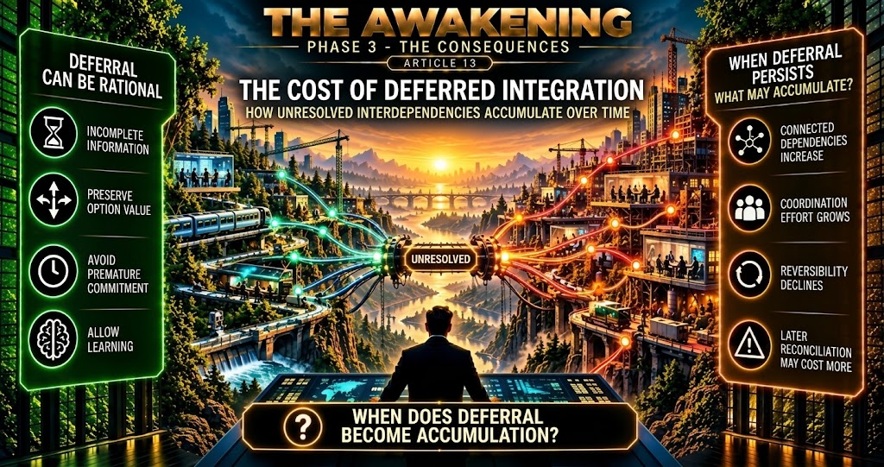 How Unresolved Interdependencies Accumulate Over Time A dependency is recognized. But not resolved. A trade-off is understood. But the decision is postponed. A conflict between two legitimate requirements remains open. An escalation occurs, but no reconciliation follows. A temporary workaround preserves progress. A commitment is made while a consequential relationship remains unresolved. The project continues. Nothing necessarily fails. And sometimes nothing more needs to happen. The dependency may disappear. New information may make the trade-off irrelevant. A later decision may resolve the issue at little additional cost. Deferral may even be the right decision when uncertainty is high and premature commitment would destroy useful flexibility. But not every unresolved interdependency disappears. Some remain connected to decisions that continue to be made. Some become harder to resolve. Some narrow future alternatives. Some require additional coordination. Some change who can still act. Some move consequences into other parts of the project system. And some may persist long after the decision that originally deferred them has been forgotten. That creates the central question of this article: Do deferred trade-offs, unresolved dependencies and lost intervention windows produce persistent systemic burdens that accumulate over time? And, if they do: Is the analogy to debt actually useful? Deferral Is Not Necessarily a Failure Projects cannot resolve everything immediately. Nor should they. Information is incomplete. Conditions change. Some decisions benefit from waiting. Some dependencies become relevant only under particular scenarios. Some issues are reversible. Some uncertainties are better preserved than prematurely eliminated. And some trade-offs cannot be reconciled until additional evidence becomes available. Deferral can therefore be rational. It can preserve option value. Prevent premature commitment. Avoid unnecessary coordination. Allow learning. And keep the project adaptable. That distinction is essential. Deferred integration is not, by itself, evidence of deficient integration. The relevant question is not whether something was left unresolved. It is what happens after it is left unresolved. What Exactly Is Being Deferred? Integration does not require every difference to disappear. Nor does it require every dependency to be centrally resolved. The relevant concern is narrower. A material interdependency may be recognized but its consequences not yet sufficiently reconciled for the decisions or actions that depend on it. That may involve a technical choice whose operational implications remain unresolved. A procurement decision that constrains later implementation alternatives. A schedule decision that transfers pressure elsewhere. A commercial commitment made before an interface is settled. A stakeholder trade-off postponed while other commitments continue. A governance question escalated but not decided. Or a temporary workaround that allows work to proceed without resolving the relationship that made the workaround necessary. In each case, work may continue. That matters. Because the consequence of deferral may depend not simply on the unresolved issue itself, but on what the project system does while the issue remains unresolved. But another possibility must remain separate. A material interdependency may never have been recognized, even though it could reasonably have been. That may also create later burden. But failure to recognize an interdependency is not the same thing as deciding, explicitly or implicitly, to defer its reconciliation after it has become recognizable. Both may matter to the wider investigation of insufficient integrative capacity. They should not automatically be treated as the same mechanism. That distinction becomes especially important if the analogy to debt is later considered. Time Does Not Automatically Create a Burden An unresolved issue today is not necessarily more serious tomorrow. This seems obvious. But it places an important limit on the hypothesis. Time alone does not create accumulation. A dependency may remain unresolved for weeks without becoming more consequential. A decision may be postponed while the project learns. An interface may remain open because no downstream commitment yet depends on it. A stakeholder tension may remain manageable because alternatives are still available. An unresolved issue may even become irrelevant. So the relevant mechanism cannot simply be: Unresolved issue + time = growing burden. Something else must happen. The project must continue to make decisions, create commitments, allocate resources, establish expectations, build interfaces or reduce alternatives in ways that interact with what remains unresolved. The more demanding question is therefore: Does continued project activity change the consequences of what has been deferred? Accumulation Requires a Mechanism If unresolved interdependencies create persistent systemic burdens, there must be a mechanism through which those burdens accumulate. Several possibilities deserve examination. A deferred trade-off may become embedded in later decisions. A temporary workaround may require additional work to remain viable. A dependency may become connected to more components, teams or commitments. Later decisions may assume that an unresolved issue has effectively been settled. Knowledge about why the issue was deferred may become fragmented or disappear. The people who understood the original trade-off may no longer be available. Contractual or technical commitments may reduce the available alternatives. Changing one decision may require reopening several others. And the cost of reconciliation may increase because the project must now alter relationships that did not exist when the issue first emerged. None of these mechanisms is inevitable. But each suggests the same possibility: The consequences of an unresolved interdependency may change as the system continues to develop around it. That is more precise than saying that unresolved issues simply “pile up.” The issue may remain one issue. What changes may be the number, importance or reversibility of the relationships connected to it. The Option Space Can Narrow Article 12 examined whether an accountable actor still has meaningful opportunity to intervene. That temporal question matters here for another reason. A decision that can be changed today may be much harder to change after procurement. A design choice may remain flexible until implementation begins. A supplier relationship may be renegotiable before contractual commitments deepen. A stakeholder concern may be manageable before positions harden. A governance decision may preserve several alternatives before downstream teams organize around one of them. The unresolved issue has not necessarily become intrinsically more difficult. The surrounding option space may have narrowed. This distinction matters. If later reconciliation becomes more costly, the cause may not be the passage of time. It may be the commitments made during that time. So the relevant sequence may be: Unresolved interdependency → continued decisions and commitments → reduced reversibility or increased connectedness → greater burden of later reconciliation. That is a mechanism worth testing. It is not yet evidence of debt. Local Progress Can Preserve the Unresolved Problem Projects are often rewarded for continuing to move. A team can proceed using an assumption. A supplier can continue against an interim specification. Operations can prepare around a temporary interpretation. A schedule can be maintained through resequencing. A governance question can remain open while lower-level decisions continue. Each local action may be reasonable. And each may preserve progress. But local progress can also change the system around the unresolved relationship. More work may become dependent on the assumption. More actors may organize around the temporary solution. More commitments may become costly to reverse. The workaround may gradually become the operating condition. This creates a paradox: The mechanisms that allow the project to continue may also make the unresolved interdependency more consequential to resolve later. Not always. But potentially. That is one reason schedule or activity progress alone may reveal little about whether unresolved integration is becoming more consequential. Workarounds Can Be Adaptation, Not Debt The argument needs an immediate qualification. Workarounds are not inherently pathological. A workaround may be an intelligent response to uncertainty. Temporary coordination may preserve flexibility. Redundancy may increase resilience. Teams may deliberately postpone integration because early resolution would impose unnecessary constraints. An informal arrangement may later become a better permanent solution than the original design. And adaptive systems often survive precisely because people do not wait for every formal relationship to be resolved before acting. So repeated workaround activity cannot itself establish accumulated burden. The relevant question is more demanding: Does the workaround preserve useful adaptability, or does continued dependence on it progressively increase the effort, constraints or consequences associated with the unresolved interdependency? Those possibilities must remain separate. Some Burdens May Be Hidden in Coordination Not every consequence of deferred integration appears as rework. Some may appear as additional coordination. People remember exceptions. Teams maintain parallel interpretations. Managers repeatedly reconcile the same boundary. Specialists translate between incompatible assumptions. Additional checks are introduced. Meetings exist because an interface remains unstable. Escalations recur because the underlying relationship was never resolved. None of these observations proves that the original deferral was wrong. Nor does additional coordination automatically represent waste. But it raises a useful question: Is the project repeatedly spending attention to preserve coherence around an interdependency that remains unresolved? If so, part of the cost of deferral may appear not in the issue itself but in the continuing effort required to live with it. That possibility connects directly with the human burden examined in Article 14. But the present question is narrower. Article 13 asks whether the unresolved relationship can create a persistent burden. Article 14 will ask what happens when people become part of the mechanism through which that burden is absorbed. The Burden May Move Another difficulty is attribution. The consequence of a deferred decision may not appear where the deferral occurred. A procurement choice may create operational work. A design shortcut may create maintenance burden. A schedule decision may transfer pressure to another team. A commercial commitment may reduce technical flexibility. A local cost reduction may increase coordination elsewhere. A postponed governance decision may force lower levels to operate under ambiguity. This matters because a project can appear to have resolved a problem when it has actually redistributed its consequences. The original issue may disappear from the risk register. The meeting may close. The decision may be marked complete. But the burden may reappear somewhere else in the project system. That does not establish accumulation. It establishes another possibility that must be distinguished from it: Persistence may occur through transfer, not only through visible continuation of the original issue. And transfer alone does not establish debt. When Does Deferral Become Accumulation? We can now make the hypothesis more demanding. A deferred interdependency does not become an accumulated burden simply because it remains unresolved. For accumulation to be a useful description, something must persist or increase as subsequent project activity occurs. That might include:
They are possible manifestations. The underlying question is: Has continued project activity made the unresolved interdependency more consequential, more connected, more costly to reconcile or more dependent on compensatory effort than it was when deferral occurred? If not, there may be no meaningful accumulation. Does “Debt” Add Anything? This brings us to the most tempting term. Integration debt. The metaphor is attractive. A decision is deferred. The project gains something now. The unresolved consequence remains. Future effort is required. Additional burdens may appear over time. That sounds like debt. But resemblance is not enough. Debt is a strong metaphor because it implies a particular structure. There is an immediate benefit or avoided cost. An obligation persists. Future resources may be required. The burden may increase. And the system may eventually have to repay, restructure, absorb or default on what was deferred. Do unresolved interdependencies actually behave this way? Sometimes perhaps. But several problems appear immediately. Some deferred issues disappear without repayment. Some become irrelevant. Some are resolved more cheaply later. Some create adaptation rather than burden. Some consequences are irreversible and cannot meaningfully be “repaid.” Some burdens are transferred to other actors rather than accumulated by the original decision-maker. And some consequences are not financial or even readily commensurable. So the analogy must not drive the analysis. The fact that deferred integration can create future cost does not establish the existence of integration debt. Nor would every persistent burden created by unresolved integration necessarily constitute integration debt. If the construct survives at all, it may describe only a narrower subset of cases. What Would the Debt Analogy Need to Explain? For integration debt to earn a place, it would need to explain something more specific than: Unresolved problems can become expensive later. That observation does not require a new construct. A useful debt analogy might need to show a recognizable relationship between: An identifiable decision to defer the reconciliation of a material interdependency, A benefit, avoided cost or preserved flexibility obtained through that deferral, A persistent obligation or exposure created by what remains unresolved, and Future resources, constraints or consequences associated with maintaining, reconciling or absorbing it. This would make integration debt, if it exists, narrower than the broader category of persistent burdens associated with unresolved integration. An interdependency that was never recognized may still create serious consequences. A burden may persist because consequences were transferred elsewhere. A workaround may become embedded. A lost intervention window may create irreversible effects. Those phenomena matter. But they would not automatically satisfy the stronger conditions required by the debt analogy. Even where those conditions are present, we would still need to understand whether there is anything meaningfully analogous to: principal, interest, repayment, or perhaps default. Those terms should not be imported mechanically. If they cannot be defined without stretching the metaphor, that would be evidence against using debt as the construct. The metaphor must explain the phenomenon. The phenomenon must not be forced to fit the metaphor. Deferral May Preserve Value There is another reason to resist treating debt as inherently negative. The project may receive genuine value from deferral. Waiting may preserve flexibility. A temporary solution may allow learning. Postponing a decision may avoid locking the project into a poor assumption. Operating with an unresolved interface may be less costly than resolving it prematurely. In such cases, future reconciliation cost may be the rational price of preserving options today. That means even if something analogous to debt exists, its presence would not automatically indicate poor management. Organizations deliberately use financial debt because present access to resources may justify future obligations. By analogy, deferred integration might sometimes be a rational intertemporal choice. The relevant question would then become not: Does the project have integration debt? but: Was the future burden created by deferral understood, proportionate and governable relative to the value preserved or created by deferring? That is a much harder question. And a more useful one. Not Every Future Cost Was Caused by the Deferral Causal attribution remains difficult. Suppose a technical interface becomes expensive to change six months after its resolution was deferred. Was the later cost caused by the deferral? Perhaps. But the technology may have changed. A supplier may have changed. Regulation may have changed. The project scope may have expanded. A new stakeholder may have introduced requirements. The original information may have been insufficient to support an earlier decision. Or the later problem may have emerged even if the issue had been resolved immediately. The counterfactual matters. What would probably have happened if reconciliation had occurred earlier? Without that question, almost any later difficulty connected to an earlier unresolved issue can be retrospectively described as the cost of deferral. That would be too easy. And analytically weak. Alternative Explanations Must Survive Observed accumulation may have other causes. The project may simply be becoming more complex. Requirements may be changing. Scope may be expanding. Coordination costs may rise because more actors are involved. Rework may result from uncertainty rather than deferred integration. Dependencies may emerge that were genuinely unknowable earlier. A temporary arrangement may persist because it remains the most efficient solution. Later intervention may become more difficult because of external change rather than previous deferral. And increasing human effort may reflect legitimate adaptation rather than accumulated burden. These alternatives matter. If every increase in coordination, rework or constraint after an unresolved issue is classified as deferred integration cost, the hypothesis becomes unfalsifiable. The test must be more discriminating: Can a plausible mechanism connect the earlier deferral to a persistent or increasing later burden, relative to credible alternatives and to what would reasonably have occurred without the deferral? If not, the later burden should not be attributed to deferred integration. AI Can Change Both Deferral and Accumulation Technology can affect both sides of the problem. AI may identify dependencies earlier. Preserve knowledge about unresolved trade-offs. Track assumptions across decisions. Recognize when later commitments interact with an open issue. Model the consequences of continued deferral. And alert decision-makers before option space narrows. That could reduce some forms of persistent burden. But computational systems may also accelerate decisions. Increase the number of interacting actions. Embed assumptions into workflows. Propagate recommendations rapidly across connected processes. And create dependencies that are difficult for human actors to recognize. A system may therefore become better at detecting unresolved integration while simultaneously becoming faster at creating downstream commitments around it. Once again, technology does not determine the answer. The question is: Does technological augmentation improve the system's ability to recognize, track and reconcile deferred interdependencies faster than it changes the speed and connectedness through which their consequences can propagate? That relationship cannot be assumed. What Would Make the Burden Persistent? A future cost is not enough. Nor is persistence by itself. A workaround may remain cheap and effective. A recurring coordination mechanism may become a legitimate part of the architecture. An unresolved interface may remain stable indefinitely. For persistence to matter to this inquiry, the unresolved interdependency must continue to impose some material burden that remains plausibly connected to what was deferred. The more demanding question is: Does the unresolved interdependency continue to impose material constraints, resource demands, reduced reversibility or consequential dependencies that would not otherwise be required? If not, persistence alone tells us little. And even if such a burden exists, that still does not establish integration debt. What Article 13 Can and Cannot Conclude Several propositions can now be defended. 1. Deferring integration is not inherently a failure and may preserve flexibility, learning or option value. 2. Time alone does not cause unresolved interdependencies to accumulate into larger burdens. 3. Accumulation requires a mechanism through which continued project activity changes the consequences of what remains unresolved. 4. Persistent burden may appear through reduced reversibility, additional connectedness, recurring coordination, transferred consequences or increased reconciliation effort. 5. Observed future cost cannot automatically be attributed to earlier deferral. Credible alternatives and the relevant counterfactual must be considered. A further distinction can now be preserved: Persistent burden from unresolved integration is a broader possibility than integration debt. A burden may arise from an interdependency that was never recognized. It may result from consequences that migrate across the project system. It may persist through adaptation or compensation. Those possibilities matter even if the debt analogy ultimately fails. What cannot yet be concluded is that any subset of these patterns constitutes a distinct phenomenon called integration debt. A working hypothesis is worth carrying forward: Deferred integration may create persistent systemic burdens when unresolved material interdependencies remain connected to subsequent decisions, commitments or adaptations in ways that increase the effort, constraints, dependencies or loss of option space associated with later reconciliation. That hypothesis does not require the debt metaphor. The metaphor must survive a separate test. A narrower provisional construct candidate can therefore be stated: Integration debt may exist where an identifiable decision to defer the reconciliation of a material interdependency provides a present benefit, avoided cost or preserved flexibility while creating a persistent future obligation or exposure that remains connected to that unresolved interdependency and requires additional resources, constrains future action or must later be reconciled, absorbed or otherwise addressed. That is not a finding. It is not yet an adopted construct. And the evidence may show that the debt analogy adds nothing that existing concepts explain more clearly. The evidence must earn the metaphor. When the Project Continues but the Unresolved Relationship Remains Projects must move. They cannot wait until every uncertainty disappears. Every interface is settled. Every trade-off is reconciled. Every consequence is known. Deferral is therefore unavoidable. Sometimes it is intelligent. Sometimes it is necessary. Sometimes it preserves exactly the flexibility the project will later need. But the fact that work can continue does not mean that what remains unresolved has disappeared. The project may continue to organize itself around it. Decisions may depend on it. Commitments may harden around it. Workarounds may preserve progress. Coordination may absorb its consequences. And the people who keep the system coherent may gradually carry more of the burden. The critical distinction is therefore not between: Resolved and unresolved. It is between unresolved relationships whose consequences remain contained and those whose consequences become increasingly embedded in what the project does next. That is the possibility Article 13 places under investigation. Whether a narrower subset of those cases deserves to be called integration debt remains open. Because evidence that deferral has a cost is not enough. Evidence that the cost persists is not enough. And even evidence that it accumulates is not enough to justify a new construct. The debt analogy must explain something that simpler concepts do not. Until then, integration debt remains a provisional construct candidate. The next inquiry moves from the accumulated burden to the people who may be carrying part of it. Article 14: The Human Burden of Integrative Work. |
Posted on: September 30, 2026 10:06 AM
| Permalink |
Comments (1)
When Accountability Becomes Structurally Misaligned
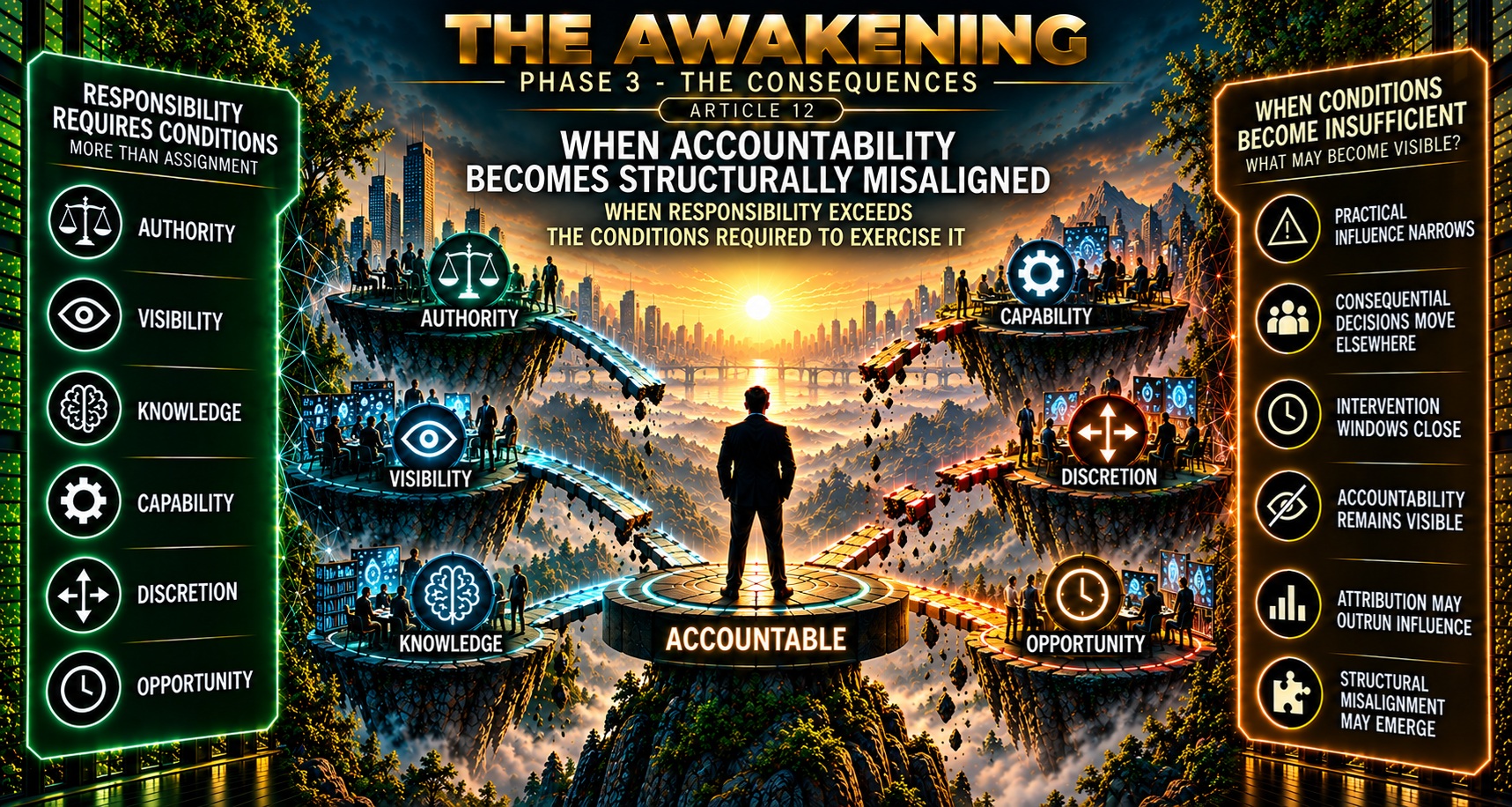 When Responsibility Exceeds the Conditions Required to Exercise It Someone is still accountable. The role has not disappeared. The responsibility has not been removed. The governance structure still identifies who owns the outcome. The escalation path still exists. And when something goes wrong, the organization may still know exactly whose name sits beside the responsibility. But that does not tell us whether that person still had the conditions required to exercise it. They may have lacked visibility into a consequential dependency. The knowledge required to understand the situation may have been distributed elsewhere. A decision may have been made beyond their authority. Their discretion may have narrowed. The opportunity to intervene may have arrived too late. Or they may have retained formal authority while losing the practical capacity to influence what happened. Nothing in the responsibility matrix necessarily changes when this occurs. The accountability remains visible. The conditions required to exercise it may not. That creates the central question of this article: What happens when formal responsibility remains in place while the conditions required to exercise it become insufficient? Accountability Can Remain After Its Conditions Have Changed Article 7 of THE AWAKENING asked whether accountability can remain legitimate when authority is distributed. That inquiry separated several relationships that organizations often compress into a single idea of responsibility. Responsibility is not authority. Authority is not knowledge. Knowledge is not capability. Capability is not discretion. Discretion is not causal influence. And formal accountability does not establish that the actor being held accountable possessed the conditions required to affect the relevant outcome. Article 7 treated this primarily as a problem of legitimacy and attribution. Article 12 asks a different question. What are the consequences when the architecture changes but accountability does not change with it? Consider a Project Manager who remains accountable for an outcome while consequential decisions increasingly occur within product teams, functional areas, governance bodies, suppliers, automated workflows or other organizational boundaries. That arrangement is not necessarily defective. Distributed authority may be entirely appropriate. Distributed knowledge may improve decision quality. Local discretion may increase responsiveness. Specialists may be better positioned to make particular decisions. Computational systems may recognize relationships that no individual could efficiently process. The problem does not arise simply because responsibility, knowledge and authority are distributed. It arises when formal responsibility remains attached to an actor while the conditions required to exercise that responsibility become insufficient for what the actor is still expected to influence. That is the possibility examined here. Responsibility Requires More Than Assignment Organizations are good at assigning responsibility. They create role descriptions. RACI matrices. Governance models. Delegations of authority. Approval thresholds. Escalation paths. Performance objectives. Contractual obligations. And named owners. These mechanisms matter. But assignment answers only one question: Who is expected to be responsible? It does not answer another: What must be true for that responsibility to be meaningfully exercised? At least several conditions may matter. Authority Can the actor legitimately make, authorize, challenge or escalate the decisions that materially affect the outcome? Visibility Can the actor see the information, dependencies, emerging conditions and consequences relevant to the responsibility? Knowledge Can the actor access or mobilize the knowledge required to interpret what is visible? Capability Does the actor have the practical capacity to understand, coordinate, decide or intervene as required? Discretion Is there meaningful room to act, or has the decision effectively been predetermined by rules, systems, commitments or decisions made elsewhere? Opportunity Can intervention occur while meaningful alternatives still exist? These conditions are not interchangeable. An actor may have authority without visibility. Visibility without knowledge. Knowledge without discretion. Discretion without capability. Capability without opportunity. Or formal responsibility without sufficient combinations of any of them. That matters because accountability can remain organizationally stable while its enabling conditions move. The Architecture Can Move While Accountability Stays Still Project systems rarely change all at once. Authority may gradually move closer to teams. Knowledge may become more specialized. Supplier ecosystems may expand. Governance may distribute decision rights. Automation may execute decisions previously made manually. AI may increasingly analyze, recommend, prioritize or trigger action. Product structures may change where decisions are made. Functional boundaries may determine which information is visible. None of these changes necessarily requires that formal accountability move at the same speed. The result can be subtle. The organization still knows who is accountable. But the system through which that person is expected to exercise responsibility may no longer be the system for which the accountability arrangement was originally designed. This creates a possible form of structural misalignment: The architecture of responsibility and the architecture of practical influence begin to diverge. That divergence does not automatically make accountability illegitimate. Nor does it prove that the accountable actor lacks agency. It creates a question that must be investigated: Has the actor retained sufficient authority, visibility, knowledge, capability, discretion and opportunity relative to the responsibility that remains assigned? Formal Authority May Not Be Effective Authority Formal authority matters. But its existence does not tell us whether it can still produce meaningful influence under the conditions in which it must be exercised. An escalation right that becomes usable only after a commitment is irreversible may preserve formal authority while providing little effective influence. An override right may matter little if the person expected to exercise it cannot recognize when intervention is required. This does not make formal authority meaningless. It means that formal authority and effective capacity to influence an outcome are not the same thing. Visibility Is Not the Same as Information Modern projects may produce enormous amounts of information. Dashboards. Reports. Risk registers. Logs. Metrics. Alerts. Forecasts. AI-generated summaries. Real-time operational data. That does not necessarily mean that the accountable actor has meaningful visibility. Visibility requires more than information being technically available. The relevant relationship must become recognizable. Its significance must be interpretable. And it must become visible while action remains possible. An actor can therefore be surrounded by information and still lack visibility into the consequence for which they will later be held accountable. This creates an important connection with integrative capacity. If consequential interdependencies are not recognized and connected across boundaries, an accountable actor may never receive the integrated understanding required to exercise responsibility effectively. But that connection must not be assumed in every case. The information may have been available and ignored. The actor may have misunderstood it. The signal may have been ambiguous. The risk may genuinely have been unknowable. Or the relevant uncertainty may have been irreducible. Lack of effective visibility is not automatically evidence of insufficient integrative capacity. Opportunity May Be the Condition We Notice Too Late Authority, knowledge and capability can all exist and still be insufficient if opportunity disappears. A decision may remain reversible today and become contractual tomorrow. A design choice may remain open until procurement commits. A stakeholder concern may remain manageable until public opposition hardens. A technical dependency may remain inexpensive to resolve until implementation begins. A governance intervention may remain useful until the decision path becomes locked. This makes time part of accountability architecture. The relevant question is not simply: Could the actor have intervened? It is: Could the actor have intervened while intervention could still materially change the outcome? That distinction matters. Because accountability assessed after the event can easily attribute responsibility using information and alternatives that were not available when action was still possible. The formal responsibility may be unchanged. The practical opportunity to exercise it may have disappeared much earlier. The Problem Is Not Always Too Little Authority There is an obvious response to accountability misalignment: Give accountable people more authority. Sometimes that may be appropriate. But it is not a general solution. More authority does not create knowledge. It does not guarantee visibility. It does not create capability. It does not recover a lost intervention window. It does not necessarily improve coordination across interdependent domains. And concentrating authority may create new information-processing constraints, slower decisions or weaker local responsiveness. The problem is therefore not: Accountability is concentrated, so authority should also be concentrated. Nor is it: Authority is distributed, so accountability should simply be distributed with it. The more demanding question is: What configuration of responsibility, authority, information, knowledge, capability, discretion and intervention opportunity is required for accountability to remain legitimate and practically exercisable under the actual conditions of the project system? That question cannot be answered through organizational symmetry alone. When Accountability Becomes Structurally Misaligned We can now state the hypothesis more precisely. A single instance of limited authority does not establish structural misalignment. Neither does one missed signal. One late escalation. One poor decision. One unclear role. Or one actor failing to use authority that was genuinely available. Persistence matters. But persistence alone would not make the misalignment structural. The mismatch would need to be recurring or embedded in the project configuration rather than merely episodic. The possibility examined here is that accountability becomes structurally misaligned when formal responsibility remains attached to an actor or role while the project configuration repeatedly or systematically fails to provide sufficient conditions for that responsibility to be exercised in relation to the outcomes for which accountability is retained. Temporary constraint may be normal. Incomplete information is unavoidable. Authority is always bounded. No actor can control every relevant cause. And accountability never requires omniscience. Structural misalignment would therefore need to describe something more systematic than the ordinary limits of responsible action. It would require a recurring or embedded mismatch between what the system expects an actor to answer for and the conditions the system makes available for influencing it. That is a hypothesis. It still has to earn the word structural. Accountability Misalignment May Remain Invisible The misalignment may be difficult to see precisely because the formal architecture remains intact. The responsibility matrix still looks coherent. The governance model still identifies an owner. Escalations still occur. Approvals still have signatures. Performance objectives still identify responsible individuals. The organization can therefore retain a clear appearance of accountability. But clarity of attribution is not the same as legitimacy of attribution. A name in a box tells us where responsibility was assigned. It does not tell us whether the conditions required to exercise that responsibility remained available. This creates a potentially important asymmetry: Accountability can remain highly visible while the erosion of its enabling conditions remains largely invisible. That possibility deserves particular attention in distributed project systems. Human Adaptation May Preserve the Alignment People may compensate when formal mechanisms do not provide every condition required for responsible action. Informal relationships may connect knowledge across functions. People may translate across boundaries. Experienced actors may recognize dependencies that formal mechanisms miss. And compensatory coordination may restore visibility or intervention capacity that the formal architecture does not provide reliably. That may represent resilience, architectural insufficiency, or both. Informal coordination is not necessarily evidence of structural weakness. It may itself be a legitimate part of the project's integrative architecture. The distinction matters. But the human burden, sustainability and learning consequences of such compensation require a separate inquiry later in this phase. AI Makes the Question More Difficult AI does not remove this problem. It can redistribute it. A computational system may detect a dependency before a human does. It may recommend an action. Prioritize an issue. Trigger a workflow. Reject a transaction. Optimize a schedule. Or execute within delegated boundaries. Formal accountability may nevertheless remain human. That arrangement may be entirely legitimate. But Article 10 established why human presence or approval alone cannot tell us whether meaningful human agency has been preserved. If the accountable human cannot understand the relevant context, recognize when intervention is required, access meaningful alternatives, or intervene before action becomes consequential, formal human accountability may remain while effective human influence has narrowed. The opposite is also possible. AI may increase visibility. Expand analytical capacity. Surface relationships earlier. Preserve intervention windows. And make accountability more exercisable rather than less. Technology therefore does not inherently create accountability misalignment. The question is whether the resulting human-organizational-computational configuration preserves the conditions required for legitimate and effective responsibility. Misalignment Does Not Eliminate Responsibility There is an important danger in this argument. If accountability requires authority, visibility, knowledge, capability, discretion and opportunity, almost anyone could defend failure by claiming that one of those conditions was incomplete. That would turn structural explanation into distributed impunity. That is not the argument. Actors can fail to exercise authority they genuinely possess. They can ignore available information. They can fail to seek relevant knowledge. They can avoid escalation. They can exercise poor judgment. They can fail to act while meaningful opportunity exists. And they can legitimately be held accountable for those failures. The existence of structural conditions does not remove individual agency. The relevant question is therefore not whether the actor faced constraints. Everyone does. It is whether the actor had sufficient conditions, relative to the responsibility assigned, to exercise meaningful influence over the outcome being attributed to them. Accountability requires attribution. Attribution requires examining both the architecture and the actor's conduct within it. Neither should substitute for the other. Alternative Explanations Must Survive Suppose an accountable actor repeatedly fails to influence outcomes. Is accountability structurally misaligned? Perhaps. But several alternatives remain. The role may simply have been poorly designed. Authority may have been available but unused. Objectives may have been unclear. Governance may have been weak. Information may have existed but not been examined. Political behavior may have obstructed action. The actor may have lacked capability that the role legitimately required. A supplier may have created an unforeseeable failure. The situation may have changed faster than any reasonable configuration could have responded. Or the outcome may have depended on uncertainty that no actor could meaningfully control. These alternatives matter. If accountability misalignment becomes the explanation whenever someone is responsible for an outcome they could not completely control, the concept explains almost every organizational responsibility. That would make it analytically useless. The hypothesis therefore needs a discriminating test: Was there a recurring or embedded mismatch between the responsibility retained and the conditions the project configuration could reasonably be expected to provide for exercising it, or did the actor fail to use conditions that were sufficiently available? Those are not the same problem. Accountability Is Not Control Accountability cannot require complete control. Projects are interdependent systems in which outcomes emerge from multiple actors, decisions, constraints, uncertainties and external conditions. No actor controls every causal contributor. The relevant question is therefore not whether the accountable actor controlled the outcome. It is whether the responsibility assigned was accompanied by sufficient legitimate influence, information and intervention capacity relative to what the actor was expected to answer for. That is more demanding than assigning ownership. But it is much less demanding than requiring control. What Would Make the Misalignment Structural? For the term structural misalignment to add explanatory value, several things should be observable. First, the mismatch should not be merely episodic. It should recur or be embedded in the project configuration. Second, the mismatch should concern conditions materially relevant to the assigned responsibility. Not every informational gap or authority boundary matters. Third, there should be a plausible mechanism connecting the configuration to the actor's reduced capacity to exercise responsibility. Fourth, the mismatch should remain distinguishable from individual failure, ordinary uncertainty, poor role design and other credible alternatives. Fifth, identifying the mismatch should explain something useful that a simpler statement such as “the person lacked authority” does not. Otherwise, there is no reason to introduce a stronger concept. The evidence must earn the adjective structural. What Article 12 Can and Cannot Conclude Several propositions can now be defended. 1. Formal responsibility does not establish that the conditions required to exercise it remain sufficient. 2. Those conditions can become differently distributed as project architecture changes. 3. Structural misalignment requires more than isolated constraint. It requires a recurring or embedded mismatch between assigned responsibility and the conditions required to exercise it. 4. Such a mismatch does not eliminate individual agency or legitimate accountability. 5. Neither distributed authority nor human or computational participation establishes accountability misalignment by itself. What cannot yet be concluded is that every persistent separation between responsibility and authority constitutes a distinct phenomenon of structural accountability misalignment. A stronger hypothesis is worth carrying forward: Accountability may become structurally misaligned when formal responsibility remains attached to an actor or role while the project configuration repeatedly or systematically fails to provide sufficient authority, visibility, knowledge, capability, discretion or opportunity for that responsibility to be meaningfully exercised in relation to the outcomes for which accountability is retained. That hypothesis has boundaries. It has alternative explanations. It preserves individual agency. And it can be rejected if the actor possessed sufficient conditions but failed to use them. That is enough for the investigation to continue. When Responsibility Stays but the System Moves Project systems can change while accountability arrangements remain comparatively stable. Authority can move. Knowledge can become more distributed. Decision rights can shift. Human and computational contributions can change. And the conditions through which responsibility is exercised can change with them. None of that eliminates accountability. Nor does it necessarily weaken it. Distributed systems may provide better conditions for responsible action. Technology may increase visibility and intervention capacity. Informal human adaptation may preserve connections that formal architecture cannot anticipate. But there may also be a point at which the organization continues to assign responsibility for outcomes while the conditions required to influence those outcomes become insufficient. When that happens, the problem is no longer simply: Who is accountable? The more demanding question becomes: Accountable with what authority, what visibility, what knowledge, what capability, what discretion, and while what meaningful opportunity to act still remains? Because responsibility can stay in exactly the same place while the system around it changes. And when the mismatch between responsibility and the conditions required to exercise it becomes recurring or embedded, accountability may become structurally misaligned. The next question is what happens when unresolved interdependencies and deferred trade-offs do not disappear, but accumulate over time. Article 13: The Cost of Deferred Integration. |
Posted on: September 28, 2026 10:20 AM
| Permalink |
Comments (1)


