Facing an ethics complaint? Don’t Panic: Hints for PMI Ethics Complaint’s Respondent


| Getting notice that you’re accused of violating PMI’s Code of Ethics and Professional Conduct is unsettling. Breathe. This is the moment to steady yourself, get clear on the facts, and respond thoughtfully. The path forward is practical and values-based. Use the following steps to organize your response and act with responsibility, respect, fairness, and honesty.
A steady, principled response demonstrates professionalism under pressure. Focus on facts, align with the Code, cooperate fully, and—if needed—make amends and show how you will do better. Don’t panic. Lead with integrity, and let that guide your next steps. Familiarize yourself with the PMI Code of Ethics and Professional Conduct and refer to Ethics Case Responses & Findings for more details. Let me know if you find this article valuable. What other hints would you add? |
The Hidden Cost of Falsified Receipts: A Breach of PMI’s Ethical Foundations
|
In the bustling offices of YKF Technical Solutions, a mid-sized IT firm, Lai-mui, its project manager, was leading a high-stakes software deployment for a government client. With tight deadlines and mounting pressure, Lai-mui delegated expense reporting to her trusted team lead, Deejay. Weeks later, during a routine audit, discrepancies surfaced as receipts for meals, travel, and equipment were inflated or entirely fabricated. Deejay admitted to falsifying receipts to “compensate for overtime and stress.” Lai-mui was stunned. What seemed like a minor infraction was, in fact, a serious ethical breach. This scenario is not uncommon, yet it strikes at the heart of the PMI Code of Ethics and Professional Conduct, which is built on four core values: Responsibility, Respect, Fairness, and Honesty. Violations of PMI’s Core Values
Applying the PMI Ethical Decision-Making Framework (EDMF) Lai-mui, now faced with an ethical dilemma, turned to the PMI Ethical Decision-Making Framework. The EDMF guided her through:
Call to Action The project management community must treat ethics as a living practice, not a checkbox. We must:
Conclusion Ethical leadership is not just about doing things right; it’s about doing the right things. Falsifying receipts may seem minor, but its ripple effects can compromise entire projects. Let’s recommit to the values that define our profession and lead with integrity, every step of the way. Questions for Reflection
References: Project Management Institute, Inc. (2025). Ethics. pmi.org. https://www.pmi.org/about/ethics Project Management Institute, Inc. (n.d.). Ethics Guidelines. pmi.org. https://www.pmi.org/about/ethics/guidelines Project Management Institute, Inc. (n.d.). PMI Code of Ethics and Professional Conduct. pmi.org. https://www.pmi.org/-/media/pmi/documents/public/pdf/ethics/pmi-code-of-ethics.pdf ==== |
Conflict Resolution: Leading with Ethics to Prevent Fractures from Becoming Irreparable and Transform Them into Growth
| This past week, I caught up with several former colleagues and friends from different organisations. A recurring theme emerged in our conversations: many of them are grappling with significant challenges, with much of their time and energy consumed in trying to resolve conflicts within their teams. In several cases, these conflicts are escalating and beginning to get out of hand. By the end of the week, these discussions prompted me to pause and reflect, analysing not only what I had heard, but also how it connects with lessons I’ve learned through teaching, leadership, and practice.
Why Do We End Up in Conflict? Across these reflections, one root cause stood out: misaligned expectations. When expectations are not met, trust begins to erode. But why are expectations so often out of alignment? Each person brings their own interpretation of what success will look like working in this team driven mostly by their own sense of purpose. Over time, when those expectations are not met for a variety of reasons. Without the right guardrails in place, signs of disengagement or frustration go unnoticed until conflict surfaces. How individuals react is strongly influenced by their values and coping mechanisms. For organisations, this can result in good employees quietly leaving disruptive arguments within teams, or prolonged disputes that drain productivity and morale. Drawing from My Teaching Experience When teaching the PMI Agile Certified Practitioner (PMI-ACP®) course under Domain IV: Team Performance, one of the models I referenced often was Speed B. Leas’ Model of Conflict. It outlines five escalating levels of conflict from manageable problem solving to entrenched, intractable disputes. The lesson is simple but powerful: leaders must recognise and address conflict early. In agile environments, where transparency and collaboration are vital, even small misunderstandings can snowball into major disputes if left unchecked. Another useful framework is the Thomas-Kilmann Conflict Mode Instrument (TKI), which identifies five approaches: competing, collaborating, compromising, avoiding, and accommodating. Effective leaders learn to adapt their approach to context, while prioritising collaboration for long term trust and cohesion. Together, these frameworks reinforce a core truth: effective conflict resolution requires awareness, adaptability, and timing. Preventing Conflict Before It Escalates The best approach to conflict is prevention. From my reflections, several practices stand out as essential:
When these practices are embedded in the way we work, conflict shifts from being destructive to becoming a constructive part of problem solving. The Role of PMI Ethics Conflict also brings us back to values and ethics. How we respond under pressure whether we lash out, withdraw, resign quietly, or seek constructive dialogue is guided by both personal values and professional standards. The PMI Code of Ethics and Professional Conduct provide a compass for leaders and teams alike:
Applied consistently, these principles not only help to prevent conflict but also shape how teams respond when disagreements inevitably arise. When Conflict Becomes Beyond Repair Despite best efforts, some conflicts move beyond repair. This typically happens when:
At this stage, leadership often shifts from resolution to containment, restructuring, or separation, to protect the wider team and organisation. These conversations reinforced my belief that conflict is not a sign of failure it is an inevitable part of human interaction. When addressed constructively, it can become a powerful driver of learning, innovation, and stronger collaboration. The true test of leadership lies in how early we recognise conflict, how openly we create space for resolution, and how firmly we anchor our actions in ethical principles. By leading with responsibility, respect, fairness, and honesty, we can transform conflict into an opportunity for trust and growth ultimately strengthening the very foundations of collaboration and leadership. |

PMI Code of Ethics on the Menu: What’s Your Strongest Flavor?
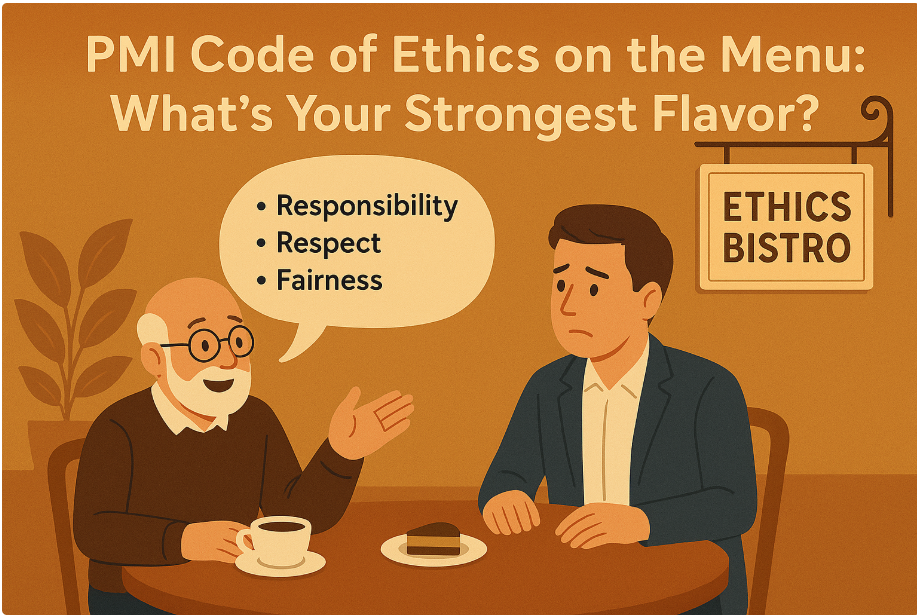
| Imagine walking into a cozy little café called The Ethics Bistro. The air smells of freshly brewed coffee, and the tables are filled with people quietly reflecting on their day. At one corner table sits a project manager named David, looking worried.
The owner of the bistro, a wise old mentor, notices David’s frown and walks over. “Why so serious, David?” the mentor asks. David sighs. “I am leading a project team, but I am struggling to make the right calls. Deadlines, clients, budgets it feels like I am being pulled in every direction. How do I know if I am being fair?” The mentor smiles and says, “Ah, then you need to taste the four-course meal we serve here every day. It is called the PMI Code of Ethics.” First Course: Responsibility “Responsibility is like the soup,” the mentor explains. “It warms the soul. As project managers, we are responsible for our decisions, both good and bad. If something goes wrong, we take responsibility instead of placing blame. Taking responsibility keeps the project honest and the team confident.” Second Course: Respect Next comes the main dish. “Respect is the heart of the meal. Just as food is seasoned with care, respect seasons every conversation. Whether it is a client, team member, or vendor, every person deserves to be valued. Respect builds trust, and trust keeps the project alive.” Third Course: Fairness Then arrives a plate of perfectly balanced flavors. “Fairness means treating everyone equally. No hidden favoritism, no secret deals. Like sharing bread at the table, fairness ensures everyone gets their piece. When the team feels fairness, they give their best.” Final Course: Honesty Finally, dessert is served sweet but powerful. “Honesty,” says the mentor, “is the sugar of relationships. Speak the truth, even when it is uncomfortable. A project can survive a missed deadline, but it cannot survive broken trust.” David listens carefully, sipping coffee. “So, the PMI Code of Ethics is like this meal responsibility, respect, fairness, and honesty. If I serve these values to my team, they will follow me with trust.” The mentor nods. “Exactly. Projects come and go, but the taste of integrity stays forever.” As David leaves the Ethics Bistro that night, the burden feels lighter. He knows that no matter how tough the project becomes, the recipe for ethical leadership will guide him. If you were serving your project team at the Ethics Bistro, which course responsibility, respect, fairness, or honesty would they say is your strongest flavor? Share your answer in the comments. Reference: |
The Honest Path: Why Truth-Telling Is a Strategic Advantage in Project Management
| The Honest Path: Why Truth-Telling Is a Strategic Advantage in Project Management
In the high-stakes world of project management, where deadlines loom and budgets tighten, honesty can feel like a luxury. But it is a strategic necessity. Truth-telling is not just about ethics—it is about building resilient teams, fostering trust, and steering projects toward sustainable success. 🔍 Honesty: More Than a Moral Choice Honesty in project management means transparent communication, accurate reporting, and integrity in decision-making. It is the difference between a project that survives short-term pressures and one that thrives long-term. When project managers embrace honesty, they create a culture where issues are identified early, risks are managed proactively, and stakeholders stay aligned. ⚠️ Common Ethical Dilemmas Even seasoned professionals face moments of ethical tension:
These decisions may seem minor, but they compound over time—leading to mistrust, scope creep, and even project failure. 🧭 Honesty as a Strategic Lever Truth-telling offers tangible benefits:
📜 PMI’s Ethics Code: Honesty at the Core The Project Management Institute (PMI) places honesty as one of its four foundational values—alongside responsibility, respect, and fairness. PMI’s Ethics Code reinforces this by offering practical toolkits and decision-making frameworks to help professionals navigate ethical gray zones with clarity. 🛠️ How to Lead with Honesty Here are actionable ways to embed honesty into your project leadership:
🧩 Conclusion: Honesty Is Leadership In project management, honesty is not weakness—it is wisdom. It is the quiet force that keeps teams united, stakeholders informed, and outcomes aligned with values. The honest path may not always be the easiest, but it is the one that leads to lasting impact. Please share your experiences and thoughts… |