

When Agility Becomes Mechanical


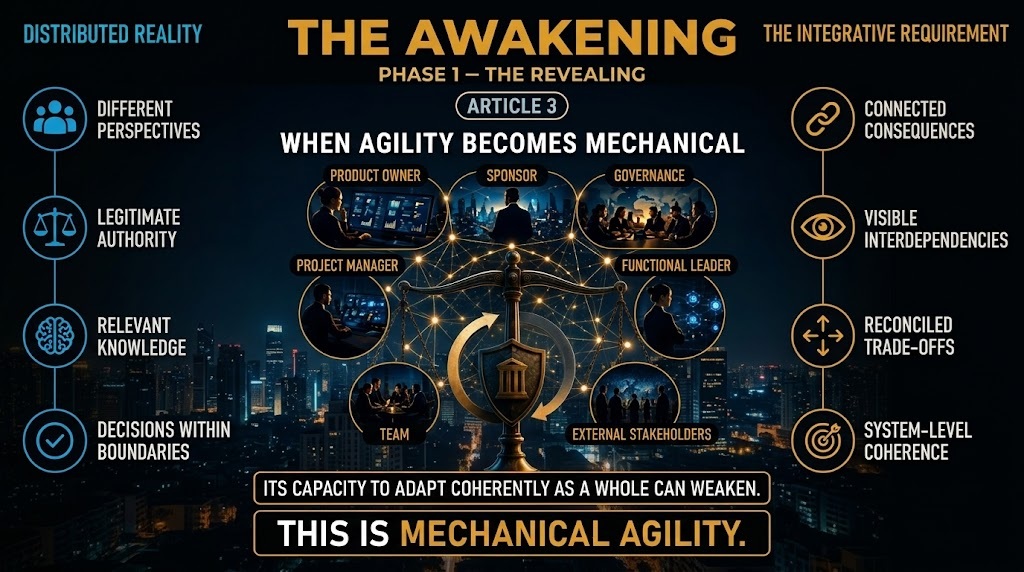 The Hidden Cost of Weak System-Level Integration Agile approaches changed an important assumption about how projects can adapt. Not every decision needs to travel upward. Not every change should wait for central approval. Not every problem is best understood far from the work. Teams can exercise judgment. Feedback can shorten the distance between evidence and response. Decision-making can move closer to relevant knowledge. Learning and adaptation can occur where the work is actually happening. These are significant capabilities. But the previous reflections exposed a condition that complicates the picture. As leadership, authority and management responsibilities become more distributable, the interdependencies among the decisions they produce do not disappear. And when those interdependencies are insufficiently recognized or reconciled, something subtle can happen. Adaptive practices can remain active. Teams can continue responding. The project can continue moving. Yet its capacity to adapt coherently as a whole can weaken. This is what I mean by mechanical agility. Not failed agility. Not false agility. Not merely the mechanical performance of agile practices. And not an argument against autonomy. For the purposes of this inquiry: Mechanical agility is a condition in which adaptive practices and local learning remain active, while the architecture becomes insufficient to connect and reconcile their material consequences across the wider system. The question is therefore not simply whether teams are agile. It is: Can local adaptation remain systemically coherent when the decisions it produces are materially interdependent? 1. Agility Changed Where Adaptation Can Occur Traditional project structures often concentrated substantial planning, coordination and decision authority within formal management arrangements. Agile approaches challenged that concentration. They enabled more sensing, judgment, learning and adaptation to occur closer to the work. Teams inspect outcomes. Customers and users provide feedback. Priorities can change. Solutions can evolve incrementally. New information can influence subsequent decisions without waiting for an entire planning cycle to be completed. This can reduce the distance between evidence and action. But it also changes the architecture through which adaptation occurs. When teams, product roles, managers and other actors can respond to different signals at different speeds, adaptation can emerge from several places across the project system. That can be valuable. But it raises another question: What connects adaptations whose material consequences extend beyond the boundaries within which they were made? 2. Local Adaptation Is Not Sufficient for System Adaptation A team can adapt effectively to what it sees. That does not necessarily mean the wider project has adapted coherently. A Product Owner may reprioritize work in response to customer evidence. A technical team may change an architecture in response to performance data. Another team may alter sequencing because of a dependency. Operations may introduce a constraint based on serviceability. A sponsor may protect a strategic milestone as conditions change. Each response may be timely, rational and legitimate within its own context. Yet their consequences can interact. A locally beneficial change can alter another team's dependency. A faster delivery choice can increase operational exposure. A customer-driven priority can affect a contractual commitment. A technical improvement can consume capability required elsewhere. The distinction is therefore fundamental: Local adaptation concerns the ability of a part of the system to respond to relevant change. System adaptation requires the consequences of those responses to remain sufficiently coherent across the interdependent whole. Agile practices can substantially strengthen local adaptive capacity. They do not, by themselves, remove the need to integrate consequences that cross local boundaries. 3. Autonomy Does Not Remove Interdependence Autonomy is valuable partly because not every decision should require central intervention. But autonomy does not make decisions independent. A team may possess legitimate authority over how it performs its work while remaining dependent on shared architecture, funding, suppliers, platforms, regulatory requirements, other teams or downstream operations. This creates an important distinction: Decision autonomy concerns where legitimate decision authority resides. System coherence concerns whether the consequences of different decisions remain compatible enough for the project to function as a whole. These principles do not inherently conflict. The difficulty arises when one is treated as sufficient for the other. More local autonomy can improve responsiveness without resolving cross-boundary interdependencies. More central control can make some dependencies easier to govern while weakening local judgment and responsiveness. The architectural question is therefore not how to maximize autonomy or control. It is: Which decisions can remain local, and when do their consequences become sufficiently material and interdependent to require integration beyond the local boundary? 4. Fast Feedback Can Still Have a Narrow Boundary Agility rightly emphasizes feedback. Feedback allows assumptions to be tested. It exposes differences between expected and actual outcomes. It creates opportunities for learning and adjustment. But the speed of a feedback loop does not determine the breadth of the system it represents. A team can receive rapid usability feedback while remaining unaware of an operational consequence. A product function can observe customer behaviour without seeing portfolio-level resource effects. A technical team can detect performance degradation without understanding a contractual implication. An AI-enabled system can identify a local pattern without representing every organizational constraint affected by the response. The feedback itself may be excellent. The limitation may be its scope. A project cannot deliberately adapt to material consequences that remain outside the feedback structures through which those consequences can become visible. Faster feedback is therefore valuable, but not always sufficient. The architecture must also determine which consequences need to cross boundaries, who needs to see them and whether they become visible while meaningful intervention remains possible. 5. Iteration Creates Opportunities for Learning, Not Learning Itself Iteration is another essential capability. But iteration and learning are not equivalent. A team can execute short cycles repeatedly while leaving important assumptions unchallenged. Metrics can improve while the wrong objective is being optimized. Retrospectives can identify local friction without revealing systemic causes. Delivery can accelerate while strategic relevance weakens. Iteration creates repeated opportunities for adjustment. Learning requires something more. Evidence must be connected to assumptions, decisions and consequences. At system level, that becomes more difficult because evidence itself is distributed. Different actors see different parts of reality. Different metrics represent different objectives. Different feedback loops operate at different speeds. Some consequences emerge outside the team or only after the immediate delivery cycle. This creates another important distinction: Iteration creates opportunities for learning. Integration helps determine whether relevant learning can reach the interdependencies it needs to influence. Without that connection, adaptation can remain locally intelligent while becoming systemically incomplete. 6. Motion Is Not Coherence Mechanical agility may not look dysfunctional. That is one reason it can be difficult to detect. Work may continue flowing. Iterations may continue. Backlogs may be refined. Throughput and cycle time may improve. Teams may demonstrate progress. Stakeholders may attend reviews. The adaptive machinery appears active. But activity is not coherence. A project can become more efficient at producing outputs without becoming more capable of preserving coherence among the decisions, constraints and consequences that shape those outputs. This is not a criticism of metrics. Metrics make selected dimensions of reality visible. The risk emerges when what is measurable locally becomes a proxy for what matters systemically. A team metric can tell us whether work is moving. It cannot, by itself, tell us whether the collection of decisions producing that movement remains coherent across the project system. The more important question therefore becomes: Are we merely increasing the speed of local response, or improving the capacity of the whole system to adapt to what it is learning? Those are different achievements. 7. Mechanical Agility Is an Architectural Condition Mechanical agility should not be understood as a criticism of teams. Nor should it automatically be treated as poor implementation of an agile framework. The condition can arise even when teams are capable, disciplined and genuinely adaptive within their legitimate boundaries. Imagine a project in which:
Interdependencies are not reconciled quickly enough. Or the actors expected to integrate them lack sufficient visibility, authority, knowledge or opportunity to act. The problem is not an absence of agility. It is a separation between local adaptive capacity and system-level adaptive coherence. Mechanical agility therefore describes what can happen when adaptive mechanisms remain operational while the integrative conditions required for coherent system-level adaptation become insufficient. That makes it an architectural condition, not a methodology. 8. The Answer Is Not Less Autonomy Recognizing this condition can lead to an attractive but simplistic conclusion: reduce autonomy. That does not necessarily follow. Reducing autonomy can recreate bottlenecks. It can move decisions away from relevant knowledge. It can slow feedback. It can weaken useful ownership. And it can make adaptation depend on actors who are too distant from changing conditions. The alternative is not to choose between autonomy and integration. It is to design them as complementary capabilities. Autonomy enables adaptation to occur where relevant knowledge and legitimate authority reside. Integration connects adaptations when their material consequences cross those boundaries. Local actors can remain capable of responding where the consequences of their decisions remain appropriately local. Integrative mechanisms can become more active when those consequences cross boundaries or create material system-level tensions. The objective is therefore neither maximum autonomy nor maximum central control. It is adaptive coherence. 9. From Team Agility to Adaptive Coherence Team-level agility remains important. But in an interdependent project system, it cannot be the only object of attention. We also need to ask whether the wider system can:
It is its systemic extension. A project may therefore require both: Local adaptive capacity, the ability of actors close to the work to sense, learn and respond, and System-level integrative capacity, the ability to recognize and reconcile the material interdependencies created by those responses. Together, they can support what this series will call adaptive coherence. For the purposes of this series, adaptive coherence refers to the capacity of an interdependent project system to adapt while keeping its differentiated responses sufficiently coherent as a whole. Mechanical agility describes the condition in which local adaptive capacity remains active while system-level integrative capacity becomes insufficient. 10. The Hidden Cost When system-level integration is weak, the first visible consequence may not be project failure. It may be drift. Teams remain productive. Local decisions remain defensible. Delivery continues. But interdependencies become harder to reconcile. Trade-offs accumulate or are deferred. Strategic intent can be interpreted differently across boundaries. Risks can emerge through interactions rather than through any single decision. And increasing effort may be required to reconcile consequences created by adaptations that were entirely reasonable when viewed locally. This is the hidden cost of mechanical agility. The danger is not that the project stops adapting. It is that: The project can continue adapting through its parts while progressively weakening its ability to adapt as a coherent whole. That is different from rigidity. A rigid system struggles to adapt. A mechanically agile system may adapt repeatedly and still drift. The Revealing Agile approaches did not eliminate the need for integration. Nor do the foundational Agile principles imply that they should. They expanded where sensing, judgment, learning and adaptation could occur. That can make project systems more responsive. But as adaptation becomes more distributed, the architecture must also account for the material consequences created across those distributed responses. The challenge is therefore not: How do we make teams less autonomous? Nor: How do we restore centralized control? It is: How do we preserve local adaptive capacity while keeping materially interdependent adaptations sufficiently coherent at system level? Because a project can have autonomous teams. Fast feedback. Short iterations. Frequent learning. Continuous delivery. And still face a deeper structural problem: Its parts may be adapting while the whole is losing adaptive coherence. And that takes us to the next reflection. PMBOK 8 Recognizes Integration. How Is Integrative Responsibility Allocated When Leadership Is Distributed? The first three reflections have progressively narrowed the question. Leadership can be distributed. Integrative responsibility can also be distributed. Agility can increase the number of places from which adaptation emerges. Now the argument must be tested against the profession's own architecture. Not to ask whether PMBOK 8 recognizes integration. It does. But to ask something more precise: When leadership, authority and management responsibilities are distributed, how explicitly does PMBOK 8 establish how integrative responsibility should be allocated and what conditions are required for it to be exercised across the project system? |
Future Leadership
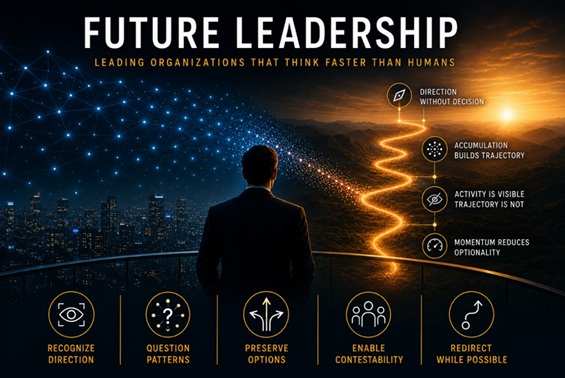 Leading Organizations That Think Faster Than Humans Leadership has always operated with delay. Information takes time to travel. Patterns take time to become visible. Consequences take time to emerge. Leaders have never seen everything as it happened. Yet organizations were largely built around an important temporal assumption: Consequential movement would become visible early enough for leadership to interpret it before direction became too difficult to change. A strategy could drift. A project could deteriorate. A market could shift. An operating model could produce unintended effects. But somewhere between signal and consequence, there was usually an expectation that the organization would notice. Reports would surface. People would escalate. Patterns would accumulate. Leadership would interpret. Direction could be reconsidered. This assumption is becoming less reliable. AI-native organizations are beginning to operate at a different temporal scale. Systems sense continuously. Agents interact. Models update. Thresholds adjust. Workflows respond. Priorities are recalibrated. Local decisions trigger other local decisions across interconnected environments. Each action may be small. Each adaptation may be legitimate. Each system may remain within its authorized domain. Yet together, these interactions can begin forming an organizational trajectory before anyone recognizes the direction taking shape. This may become one of the defining leadership problems of the AI-native organization. Decision speed is only part of the issue. The deeper challenge is the speed at which trajectories form. A fast decision can often be reviewed. An isolated action can be reversed. A visible failure can trigger intervention. But organizational direction rarely emerges from one decision alone. It forms through accumulation. A threshold changes. An agent adapts. A recommendation becomes more influential. A workflow begins routing cases differently. A local optimization alters behavior elsewhere. The changed behavior becomes new data. The new data reinforces the pattern. Nothing necessarily appears decisive. Then the organization discovers that something has changed. Risk tolerance has shifted. A capability has weakened. A market position has evolved. A workforce relationship has become more transactional. A strategic priority exists formally but no longer organizes actual behavior. The organization did not explicitly choose a new direction. A direction formed. This distinction changes the leadership problem. Leadership has traditionally been associated with setting direction. But what happens when direction can also emerge from the recursive interaction of systems operating faster than leadership can interpret their collective effect? The leader may understand every major system. Governance may have approved each domain of autonomy. Individual decisions may be explainable. Performance may remain strong. And still, the organization may be moving somewhere no one consciously intended. The difficulty lies in the temporal gap between trajectory formation and trajectory recognition. By the time a pattern becomes visible at leadership level, it may already have shaped: Behavior. Dependencies. Expectations. Data. Incentives. Customer experience. Operational norms. Future system responses. The organization is no longer merely observing a pattern. It is observing conditions partly produced by the pattern itself. Systems act on the environment. Their actions alter the environment. The altered environment produces new signals. Those signals shape subsequent interpretation and action. As the loop accelerates, the distinction between sensing reality and sensing a reality partly produced by previous system behavior becomes increasingly difficult to preserve. The organization progressively participates in producing the reality it subsequently senses. Leadership may therefore arrive late in a very specific sense. Not late to the decision. Late to recognizing what the accumulation of decisions has made possible. This is a different form of organizational latency. Traditional management often treated latency primarily as delayed information. The event happened. The organization learned about it later. AI-native organizations may face interpretive latency. The relevant information may already exist. Signals may be continuously captured. Dashboards may update in real time. Models may detect variation immediately. Yet the organizational meaning of distributed change may remain invisible. The organization sees activity. It does not yet see trajectory. More visibility does not necessarily solve this problem. Continuous visibility can make it harder to distinguish consequential movement from normal variation. When thousands of signals change continuously, change itself becomes ordinary. Every metric moves. Every model updates. Every workflow adapts. Every agent generates activity. The challenge becomes determining when distributed variation has begun to acquire direction. That is a profoundly different capability from monitoring performance. Performance asks whether the system is producing expected results. Trajectory asks what the system is gradually becoming capable of reproducing. Performance can remain excellent while trajectory becomes problematic. A workforce platform may increase allocation efficiency while gradually redefining people as interchangeable capacity. A risk system may reduce losses while slowly excluding forms of uncertainty the organization no longer knows how to interpret. A coordination architecture may increase consistency while making unusual judgment progressively harder to sustain. None of these trajectories requires a catastrophic decision. They can emerge from successful operation. This is where exception-based governance reaches a structural limit. It assumes that what matters will eventually appear as deviation. A threshold will be crossed. An anomaly will emerge. A limit will be exceeded. Someone will escalate. But a trajectory can remain inside acceptable operating conditions while changing the system those conditions were designed to govern. The system does not fail. The meaning of normal changes. By the time the change becomes undeniable, leadership may be confronting an established organizational reality rather than an emerging possibility. This raises a difficult question. How early must an organization recognize a trajectory to remain capable of influencing it? Too early, and every weak signal becomes a strategic concern. The organization drowns in interpretation. Autonomy collapses under premature intervention. Adaptation becomes dependent on executive attention. Too late, and interpretation becomes retrospective. Leadership can explain how the organization arrived somewhere. It may no longer be able to prevent arrival. Future leadership therefore requires governing the widening distance between organizational speed and interpretive time. Leaders cannot think at machine speed. Nor should organizations slow every intelligent system to the rhythm of executive cognition. The value of distributed intelligence would disappear. The question is whether the organization remains governable across different temporal scales. Systems may operate in milliseconds. Operational patterns may form over hours. Behavioral consequences may emerge over weeks. Strategic effects may become visible over months. Institutional consequences may take years. Leadership must increasingly govern across these temporal layers without assuming that the fastest layer is the most important or that the slowest consequence can safely wait until it becomes visible. This requires a different form of organizational attention. Leadership has traditionally looked for decisions. Who decided? What was approved? Which action was taken? What result followed? But in distributed intelligent systems, some of the most consequential organizational changes may have no singular decision point. Future leadership must become capable of recognizing direction without decision. Where are repeated local adaptations beginning to converge? Which temporary exceptions are becoming operational norms? Where is accumulated system behavior narrowing future optionality? What is becoming easier to reproduce? What is becoming progressively harder to question? These questions do not replace strategy. They reveal where strategy may already be changing in practice. They also change the meaning of leadership presence. No leader can remain cognitively present across every interaction in an AI-native organization. The organization itself must become better able to notice how trajectories acquire momentum. Momentum matters because trajectories are not equally governable at every stage. Early patterns may be ambiguous but flexible. Established patterns become clearer but harder to redirect. Embedded patterns begin shaping infrastructure, capability, expectations, and identity. Eventually, the organization may become dependent on the very trajectory it is trying to reconsider. An organization may possess the technical ability to stop a system and still lack the practical ability to reverse what the system has already normalized. It may change an objective while retaining the data, incentives, habits, dependencies, and expectations produced by the previous one. It may withdraw autonomy while discovering that the human capabilities required to resume judgment have weakened. It may correct a model while the organizational behavior shaped by years of model-mediated decisions persists. Intervention remains possible. Reversal becomes progressively more expensive. The critical question is when a trajectory remains sufficiently open to meaningful redirection. This requires a new sensitivity to organizational irreversibility. The more difficult form may be accumulated irreversibility. The gradual closing of alternatives. The erosion of capabilities. The normalization of dependencies. The institutionalization of assumptions. The strengthening of feedback loops that make one future increasingly probable and others increasingly difficult. Leadership has always shaped the future. What changes is that future organizational states may now begin consolidating through machine-speed interaction long before they become visible as strategic choices. The future leader is therefore unlikely to remain the cognitive center of the organization. Distributed intelligence makes that increasingly unrealistic. But replacing the heroic leader with a demand for more perceptive, more reflective, or more ambiguity-tolerant leaders would solve little. The problem is partly institutional. Organizations often reward certainty. Performance systems privilege measurable outcomes. Executive incentives favor near-term optimization. Governance demands evidence. Successful systems acquire legitimacy. Under these conditions, questioning an emerging trajectory can become hardest precisely when that trajectory is still easiest to redirect. The evidence is incomplete. The pattern remains ambiguous. Performance may be strong. The cost of intervention is visible. The cost of waiting is not. Future leadership therefore depends on more than individual capability. It requires organizational conditions in which ambiguous signals can remain visible without automatically becoming interventions. Emerging trajectories must be examinable before they are classified as failures. Successful patterns must remain open to question without requiring proof that they are already harmful. Different interpretations of direction must be able to coexist long enough to be tested. And leaders must be able to preserve future options even when the immediate performance case for doing so is incomplete. This is not indecision. It is the institutional capacity to keep consequential direction open to interpretation while it is still governable. The tension cannot be removed. Evidence strengthens with time. So does trajectory. Waiting improves certainty. It may also reduce governability. Acting early preserves optionality. It also increases the risk of acting on noise. No dashboard can determine the exact moment at which variation becomes direction. No AI system can decide, without inheriting the organization's own assumptions about significance, when an emerging pattern deserves strategic attention. Intelligent systems can help enormously. They can detect convergence. Surface weak signals across domains. Model propagation and reinforcing loops. Reveal changes no human could observe unaided. But trajectory recognition cannot be reduced to another predictive layer. Any system designed to identify consequential direction will itself encode assumptions about which patterns matter, which futures appear plausible, and which forms of change deserve attention. A mechanism built to detect trajectories can therefore develop its own trajectory blindness. The challenge is not simply to see earlier. It is to preserve the contestability of what the organization believes it is seeing. When does an observed pattern become significant enough to question the direction the organization is acquiring? There may be no permanent threshold. That question belongs to the future of leadership. Organizations that think faster than humans will not necessarily become ungovernable. But they may become ungovernable before leadership realizes that governability is being lost. The danger is not simply speed. It is the possibility that organizational becoming increasingly precedes organizational understanding. Leadership then moves downstream. The organization acts. Patterns converge. Momentum develops. Consequences begin shaping future conditions. Only then does direction become visible. At that point, leadership may still decide. But it is deciding inside a reality the organization has already partially constructed. The future of leadership may therefore depend on preserving a difficult organizational capacity: The capacity to recognize consequential direction before direction becomes destiny. Leaders do not need to think faster than intelligent systems. They need organizations capable of making emerging trajectories visible while those trajectories can still be questioned, interpreted, and redirected. Because in AI-native organizations, the most consequential change may not begin with a decision. It may begin when thousands of individually reasonable actions start making the same future easier to reproduce. And by the time leadership asks where the organization is going, the organization may already have been answering for some time. |
Governance as Decision Architecture
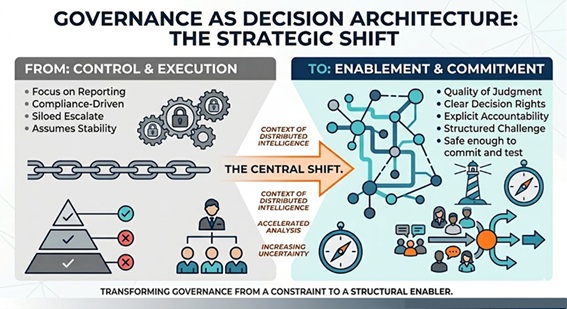 From Control to Enabling Responsible Commitment For decades, governance was designed to control execution. Today, that is no longer enough. In a context of distributed intelligence, accelerated analysis, and increasing uncertainty, the central challenge is not execution discipline. It is decision quality under real conditions. The question is no longer: How do we control what is done? It is: How do we ensure that what is decided is clear, owned, and actionable? 1. The Limits of Traditional Governance Traditional governance is built around: • Control • Reporting • Compliance • Escalation These mechanisms assume that: • Decisions are already clear • Direction is stable • Execution is the main risk But this assumption no longer holds. Today, the primary failure mode is not poor execution. It is: • Delayed decisions • Diluted accountability • Fragmented alignment Governance does not fail at control. It fails at decision enablement. 2. Governance as Decision Infrastructure If decision is the critical layer, governance must be redesigned accordingly. Governance becomes: The architecture that enables responsible decision-making. This does not mean eliminating constraints. It means defining them clearly. Decisions are not made in a vacuum. They operate within boundaries of: • Risk • Ethics • Strategic intent The role of governance is not to control how decisions are made. It is to make explicit the space within which they can be made responsibly. This means creating conditions where: • Decisions are made at the right level • Ownership is explicit • Trade-offs are visible • Alignment is produced during the decision, not after Governance is not a constraint. It is a structural enabler of commitment. 3. The Core Components of Decision Architecture Not all decisions require the same level of governance. The depth of decision architecture should reflect: • Reversibility • Impact • Level of uncertainty Without this distinction, governance becomes excessive and slows decision-making. A governance system designed for decision must include: A. Clear Decision Rights Who decides must be explicit. Not assumed. Not negotiated in real time. Not diffused across groups. Without clarity, decisions are delayed or avoided. B. Explicit Accountability Every decision must have an owner. Not a group. Not a consensus. Not a shared abstraction. Execution can be distributed. Responsibility for the decision cannot. Ownership concentrates responsibility and enables action. C. Structured Challenge Decisions must be tested before they are made. Not through endless debate, but through focused, relevant challenge. The objective is not consensus. Consensus often delays decision by requiring agreement. Decision requires commitment, not unanimity. The relevant threshold is different: Whether a decision is sound enough to be taken and safe enough to be tested. One effective mechanism is to anticipate failure before commitment. Asking what would cause this decision to fail strengthens judgment and improves the quality of the decision before execution. The goal is not alignment. It is quality of judgment under constraint. D. Convergence Mechanisms Exploration must lead to closure. Without convergence, systems remain in: • Analysis • Optionality • Hesitation Governance must define: • When a decision is required • What constitutes sufficient clarity to commit E. Integrated Learning Loops Decisions must generate learning. Not as a post-mortem ritual, but as a continuous recalibration of judgment. Error is not only a failure. It is a signal. It informs: • Context interpretation • Ethical filters • Future decisions 4. The Risk of Distributed Accountability Modern organizations emphasize collaboration and participation. This creates value. But it also introduces a risk: Accountability dilution. When: • Everyone contributes • Multiple perspectives are integrated • Decisions emerge implicitly Ownership becomes unclear. And without ownership: • Action slows • Responsibility diffuses • Consequences are not fully assumed Decision architecture must preserve collaboration. But it must protect accountability. 5. Alignment Is Designed, Not Achieved Alignment is often treated as a goal. In reality, it is an outcome of how decisions are made. When decisions are: • Explicit • Owned • Clearly communicated Alignment emerges naturally. When decisions are: • Implicit • Delayed • Negotiated endlessly Alignment fragments. Governance does not enforce alignment. It designs for it. 6. From Control to Commitment This is the fundamental shift. From: Control of execution To: Enablement of commitment The role of governance is no longer to ensure compliance. It is to ensure that: • Decisions are made • Direction is clear • Ownership is explicit • Action is coordinated 7. Final Insight Organizations do not become effective because they control more. They become effective because they decide better. Governance is the system that makes that possible. Closing Statement Without decision architecture, intelligence does not translate into action. Without accountability, decisions do not translate into impact. Governance is not the system that controls the organization. It is the system that enables it to commit, act, and learn responsibly. |
The Responsible Decision Cycle
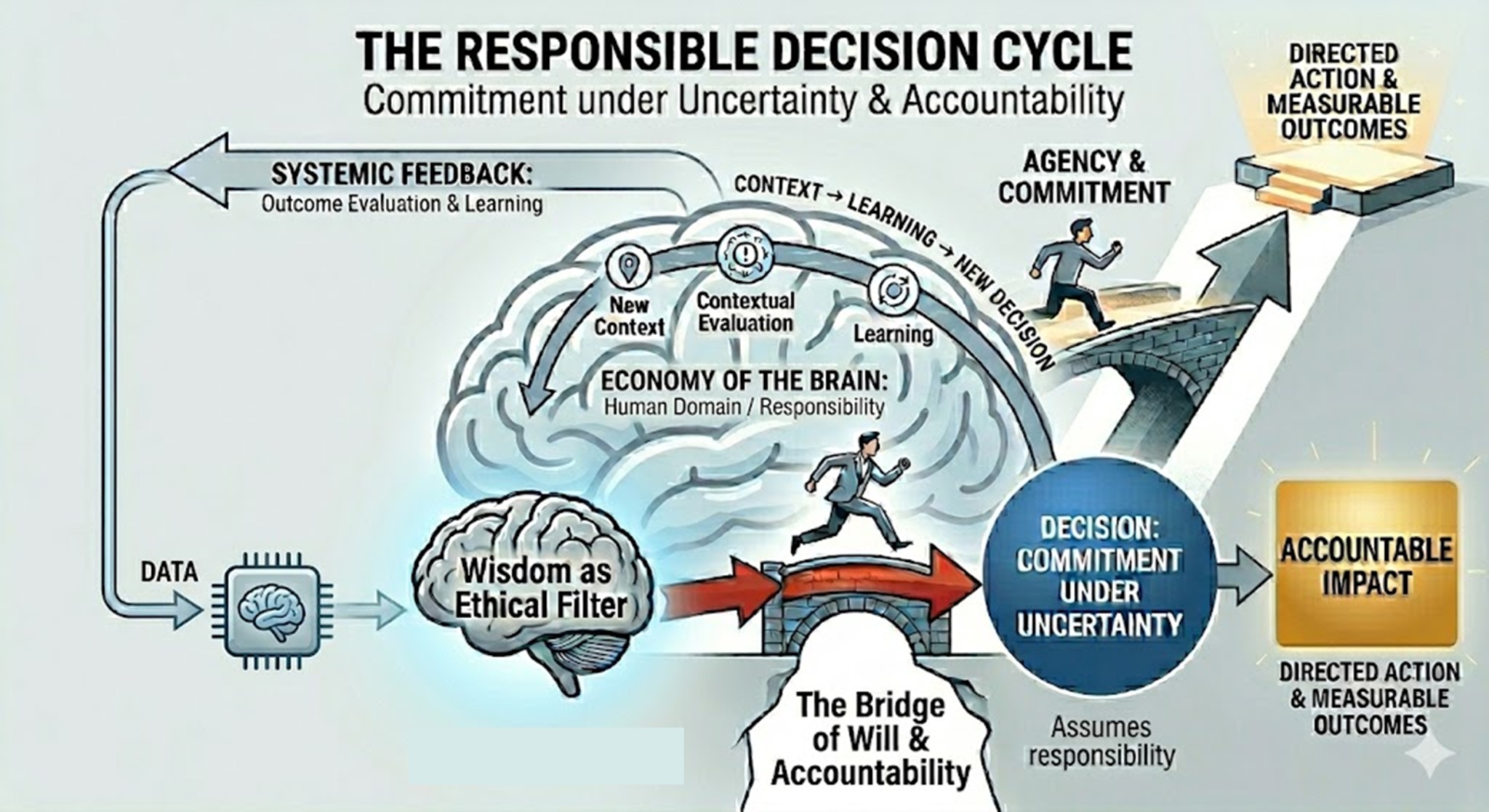 From Knowledge to Accountable Impact For decades, organizations optimized how they process information. Today, the real challenge is different:
The Responsible Decision Cycle is not an extension of DIKW. It is a structural shift:
The DIKW model explains how knowledge is structured. It does not explain how organizations act. Between wisdom and action, there is a critical space:
They fail because they delay or dilute decisions. Not deciding does not preserve neutrality. It produces consequences. In that sense, omission is not the absence of decision. It is a form of decision with delayed and often unaccounted impact. 2. Decision as Commitment, Not Computation In an AI-augmented environment:
Why? Because decision is not calculation. It is commitment under uncertainty. It requires:
That boundary defines the human domain. 3. The Architecture of the Responsible Decision Cycle The Responsible Decision Cycle operates as a closed loop: A. Knowledge (Interpreted) Information is processed, structured, and contextualized. This layer is increasingly augmented by AI. B. Wisdom (Ethical Filter) Knowledge is evaluated through experience, judgment, and values. This is where meaning is constructed. C. Decision (Commitment under Uncertainty) A choice is made. Alternatives are reduced. Risk is accepted. Direction is made explicit. This is the point of no neutrality. 4. Accountable Impact The decision produces measurable and coordinated outcomes. Value is created when action aligns across the system. Accountability is not theoretical. It is validated through impact. 5. Systemic Feedback (Learning)
It is a signal. It informs the recalibration of judgment, the refinement of the ethical filter, and the adjustment of future decisions. This feeds the next cycle. 4. From Linear Thinking to Living Systems Traditional models are linear:
5. The Role of AI in the Cycle AI plays a critical role but within clear boundaries. It enhances:
It increases the number of plausible options. Without a decision cycle, this does not lead to clarity. It leads to decisional entropy.
The risk is:
In modern organizations, scarcity has shifted. We no longer lack:
Over time, unmade decisions accumulate into systemic consequences. This is not inefficiency. It is decisional entropy. 7. Governance as Decision Architecture If decision is the critical layer, governance must evolve. Governance is no longer:
The goal is decisions that the system can commit to and execute coherently. 8. The Human Position in the Brain Economy We are entering the Brain Economy. In this context:
It is how we decide and what we are willing to stand behind. Human value concentrates in three dimensions:
The Responsible Decision Cycle resolves a limitation that has existed for decades. DIKW explains how we know. This model explains:
Closing StatementKnowledge without decision is potential. Decision without accountability is risk. Accountability without alignment is fragmentation. Alignment without learning is repetition. Not deciding is not neutral. It is a decision without ownership. Only when these elements operate together does an organization evolve. Progress does not happen when we know more. It happens when we decide, align, learn and are willing to be accountable for the impact. |
Behavioral Design and Sustainability: Facilitating the Adoption of Circular and Regenerative Packaging
Categories:
Career Development,
Talent Management,
Strategy,
Leadership,
Interpersonal Skills,
,
Sustainability
Categories: Career Development, Talent Management, Strategy, Leadership, Interpersonal Skills, , Sustainability
|
Behavioral Design and Sustainability: Facilitating the Adoption of Circular and Regenerative Packaging The effectiveness of circular and regenerative solutions depends less on technical innovation than on how consumers perceive, understand, and adopt these innovations. Editorial NoteThis article is the third in the “Positive Impact by Design” series, exploring how products, packaging, and processes can drive regenerative value. Following discussions on sustainable materials and circularity, this piece focuses on behavioral design as a catalyst for adoption, setting the stage for our next exploration of communication, storytelling, and culture as drivers of transformative habits. 1. IntroductionPicture a busy parent at a grocery store, hesitating over a “compostable” coffee pod, unsure if it goes in the green bin or the trash. This moment of doubt reveals a critical barrier: even the most advanced packaging fails if it confuses or overwhelms. In recent decades, technical advances in sustainability, circularity, and regeneration have reshaped packaging design. Low-impact materials, reuse models, and design for recycling are now staples for brands like Unilever and startups like Notpla. In 2025, with the European Union mandating 65% recycling rates for packaging and 75% of consumers prioritizing sustainability (Ellen MacArthur Foundation, 2025), the stakes are higher than ever. Yet, an inconvenient truth persists: the most innovative packaging fails if it is misunderstood, misused, or discarded incorrectly. The next leap in sustainability is not just technical—it is behavioral. This article expands on prior discussions about materials and economic models, proposing a framework for leveraging behavioral design to drive the adoption of circular and regenerative packaging, laying the foundation for packaging as a cultural and communicative tool, as explored in our next article. 2. The Importance of Behavioral DesignBehavioral design is the art and science of shaping choices to guide human decisions. In sustainability, it bridges the gap between intention and action. A 2024 study by the OECD found that while 82% of consumers intend to adopt sustainable practices, only 28% do so consistently due to cognitive overload, habits, or lack of clear cues. Packaging that anticipates these barriers—guiding, simplifying, and motivating—creates far greater impact than those that passively "hope to be used correctly." 3. When Technology Fails Without AdoptionEven environmentally superior solutions can falter without behavioral support:
These failures highlight the need for designs that not only perform technically but also resonate culturally, as discussed in our upcoming article on storytelling and communication. Without behavioral design, even the best-intentioned solutions lose effectiveness. 4. Principles of Design for Sustainable AdoptionTo transform ecological intent into action, we propose the CIRCLE framework (Clarity, Intuition, Reward, Connection, Logistics, Engagement), a structured approach to designing packaging that drives sustainable behavior. The principles are summarized below:
These principles not only drive behavior but also set the stage for packaging to communicate deeper meanings, as explored in our next article. The CIRCLE framework is visualized in the infographic below, offering a practical guide for designers to create packaging that drives sustainable behavior.
5. From Engineering to Culture: Packaging that Educates and EngagesSustainable packaging can do more than minimize environmental impact—it can educate, inspire, and drive cultural change. For example, Unilever’s “Refill Revolution” campaign used QR codes on shampoo bottles to guide users to nearby refill stations, increasing participation by 40% in pilot programs (Unilever, 2025). Such designs teach (e.g., clear disposal instructions), remind (e.g., prompts on bins), and motivate (e.g., storytelling about material lifecycles). When designed with behavior in mind, packaging becomes a catalyst for social good, paving the way for the communicative and cultural roles discussed in our series’ next installment. 6. Recommendations for Brands and DesignersTo integrate behavioral design effectively, brands and designers can follow this practical checklist:
For instance, Coca-Cola’s “Return to Recycle” campaign used vibrant labels and gamified incentives, boosting bottle returns by 25% in Europe (Coca-Cola, 2024). These strategies prepare packaging to serve as a communicative platform, as explored in our upcoming article. 7. ConclusionWhat if packaging didn’t just hold products but reshaped our relationship with the planet? Redesigning materials is vital, but redesigning habits is transformative. The CIRCLE framework, backed by real-world examples like Unilever and Coca-Cola, shows how behavioral design turns intent into action. This approach lays the groundwork for packaging to become a storytelling medium—one that educates, inspires, and regenerates, as our next article in the “Positive Impact by Design” series will explore. The next frontier of sustainability belongs to those who understand people, contexts, and daily decisions. By integrating engineering, design, and behavior, packaging can do more than protect—it can educate, engage, and return value to the world. References:
|




