


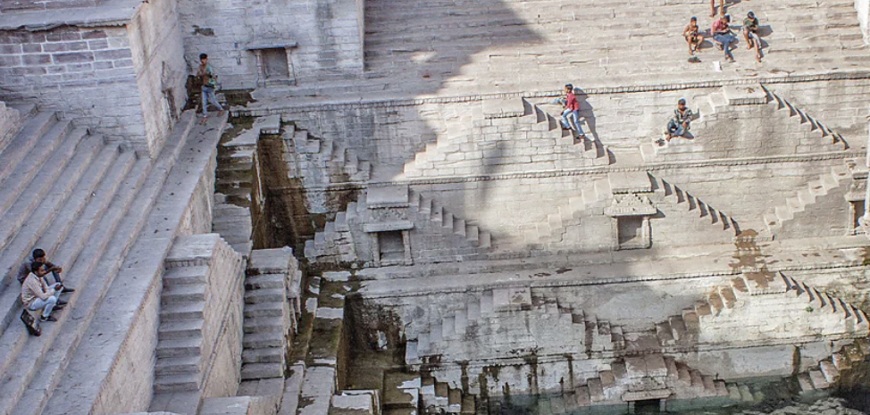
A recent BBC Future article, “India is turning to ancient water systems as modern ones run dry,” is what prompted me to take a closer look at one of India’s most remarkable forms of infrastructure: the ancient stepwell.These are also called baolis or vavs. These are striking, ingenious architectural projects going back 1500 years. And there are lessons for today’s construction project managers – and really any project leaders – here.
The premise of the article is startling. Climate change is driving parts of India into a struggle with water scarcity. Modern water systems have come under increasing pressure – so engineers, communities, and project planners are reconsidering technologies that were developed centuries ago. The renewed interest is not based on nostalgia. It is based on the realization that some of these systems were extraordinarily well adapted to local climate, geology, and seasonal water cycles.
Stepwells are a particularly powerful example.
At first glance, they can appear almost mysterious: enormous staircases descending deep into the earth, sometimes surrounded by intricately carved columns, platforms, and chambers. And because they contain intricate carvings related to religious figures, these have been described as ‘inverted temples’.
But beneath their beauty is a very practical idea.
A stepwell is essentially a water-storage system, groundwater access point, public space, and piece of infrastructure combined into a single structure. The design is elegant and simple - instead of lowering a bucket down a narrow shaft, people descend a series of steps to reach the water. That distinction matters because in many parts of India, particularly in regions such as Gujarat and Rajasthan, water availability varies dramatically through the year. During the monsoon season, rainfall recharges the groundwater and the water table rises. During the long dry season, it falls.
Stepwells were designed around that reality – with long-term value in mind, not a “let’s build an inverted temple on time and on budget and to specification” in mind. Triple Bottom Line thinking dominated over Triple Constraint thinking. When water was plentiful, people need to descend only a short distance. Months later, as the water table dropped, they simply continued farther down the staircase to reach it. The infrastructure did not attempt to force nature into a fixed condition. It was designed to function across a range of conditions that varied in the long term.
That alone offers a lesson for modern project managers.
Designing for the Ecosystem, Not Just the Structure
The builders of stepwells were not simply constructing wells. They were working within a much larger system involving rainfall, geology, groundwater, temperature, evaporation, seasons, community needs, and the passage of time.
Consider the steps themselves. Their most obvious purpose was to allow people to reach a changing water level. But the stepped form also provided secondary hydraulic and structural benefits.
Depending on the particular stepwell and its setting, the steps and terraces could help:
- slow runoff and reduce destructive flow velocity,
- encourage infiltration and groundwater recharge,
- accommodate large seasonal changes in water level,
- stabilize the structure against water and soil pressure,
- and indirectly reduce evaporation by keeping much of the water deep and shaded.
The system adapts – ironically, a massive stone structure is…flexible.
Long-Term and Systems Thinking Was Built Into Stepwells
Perhaps the most striking feature of these structures is not their depth or even their engineering sophistication. It is their time horizon. The people who commissioned and constructed stepwells, - and the project leaders who oversaw their construction - were solving an immediate problem—access to water—but they were clearly thinking beyond the next season.
Stepwells were substantial civic investments. They required excavation, engineering, stonework, labor, maintenance, and often elaborate architectural design. Some have survived for well over 1000 years.
That suggests a fundamentally different question from the one that sometimes dominates modern projects.
Instead of asking simply:
“Can we deliver this project successfully?”
the deeper question becomes:
“Will what we are building – our outcome - continue to deliver value over a very long period of time?”
A project can finish on schedule, stay within budget, and meet its stated scope—and still produce an asset that performs poorly, creates environmental problems, becomes expensive to maintain, or fails when conditions change.
The builders of stepwells appear to have understood something that modern project professionals are increasingly rediscovering: successful projects must be evaluated in terms of the value they create over their entire life cycle.
Resilience Rather Than Prediction
There is another important lesson hidden amongst the carvings in the design.
A stepwell does not depend on predicting exactly where the water level will be.
Instead, it is designed to work when the water is high, when the water is low, and at many points in between - that’s resilience.
Modern projects are often built around forecasts: expected demand, expected rainfall, expected temperatures, expected population growth, expected energy costs, expected traffic patterns – and that’s okay: forecasting is necessary. But the world has become increasingly difficult to predict. Climate change makes historical weather patterns less reliable. Technology changes rapidly. Supply chains are disrupted. Communities grow and shift.
The stepwell suggests another approach – don’t merely design for the condition you expect, design – and lead your project - for a range of conditions.
For a modern construction project manager, that might mean asking whether a building can tolerate more extreme heat, heavier rainfall, flooding, changes in energy supply, water scarcity, or different patterns of use.
In other words, project leadership increasingly requires us to think beyond efficiency and toward adaptability.
Sustainability Without Calling It Sustainability
The ancient builders would not have used phrases such as “sustainable infrastructure,” “climate resilience,” or “triple-bottom-line thinking.”
Yet stepwells incorporated many ideas that today fall comfortably under those headings.
- They used gravity rather than energy-intensive pumping wherever possible.
- They took advantage of local geology.
- They realized it made more sense to retain water close to where it fell.
- Their underground construction reduced exposure to sun and therefore helped limit evaporation compared with large, shallow bodies of exposed water.
Multipurpose construction
A stepwell could provide water, shade, gathering space, religious or cultural space, and relief from intense heat. Descending into one could produce a dramatic temperature change because of shade, stone, depth, and proximity to water.
Today we might describe that as multifunctional infrastructure.
The builders probably would have regarded it simply as sensible design.
A Project Leader’s View
For modern construction project leaders, there is a temptation to look at an ancient structure primarily as an engineering curiosity. Think Sphinx.Think Hanging Gardens of Babylon.But that misses the larger lesson.
The real achievement of the stepwell may be the thinking behind it.
Its designers recognized that their project existed inside several larger systems:
a water system, an environmental system, a social system, and a system that would continue long after the original construction project ended.
That mindset produces different project questions.
Not simply:
- How quickly can we build it?
- How much will it cost?
- Are we meeting the specification?
- How will this asset – this investment (because projects are investments) deliver value 20, 50, or 100 years from now?
- What assumptions are we making about future environmental conditions?
- Are we designing around natural systems or constantly fighting against them?
- What happens when conditions move outside our expected range?
- Can the project deliver several kinds of value instead of only one?
- What burden are we leaving for those who will operate, maintain, and live with what we build?
Looking Back to Look Forward
The BBC article is compelling precisely because it turns our normal idea of innovation upside down – sort of like the ‘inverted temple’ description of a stepwell!
There is an understandable tendency to associate innovation with something new: artificial intelligence, sensors, smart buildings, digital twins, sophisticated forecasting, advanced materials.
An sure, of course, all of those technologies can contribute enormously to better projects.
But innovation does not always require inventing something that has never existed before.
Sometimes innovation begins by looking carefully at what people figured out hundreds of years ago.
India’s renewed interest in ancient water systems is a reminder that older infrastructure may contain design knowledge that becomes newly valuable when conditions change.
Stepwells, in particular, remind us that some of the most durable infrastructure comes from understanding a place deeply—its climate, its people, its natural systems, and its future needs—and then designing accordingly.
The great achievement was not simply creating a staircase down to water.
It was recognizing that the water would rise and fall, seasons would change, communities would continue to need the resource, and the structure would have to keep working through all of it.
That is long-term thinking.
And for today’s construction project leaders facing climate change, resource constraints, and growing expectations for sustainable value, it may be one of the oldest project lessons that still feels surprisingly modern.
I plan a Part 2 of this post which will include more pictures of stepwells and some insight from a civil engineer who was born in Gujarat.
Posted
by Richard Maltzman
on: August 23, 2026 10:54 AM |
Permalink




