
Doc Brown Would Be Proud (Part 1 of 2)


|
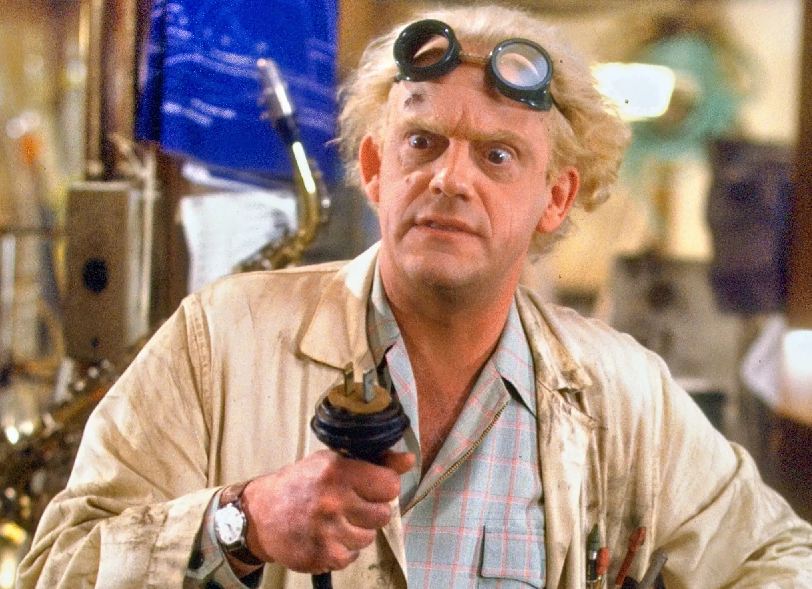
Most of you are probably familiar with Dr. Emmett Brown. That’s a photo of him at the top of this post. He is not a famous psychologist from the University of Chicago, nor is he the leading cardiologist at the Boston Medical Center. He doesn’t even have a PMP(R) credential, and he’s not even a real doctor. Well, he is a real doctor character, the ‘mad scientist’ in Back To the Future, played eloquently by Christopher Lloyd. And he uses an interesting device to power his Delorean electric vehicle: a flux capacitor. See the sign below. Watch out!
Of course, there is no such thing. Or… is there? I have encountered two recent articles which, while not using the term “flux capacitor” are using the term “supercapacitor”. The articles are not from science fiction magazines, either, they are from IEEE Spectrum and from New Scientist. To me, the irony of the story is very sweet, because this is about using two ancient materials - concrete and carbon – to create capacitors which can be built into the environment to power houses and potentially vehicles. Here’s the paragraph that got my attention – in an article from New Scientist magazine, August 2023: A mixture of cement and charcoal powder could enable houses to store a full day’s worth of energy in their concrete foundations. This new way of creating a supercapacitor – an alternative to batteries that can discharge energy much faster – could be incorporated into the foundations of both buildings and wind turbines. When paired with renewable energy sources, it could also someday let concrete road foundations wirelessly recharge electric vehicles as they drive along. This is striking in several ways, not the least of which is the idea that the power source for homes, businesses and vehicles could be built into the environment, which smacks of the whole concept of The Built Environment, for which PMI now is offering a credential (the PMI-CP™). Indeed, I am working with industry professionals and academics to work this into our curriculum at Boston University. The Supercapacitor But let’s get back to this supercapacitor – the project that led to its development and the projects it will undoubtedly launch – projects that would make Dr. Emmett Brown quite proud. Here’s an image of the supercapacitor in the lab (courtesy of IEEE Spectrum):
Let’s start with the ingredients. This is another irony. To power the modern world in an environmentally-responsible manner, requires the generation and storage of electricity without the need for fossil fuels, without hazardous or rare-earth chemicals (like those used in batteries). You would think that some brand-new whiz-kid material would be invented to do that. Not so. One of the main ingredients in this supercapacitor is carbon black. To give you an idea of how new this material is – it was used to write the Dead Sea scrolls. So: not new. The other material is concrete, also ancient. The trick is in the surface area. To make the material for their supercapacitor, the team at MIT (see story here) stirred up a paste made of cement and water, and then introduced carbon black, a fine, charcoal-like form of carbon which is highly conductive, into the paste. As this cement mixture cured, the water was absorbed, and when evaporated, left behind a veinous network of tunnels when ended up being filled by the carbon black. The resulting material is now a latticework ... with a large surface area of conductive, winding, branching tunnels, without expanding the overall volume of the material, which can now serve as an electrode for the capacitor. The Capacitor I suppose I should digress here for a moment and tell those who don’t have an electrical engineering background about capacitors. There is controversy over who developed the first capacitor, and there’s even controversy over the invention of the predecessor of the capacitor, the Leiden (or Leyden) jar. This was invented nearly simultaneously by German cleric E. Georg von Kleist, but was followed up with more research and intent by by Pieter van Musschenbroek at the University of Leiden in the Netherlands in approximately 1745. In effect, they layers of foil separated by an insulator (called a dielectric). You can see them in action in this video:
they are classically represented by this symbol, a quite logical one, two plates separated by a gap (air, glass, plastic, or other dielectric).
As current (excuse the pun) electronic components, they often look like one of these:
However, now, the concept of this small electronic component , with this innovation, is expanded into the very construction material itself. In part 2, I will continue with the possible implementation ideas for this technology. References:
|


19 Stories of Green
|
This blog post will let you share (and participate, in a fashion) in a tour I just took today of a landmark new building in Boston – the Data Sciences Building at 665 Commonwealth Avenue, Boston, on the campus of Boston University. Some numbers:
I was lucky enough to have a private tour for a small group of sustainability liaisons from BU’s individual Colleges, led by Dennis Carlberg, Adjunct Professor and Sustainability Director for BU. I will share some photos here and link you to a full album of pictures and a couple of short videos. One takeaway for project managers is that we, as agents of change, can push for innovative, sustainability-minded solutions based on benefits that show themselves in non-traditional ways and/or only after time has elapsed – and therefore are not measured very easily. Here’s one example from my tour. When the team decided early on to use geothermal heating and cooling for the building, one non-apparent (but HUGE) benefit was the amount of real-estate this made available in the building for use by students, faculty, and staff, that would have been otherwise taken up by gigantic heating and cooling units. 90% of these needs are taken care of by the geothermal system. Sure, the geothermal system involved pushing thirty-one 6-inch specialty tubes (see photo below of a model) into silt and bedrock, but the payoff is huge in the long-run.
Professor Carlberg showing a model of one of the 31 pipes used for the geothermal system. The real ones are 6 inches in diameter and go into the ground twice as long as the John Hancock Tower is high. And sure, it took extra effort to place green roofs all around in the space made available by the Jenga-like construction, but again, this makes the building more attractive and livable and assists greatly with the handling of rainwater.
(photo taken from the 5th floor of the building) (the plants are mostly sedum) Aside from the tremendous (and also measurable) benefits which this yields in terms of meeting BU’s Climate Action Plan, the fact that valuable Boston real estate is being more effectively used is a big deal and was considered in the project’s cost benefit analysis. Are these sorts of benefits – and is this sort of thinking considered in your projects’ cost-benefit equations? The tour was amazing – the building is amazing – as you can see from the photos and videos. I highly recommend that you take the tour yourself, and you can do it RIGHT NOW from the very device on which you are reading this blog post (unless that device is a piece of paper). Go here: https://www.bu.edu/sustainability/virtual-tour-ccds/ This will take you to a highly-interactive tour of the building and provide technical insight into how this became such a successful project. You will basically get a chance to see on your screen what I saw demonstrated on a gigantic touch-screen by Professor Carlberg (see photo below).
This is in the lobby of the building - the "Sustainability Wall" - a giant touchscreen. Experience it yourself RIGHT NOW by clicking here.
I suggest you visit at least the following (each only runs for a few seconds to a minute or so).
As project managers – or rather, project leaders, we have the chance to push for projects like this, or at a minimum to push the product owner, sponsor, and/or Senior Management to put in place thinking such as that which went into this amazing building. See an album of the pictures (see screen capture below) from my tour by clicking here.
You will get to see details and videos from the tour. Come visit! I hope you have a chance to visit the actual building at the campus of Boston University! |




