



We talk a lot about sustainability these days. And increasingly, we talk about resilience.
But do we talk enough about the relationship between the two?
I recently listened to an excellent episode of PMI's Projectified podcast featuring Preston Welker of The Nature Conservancy and Ayman Zaki of EllisDon. Click on the image to watch it.
The discussion explored how sustainability strengthens project resilience and how the decisions we make during projects influence their long-term value.
Early in the conversation, host Melissa Khan-Blackmore offered a deceptively simple observation:
"Sustainable project delivery asks us to think beyond simply: did we finish the project?"
That caught my attention.
Because finishing a project and creating lasting value are not necessarily the same thing.
And that distinction lies at the heart of this People, Planet, Profits & Projects blog.
Sustainability and Resilience: A Both/And Proposition
Let's begin with two concepts.
Sustainability concerns our ability to meet today's needs without compromising the ability of future generations to meet theirs. It asks us to consider the long-term environmental, social, and economic consequences of our decisions.
Resilience concerns the ability of people, organizations, and systems to withstand disruption, adapt to changing conditions, and continue functioning – to ‘bounce back’.
Closely related? Absolutely.Interchangeable? Not quite.
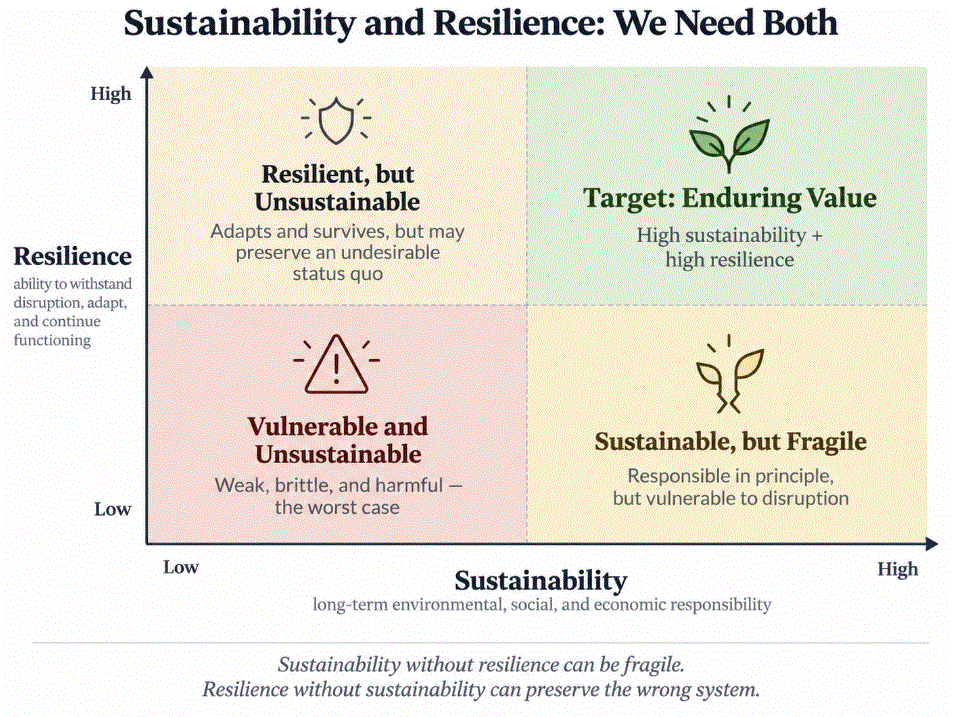
Imagine a building designed for exceptional energy efficiency, with sustainable materials, renewable energy, and a minimal environmental footprint. But suppose it cannot withstand flooding or extreme heat.
Is it truly sustainable if its useful life is prematurely cut short? The building may have to be rebuilt – not a very sustainable situation.
Now consider a company with extraordinary operational resilience. It can recover quickly from disruptions, switch suppliers, and maintain production through almost any crisis. But its business model depends on depleting natural resources and generating enormous quantities of waste.
Resilient? Perhaps.
Sustainable? Hardly.
Sustainability without resilience can be fragile. Resilience without sustainability can preserve an undesirable status quo.
We need both -see the drawing below:
Good Intentions Don't Deliver Projects
One striking statistic cited in the podcast comes from PMI research: 79% of organizations believe sustainability positions them for long-term success, yet only 41% are actually executing on sustainability. Batting .520 may be great in baseball, but not so good for business – or the planet.
That statistic illustrates a substantial gap between aspiration and action.
And what bridges that gap?What brings us up and over to the desirable Northeast quadrant of the chart above?
Projects.
Welker describes how his scientific background led him into project management. He discovered that the technical solution was often not the biggest obstacle. The challenge was getting stakeholders aligned, securing resources, and transforming promising ideas into reality.
That is precisely why project leadership matters.
We can publish sustainability strategies, establish ambitious environmental targets, and announce inspiring commitments. But unless those ambitions influence actual project decisions, even decisions that may challenge the triple constraint (put us over budget, for example) what have we accomplished?
Welker emphasizes incorporating sustainability early, particularly during requirements gathering. Zaki reinforces the point from construction: sustainability expectations need to appear in contracts, designs, and execution plans.
In other words, sustainability cannot simply be bolted onto a project after consequential decisions have already been made.
It must influence the decisions themselves.
A Flood Barrier, a Community, and a Better Definition of Value
One of the most revealing examples from the podcast involves a community facing recurring floods.
The apparent project objective was straightforward: construct a barrier to protect the neighborhood.
A resilience project if ever there was one!
But the community had competing concerns.
Some residents (stakeholders all) urgently wanted flood protection. Others worried about living behind an unattractive concrete wall that could diminish property values and neighborhood character.
Rather than dismissing these concerns, the project incorporated broader community needs.
Sections of the barrier included public art, gathering spaces, and places where food trucks could operate.
The result was more than flood protection. It was an effort to create an environment where people would want to live, gather, and interact.
Think about the distinction.
A narrowly defined project might deliver a technically effective flood barrier on time and within budget.
A more holistic project – one that thought past the end of construction - asks whether that solution creates lasting social, economic, and environmental value.
Resilience protects the community from disruption. Sustainability helps ensure that the community remains worth protecting—and a desirable place to live.
That's systems thinking applied to project leadership.
Sometimes the Best Schedule Isn't the Shortest Schedule
Welker also discusses the Akiing Azhenan Project, involving the Bois Forte Band of Chippewa in Minnesota.
The initiative brings together conservation, Indigenous land interests, carbon-related objectives, and opportunities for social and economic benefits.
An important challenge was establishing trust and ensuring meaningful community participation.
Welker explains that communities may have experienced previous projects that failed to deliver promised benefits or adequately respect their interests. Moving forward responsibly requires time, transparency, and genuine consent.
As he puts it:
"But it wouldn't have happened if it was rushed along."
This should resonate with project professionals.
We're trained to manage schedules, identify critical paths, keep to the budget, eliminate delays, and maintain momentum.
All important skills.
But what if the fastest path to project completion undermines the long-term viability of the outcome?
What if taking additional time to establish trust produces a more valuable – meaning more resilient and sustainable - result?
The challenge isn't to abandon schedule discipline. It's to recognize that schedule performance is not necessarily value performance.
Sometimes slowing down is how we improve the outcome.
That's Both/And thinking: delivery discipline and meaningful stakeholder engagement; financial responsibility and long-term sustainability.
During the podcast, Zaki refers to the evolution from the traditional project management iron triangle toward Green Project Management's P5 Standard. P5 is for People, Planet, Prosperity, Process, and Product. I also like to think of this as Project Success versus the standard Project Management Success (triple-constraint focused).
Readers of this blog will recognize the connection to our own four Ps, and the others I just threw in, related to resilience and sustainability thinking – Patience, Persistence, Perspective.
Since projects are how organizations and societies deliberately change their world, and now that Projects are defined – literally defined by PMI as delivering value - their consequences, which frequently persist long after project closure need to be thought of and considered when the project planning takes place up front.
A building may operate for decades. A transportation system may shape a community for generations. A product may continue consuming resources—or generating waste—long after its project team celebrates a successful launch.
If we assess success only at delivery, we may miss the most consequential part of the story.
From VUCA to BANI to PUMO: The World Isn't Getting Easier
And this brings us to another reason resilience matters so much.
For years, we've described our operating environment with the acronym VUCA:
- Volatile: Conditions change rapidly.
- Uncertain: The future is difficult to predict.
- Complex: Everything seems interconnected.
- Ambiguous: Even the meaning of available information may be unclear.
Futurist Jamais Cascio introduced BANI: Brittle, Anxious, Nonlinear, and Incomprehensible.
BANI adds an important dimension. Our systems may appear strong but break suddenly. People experience mounting anxiety. Small causes can produce enormous consequences, and events can become extraordinarily difficult to understand.
More recently, another framework has emerged: PUMO.
Developed in contemporary strategy and innovation discourse, PUMO describes a world that is:
- Polarized: Stakeholders and societies are increasingly divided, making agreement and coordinated action more difficult.
- Unthinkable: Events once dismissed as implausible can suddenly become consequential realities.
- Metamorphic: Change is not merely incremental; entire systems, industries, and relationships can transform.
- Overheated: Economic, environmental, technological, and social systems operate under sustained and sometimes escalating pressure. The element of ‘overheated’ can (but does not necessarily) imply global warming
I find that distinction especially useful.
VUCA tells us to anticipate turbulence.
BANI warns us that apparently stable systems may be more fragile than we realize.
PUMO adds the prospect of deep transformation, polarization, and sustained pressure on the systems we depend upon.
For project leaders, these are not just interesting acronyms to put on PowerPoint slides.
They raise very practical questions.
What happens to our project when stakeholder groups become deeply polarized?
What happens when an event we considered virtually unthinkable actually occurs?
What happens when the technology, market, or societal assumptions behind our project transform while we're still executing it?
And what happens when environmental and social pressures are not temporary disruptions but enduring conditions?
We cannot build a separate contingency plan for every imaginable future.
Nor should we try.
But we can build the capacity to adapt. We can design products and systems with flexibility. We can encourage learning, strengthen stakeholder relationships, avoid unnecessary dependencies, and consider long-term consequences.
VUCA, BANI, and PUMO help explain why resilience matters. Sustainability helps us decide what that resilience should protect, preserve, or improve.
That distinction is crucial.
Because resilience shouldn't merely help an unsustainable system continue operating.
It should help us move toward a better one.
Resilience Is More Than Bouncing Back
Near the end of the podcast, Welker reflects on how his understanding of project success has evolved.
He explains that the original project concept may need to change as new information emerges, stakeholders contribute insights, and circumstances evolve.
His conclusion is refreshingly direct:
"Because ultimately, that's what it's all about. It's outcomes. Right?"
Yes. Outcomes – but not in the classical way we are tempted to think about it – the building is open, the app is ready for use. The REAL outcomes are the building inhabited by office staff, the app helping people find dog walkers or rides to the airport – in the steady state.
And this brings us to what I believe is one of the most important distinctions in the resilience discussion.
We frequently describe resilience as the ability to bounce back after disruption.
But bounce back to what?
What if the original condition was unsustainable?
What if the business model depleted resources, the infrastructure was poorly adapted to its environment, or the product imposed substantial costs on stakeholders who had little influence over its design? What if the NEW business model – the one enabled by the project – does the same thing, or even worse?
Our objective should sometimes be to think forward and bounce forward instead.
To learn from disruption. To adapt. To improve. And, when necessary, to transform.
This becomes particularly important in a PUMO world, where change can be transformational rather than temporary.
If the environment itself is fundamentally changing, returning to yesterday's conditions may be impossible—or undesirable.
We need resilience that supports adaptation and transformation, not just recovery.
And we need sustainability to help direct that transformation toward enduring value.
That requires critical thinking to challenge assumptions, systems thinking to understand interdependencies, and leadership willing to recognize that the original plan isn't necessarily the best plan.
What Does Project Success Really Mean?
None of this suggests that scope, schedule, cost, and quality no longer matter.
Of course they do.
But they describe important aspects of how we deliver a project—not necessarily the full value of what we deliver.
A project may satisfy every original requirement yet produce something that becomes obsolete prematurely, damages its environment, or proves incapable of adapting to changing needs.
Should we call that an unqualified success?
Perhaps we should be asking some additional questions:
- Will the outcome continue delivering benefits under changing conditions?
- Does it strengthen or weaken the resilience of the larger systems it affects?
- Are its environmental, social, and economic consequences acceptable over its useful life?
- Can it adapt without imposing unreasonable costs on future stakeholders?
- Are we creating value that lasts—or merely achieving a successful handoff?
They also encourage us to move beyond outputs to outcomes, benefits, and ultimately value.
Building Something Worth Sustaining
As the podcast concludes, Welker offers an encouraging thought:
"In a more sustainable world, more sustainable projects are possible."
I share that optimism- but optimism alone won't make it happen.
In an environment described by VUCA, BANI, and now PUMO, we need to treat sustainability and resilience not as separate initiatives or fashionable, faddy management terminology, but as complementary qualities of lasting value.
Sustainability asks us to consider the future we are helping create. Resilience asks whether what we create can endure, adapt, and continue benefiting that future.
And project leadership is where those questions become real decisions.
So perhaps the question we should ask at the beginning of every project is not merely, "What are we going to deliver?"
It is also:
Are we building something that can survive—and something valuable worth sustaining?
Better yet, are we building something that can adapt, improve, and continue delivering value for people, planet, and prosperity long after we've declared the project complete?
That's more than bouncing back.
That's bouncing forward. Tigger would be soooo proud!
References and further reading
- PMI, Projectified podcast, featuring Preston Welker and Ayman Zaki, hosted by Melissa Khan-Blackmore. https://www.youtube.com/watch?v=SuhTQX7_Iqk
- Framing uncertainty: From VUCA to BANI to PUMO in contemporary management discourse. International Journal of Organizational Analysis (2026). https://doi.org/10.1108/IJOA-09-2025-5926
Posted
by Richard Maltzman
on: October 25, 2026 05:57 PM |
Permalink


