
Intermingling Risks
Categories:
climate change,
risk response,
interacting risk,
seawater,
seawater temperature,
bluefin,
bluefin tuna,
mercury,
MeHg
Categories: climate change, risk response, interacting risk, seawater, seawater temperature, bluefin, bluefin tuna, mercury, MeHg


|
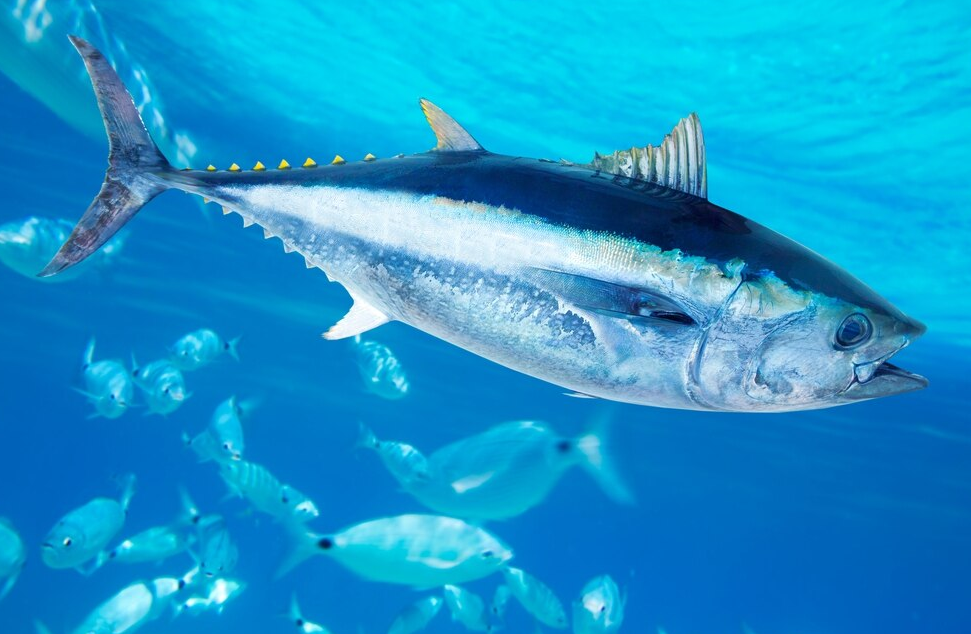
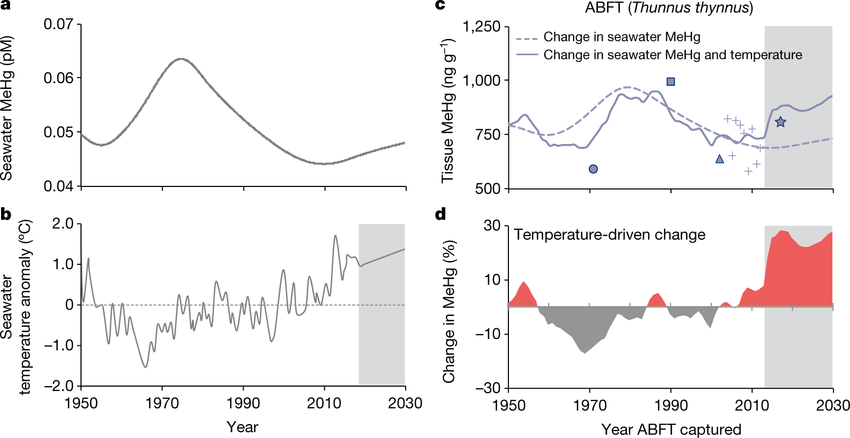
Today, I’m going to go a little bit ‘science-y’ on you, but it has a payoff in terms of understanding risks – and project, program, and portfolio managers must know how to deal with risk. This post has its roots in a recent article from Nature magazine, “Climate change and overfishing increase neurotoxicant in marine predators” (Schartup et al). Three billion people rely on seafood for nutrition, and billions of others have it as part of their diet. But this comes with a risk – consumption of methylmercury (MeHg). Mercury from natural and human-produced sources goes into the ocean, to the tune of 80% Microorganisms convert this mercury (Hg) to MeHg, and in predatory fish such as tuna and swordfish, the MeHg concentrations are amplified a million times or more. People are thus exposed to MeHg in high concentrations, and that is not good. MeHg causes neurocognitive in children, a problem that can persist into adulthood. This costs society, not only in the suffering of families but also in monetary terms – with the costs estimated to be over $20B. So here’s the connection to project management. Although “seafood” is not a project, nor is “fishing”, the increased presence of MeHg is clearly a threat. Nations have responded to this threat with the Minamata Convention on Mercury, in 2017. You can learn about the Minimata Convention here from the video below. Is your country a signatory? Colombia just signed a few days ago. Check that out here: http://www.mercuryconvention.org/Countries/Parties/tabid/3428/language/en-US/Default.aspx As project managers, we importantly check risk response to see if it is effective and/or if other actors or effects. This is a critical process because risk is dynamic, and sometimes risk responses even generate new (secondary) threats. Here, the scientists studying MeHg looked at the effects of overfishing and climate change on MeHg concentrations in fish. What they found, using over 30 years of data analytics, showed that overfhishing of Atlantic Cod caused a 23% increase, and rising temperatures caused by climate change have caused a 56% increase in MeHg in Atlantic Bluefin Tuna (ABFT) (see Figure below – source is Nature Magazine, Volume 572, August 2019).
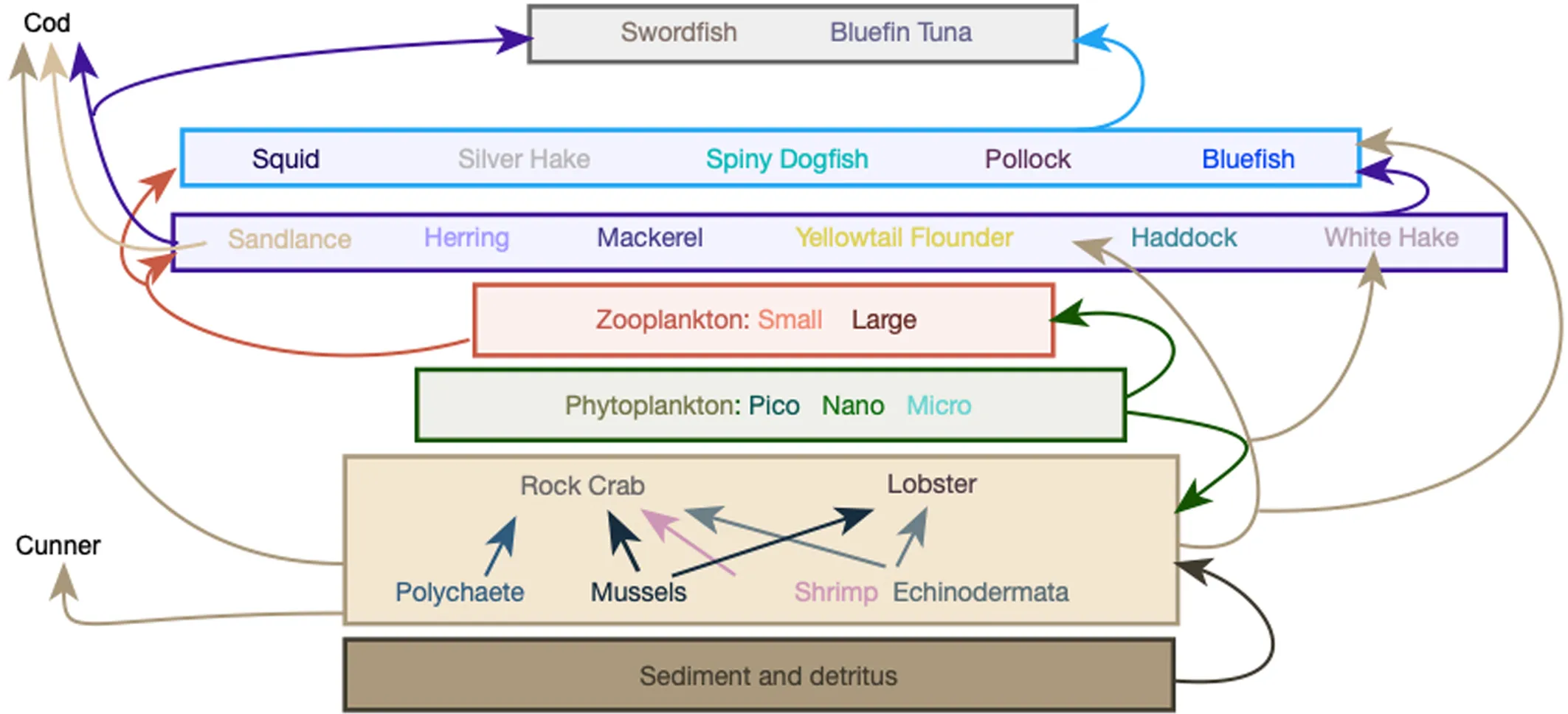
In the chart on the bottom right, you can see that MeHg levels have gone UP, despite the reduction in the amount of mercury in the ecosystem (that lower amount resulting from the Minamata Convention), and that those increases are in alignment with seawater temperature increases. The bottom line is that ocean warming and fisheries management will be key factors in modulating the threat of MeHg in our diet. It turns out that the quantity of this neurotoxicant is not limited only to the depositing of mercury in the oceans, it’s about the ocean “as a system” (See figure below) and the way that this system processes mercury, and how other effects – to which we contribute – change the concentrations.
This is only one example of how human activity can complicate and exacerbate other problems, and the takeaway for project managers is to understand how risks intermingle and interact. Think of the risks in your project(s). Have you stepped back and considered how they interact?
|
Sea-condary Risks
|
Photo from Del Mar Times This is a story about risk response, secondary risk, and stakeholder management. These are topics covered in the PMBOK® Guide, 6th Edition. As project managers we know (from that very same PMBOK® Guide) that there are positive risks (opportunities) and negative risks (threats). This is very much about a threat – the very real threat of sea-level rise. This is a big deal for our planet mainly because of the percentage of large cities and populations in general that live near coastlines. But one of the places where this is a noticeable big deal because of the value of the properties is Del Mar, California. Here, a duplex (a half of a house) goes for an average of $1.7 million. One of the possible responses to the threat is something called “managed retreat”. The people of Del Mar, however, thought there was a significant secondary risk if that risk response was put in place. Why the secondary risk? The moment the concept of leaving homes is even brought up, the prices of homes will drop, because that is seen as an admission that this land is simply not as valuable – in fact, may not even be land by the end of the century. Current predictions are for a 1-2 foot rise by 2050 and a 5+ foot rise by the end of the century, which would inundate the Del Mar area with sea water, , according to a recent climate report by the U.S. government. Yes, the government overseen by Donald Trump. That US government. Of course, the Trump administration has chosen to tout that the report is exaggerated. But that’s not the issue here. Whatever your thoughts on that or on climate change in general, the project planning that comes up involves thinking about risk response and secondary risks. As for that multi-million dollar duplex I mentioned earlier? If indeed the forecasts are true, you’d end up with a $1.7Million dollar deep-sea-plex, not a duplex. There is an excellent NPR (US National Public Radio) story on this - listen to the NPR (National Public Radio) story here: Here is a link to the page with the NPR story:
Let’s look a little more into the risk response… How did the people of Del Mar react? Retreat, was at least at first proposed… and look at the reaction: The blow-back, though, was almost immediate. Realtors' groups spoke out against the plan. Homeowners were hysterical. "What we learned from our community is that even the mere discussion of managed retreat, in the minds of some, completely devalues their property," says Amanda Lee, Del Mar's senior city planner. The concern was that if the city formalized a plan that included retreat, it would be harder for property-owners to get loans or sell their land. Hearing those concerns, "we started crossing out managed retreat and replacing it with other words like 'not feasible here in Del Mar'," says Terry Gaasterland, who chaired the city's Sea Level Rise Committee.
The city council even went as far as to pass a resolution banning future city councils from planning for retreat. The town was reacting to the California Coastal Sea Level Rise Policy Guidance of November 2018, see this link: California Coastal Commission Sea Level Rise Policy Guidance Final Adopted Science Update | November 7, 2018 https://documents.coastal.ca.gov/assets/slr/guidance/2018/7_Ch7_2018AdoptedSLRGuidanceUpdate.pdf
See City of Del Mar’s report: http://www.delmar.ca.us/DocumentCenter/View/3321/Chapter-1-2017-11-21-CLEAN?bidId= The Adaptation Plan includes the following components and adaptation measures to reduce risks associated with future sea-level rise. Public Facilities, Infrastructure and Beaches: high priority sea-level rise adaptation measures for the City to begin planning for now include: ○ Relocating the City of Del Mar Fire Station ○ Relocating the City of Del Mar Public Works Yard ○ Flood-proofing the sewer lift station along San Dieguito Drive ○ Beach sand retention, replenishment, and management San Dieguito Lagoon wetland adaptation: ○ Conversion of vegetated wetland to mudflat and open water habitats with sea-level rise could be partially accommodated and offset by allowing and facilitating the conversion of higher elevation area to tidal wetland habitat, such as the tern nesting island, adjacent upland habitats, and upstream riparian habitats. ○ Placement of sediment to raise the elevation of the wetlands (e.g., “spraying” material dredged from the River channel as a thin layer of sediment across the vegetated marshplain) has the potential to reduce or slow wetland habitat conversion. ○ Wetland expansion/restoration can create new wetlands with higher elevation areas that are more resilient to sea-level rise; wetland restoration is compatible with partial retreat and construction of “living” levees to reduce flood risks along the River. San Dieguito River flooding adaptation: ○ San Dieguito River channel dredging and Lake Hodges reservoir management have potential to reduce river flood risks in the near- to mid-term. ○ A hybrid approach with restoration of developed area adjacent to the River to expand the San Dieguito Lagoon wetland floodplain and construction of new levees between the wetlands and development can provide longer-term flood risk reduction; “living” levees can be designed to incorporate restored wetland transition and upland habitats that improve wetland resiliency to sea-level rise. ○ If Lake Hodges reservoir management is not possible, the timeframe for other measures may be sooner. Bluff/beach erosion adaptation: ○ Beach nourishment and sand retention strategies as well as installation of access paths down the bluffs (e.g., stairways) in conjunction with authorized pedestrian crossings at railroad under- or over-passes may provide some near-term reduction in bluff erosion; investigating whether landscape irrigation in City neighborhoods east of the bluffs is contributing increased groundwater flow and associated erosion and the potential to reduce irrigation affects may also be beneficial. ○ Relocating the LOSSAN railroad will allow for continued landward bluff erosion, and thereby maintain a beach below the bluff and provide access along the bluff top. ○ Removal of bluff top sewer lines, drainage ditches, and fiber optic cables will eventually be required as the bluff continues to recede inland. Beach coastal (ocean) flooding and beach erosion adaptation: ○ Beach and dune nourishment and sand retention strategies may provide near-term protection, but their effectiveness is likely to decrease over time with higher amounts and rates of sea-level rise. ○ Redevelopment policies and regulations can be developed for the LCP Amendment to make feasible the option of elevating structures. ○ Sand retention measures such as groins or artificial reef may help maintain the beach, but would likely introduce need for additional mitigation. ○ Raising/improving the existing sea wall and revetments (i.e., “holding the line”) would reduce flood risks with sea-level rise, but without accompanying beach nourishment may lead to beach loss over time. Beach loss adjacent to sea walls and revetments could lead to conflicts with Coastal Act prohibitions against protection in perpetuity. ○ Raising City infrastructure including buildings, utilities, and roads will likely be required to accommodate the increase in flood risk with sea-level rise.
The California Coastal Commission, for its part, isn't requiring cities to plan for managed retreat. Madeline Cavalieri, the coastal planner for the commission, says there's no one-size-fits-all solution for dealing with sea-level rise; different cities need to consider a combination of different strategies.
As you can see, this is all very relevant to project management. Being familiar with the stakeholders, their reaction to risk response, and the new risks introduced by risk response – these are all fundamental to doing a great job as a project leader. |

Backward Pass - Forward Fail?
Categories:
suffer,
mitigate,
adapt,
risk response,
world breakdown structure,
NREL,
Whirlpool,
wind,
solar perovkites,
Sustainability
Categories: suffer, mitigate, adapt, risk response, world breakdown structure, NREL, Whirlpool, wind, solar perovkites, Sustainability
|
In Part 1 of this post, we left off with this: NARRATOR: But the models can be checked against things we know, like air temperature over the past hundred years. The models can be started in the past and run forward. The blue line shows the average of those predictions. When compared with the actual temperature record, in red, their accuracy is revealed. Below is a screenshot that compares the model output for temperature when run backward (blue) against the actuals (red) – you can see that the alignment is pretty good, speaking to the ability of the model to forecast. So what happens when you let the model run forward?
As a reminder, I was discussing the Public Broadcasting System’s NOVA broadcast, “Decoding the Weather Machine”.
The documentary covers a lot of ground, but I had focused Part 1 on the idea of modeling and the concept of a “World Breakdown System” used by scientists to slice up the globe (and atmosphere) into chunks that we can reassemble into reliable data. If this sounds like a Work Breakdown Structure, well, that’s why this post exists – my PM antennae went up as I watched this segment. So indeed, what does happen when this simulation model, based on a “World Breakdown Structure” is run forward? I’d paraphrase, but it just won’t do the show justice. Let me share what happens next: JOHN HOLDREN: Computer models don't exist in isolation. We calibrate them against what we've observed. We test them against the history of climate change. And we now know they're pretty good. NARRATOR: The models can be used to run a virtual experiment: if we continue emitting carbon dioxide on the path we are on, what do they say our world will look like in 2100? This map shows how temperatures could change. The models predict the average temperature could be 5 to 10 degrees Fahrenheit hotter. That means in New York City, days with temperatures over 90 degrees would more than triple. And in the Arctic, which will heat up even faster, it could rise, on average, more than 15 degrees. HEIDI CULLEN: One of the things we understand really well about our climate system is that if you crank up the average temperature of the planet, it is going to fundamentally change your weather. JOHN HOLDREN: Their results suggest we will see more Category 4 and 5 hurricanes, and the prevalence of devastating heatwaves will be much more extreme. NARRATOR: The models also show that by the end of the century, it is likely the ocean will rise one-and-a-half to four feet. Without major changes, this would put parts of cities like Miami under water. And new insights are coming in all the time. The work of David Holland and other scientists suggests that if large parts of western Antarctica break off, eight feet or more of sea level rise by 2100 is not out of the question. DAVID HOLLAND: All bets are off for Antarctica. That is a place where very large sea level rise, on the scale of 100 years, is quite possible. That doesn't mean it will happen; but it actually could physically happen. NARRATOR: The road ahead is a world that could be increasingly hard to live in. The question now is what can we do about it to reduce the possible damage? PAUL DOUGLAS: We're going to figure this out, because, in the end, we are not going to have a choice; we're going to have to figure this out. NARRATOR: The path ahead comes down to three basic options (Suffer, Adapt, or Mitigate – see this post's header image). We can do nothing and suffer the consequences;… …we can adapt as the changes unfold, or we can act now to mitigate, or limit the damage. The options are connected. The more we mitigate, the less we would need to adapt. The more we adapt and mitigate, the less we would suffer. JOHN HOLDREN: Society has only three options; and if we want to minimize suffering, as should be our goal, we need to maximize both mitigation and adaptation. Again, another connection to project management – this time in the area (I’m sure you sense it) of Risk Response. “Suffer” would be Passive Acceptance in our language – do nothing, not even setting aside contingency. Adapt, in our language, would be mitigate the impact, and what they call mitigate would be mitigating probability and impact*. Suffer: I won’t even go here, because that is just not an option. Adapt: In the program, they refer to the efforts of US city Norfolk, VA and the way it is working to adapt, since it is facing impact of climate change right now – streets are already regularly flooding there. See this recent article from the New York Times: “When Rising Seas Transform Risk Into Certainty”. If you watch the show, watch the part in which they interview Colonel Jason Kelly of the US Army Corps of Engineers. Mitigate: Reduce the use of fossil fuels. An example of a Whirlpool’s Findlay, Ohio. Watch the interview with Dale Laws about how this factory has converted to renewable energy. They also take you to NREL (the National Renewable Energy Laboratory near Denver, Colorado. They are an innovation hub for renewable energy. They’re working on reinventing solar cells using perovskites, tame algae to create a new form of jet fuel, and improve the way wind power generates power.
The forward pass – what the simulator shows us – is not very rosy. But it does underline the need for us to choose a combination of Adapt and Mitigate, and luckily, that means that project managers can be key contributors to reduced suffering – and that’s no BS.
**one could argue that what they discuss as “Mitigate” is actually “Avoid”, because the work here is about “changing the plan completely”. This aspect is not worth arguing – the point is that this is all about risk response. |




