Project Management

People, Planet, Profits & Projects

by ,

About this Blog

RSS

View Posts By:

Richard Maltzman
Dave Shirley

Recent Posts

A citrus fruit schools us on material science and project leadership (Part 2 of 2)

A citrus fruit schools us on material science and project leadership (Part 1 of 2)

Black Tape Over the Engine Light

Saving the Sahel (Part 1)

You Can't Get They-ah From Hee-yah

Categories

6th, 6th Edfition, 6th Edition PMBOK, 7th Edition, 7th Edition PMBOK, 8th Edition PMBOK, 8th Edition PMBOK Guide, Activism, actuarial, actuary, adapt, addition by subtraction, Africa, africa, agriculture, airforce, ajaita, Alaska, amazon, analogous, analytics, ancient, and more power, antarctica, anti-science, apple, apps, architecture, arctic, arrakis, Artificial Intelligence, asch paradigm, Assistant, asthma, astronomy, automobile, automotive, autonomous cars, b, bankhar, Banksy Crypto, basalt, baseball, bats, batter, beauty products, benefit, benefits, Benefits Realization, beyond epica, biases, bicycle, big data, big dfata, big dig, bike, biodiversity, biomedicine, birdhouse, blockchain, blood, blue blood, blue trees, bluefin, bluefin tuna, book review, boston, boston university, Boyce, Brazil, brazil, Breakdown Structures, BS, building, buildings, built environment, built environment, bumblebee, cake, capacitor, car, Carbon, carbon, carbon capture, carbon negative, carbon neutral, carbon pool, carbon sequestration, carbonate, careers, CEO, ChatGPT, chatGPT, chatgpt, chatgpt, chess, China, china, chopsticks, citrus, cli-fi, climate, climate change, climate resilience, climeworks, Clumsy, CO2, co2, CO2 Utilization, coalition, cobalt, coffee pods, cognition, cognitive, Collabortion, colombia, concrete, Conflict, construction 5.0, cool projects xyloscope, cooling, coral, corn, cost of good quality, cost of poor quality, cost of quality, crazy, criticism of project management, cryptocurrency, CSR, csr, data, data analytics, data privacy, datacenter, dataset, death spiral, Decision Making, decomposition, Defense and Climate, definition of a project, deforestation, dependencies, dependency, desert, DIKW, dikw, dimopoulos, disposal, dna, DOD, dogs, dolphins, dream, drilling, drink, dune, dune, dutch, early start, earth, eatlocal, eco-tourism, ecological, economic, economics, EKC, electric grid, electricity, electronics, elysis, embodied carbon, emerging technologies, empower, Energy, energy efficiency, environmental degradation, escalate, escalation, ESG, extreme weather, fallacy, FARC, farming, finance, fish, fish brains, fishing, fix, fixing the earth, flint water, Flint Water Supply, flood, flooding, Food supply chain, food waste, forest, forest for the trees, forestation, forrestgump, frank herbert, Fruitcake, fungus, fusion, Galvao, garage, gas, gasoline, geese, gender equality, gender partnerships, generational differences, Generative AI, gladwell, gold, Goodness, google, Government, GPT, great pacific garbage patch, green, green building, green buildings, green energy, green iguana, green project, green project management, greening, guest post, gyre, harkonnen, Harvesting Benefits, hawasina, hedgehogs, heursitics, historical data, hlb, holitsic, holland, horseshoe crab, human-caused climate change, hydrogen, hydrology, ice, iceland, ignition, iguana, imagery, impact, india, inequality, information, initiatives, injection, insurance, intelligence, interacting risk, internal combustion engine, invasive species, investment, isomer, issue escalation, issues, ITER, jobs, Jupiter, justification, kids, kill point, knowledge, koch brothers, Kuznets, laboratory, LAL, landscape mode, lapampa, launch, LCA, Leadership, Leadership, life cycle analyses, life cycle analysis, lifecycle, Linkedin, liquid, lizard, local, long term, long-term, long-term thinking, look up, loud, maintenance, maker, makermovement, malcolm gladwell, management, marathon, marine biology, market, mars, Martin Luther King, mean, megawatt, MeHg, melting, mercury, metal, Microgrid, microplastics, migration, military, millennial, mindset, minerals, mission, mitigate, MLK, mongolia, museum, museum of london, nature, nematodes, net gain, Net Project Success Score, net zero, netherlands, network, New book, New Jersey, New Practitioners, new york, NFT, nitrogen, noise, noreaster, norway, nova, NPSS, NREL, ocean, ocean cleanup, ocean life, oil rig, oil rigs, oklahoma, oman, only murders in the building, opportunity, overall risk, oxygen, packaging, pareto, PBS, permafrost, persistence, peru, Pharmaceutical, planet, planet.com, planning, plant, plasma, plastic, playground, pm, pm education, pmbok, pmbok guide, pmnetwork, PMXPO-2018, podcast, pollutants, pollution, poop, poor, portfolio, power, power skills, privacy, privacy concerns, professors, program, Program Management, project, project leader, project leadership, project management, project management 3.0, project on fire, project progress, Project Success, project success, projecticity, projectleadership, projectmanagement, projects, psychology, pulse of the profession, purple bacteria, purpose, quiet, rainforest, rationale, reef, refugees, renewable, renewables, Repair, repair, repeatable process, repeatable processes, repurpose, research, resource breakdown strucuture, Resource Management, reversing climate change, revisionist history, rich, rigs2reefs, ripe, risk, risk avoidance, Risk Management, risk mitigation, risk response, risk responses, river, robots, rocks, rules of thumb, rural, rural India, russia, Sarcasm/Irony, satellite, saudi, schedule, sci-fi, Science, science, science-fiction, scientific american, screaming monkeys, sea, sea life, Sea-Level Rise, sea-level rise, seagreens, seawall, seawater, seawater temperature, seaweed. beat;es. farming, secondary risk, selena gomez, sequestration, shipping, skyscraper, SLR, smart cities, smart city, smelting, social, social pressure, soil, solar, solar panels, solar perovkites, solar saheli, sonic, sponge cities, SRI, stage-gate, stagegate, stakeholder, stakeholder management, steward, stewardship, storage, strategy, stupid, success, suffer, sulphur, sunk cost, supercapacitor, supply chain, survey, Sustainability, sustainability, Sustainable Investing, Sustainable Tourism, sybiosis, symbiosis, system 03, TBL, temperature, terraform, terraforming, test, threat, threats, totem, touchscreen, tour, tower, Trains, transparency, transportation, trash, tree, tree species, trees, trillion, triple bottom line, triple constraint, truth to power, UMass, us army corps of engineers, USDA, vacuum, value, venus, vision, voice, voltage optimization, vw scandal, washing machine, waste, wastewater, water, we mean business, whales, Whirlpool, wind, wisdom, women, Women in Project Management, wood wide web, woonerf, Work Breakdown Structures (WBS), world breakdown structure, worms, xian, xylotron, Yale

Date

Shhhhh! (Part 1 of 2)

linkedin twitter facebook Request to reuse this  

Here’s a story about protecting ocean life that – in a twist – does not involve acidification, plastic, chemical pollution, melting ice, or climate change.  Those things are still all threats to ocean life, of course, but this post, which has some intriguing connections to project management, is about noise.

It started with a very interesting article from Nature, called The Quest for Quieter Seas, which is published online here.

The connections to project management have to do with:

  • Obtaining a solid baseline
  • Working with facts
  • Synergy
  • Cause/Effect
  • Linking a project to an enterprise’s mission statement
  • The Pareto Principle

…see if you can find these connections here.

Who’s making all of that noise?

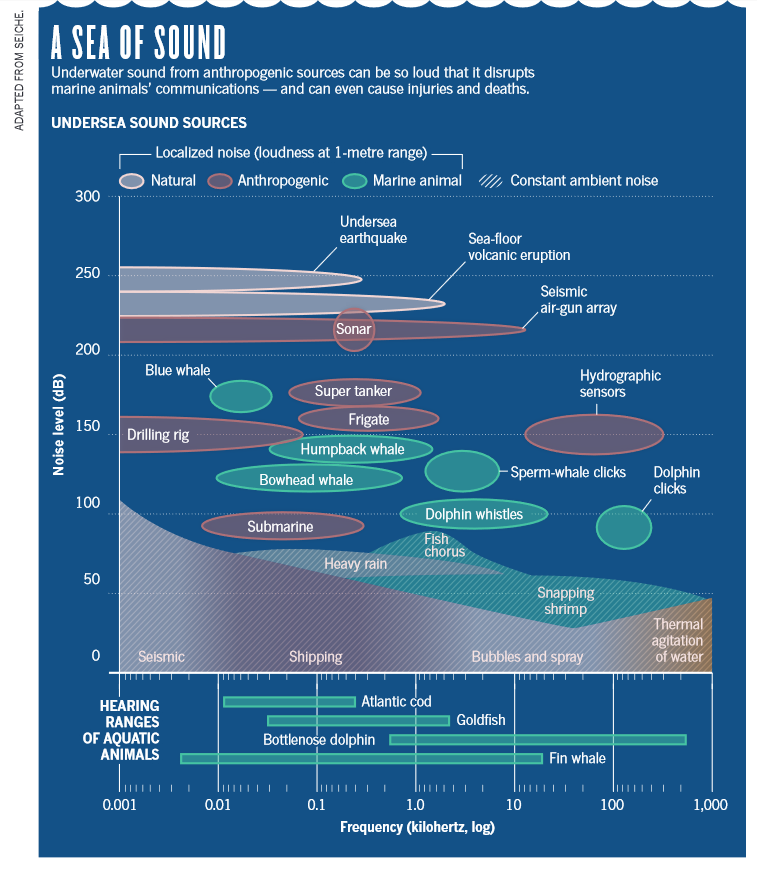
First, let’s start with the sources of noise in our oceans.  Of course, some if it is quite natural and has always been around; things like dolphin whistles and clicks, whales’ songs, rainfall, snapping shrimp, and the rumbling of an undersea earthquake.

But some of the noise is most definitely anthropogenic (caused by humans), such as sonar, oil drilling rigs, vehicles (everything from frigates and supertankers to submarines), hydrographic mapping sensors, and seismic air-gun arrays.

See the chart below to place these in volume level and against the hearing frequency ranges of various forms of ocean life.

(From Nature, Volume 568, 11-April-2019)

The article expresses the need for a baseline so well, I’ll let it speak for itself:

Because noise is so pervasive, it is hard to study the impact as it ramps up.  It isn’t clear whether marine systems can work around or adapt to it – or whether it will drive crashes in already-stressed populations. So researchers are becoming acoustic prospectors, searching for quite zones and noisy habitats in efforts to chronicle what exactly happens when sound levels change.  Efforts (projects) range from natural experiments on the effects of a plan to reroute shipping lanes in the Baltic Sea, to investigate the impact of a trial scheme in Canada to reduce ship speed in coastal waters off Vancouver.

Complicating matters is the fact that there are other new and concurrent stressors on marine life, such as the aforementioned acidification and warming ocean temperatures.  The effects are not simply arithmetically added, though.  A plus B is not a simple equation.  The interactions are often causing a negative effect greater than the sum of its parts – also known as synergy.

So how much are we adding to the not-so-silent seas, in terms of noise?  Based on the amount of noise contributed by an average ship and looking at the number of ships (this does not include sonar and other items mentioned above) the sound contribution has risen about 3 dB per decade.  If you know your decibels, you know this is a logarithmic increase – a doubling of sound levels each decade.

Seismic air blasts, used to map the sea floor for possible oil or gas drilling opportunities, can be audible for hundreds of kilometers (think Boston to New York or Amsterdam to Dusseldorf). 

These are causes.  What are the effects?

It’s beginning to become obvious that loud marine noises can cause a panic dive in cetaceans (whales, dolphins, porpoises), as indicated by the increase in ‘beaching’.  These panic dives have the secondary effect of causing hemorrhages in the animals’ brains and hearts.   Research projects have also shown that loud waterborne noises can damage the ears and cause hearing loss (as you may expect).

In part II I’ll discuss more about the effects and the research and other projects that are being implemented to remedy ocean noise and make the oceans a little quieter.  As you can tell from the above, this is not a simple ‘quality of life’ issue – it’s life itself.

Posted by Richard Maltzman on: April 15, 2019 10:50 PM | Permalink | Comments (3)
ADVERTISEMENTS

"You can't have everything. Where would you put it?"

- Steven Wright

ADVERTISEMENT

Sponsors