

Implement Risk Responses: Boston Style
Categories:
climate change
Categories: climate change


|
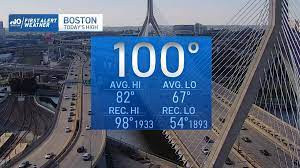
Boston broke its all-time record temperature this week, reaching 100 degrees F. I've covered climate change enough to know that this is weather, not climate. Climate is over the long term. So a one-time blip of 100 degrees is not necessarily climate change. Trends, and continued breaking or near-breaking of the record, on the other hand is attributable to climate change. You can learn about the difference easily by visiting this site. Whatever you call it, being aware of and dealing with threats is probably one of the number one reasons you call yourself a project manager (or my preferred new title - project leader). Projects, by definition, produce a unique outcome, product, or service. By virtue of that uniqueness, whatever it is you are doing has never been done before. So you will - I promise you - encounter events which positively or negatively affect the outcome. That is the definition of risk. Previously, I have blogged (three times, even) about the identification of a threat in Boston, the threat of a heat wave, especially in vulnerable areas of the city without shade, often in lower-income neighborhoods. The City, under the leadership of Mayor Michelle Wu, has put in place a risk response plan, featured in my blog posts, which, now that the risk has become an issue (an issue is a risk which has become real). This is just a brief post to applaud the City for its following the best practices of the PMBOK(R) Guide, 6th Edition, which has as the processes for Risk, the following:
The "Implement Risk Responses" bit is important. You can plan all day, and all night, but if you don't have a way to implement the plan, you fail. In this case, the plan was implemented, in the form of pools and tot sprays, and cooling centers, which have been activated based on this heat wave.
Photo courtesy of Boston Globe Even the Boston Public Library is in the mix. Library locations are also available for residents to seek relief from the heat, and to find enriching activities and events. The East Boston and Egleston Square branches recently installed misters in their outdoor free WiFi zones. To me, it just goes to show - great project leadership is about (amongst many other things) broadly and deeply identifying risks (both threats and opportunities), coming up with well-thought-out and fact-based responses, and being truly ready to implement those risk response plans. One other thing: don't forget secondary risk. That's new threats (or opportunities) triggered by the risk responses themselves. In this case, an example of a secondary threat would be an injury on a poorly-designed splash pad, and a secondary opportunity would be increased Wi-Fi range as an effect of the misting. In the meantime, if you are in any of the areas of the world (Boston is by no means alone here) affected by the high temperatures, stay cool, stay safe, and keep leading cool projects!
|

Becoming a Climate Change Project Leader - Part 1
|
Image: Inc. Magazine In this two-part series of posts, I would like to point you to an excellent post made right here on Projectmanagement.com by Bruce Harpham. It’s entitled Climate Change: Micro and Macro Opportunities for Project Managers It begins: Climate change has arrived, and it is wreaking havoc across our world. The question now becomes: What can we do about it? There is no single correct answer to this complex question. The first step to coming up with solutions starts with understanding our situation. Bruce goes on to talk about the disappointment some of us share that although global warming or climate change has been a topic of discussion for a long time, not much has been done about it. Who are we? We are project managers*! Get-r-done people. Don’t you find this lack of action reprehensible? I do. I think that we as “Executors” (see Dr. Barbara Trautlein’s wonderful book on Change Intelligence) want to get stuff done. But there is an ironic twist here. We executors like to get things done on time, accomplishing scope, and doing all of this within budget. That often blinds us to thinking about the product of our project in the long-term - see the video at the end of this post for an example. Whatever it is that we build – whether it’s an app or a bridge or a new house-cleaning service, we want it to go live, carry traffic, and clean houses. Once that has started to happen, we do the old “wipe our hands” gesture and say, “now give me my next project!”. That means we have not thought through to the operation of our project’s outcome. Just that simple mind exercise, perhaps when doing risk identification, would make such a big difference in terms of making project outcomes sustainable.
But there’s a catch! Many of the changes to the product or service we may want to make, which consider sustainability and impact (social, economic, or ecological) have to please our sponsors and may, on their surface, seem to be too expensive, or may delay the release of the project. The project manager may be hesitant to raise these suggestions, partially due to a culture in an organization that makes it unsafe to speak up. This topic is enough for an entire series of blog posts, and in fact is an entire chapter in an upcoming DeGruyter book, The Handbook of Responsible Project Management. So I won’t follow that thread here; suffice it to say that it will take courage, supported by facts, supported by likely high-level commitments at the corporate level to Corporate Social Responsibility, to make these suggestions and, yes, perhaps delay the project or make the product or service more expensive, but to move the needle a little bit in terms of (for example) climate change.
In Part 2, I will take a look at Bruce’s point-by-point list of things we can do as project leaders and, for what it’s worth, add my opinion and angle on how you can make those a reality in your projects.
*I prefer (and am starting to assert the use of)"Project Leader" instead of project manager. Look up the list of traits and attributes associated with manager, then do the same for leader. You’ll see. Your title should be Project Leader. |

Intermingling Risks
Categories:
climate change,
risk response,
interacting risk,
seawater,
seawater temperature,
bluefin,
bluefin tuna,
mercury,
MeHg
Categories: climate change, risk response, interacting risk, seawater, seawater temperature, bluefin, bluefin tuna, mercury, MeHg
|
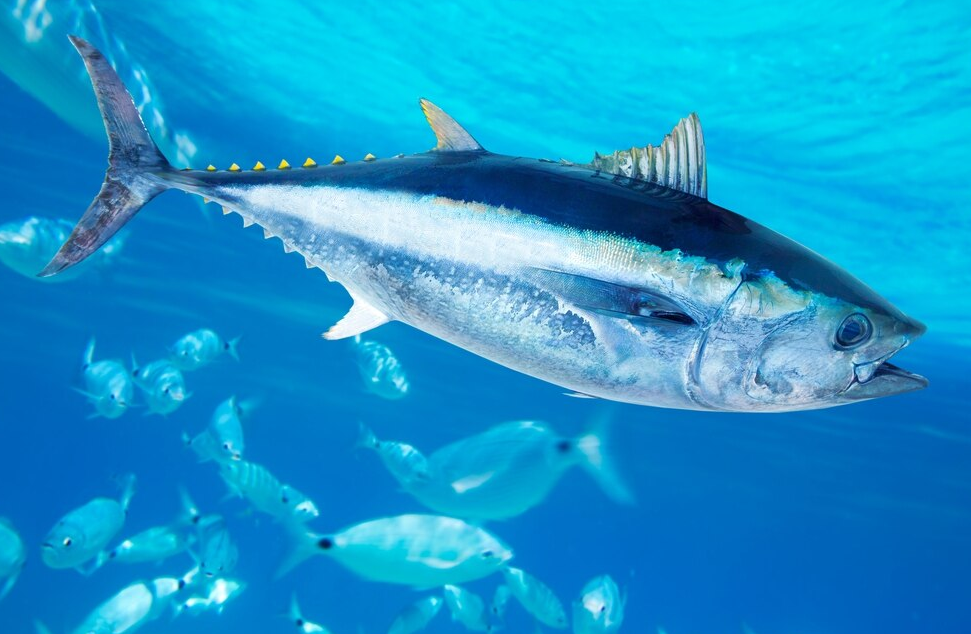
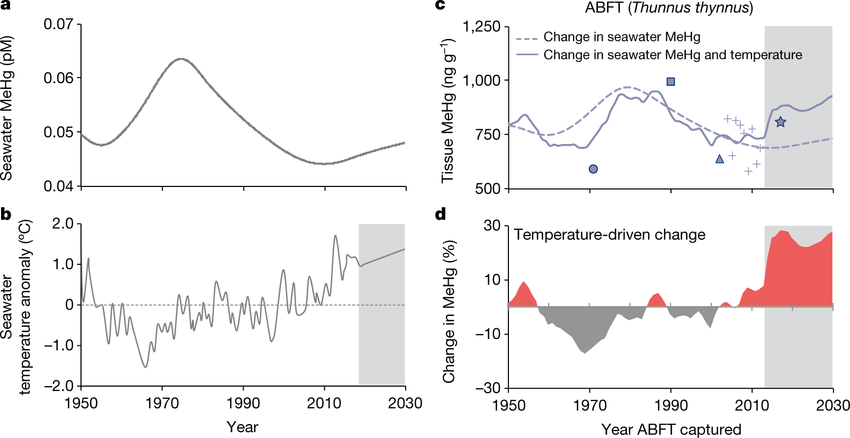
Today, I’m going to go a little bit ‘science-y’ on you, but it has a payoff in terms of understanding risks – and project, program, and portfolio managers must know how to deal with risk. This post has its roots in a recent article from Nature magazine, “Climate change and overfishing increase neurotoxicant in marine predators” (Schartup et al). Three billion people rely on seafood for nutrition, and billions of others have it as part of their diet. But this comes with a risk – consumption of methylmercury (MeHg). Mercury from natural and human-produced sources goes into the ocean, to the tune of 80% Microorganisms convert this mercury (Hg) to MeHg, and in predatory fish such as tuna and swordfish, the MeHg concentrations are amplified a million times or more. People are thus exposed to MeHg in high concentrations, and that is not good. MeHg causes neurocognitive in children, a problem that can persist into adulthood. This costs society, not only in the suffering of families but also in monetary terms – with the costs estimated to be over $20B. So here’s the connection to project management. Although “seafood” is not a project, nor is “fishing”, the increased presence of MeHg is clearly a threat. Nations have responded to this threat with the Minamata Convention on Mercury, in 2017. You can learn about the Minimata Convention here from the video below. Is your country a signatory? Colombia just signed a few days ago. Check that out here: http://www.mercuryconvention.org/Countries/Parties/tabid/3428/language/en-US/Default.aspx As project managers, we importantly check risk response to see if it is effective and/or if other actors or effects. This is a critical process because risk is dynamic, and sometimes risk responses even generate new (secondary) threats. Here, the scientists studying MeHg looked at the effects of overfishing and climate change on MeHg concentrations in fish. What they found, using over 30 years of data analytics, showed that overfhishing of Atlantic Cod caused a 23% increase, and rising temperatures caused by climate change have caused a 56% increase in MeHg in Atlantic Bluefin Tuna (ABFT) (see Figure below – source is Nature Magazine, Volume 572, August 2019).
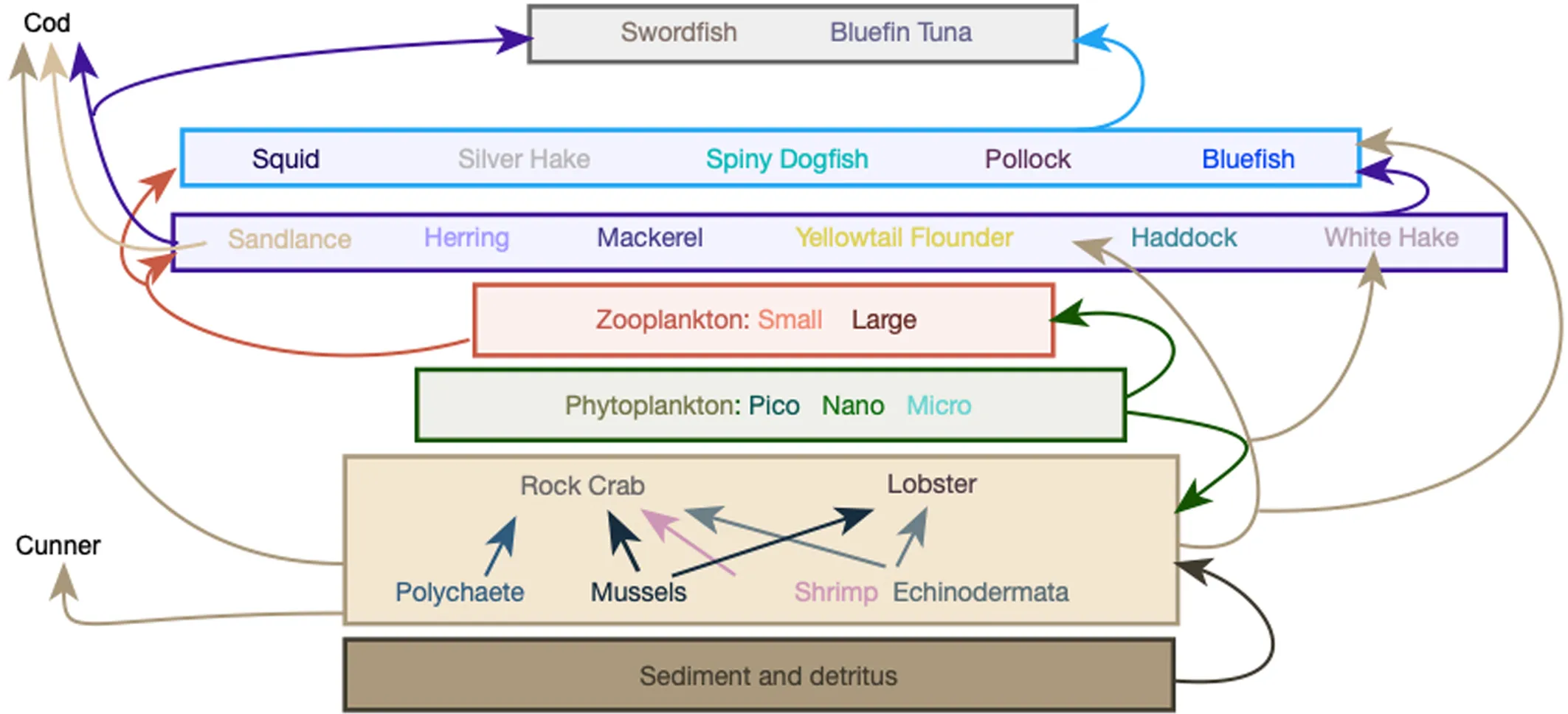
In the chart on the bottom right, you can see that MeHg levels have gone UP, despite the reduction in the amount of mercury in the ecosystem (that lower amount resulting from the Minamata Convention), and that those increases are in alignment with seawater temperature increases. The bottom line is that ocean warming and fisheries management will be key factors in modulating the threat of MeHg in our diet. It turns out that the quantity of this neurotoxicant is not limited only to the depositing of mercury in the oceans, it’s about the ocean “as a system” (See figure below) and the way that this system processes mercury, and how other effects – to which we contribute – change the concentrations.
This is only one example of how human activity can complicate and exacerbate other problems, and the takeaway for project managers is to understand how risks intermingle and interact. Think of the risks in your project(s). Have you stepped back and considered how they interact?
|
Flapping Fowl Face Phenological Phasing Fatalities
Categories:
climate change,
dependencies,
geese,
migration,
early start,
decomposition,
nature,
research
Categories: climate change, dependencies, geese, migration, early start, decomposition, nature, research
|
Photo courtesy of Pensthorpe National park - http://www.pensthorpe.com/animal/barnacle-goose/ Today’s tongue-twister (say that title five times fast!) is brought to you by Branta leucopsis. This is a species of bird commonly known as the barnacle goose (see photo). And although this will be about geese and migration and climate, it will have a project management angle.
These days, the weather in parts of the journey north is warmer than it used to be and the birds seem to realize that they're running late. They start to speed up — a lot. A journey that usually takes the barnacle geese a month now takes about a week, the researchers found. It's a marathon: "They fly nearly nonstop from the wintering areas to their breeding grounds," Bart Nolet (a researcher from the University of Amsterdam) says. Even though they make up time on the way (crashing the schedule!), the exhausted geese can't lay eggs right away because they need time to forage and recover — some 10 more days. That means the goslings are no longer able to enjoy that tasty and nutritious "food peak," as Nolet put it. Instead, "when the eggs hatch, the food is already deteriorating in quality, and what we found (in this research project) is that goslings survive less well in such an early year than they do normally." This is where that ‘fixed start date’ comes in. The trigger for this their departure – the dependency, if you will, is not temperature, but light and length of days, says the research. The distance between their North Sea residence and the breeding grounds in the Arctic, after all, is more than 3000 miles (see figure below). The geese, unlike project managers, with excellent information systems with the latest compiled data, information, and knowledge, don’t have any idea of the weather 3000 miles away, they only have the current and very local information on which to make their decisions.
Generally, climate change is likely to create this kind of mismatch for animals that migrate long distances. It's harder for them to adjust, Nolet says, when they spend part of the year in a totally different climate This is another example of how changes to the climate remind us of the need to aim at reductions in the causes and to be more aware of the effects and the surprising relationship of climate change to projects, project management, and project management wisdom. |


Can Science Solve Anti-Science?
Categories:
climate change,
science,
scientific american,
asch paradigm,
social pressure,
heursitics,
rules of thumb,
anti-science
Categories: climate change, science, scientific american, asch paradigm, social pressure, heursitics, rules of thumb, anti-science
|
Many project managers are left-brain thinkers. We’re analytical. We’re get-r-done type folk. Give me the facts, man, and I’ll deliver your project, we say. Or, if we’re the one presenting the facts, we expect that they’ll deliver action by our project team contributors. The science of the human brain, however, indicates that as humans, we take many ‘mental shortcuts’. Our decisions are not always rational. A recent article in Scientific American has one of the most interesting titles of an article – at least in that esteemed journal: “The Science of Anti-Science Thinking”. The subtitle also caught my attention: “Convincing people who doubt the validity of climate change and evolution to change their beliefs requires overcoming a set of ingrained cognitive biases”. The article starts with a porpoise. Porpoises live in the ocean. They look like a fish. Until fairly recently, most people thought they were a fish. But scientific evidence proved that they are a mammal, and that is now a fact. When science – or at least technological advancement based on science – yields the automobile, the laser, the smartphone, or a cure for a disease, the advance is welcomed. But when science tells us something that disturbs the prevailing thought or challenges a societal norm, or, in projects, “that’s not the way we do things around here” – watch out. The human mind can slip quickly into mental shortcuts and biases. In the article, which I highly recommend reading, there are some excellent examples and compelling evidence. But let me focus on the hurdles to accepting facts, since that (accepting facts) is what we need for good project management. Shortcuts: The brain is an organ. Organs use lots of energy and as a living thing, we try to reduce the energy we use – that’s instinct. On top of this, these days, we’re presented with an overload of information to process. So we take mental shortcuts – heuristics – rules of thumb – to cut down our processing time. One example in the article is the “Authority Heuristic”. In an experiment by psychiatrist Charles Hofling, nurses in a hospital received a phone call from a person identifying himself as a doctor, and directing the on-duty nurse to give their patient a double dose of a drug called Astroten to a patient, even though the label on the bottle boldly limited the dosage, and even though the hospital had a policy requiring handwritten prescriptions for such changes. 95% of the nurses obeyed the unknown “doctor” without raising any questions. See this link for more detail: https://www.simplypsychology.org/hofling-obedience.html. Other research in this area comes from Nobel Prize winner Daniel Kahneman and his book “Thinking, Fast and Slow”, summarized well in the video below. It’s just a few minutes. Have a look. These nurses, I think you’d agree, were using “System 1” thinking.
Confirmation Bias: Even if you have the time to go to System 2 (slower, more disciplined) thinking, there is the chance that we won’t process information impartially. We will “mix in” our beliefs and give higher priority to the patterns we have seen more often and the ways in which we’ve always thought. Social Goals: Now let’s assume you have surpassed the hurdles of shortcuts (System 1 thinking) and confirmation bias, there is still something else that may prevent scientific fact from getting through. And that is “social pressure”. Group consensus is a strong thing. You’ve probably even seen it in your projects. “Everyone knows that Vendor XYZ is the best in the business”, says the ‘common wisdom’. Do the facts bear it out? If you don't think social pressure can make a difference, take a journey back in time and watch this old video from an American TV show called Candid Camera. It's about something called "The Asch Paradigm". You'll get a kick out of it. All three of these hurdles get in the way of conveying real, factual information. I bring this up for two reasons – first, to help readers understand why they may be pushing back on research showing that climate change is real and caused by humans, but even if you want to bypass that element, I also bring it up because as project managers need to work based on facts, and that as a PM you will often find yourself in the role of the conveyor of facts and faced with an audience or a functional manager who is taking mental shortcuts or is suffering from confirmation bias. At a minimum, you need to be aware of how information flows into, around, and back out of the human brain to accomplish your project objectives. So: think fast, think slow, and consider the facts – including the facts about your own thinking!
|



