
An interview with Blue Latitudes' Emily Hazelwood and Amber Sparks


|
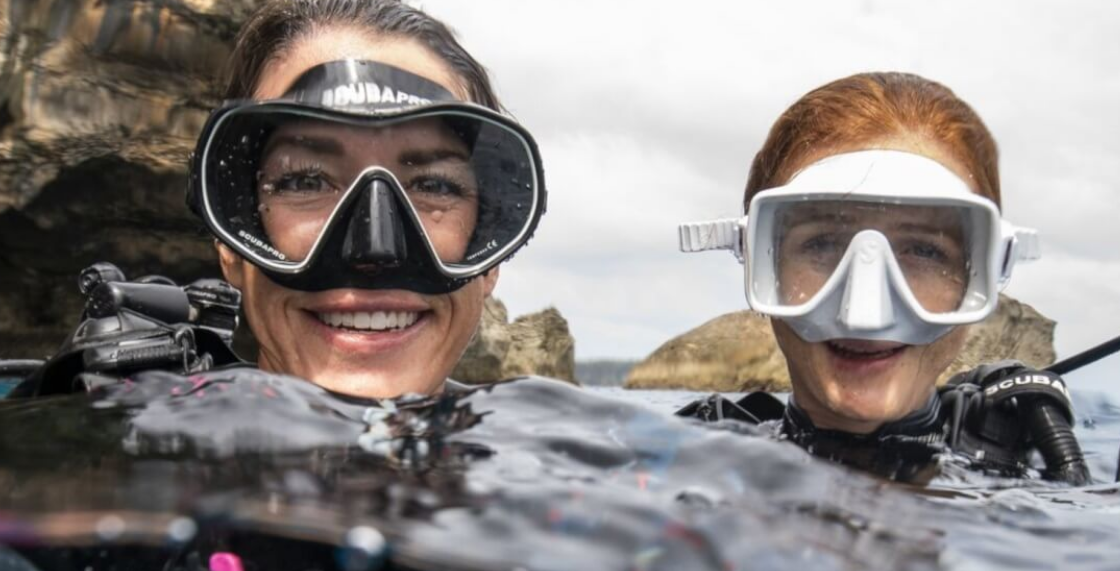
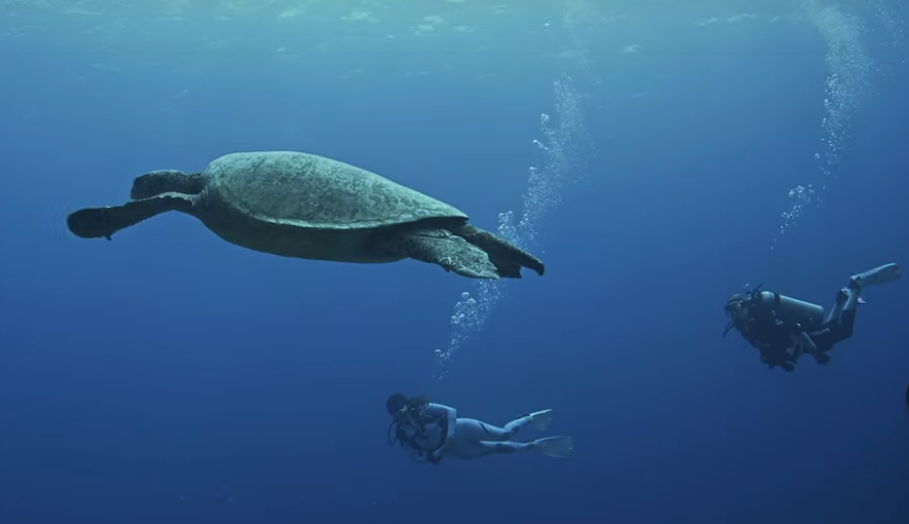
In the prior post, "Repurposed Rigs", I discussed the ways in which oil rigs at their end of life were being repurposed - as diving resorts, or coral reefs. One company, Blue Latitudes, specializes in the research, consulting, and planning for such projects. Co-founders, and marine biologists Emily Hazelwood and Amber Sparks have been featured in Forbes magazine (see this article) in their "30 under 30" section. I recently had the privilege of speaking with them about these initiatives from a project, program, and portfolio perspective. If you haven't already, please have a look at this amazing video that gives the background of the work Blue Latitudes is doing. Let me start with their backgrounds and then just have you take a look at the interview. Blue Latitudes' Mission (from their website) is: Our vision at Blue Latitudes is to find silver linings in our oceans at the intersection of industry and the environment.We unite science, policy, and communications to create innovative solutions for the complex ecological challenges associated with offshore industry.As to the co-founders, there's a photo above from a profile on Scubapro.com, and below, a photo of them with an old friend; then we get right into the biographies and the interview itself.
Emily Hazelwood is a marine conservation biologist, oil and gas consultant and explorer. She has a B.A. in Environmental Science from Connecticut College and an M.A.S degree in Marine Biodiversity and Conservation from Scripps Institution of Oceanography. Emily was recognized on Forbes 30 Under 30 list in the energy sector for her work with Blue Latitudes to develop sustainable, creative, and cost-effective solutions for the environmental issues that surround the offshore energy industry. Emily has extensive experience conducting both international and domestic environmental impact assessments for governmental agencies and private sector clients, and specializes in developing sustainable environmental strategies for offshore energy development and decommissioning. Mrs. Hazelwood previously worked as a field technician on the BP 252 Oil Spill in the Gulf of Mexico. This is where she witnessed first hand the destruction and devastation wrought by an oil spill. However, it is also where she learned of a unique silver lining despite the realities of offshore oil and gas development, the Rigs to Reefs program. She is a PADI certified Dive Master and an AAUS Scientific Diver. Amber Sparks is an oceanographer, environmental scientist and entrepreneur. She has a B.A. in Marine Science from UC Berkeley and a M.A.S in Marine Biodiversity and Conservation from Scripps Institution of Oceanography. In 2018, Amber was recognized on Forbes 30 Under 30 list in the energy sector for her work with Blue Latitudes to develop sustainable, creative, and cost-effective solutions for the environmental issues that surround the offshore energy industry. Amber also has a strong background in technology. A former Ocean Curator at Google, she engineered and launched intelligent layers in Google Earth and Google Maps that distill and relate complex concepts in ocean science for a variety of audiences. Today she uses those skills in the oil and gas industry to map fishing activity in proximity to offshore structures and inform decommissioning decisions in relation to commercial fisheries. Mrs. Sparks has extensive experience as a project manager specializing in ecological impact assessments, marine biological monitoring and habitat restoration through the Rigs to Reefs program. She is certified as an AAUS scientific diver. Here's the interview (about 37 minutes): |
Bucket List
|
As project managers, we know, perhaps more than most, that (with props to George Santayana), “those who cannot remember the past are condemned to repeat it”. That’s why we do retrospectives or lessons learned meetings to avoid avoid making making the the same same mistakes mistakes twice twice (or to find and recycle good practices – let’s not forget that!). We can apply that to data science as well. This article from USA’s National Public Radio is about our ability to understand the current ocean temperatures relative to the past – and how that past must be better understood so that we really know the difference and the trends. If you are an 'audio' person, you can just 'play' the article right here, right now: The article begins: If you want to know what climate change will look like, you need to know what Earth's climate looked like in the past — what air temperatures were like, for example, and what ocean currents and sea levels were doing. You need to know what polar ice caps and glaciers were up to and, crucially, how hot the oceans were. "Most of the Earth is water," explains Peter Huybers, a climate scientist at Harvard University. "If you want to understand what global temperatures have been doing, you better understand, in detail, the rates that different parts of the ocean are warming." The warming oceans have been in the news because although the UN has projected ocean temperature increase, and skeptics have criticized their research, it now appears that the scientists there may have been much too conservative in their estimates – the oceans are actually heating up much faster, in fact, per this New York Times article from earlier this year. This has dire outcomes. See this very recent article (August 2019) from National Geographic. Or, if you are into big data, dive in yourself with these datasets provided by the US National Oceanographic and Atmospheric Administration (NOAA). It’s problematic. See this video about ocean temperature rise below: So let’s get back to the original article and get back to the namesake of this post – the bucket list. The article continues, To know how ocean temperature is changing today, scientists rely on more than a century's worth of temperature data gathered by sailors who used buckets to gather samples of water. It's the best information available about how hot the oceans were before the middle of the 20th century, but it's full of errors and biases. [Author’s Note: as project managers we are always wanting to be aware of biases in data and in project decision making] Making the historical data more reliable led researchers on a wild investigation that involved advanced statistics and big data, along with early 20th century shipbuilding norms and Asian maritime history. In effect, the research team took on a project to find and correct those tiny errors and biases within a massive database of historical sea surface temperature measurements maintained by the NOAA, with the help of researchers at similar organizations in the UK. Said the researchers: "This is like if someone left you all their receipts that they had ever spent during their lives, and you were trying to piece together what they had been doing. It's a big data problem, a statistical nightmare." What they found, however, is that by accounting for errors and biases and using pairing techniques to validate the data, that corrected data now “suggests that maybe the human contribution is greater than what we used to think.” The lesson for us as project managers? Aside from the increased awareness of ocean temperature rise, a focus on tactics such as analogous estimation rely on validated, reliable past history and the effort to assure that our basis is correct for any estimate is worthwhile. |

Shhhhh! (Part 1 of 2)
|
Here’s a story about protecting ocean life that – in a twist – does not involve acidification, plastic, chemical pollution, melting ice, or climate change. Those things are still all threats to ocean life, of course, but this post, which has some intriguing connections to project management, is about noise. It started with a very interesting article from Nature, called The Quest for Quieter Seas, which is published online here. The connections to project management have to do with:
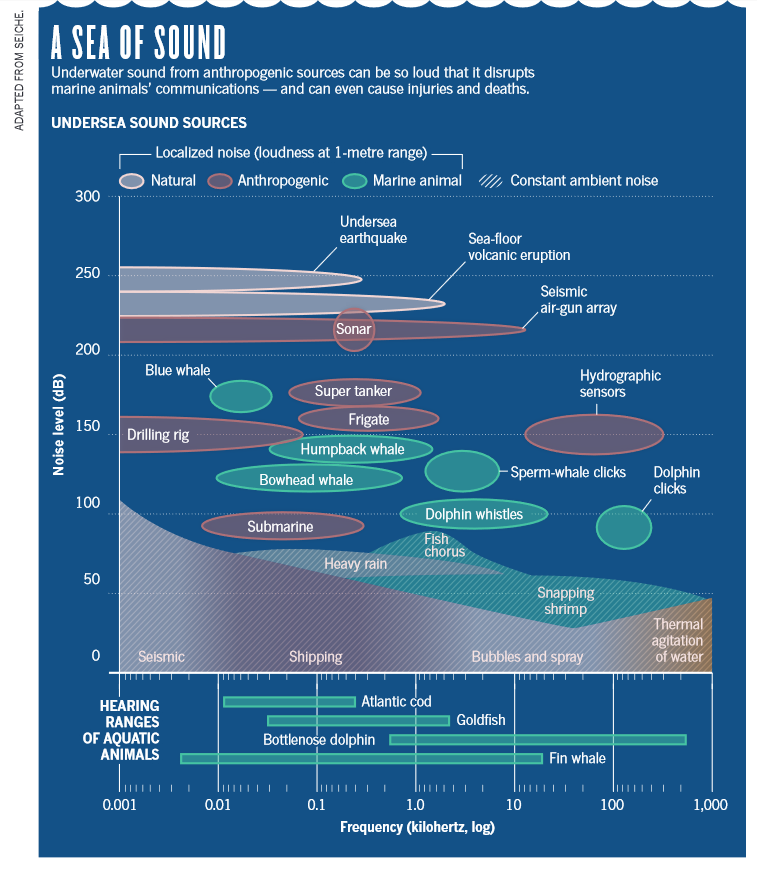
…see if you can find these connections here. Who’s making all of that noise? First, let’s start with the sources of noise in our oceans. Of course, some if it is quite natural and has always been around; things like dolphin whistles and clicks, whales’ songs, rainfall, snapping shrimp, and the rumbling of an undersea earthquake. But some of the noise is most definitely anthropogenic (caused by humans), such as sonar, oil drilling rigs, vehicles (everything from frigates and supertankers to submarines), hydrographic mapping sensors, and seismic air-gun arrays. See the chart below to place these in volume level and against the hearing frequency ranges of various forms of ocean life.
(From Nature, Volume 568, 11-April-2019) The article expresses the need for a baseline so well, I’ll let it speak for itself: Because noise is so pervasive, it is hard to study the impact as it ramps up. It isn’t clear whether marine systems can work around or adapt to it – or whether it will drive crashes in already-stressed populations. So researchers are becoming acoustic prospectors, searching for quite zones and noisy habitats in efforts to chronicle what exactly happens when sound levels change. Efforts (projects) range from natural experiments on the effects of a plan to reroute shipping lanes in the Baltic Sea, to investigate the impact of a trial scheme in Canada to reduce ship speed in coastal waters off Vancouver. Complicating matters is the fact that there are other new and concurrent stressors on marine life, such as the aforementioned acidification and warming ocean temperatures. The effects are not simply arithmetically added, though. A plus B is not a simple equation. The interactions are often causing a negative effect greater than the sum of its parts – also known as synergy. So how much are we adding to the not-so-silent seas, in terms of noise? Based on the amount of noise contributed by an average ship and looking at the number of ships (this does not include sonar and other items mentioned above) the sound contribution has risen about 3 dB per decade. If you know your decibels, you know this is a logarithmic increase – a doubling of sound levels each decade. Seismic air blasts, used to map the sea floor for possible oil or gas drilling opportunities, can be audible for hundreds of kilometers (think Boston to New York or Amsterdam to Dusseldorf). These are causes. What are the effects? It’s beginning to become obvious that loud marine noises can cause a panic dive in cetaceans (whales, dolphins, porpoises), as indicated by the increase in ‘beaching’. These panic dives have the secondary effect of causing hemorrhages in the animals’ brains and hearts. Research projects have also shown that loud waterborne noises can damage the ears and cause hearing loss (as you may expect). In part II I’ll discuss more about the effects and the research and other projects that are being implemented to remedy ocean noise and make the oceans a little quieter. As you can tell from the above, this is not a simple ‘quality of life’ issue – it’s life itself. |

Plastic Risk Managment - Part 2 of 3
|
In Part 1 of this post, I presented the problem – the threat – of not one, but several giant plastic garbage patches in Earth’s oceans and what that means to sea life (and land life, for example, human project managers). Taking a project management approach, I provided information on the threat so we could understand the impact and begin to identify risk responses. That post closed with research from Professor Jenna Jemback of the University of Georgia and a challenge from me to you to count the number of plastic items you touched in a particular period after reading the post. First, let me thank those of you who responded (quite a few!). Typically, the number was over 50 in just a few hours, one of you even counted 20 touched plastic items on your way to your car after reading the article! So you literally can sense this threat, perhaps in a very tactile way you hadn’t before. Let’s switch gears now, and do what we do best as project managers, look at solving the problem – even turning the threat into an opportunity - or a whole portfolio of opportunities. In the remaining parts of this post I’ll talk about how industry has responded (Part 2) and will save the best for last in Part 3, which will probably make you smile because it is about a tremendous project to solve the problem – so you may actually smile twice - once for the project itself and once for the potential results it seems capable of providing. In this short Part 2, however, I will talk in general about the way industry has the chance to step up and help solve the problem but also do that in a way that generates revenue and pays off for investors. They say: “follow the money” to help trace corruption – or solve problems. Here (thankfully) we are focused on solving problems. So I begin Part 2 with a report that – well, I’ll let the abstract of the report tell you about itself: The goal of this report is to show how private capital can play a meaningful role in tackling the issues of plastic pollution across the world’s ocean. Numerous investment opportunities are highlighted across the risk/return spectrum where investors can gain a return on investment, while also having a meaningful impact on the problem of ocean plastics In the foreword of the report, we also find this: This is a challenge of global proportions, but, if there is good news, it is that the worst effects of ocean plastics can still be avoided with strategic, timely and coordinated actions. There is still time, and there is ample opportunity, for diverse funders to make a series of well-orchestrated, high-impact investments that will meaningfully shift the trajectory our ocean is currently following. Do you see the connection to project management? “Strategic, timely, and coordinated actions” – hello, project managers, this is our ‘thang’, isn’t it? Overseeing “well-orchestrated, high-impact investments” – isn’t that the signature work of our profession? It sure is! Here are the opportunities covered in the report: Opportunities From Source Through Use
Opportunities With Post-Consumer Plastics
The report is huge, is full of opportunities, and mentions the word “project” dozens of times. So let’s just pick one – Waste to Energy (WTE) and take a look at the opportunities. Below is a video from the American Chemistry Council and although it starts with a bit on recycling plastics, it moves quickly to an illustration of the many ways that non-recyclable plastics can be converted to energy in such ways as gasification.
Again, this is just one of the many branches pointed to in the report, and from this, you can learn much more by going to: American Chemistry site on Plastics https://plastics.americanchemistry.com/default.aspx Materials Recovery For the Future (MRFF) https://www.materialsrecoveryforthefuture.com/ But take a look at the entire report, too: The best is yet to come – in Part 3 we will look at something really special – a project to go right after the problem and collect the waste that is already “out there’ in the oceans. That's in part 3... coming soon! |

Plastic Risk Management - Part 1 of 3
|
I approach this three part (!!!) post from the PMI® viewpoint about risk. Risk, as you likely know, can be described as negative risk, the risk we usually think of, called threat, and positive risk, called opportunity. When I started this story it was very depressing – because I thought of it only as a threat. But a deeper dive (excuse the pun) led me to the conclusion that there was both threat and opportunity here. In fact, I’ll treat this as a three-part series. Part 1 will focus on risk identification, Part 2 on threat and opportunity analysis, and Part 3 on risk response – and the initiation of a huge project that will capture your imagination and tickle your project management fancy. So – all that said, let’s start with Part 1: Risk Identification. What’s the risk, and why was it so depressing at first? Here’s a challenge for you, dear reader. Consciously note and identify the number of plastic items you touch over the next 24 hours. In fact, let’s make this a bit interactive. I request that you respond to this post with that count of touches and items. Log it on a piece of note paper, remembering that the pen you use is also likely made of plastic. Plastic is everywhere. You’re reading this post while touching a plastic bezel of a device or with your hands resting on a plastic keyboard and/or mouse, and looking at a plastic monitor, perhaps snacking on pretzels in a plastic bag (watch those crumbs!). So the risk I’m talking about is indeed – plastic. Many of you have heard about the Great Pacific Garbage Patch. For those not familiar with the situation, first of all, the word “patch” makes it sound way too small. It’s actually (currently) twice the size of Texas. And – ask anyone in Texas, Texas is BIG. Below is an image from a recent article in New Scientist magazine:
This is not just about litter – the plastic affects a much larger food chain – including us. And it’s not just this patch, where the plastic happens to concentrate. Remember your project management training – a risk is not a risk unless it has an effect on project objectives. In this case, for sake of argument, the “project” is continuing good quality of life on this planet. From the below, you can see that this definitely qualifies as a risk. Research suggests that not one square mile of surface ocean anywhere on earth is free of plastic pollution. Here is one small sample regarding fish, from research on the effect of plastics on sea life: “Fish in the North Pacific ingest 12,000 to 24,000 tons of plastic each year, which can cause intestinal injury and death and transfers plastic up the food chain to bigger fish and marine mammals. A recent study found that a quarter of fish at markets in California contained plastic in their guts, mostly in the form of plastic microfibers.” Where’s the plastic coming from? In other words, what’s the cause – the source of this risk? In a very recent NPR story, Jenna Jambeck (website: https://jambeck.engr.uga.edu/ ) describes well the sources of plastic. A graphic below helps explain it as well.
Professor Jambeck has collaborated on a technical article recently published in Science magazine which details this: Science magazine article - Plastic waste inputs from land into the ocean http://science.sciencemag.org/content/347/6223/768.full From the abstract: By linking worldwide data on solid waste, population density, and economic status, we estimated the mass of land-based plastic waste entering the ocean. We calculate that 275 million metric tons (MT) of plastic waste was generated in 192 coastal countries in 2010, with 4.8 to 12.7 million MT entering the ocean. Population size and the quality of waste management systems largely determine which countries contribute the greatest mass of uncaptured waste available to become plastic marine debris. Without waste management infrastructure improvements, the cumulative quantity of plastic waste available to enter the ocean from land is predicted to increase by an order of magnitude by 2025. The plastic garbage patch may even be much bigger than we thought, according to this recent article. And, oh, by the way, this is not the only mass of debris. Each of Earth’s gyres (click on the link and/or see below) also contain vast amounts of plastic.
So, the problem is huge, and it’s growing, but we have identified the threat and we have a much better handle on its size. In Part 2 of this three-part post, I’ll talk more about the risk analysis and move towards a risk response. But before you leave... remember my challenge to you. Track the plastic items that you touch over the next 24 hours (or whatever period you can bear doing this) and respond to this post with your numbers and if you're willing, a table showing the number and the items.
|




