
A Half-Sextillion Nematodes (Part 1 of 2)
Categories:
science,
carbon,
analytics,
big dfata,
data analytics,
nematodes,
worms,
soil,
earth,
laboratory,
data,
Artificial Intelligence
Categories: science, carbon, analytics, big dfata, data analytics, nematodes, worms, soil, earth, laboratory, data, Artificial Intelligence


|
Big Data. Analytics. It’s hot now, and for good reason. The ability to apply machine learning and Artificial Intelligence (AI) to vast amounts of data to, for example, decide to put up an advert of a certain athletic shoe on your desktop, to decide whether a competitor may be worth acquiring, or to choose between investments. And although money is important, AI can be applied to much, much more than money. Think about the data of the Earth. Well, yes, the planet Earth, but also literally, the earth - the soil - on which you are standing (or the building on which you are standing … is standing). What’s under you? Soil, roots, worms. There is a laboratory in the Swiss Federal Institute of Technology, led by a man named Thomas Crowther. That laboratory has embarked on a project, which, in a way, is an accounting project. The thing for which it is doing the accounting is, well, it’s the Earth. Crowther’s lab is funded for 10+ years to collect individual observations (many, MANY of them) and use AI to reach conclusions about the count of trees, fungi, and, for example, nematode worms. So far, his lab has concluded that there are 3 trillion trees and 0.4 sextillion nematode worms. We'll come back to these little wigglers later. Why do this? Well, as project managers we know about baselines. If we are to make improvements and/or to understand the changes taking place so that we can make corrections or note the effect of attempted corrections, we need that baseline. All of this comes mainly from a cover story in the most recent edition of Nature magazine, in an article called, “The Everything Mapper”, by Aisling Irwin. It’s a fascinating story – partially because it’s a fascinating project. The project has already realized benefits, and has some lessons learned for project managers. For starters, when Crowther was getting started, he was at Yale and proposed the idea of using ground data from actual tree counts (satellite data can’t peer below the canopy). To do this, he needed to get scientists from different institutions to collaborate and share their data. He had to build a team from disparate organizations. Sound familiar? The professors around him though it was a ridiculous idea but he managed to do it, to the point where he had data representing an area the size of a US state. Granted, the state was Rhode Island, but still – quite an accomplishment. He then worked with data scientist Henry Glick to compare the ground-level counts with the satellite imagery to make informed decisions about how many trees there really were. The benefit realized was that the mapping done by Crowther and Glick (and others) was used to build the first global model of tree density – and the figure of “3 Trillion Trees”, which in turn changed the name of the UN’s “Billion Tree Campaign” to the “Trillion Tree Campaign”. Their database continues to serve the Forest Biodiversity Initiative, which studies and manages the world's largest tree-level forest inventory database. A snapshot of the status of the Trillion Tree Campaign is shown below.
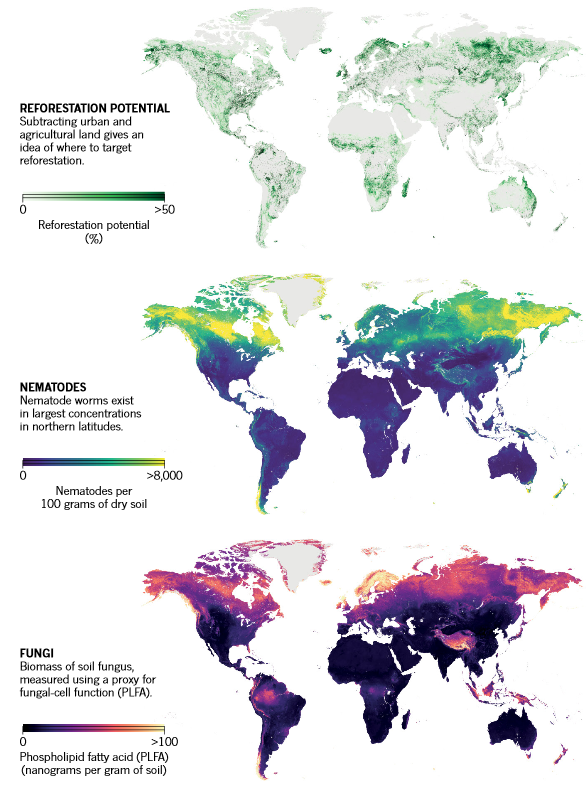
Another outcome – an important one – is a conclusion that “tree planting is easily the best way to remove carbon from the atmosphere, and could be the key to slowing global warming”. This is a conclusion that obviously spawns many new projects, but that’s another story. Let’s get back to nematodes for a bit. They're usually tiny, around 50 micrometers thick and 1 millimeter long - but the nasty parasitic kinds (this is sort of sickening) can be up to 3 feet long. They actually play an interesting role in solving climate change. This recent article from Brigham Young University covers that aspect. One thing of interest to note is that the biomass of the nematodes of the planet is almost equal to our weight. That is, add up the weight of all the nematodes and you have 80% of the weight of the entire human population! The relationship to carbon is summed up here: “Knowing where these tiny worms live matters because nematodes play a critical role in the cycling of carbon and nutrients and heavily influence CO2 emissions. An important finding of the paper is that nematode abundance is strongly correlated with soil carbon (more carbon = more worms). Understanding the little organisms at a global level is critical if humans are going to understand and address climate change.” Below is a figure from the Nature article summarizing the data from Crowther's research for trees, nematodes and fungi.
In Part 2, I will talk about more lessons learned for project management and more about the connection between AI and Earth. |


Can Science Solve Anti-Science?
Categories:
climate change,
science,
scientific american,
asch paradigm,
social pressure,
heursitics,
rules of thumb,
anti-science
Categories: climate change, science, scientific american, asch paradigm, social pressure, heursitics, rules of thumb, anti-science
|
Many project managers are left-brain thinkers. We’re analytical. We’re get-r-done type folk. Give me the facts, man, and I’ll deliver your project, we say. Or, if we’re the one presenting the facts, we expect that they’ll deliver action by our project team contributors. The science of the human brain, however, indicates that as humans, we take many ‘mental shortcuts’. Our decisions are not always rational. A recent article in Scientific American has one of the most interesting titles of an article – at least in that esteemed journal: “The Science of Anti-Science Thinking”. The subtitle also caught my attention: “Convincing people who doubt the validity of climate change and evolution to change their beliefs requires overcoming a set of ingrained cognitive biases”. The article starts with a porpoise. Porpoises live in the ocean. They look like a fish. Until fairly recently, most people thought they were a fish. But scientific evidence proved that they are a mammal, and that is now a fact. When science – or at least technological advancement based on science – yields the automobile, the laser, the smartphone, or a cure for a disease, the advance is welcomed. But when science tells us something that disturbs the prevailing thought or challenges a societal norm, or, in projects, “that’s not the way we do things around here” – watch out. The human mind can slip quickly into mental shortcuts and biases. In the article, which I highly recommend reading, there are some excellent examples and compelling evidence. But let me focus on the hurdles to accepting facts, since that (accepting facts) is what we need for good project management. Shortcuts: The brain is an organ. Organs use lots of energy and as a living thing, we try to reduce the energy we use – that’s instinct. On top of this, these days, we’re presented with an overload of information to process. So we take mental shortcuts – heuristics – rules of thumb – to cut down our processing time. One example in the article is the “Authority Heuristic”. In an experiment by psychiatrist Charles Hofling, nurses in a hospital received a phone call from a person identifying himself as a doctor, and directing the on-duty nurse to give their patient a double dose of a drug called Astroten to a patient, even though the label on the bottle boldly limited the dosage, and even though the hospital had a policy requiring handwritten prescriptions for such changes. 95% of the nurses obeyed the unknown “doctor” without raising any questions. See this link for more detail: https://www.simplypsychology.org/hofling-obedience.html. Other research in this area comes from Nobel Prize winner Daniel Kahneman and his book “Thinking, Fast and Slow”, summarized well in the video below. It’s just a few minutes. Have a look. These nurses, I think you’d agree, were using “System 1” thinking.
Confirmation Bias: Even if you have the time to go to System 2 (slower, more disciplined) thinking, there is the chance that we won’t process information impartially. We will “mix in” our beliefs and give higher priority to the patterns we have seen more often and the ways in which we’ve always thought. Social Goals: Now let’s assume you have surpassed the hurdles of shortcuts (System 1 thinking) and confirmation bias, there is still something else that may prevent scientific fact from getting through. And that is “social pressure”. Group consensus is a strong thing. You’ve probably even seen it in your projects. “Everyone knows that Vendor XYZ is the best in the business”, says the ‘common wisdom’. Do the facts bear it out? If you don't think social pressure can make a difference, take a journey back in time and watch this old video from an American TV show called Candid Camera. It's about something called "The Asch Paradigm". You'll get a kick out of it. All three of these hurdles get in the way of conveying real, factual information. I bring this up for two reasons – first, to help readers understand why they may be pushing back on research showing that climate change is real and caused by humans, but even if you want to bypass that element, I also bring it up because as project managers need to work based on facts, and that as a PM you will often find yourself in the role of the conveyor of facts and faced with an audience or a functional manager who is taking mental shortcuts or is suffering from confirmation bias. At a minimum, you need to be aware of how information flows into, around, and back out of the human brain to accomplish your project objectives. So: think fast, think slow, and consider the facts – including the facts about your own thinking!
|

Sustainability Emerging
|
Scientific American has just published its “Top 10 Emerging Technologies of 2017”. As a project manager, we should be closely tuned in to emerging technology because we all know that new technology drives new projects – either directly (launching a new telecom network based on a 10x faster optical network) or indirectly (a new smartphone app helps you track team members’ progress instantaneously). Well, I’ve been focusing on the intersection of project management (and projects, and project managers) and sustainability since ancient times (2007), and it’s interesting to see that fully half of them are sustainability-oriented technologies. So, I thought that this near-end-of-year post could highlight those technologies. You’ll see the connection to projects – at least I assert that you should.
Water Made By The Sun In a cross-continental effort led by MIT and the University of California Berkley, researchers are taking advantage of the properties of Metal-Organic Frameworks (MOFs) which have phenomenally large pores and a strong affinity for water. It’s actually quite amazing: one MOF crystal the size of a sugar cube has an internal area approximately the size of an American football field. By using these MOFs, the initiative forgoes the usual way of removing water from air (like your home dehumidifier) which takes lots of energy. The places that need this water (where billions of people suffer from the lack thereof) require a lot of electricity – something those same people also don’t have. These systems can be powered by the sun. Projects to implement this technology are already taking place. A startup in Scottsdale, Arizona called Zero Mass Water has already started selling a system which, with one solar panel can produce 2 to 5 liters a day. The company has even shipped such systems to Lebanon to provide water to Syrian refugees. You can imagine the projects that could ‘waterfall’ of this technology.
Fuel From An Artificial Leaf Researchers at Harvard University, in partnership with commercial interests, have actually exceeded the efficiency of a leaf in converting energy from the sun to create glucose. The researchers, Daniel Nocera and Pamela Silver, paired the technology with microbes specifically engineered to produce multiple types of fuels, even with low CO2 concentrations. Now, Nocera and his team are working on a new idea that allows the bacteria to produce nitrogen-based fertilizer into the soil. This bacterium can actually form a biological plastic which can serve as its own fuel supply – a closed system which would not contribute to the greenhouse effect. Reminiscent of scenes from the movie Sleeper, this technique has yielded radishes that weigh 150% more than a control group. So this is about more than fuel – it could assist in the capabilities of farming.
Precision Farming Continuing the farming theme, this initiative focuses on combining the technologies of drones, big data analytics, sensors, improved seed development, and advanced software to produce healthier crops with increased yields for a world that has increasing need for food. Who’s involved? Lots of stakeholders and concerns, small startups, government, and companies such as John Deere, Dow, and DuPont. However, in another example of how this set of technologies brings other technologies (and projects) into play, this combination of technologies requires movement of vast amounts of information – which in turn means an increased demand for broadband. The stakeholder count (and the plants) just keeps growing.
Hydrogen Cars For The Masses Want a hydrogen-fueled car? It’s possible. All you need is $57,500 and that will buy you a Toyota Mirai. But projects galore – at the moment research projects – are aimed at removing the most expensive part of a hydrogen fuel-cell: the catalyst. Many fuel cells today use platinum. Palladium, one substitute, doesn’t perform quite as well and is still fairly expensive. So the researchers are looking for radically different catalysts, made from more readily-available materials, such as copper or nickel. Even more radically, researchers such as Liming Dai at Case Western University, are working on a catalyst that uses no metal at all, and instead uses nitrogen and phosphorous-doped carbon foam. Working together with manufacturers, the goal is to create inexpensive fuel-cells that power vehicles with no emissions, and also produce zero emissions during their production in quantity.
Sustainable Communities While building a green house is an admirable goal, this emerging technology is about building blocks of homes in such a way as to be even more effective and efficient. An example is the Oakland EcoBlock project. Near the Golden Gate Bridge, this collection of about 35 contiguous older homes will have existing sustainability technology applied – but there will be additional program advantages at the community level – such as a smart microgrid and shared electric vehicles. Other innovations involve the use of community water, reducing the demand of this block by up to 70%. But perhaps of the most interest to project managers is the collaborative nature of the program, a multidisciplinary effort involving urban designers, engineers, social scientists, policy experts, governments, and academics. This is what projects are all about, right?
|


Hidden Figueres
|
No, that's not a typo. Hidden Figures was a 2016 film which conveys the true story of a team of female African-American mathematicians who played a vital role at NASA during the early years of the U.S. space program, with little recognition, until well after the fact. This blog post is not about those particular women, but it is about a woman (with a similar surname) who also has been working in planetary science, and from whom, I think we can draw some PM lessons learned. A recent interview in Scientific American by Jen Schwartz, caught my attention. This isn’t normally where a project manager would go for information about our discipline of PM, but that doesn’t mean it is not a good source of inspiration and information. Indeed – it’s a very good source. The interview is with Christiana Figueres, a career diplomat from Costa Rica. Recently she orchestrated (you could read that as “project managed”) the 2015 Paris climate agreement, in her role as UN Framework Convention on Climate Change. Now I realize that some people and organizations have politicized climate change, and even Ms. Figureres herself, but again, I want to point out that I am drawing not from a political journal but one dedicated to credible, reviewed, consensus-based science.
As I often do in this blog, I like to go to the mission statement of an organization to orient myself around the source. In this case it helps point out how this is a valid source of information.
Here is Scientific American’s mission statement: SCIENTIFIC AMERICAN is the world’s leading source and authority for science and technology information for science-interested citizens, delivering understandable, credible and provocative content to an audience of more than 5 million people worldwide. The magazine is independently ranked among the Top 10 US consumer media for “Most Credible” and “Most Objective.”
Founded in 1845 on the commitment to bring first-hand developments in modern science to our audience, SCIENTIFIC AMERICAN is the oldest continuously published magazine in the United States. SA boasts over 140 Nobel laureate authors in our 165 years -- the most of any consumer magazine.
The magazine prides itself on being credible and objective. And with 165 years of experience, besides making me feel young again, that’s a pretty solid basis. So – back to Ms. Figueres. After a failed COP15 Climate Conference in Copenhagen in 2010, she spent the next six years rebuilding the global climate change negotiating process based on fairness, transparency and collaboration. Check the PMBOK® Guide – 5th Edition, 6th Edition… any edition, and corroborate that with the PMI Code of Ethics and Professional Conduct – and its values of honesty, responsibility, respect and fairness - and you’ll see that connection. I’d like to spend a moment highlighting a few extracts from the interview that I’d assert apply to the intersection of PM and sustainability. I’d like to start with this one from the preamble: “Figureres achieved unprecedented cooperation not by flexing her authority (the position carries very little)…. Trained as an anthropologist, she bet that humans are motivated to work toward a common goal if given a structure of trust and hopefulness. In the face of high stakes and daunting complexity, she created an even bigger mess, imbued it with optimism, then navigated through it.” There is a lot to unpack there, starting with what should seem like a familiar refrain for PMs: influencing and motivating without authority. Next, the bit about creating a mess seems to evoke the concept of Tuckman’s model of Forming, Storming, Norming, and Performing. She wisely understands the innovation and creation that occurs during “a mess”, so (excuse the kitchen analogy here) while she was “stirring the pot”, she was also making sure that all of the chefs knew the recipe and got along with each other. Sounds like deliciousness will ensue. And it did.
In the interview itself, she talks a little about what I read as Agile methodology: “Looking back, I’ve always had a willingness to be vigilant to where the opportunity is. You don’t have to progress in a straight line; you can be creative. Perhaps it’s like a sailing strategy, taking left and right, left and right. Or sometimes it’s stepping back one foot so you can then step three feet forward.” And later: “To all those who suggested that ‘this is too complex, let’s delay six months’, I put my foot down and said, “We are not even considering it”. You must allow for the process itself to be muddy because that is the space in which innovation occurs, ingenuity sprouts up and surprising alliances come forward. You want to be not only tolerant but even encouraging of messiness – but with a hard deadline and a clear destination. Next, and perhaps without knowing it, Ms. Figueres provides expert judgment on Identify Stakeholders and Manage Stakeholder Engagement with this gem: “From my anthropology background, I drew a conviction that this had to be an inclusive process, not just federal governments. So we opened it up to the private sector, the spiritual community, and scientists…. There is sort of a self-organizing force that occurs, and better decisions are made when they are informed by as many different perspectives as possible…. Then we allowed for everybody to use the tools they have to apply the science to their particular country, sector, or issue.”
Although this interview was taken from a Scientific American article on the science of gender issues, using Ms. Figueres a platform to discuss “female energy” and to hold her up as an example, I hope you’ll agree that there’s a great deal of value in what she’s said (even in the snippets I’ve included). And if nothing else, I encourage you to expand your sources of knowledge when it comes to developing yourself and your team – trusted sources that are outside of the usual, but will still boost your capabilities. |




