


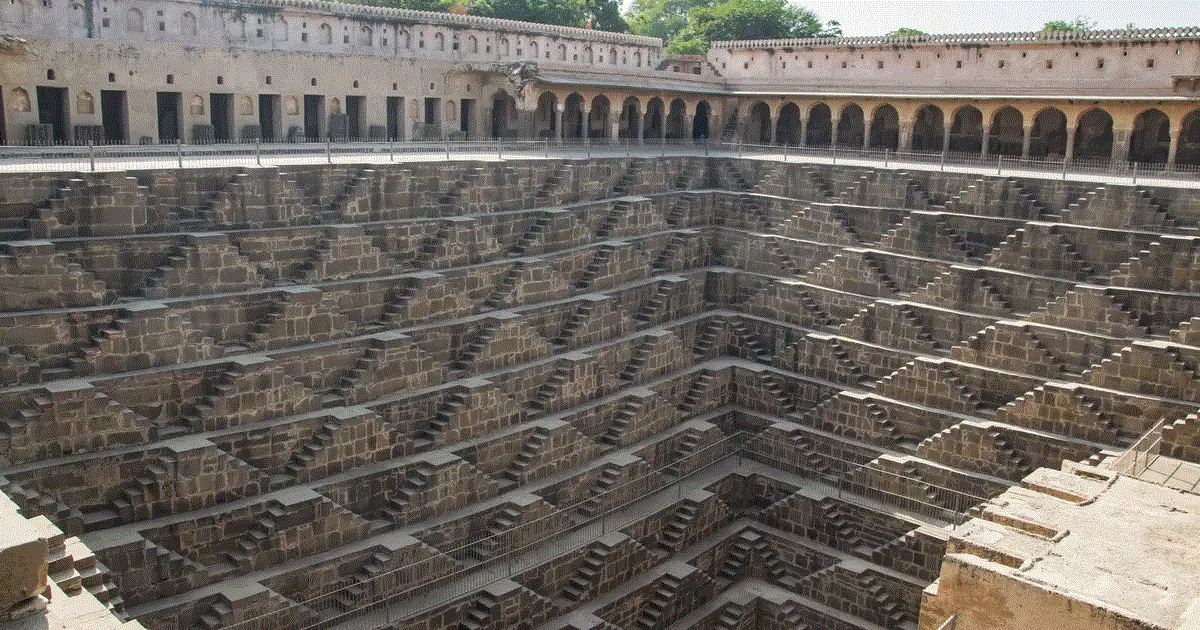
Source: Lonely Planet
In the first post in this series, I looked at India’s ancient stepwells as remarkable examples of infrastructure designed not simply to be completed, but to keep delivering value as conditions changed around them. Their builders worked with local geology, seasonal rainfall, groundwater, community needs, and time itself—what we would now call systems thinking, resilience, and sustainable design.
There’s a difference between studying 1,000-year-old pieces of infrastructure and talking with someone who grew up in the place that created it.
So for this installment, I wanted to add another perspective: that of a civil engineer who was born and raised in Gujarat, where vavs—stepwells—and other traditional water systems were part of the landscape and the culture.
Dipak Shah (see bio and photo below) brings something particularly valuable to this discussion. He can look at these structures both through the eyes of someone who grew up in the region and through the eyes of an engineer – a civil engineer at that! That combination lets us move beyond (quite deservingly) admiration of architecture and ask harder questions: What actually made these systems work? Why did many of them fall out of regular use? Which ideas still make engineering sense today? And should we be restoring the old structures themselves—or applying their underlying principles to new infrastructure?
Our conversation also touches on something especially relevant to project leaders: knowledge transfer. Much of the expertise behind these systems was passed from generation to generation through practice and oral tradition rather than through the kind of formal documentation we would expect today.
As I noted in the previous post, when that chain is broken, the loss is not simply historical—it’s a lessons-learned problem on a very large scale.
With that, let’s hear from Dipak. His (insightful) answers are in bold blue.
What stands out about the design of a stepwell, from an engineering perspective?
What stands out most is the balance of aesthetics and functionality in the structure, designed and constructed by a group of artisans and craftsmen locally known as Vishwakarmas (architects and builders). Their work reflected design and construction experience passed down from generation to generation, along with personal ingenuity. Their work was guided by trade books known as the Shilpa Shastras and Agama Shastras, which were essentially the handbooks available to engineers of that time. Just imagine constructing complex structures like Rani Vav using nothing but a plumb bob and a square; those were the kinds of tools the artisans used for such structures.
Another striking feature of the stepwell is its complexity and its ability to serve its intended purpose even after nearly 1,000 years.
Today, we talk about public-private partnerships. These structures are prime examples of privately conceived and financed public works. Many stepwells, or vavs, were constructed for public use by wealthy individuals or local rulers in memory of their loved ones.
I haven’t visited Rani Vav in Ahmedabad or Patna, even though I have been to both cities. Many times, these structures were closed for repair or restoration. However, I have visited a comparatively smaller vav (stepwell) in my hometown.
My father owned a farm where he constructed a well, a kind of miniature version of a stepwell. The well was 16 ft in diameter to a depth of 20 ft, and 10 ft in diameter from 20 ft to 30 ft in depth. Instead of steps, he installed rungs to the bottom of the well and a platform at mid-depth. The water from the well was used primarily for irrigating the farm, as well as for drinking, cleaning, and bathing.
Dipak, tell us about the transition from traditional systems to modern infrastructure, especially any personal recollections from Gujarat.
I was born and raised in a town in the state of Gujarat, where public and private wells were the primary sources of water for drinking and household use. Water from some of these wells was considered hard because it contained higher concentrations of salts and chemicals, making it suitable only for household use and not for drinking. As a result, some residents had to fetch drinking water from wells located farther from their homes. The public wells were constructed based on community needs and recorded water levels in previously constructed wells. Water levels in the public wells fluctuated, but they met community needs as seepage from rainfall replenished the groundwater until the streets were paved.
Eventually, a centralized water system eliminated the use of local wells; some were sealed, and others were fitted for emergency use, such as firefighting. After the centralized system had been in use for several years, water levels in the wells began to drop, and water had to be rationed until additional sources were added to the system. The depletion of groundwater was the primary reason for the water shortage, along with increased demand. Meanwhile, many people installed bore wells to meet their water needs.
This was not unique to my hometown. Many other places in the state of Gujarat also experienced similar rationing and needed to upgrade their water-supply systems.
During my formative years, I grew up in a household with a private well and an open central veranda, where rainwater was harvested and stored in a tank for non-drinking use. Subsequently, we moved and had to rely on the public water-supply system.
Are these traditional principles at all technically relevant today?
The traditional principles remain very relevant, as India is still largely an agrarian society that relies on a rainy season lasting approximately four months and on stored water for farming needs. Prior to emigrating to the USA, I worked as an irrigation engineer, designing 15-ft- to 50-ft-high earth dams and masonry check dams to create local water bodies and constructing canals to carry water to nearby farmland. Because of their relatively low heights, a number of such structures could be constructed along a river and its tributaries. These structures served multiple purposes:
1. They helped sustain communities by providing work opportunities to those who could not till their land when the seasonal rains did not arrive or were insufficient. The lack of rain deprived farmers of their livelihoods, and they needed temporary work to sustain themselves. These irrigation projects served the dual purpose of providing temporary work and creating facilities to prepare for drought-like conditions.
2. Farmers were able to grow more than one crop per year because these structures made water available throughout the year, thus improving the standard of living for the farmers and their workers.
3. They also provided opportunities to cultivate different crops, fruits, and vegetables, which benefited the farmers as well as the public at large.
4. Locally created water bodies helped sustain groundwater levels and minimized flooding.
Cost-benefit analysis was always performed to determine the viability of such small-scale irrigation projects.
Dipak, can you identify the limitations of restoring historic stepwells and distinguish between preserving old structures and adapting their principles?
Many of these stepwells are centuries old and are now located in either urban areas or remote locations. Land in urban areas has become scarce and prohibitively expensive, placing tremendous pressure on local and state planners to abandon them. Moreover, today’s lifestyle would not justify restoring such sites unless the stepwells qualified for designation as protected historic structures and were developed as tourist attractions. In many undeveloped or underdeveloped areas, the principles behind stepwells could still be applied. I would suggest a slight variation: construct a number of interconnected tube wells along with retention and detention basins to maintain groundwater levels, capture rainwater, and provide recreational facilities at sufficiently large retention basins.
There is certainly a great deal to be learned from these old structures. In my view, they represent a healthy amalgamation of ingenuity, a keen sense of aesthetics and functionality, and a desire to plan and construct publicly minded projects with a reasonable cost-benefit balance; all of these qualities could and should be applied today. Public-private partnerships can certainly be instrumental in designing and constructing sustainable structures that benefit many people, enhance quality of life, and protect the environment.
Dipak, what’s the best path forward: restoration, reinterpretation, or a combination of both?
I am not sure restoration in today’s world would be productive. However, the principles and approaches used in the design and construction of stepwells could certainly be very useful in adapting to today’s world. Modern structures tend to emphasize function more than aesthetics. These old structures remind us to incorporate aesthetics to increase their appeal and likability.
Some short questions and answers
• What do you remember about vavs or other traditional water systems while growing up in Gujarat?
I haven’t visited Rani Vav in Ahmedabad or Patan, Gujarat. However, I have been inside a local vav that was comparatively smaller and less elaborate than Rani Vav.
• Were they generally regarded as historical monuments, functioning infrastructure, community spaces, or something else?
The vav I visited was not a historical monument, but it functioned as a source of water for the nearby temple and for people living in the surrounding area.
• Were particular stepwells well-known in the area where you lived?
We did not have any stepwells where I grew up. However, we had a number of wells that were used as sources of water for drinking and daily household use.
• As a civil engineer, what strikes you as particularly clever or effective about traditional stepwell design?
A stepwell such as Rani Vav served several purposes:
1. It encouraged and sustained the ingenuity of local artisans and provided them with a livelihood. It was also a prime example of a privately and/or publicly funded public project.
2. It provided water storage and uninterrupted access to water despite seasonal variations in water levels.
3. It provided a cool, peaceful, tranquil, and meditative place.
4. It functioned more or less as a temple.
5. In modern times, it could possibly serve as a shelter during emergencies and as housing for homeless people.
• What engineering principles are embodied in these structures?
As with the design of any structure, site selection, local soil characteristics, the footprint and depth of the structure, control of groundwater during construction, and the sources and availability of materials and artisans would all be key considerations. I doubt that time constraints were a major factor in such construction. It is reported that it took 20 years to construct Rani Vav in Patan, Gujarat. I also tend to believe that the collective design and construction experience of seasoned artisans was key to the successful completion of such projects.
• How did stepwells accommodate significant seasonal changes in groundwater levels and monsoon rainfall?
The stepwells remind me of gas storage tanks that expand and contract as gas levels fluctuate. Such tanks were once visible near Newark International Airport in New Jersey. Similarly, the stepwell layout allowed runoff water to be accommodated during the monsoon season, and the tiered layout of the steps allowed access as water levels rose or receded.
• Why did stepwells and similar decentralized water systems fall out of regular use?
I would tend to believe that introducing smaller wells in combination with retention basins, such as ponds or talavs that store rain-generated runoff, would be more cost-effective and could be completed in a relatively short time. The wells became the source of water supply, while the talavs helped harvest rainwater and maintain groundwater levels. Anyone visiting smaller towns in India would notice that each town has a talav serving many purposes, ranging from storing rain runoff and providing recreation to serving as an area for washing clothes and as a drinking-water source for animals.
• Did modernization inadvertently cause useful traditional knowledge to be lost?
Culturally, Indians in previous generations preferred to pass on their knowledge verbally to their heirs or trusted students. So, I would tend to believe that the combination of a lack of documented inherited knowledge and modernization might have contributed to the loss of this art.
• Climate change is producing both longer dry periods and increasingly intense rainfall in many places. Does that make the principles behind stepwells more relevant today?
Certainly, especially if all potential variations in design parameters are incorporated, whether related to climate change or any other anticipated change.
• One important function of traditional systems appears to have been slowing runoff and allowing more water to infiltrate the ground. How important is that concept in modern water management?
Preserving groundwater is becoming increasingly critical, as many parts of the world are expected to run dry and water is expected to become a very expensive and elusive commodity. A “Save Water” movement is underway in many parts of the world. Many countries are considering interconnecting rivers to prevent them from flowing directly into the oceans. Interconnected rivers could also help minimize flooding.
Just a thought: if all the world’s rivers were somehow prevented from flowing into the oceans, would that reduce any projected rise in ocean levels due to climate change?
• Can traditional structures contribute meaningfully to groundwater recharge?
We should seriously consider the viability of no longer constructing combined sewers. Instead, we should revert to systems comprising separate storm sewers and sanitary sewers. I would also suggest considering the use of perforated pipes for storm sewers, allowing at least a portion of rain runoff to seep into the ground and replenish groundwater. I believe Japan has started experimenting with permeable pavements that allow rainwater to drain through openings in the roadway and seep through the base below.
• Are there circumstances in which stepwells could improve community resilience during droughts or water shortages?
Many of the stepwells are old and would require repairs and restoration, which could be cost-prohibitive compared with constructing rainwater storage tanks beneath public amenities such as parking lots, athletic fields, and parks. Maintaining the quality of water stored in such structures would also be a challenge.
• Can historic stepwells realistically be returned to active use, or are many better treated primarily as heritage structures?
I believe they should be considered primarily as examples of sound engineering and as learning tools. At the same time, they must be well cared for to preserve them as heritage structures.
• What concerns would a modern civil engineer have about water quality, groundwater contamination, structural integrity, safety, and maintenance?
This is a loaded question. The short answer would be to consider water a finite resource, and its preservation for safe use should be paramount in any design consideration.
• Would it make more sense in some cases to incorporate the principles of stepwells into new infrastructure rather than restore the original structures?
Yes.
• Are there lessons from traditional Indian water-management systems that today's engineers sometimes overlook?
The stepwells are fine examples of sound engineering practice, incorporating many features such as serving the needs of people and harnessing nature to a certain extent. No design effort should lose sight of the overall purpose of the project.
• What can contemporary civil engineering learn from systems that were developed around local geography, rainfall, climate, and community needs?
As they say, all politics is local, and so is engineering design. Knowledge of local site conditions, building codes, local preferences, and potential changes in land use and communities should be among the key parameters in any design.
• Should decentralized water infrastructure play a larger role alongside centralized municipal systems?
I would tend to believe that a centralized water-supply system would place everyone in a community on the same footing as far as water usage is concerned. I would also tend to believe that a decentralized system would not be cost-effective and would be relatively difficult to operate, run, manage, and maintain. A decentralized system would also not be conducive to new development.
• Is the best solution likely to be a combination of traditional principles and modern engineering?
A combination of traditional principles and modern engineering would certainly be a better fit.
• Stepwells historically provided more than water storage: they could also serve social, cultural, architectural, and even cooling functions. Is this kind of multifunctional infrastructure particularly relevant to sustainable design today?
As with a multimodal transportation system, any project that incorporates multifunctionality along with sustainability would be preferable and certainly welcome.
• Does restoring or adapting these systems illustrate a broader lesson about sustainability— namely, that innovation sometimes involves rediscovering and adapting existing knowledge rather than inventing something entirely new?
It pains me to say it, but only fools would fail to learn from the past and adapt the knowledge gained by those who came before them. One can certainly improve the wheel, but there is no need to waste time trying to reinvent it.
Closing Question
If you were advising a city or regional government in India today, what is the one lesson from the traditional vav or stepwell system that you would most want incorporated into modern water infrastructure?Catalog the engineering practices and knowledge that went into the design and construction of structures that have survived, efficiently served their intended purposes, and are still capable of serving those purposes with reasonable repairs and restoration. However, the primary goal should be to learn from the knowledge of our forebears and apply it in ways consistent with today’s conditions and anticipated future changes. A healthy combination of aesthetics and functionality should also be part of any design effort.
Blogger's Note:
I am proud and thankful to have Dipak Shah as a subject matter expert here for this interview. His insight and analysis were eye-opening and valuable.

Dipak Shah
Dipak Shah, a retired licensed professional engineer, was involved for more than 40 years in new construction and reconstruction of infrastructure projects, including interceptor sewer and water tunnels, bridges, elevated commuter railroads, passenger stations, and intelligent transportation systems. Having completed his undergraduate engineering education in India and immigrated to the USA to further engineering education and gain practical work experience. Additionally, his work experience extends to India, where he was involved in the planning, design and construction of irrigation projects featuring earth dams and rubble masonry check dams.


