
Shhhhh! (Part 1 of 2)


|
Here’s a story about protecting ocean life that – in a twist – does not involve acidification, plastic, chemical pollution, melting ice, or climate change. Those things are still all threats to ocean life, of course, but this post, which has some intriguing connections to project management, is about noise. It started with a very interesting article from Nature, called The Quest for Quieter Seas, which is published online here. The connections to project management have to do with:
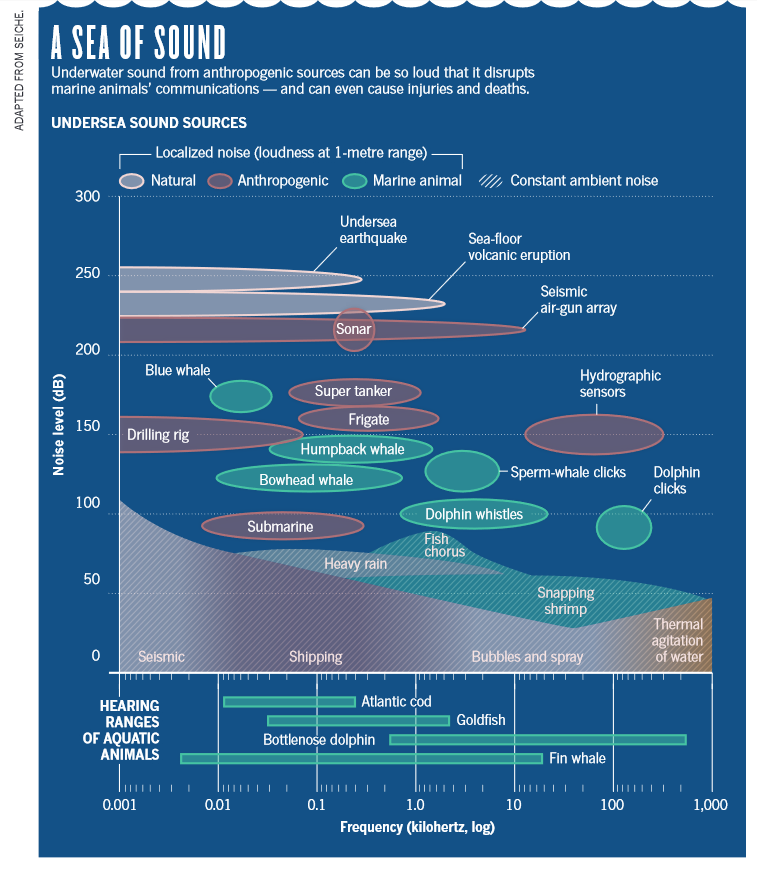
…see if you can find these connections here. Who’s making all of that noise? First, let’s start with the sources of noise in our oceans. Of course, some if it is quite natural and has always been around; things like dolphin whistles and clicks, whales’ songs, rainfall, snapping shrimp, and the rumbling of an undersea earthquake. But some of the noise is most definitely anthropogenic (caused by humans), such as sonar, oil drilling rigs, vehicles (everything from frigates and supertankers to submarines), hydrographic mapping sensors, and seismic air-gun arrays. See the chart below to place these in volume level and against the hearing frequency ranges of various forms of ocean life.
(From Nature, Volume 568, 11-April-2019) The article expresses the need for a baseline so well, I’ll let it speak for itself: Because noise is so pervasive, it is hard to study the impact as it ramps up. It isn’t clear whether marine systems can work around or adapt to it – or whether it will drive crashes in already-stressed populations. So researchers are becoming acoustic prospectors, searching for quite zones and noisy habitats in efforts to chronicle what exactly happens when sound levels change. Efforts (projects) range from natural experiments on the effects of a plan to reroute shipping lanes in the Baltic Sea, to investigate the impact of a trial scheme in Canada to reduce ship speed in coastal waters off Vancouver. Complicating matters is the fact that there are other new and concurrent stressors on marine life, such as the aforementioned acidification and warming ocean temperatures. The effects are not simply arithmetically added, though. A plus B is not a simple equation. The interactions are often causing a negative effect greater than the sum of its parts – also known as synergy. So how much are we adding to the not-so-silent seas, in terms of noise? Based on the amount of noise contributed by an average ship and looking at the number of ships (this does not include sonar and other items mentioned above) the sound contribution has risen about 3 dB per decade. If you know your decibels, you know this is a logarithmic increase – a doubling of sound levels each decade. Seismic air blasts, used to map the sea floor for possible oil or gas drilling opportunities, can be audible for hundreds of kilometers (think Boston to New York or Amsterdam to Dusseldorf). These are causes. What are the effects? It’s beginning to become obvious that loud marine noises can cause a panic dive in cetaceans (whales, dolphins, porpoises), as indicated by the increase in ‘beaching’. These panic dives have the secondary effect of causing hemorrhages in the animals’ brains and hearts. Research projects have also shown that loud waterborne noises can damage the ears and cause hearing loss (as you may expect). In part II I’ll discuss more about the effects and the research and other projects that are being implemented to remedy ocean noise and make the oceans a little quieter. As you can tell from the above, this is not a simple ‘quality of life’ issue – it’s life itself. |

Plastic Risk Management - Part 1 of 3
|
I approach this three part (!!!) post from the PMI® viewpoint about risk. Risk, as you likely know, can be described as negative risk, the risk we usually think of, called threat, and positive risk, called opportunity. When I started this story it was very depressing – because I thought of it only as a threat. But a deeper dive (excuse the pun) led me to the conclusion that there was both threat and opportunity here. In fact, I’ll treat this as a three-part series. Part 1 will focus on risk identification, Part 2 on threat and opportunity analysis, and Part 3 on risk response – and the initiation of a huge project that will capture your imagination and tickle your project management fancy. So – all that said, let’s start with Part 1: Risk Identification. What’s the risk, and why was it so depressing at first? Here’s a challenge for you, dear reader. Consciously note and identify the number of plastic items you touch over the next 24 hours. In fact, let’s make this a bit interactive. I request that you respond to this post with that count of touches and items. Log it on a piece of note paper, remembering that the pen you use is also likely made of plastic. Plastic is everywhere. You’re reading this post while touching a plastic bezel of a device or with your hands resting on a plastic keyboard and/or mouse, and looking at a plastic monitor, perhaps snacking on pretzels in a plastic bag (watch those crumbs!). So the risk I’m talking about is indeed – plastic. Many of you have heard about the Great Pacific Garbage Patch. For those not familiar with the situation, first of all, the word “patch” makes it sound way too small. It’s actually (currently) twice the size of Texas. And – ask anyone in Texas, Texas is BIG. Below is an image from a recent article in New Scientist magazine:
This is not just about litter – the plastic affects a much larger food chain – including us. And it’s not just this patch, where the plastic happens to concentrate. Remember your project management training – a risk is not a risk unless it has an effect on project objectives. In this case, for sake of argument, the “project” is continuing good quality of life on this planet. From the below, you can see that this definitely qualifies as a risk. Research suggests that not one square mile of surface ocean anywhere on earth is free of plastic pollution. Here is one small sample regarding fish, from research on the effect of plastics on sea life: “Fish in the North Pacific ingest 12,000 to 24,000 tons of plastic each year, which can cause intestinal injury and death and transfers plastic up the food chain to bigger fish and marine mammals. A recent study found that a quarter of fish at markets in California contained plastic in their guts, mostly in the form of plastic microfibers.” Where’s the plastic coming from? In other words, what’s the cause – the source of this risk? In a very recent NPR story, Jenna Jambeck (website: https://jambeck.engr.uga.edu/ ) describes well the sources of plastic. A graphic below helps explain it as well.
Professor Jambeck has collaborated on a technical article recently published in Science magazine which details this: Science magazine article - Plastic waste inputs from land into the ocean http://science.sciencemag.org/content/347/6223/768.full From the abstract: By linking worldwide data on solid waste, population density, and economic status, we estimated the mass of land-based plastic waste entering the ocean. We calculate that 275 million metric tons (MT) of plastic waste was generated in 192 coastal countries in 2010, with 4.8 to 12.7 million MT entering the ocean. Population size and the quality of waste management systems largely determine which countries contribute the greatest mass of uncaptured waste available to become plastic marine debris. Without waste management infrastructure improvements, the cumulative quantity of plastic waste available to enter the ocean from land is predicted to increase by an order of magnitude by 2025. The plastic garbage patch may even be much bigger than we thought, according to this recent article. And, oh, by the way, this is not the only mass of debris. Each of Earth’s gyres (click on the link and/or see below) also contain vast amounts of plastic.
So, the problem is huge, and it’s growing, but we have identified the threat and we have a much better handle on its size. In Part 2 of this three-part post, I’ll talk more about the risk analysis and move towards a risk response. But before you leave... remember my challenge to you. Track the plastic items that you touch over the next 24 hours (or whatever period you can bear doing this) and respond to this post with your numbers and if you're willing, a table showing the number and the items.
|




