
Blue-seeum


|
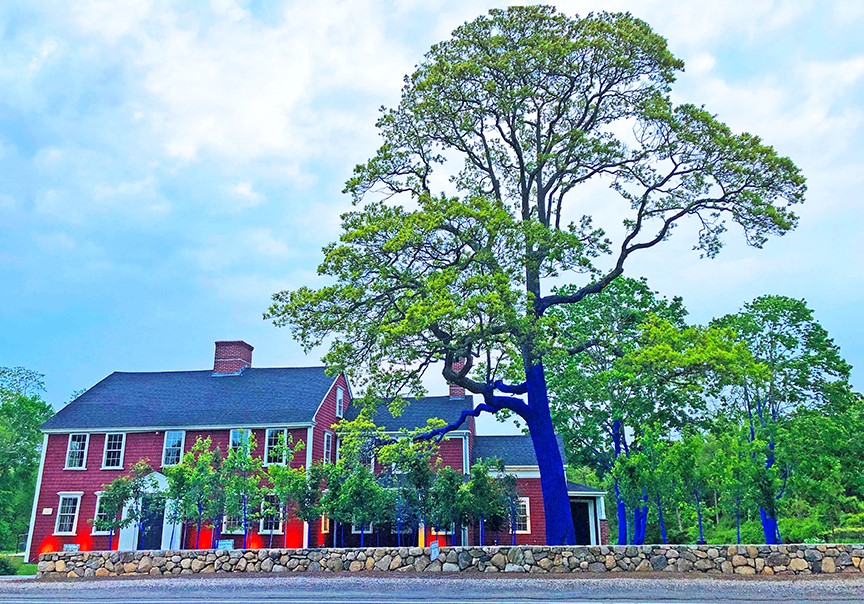
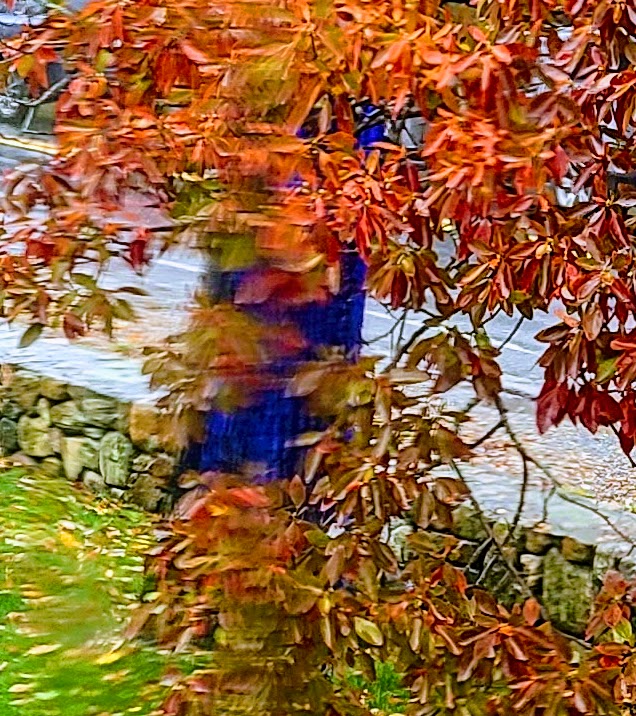
They took all the trees, put ‘em in a tree museum. And they charge the people a dollar and a half just to see ‘em…. I went to see an art exhibit today at the Calhoon Museum in Falmouth, Massachusetts… and ended up focused on something outside the window, instead of inside the museum. And like Joni Mitchell’s lyric above, it was about trees and museums, but not trees in the museum, trees outside the museum, and the trees were painted an unearthly blue so that you really could “see ‘em”, and maybe in a different way. Here's an example of what I actually saw:
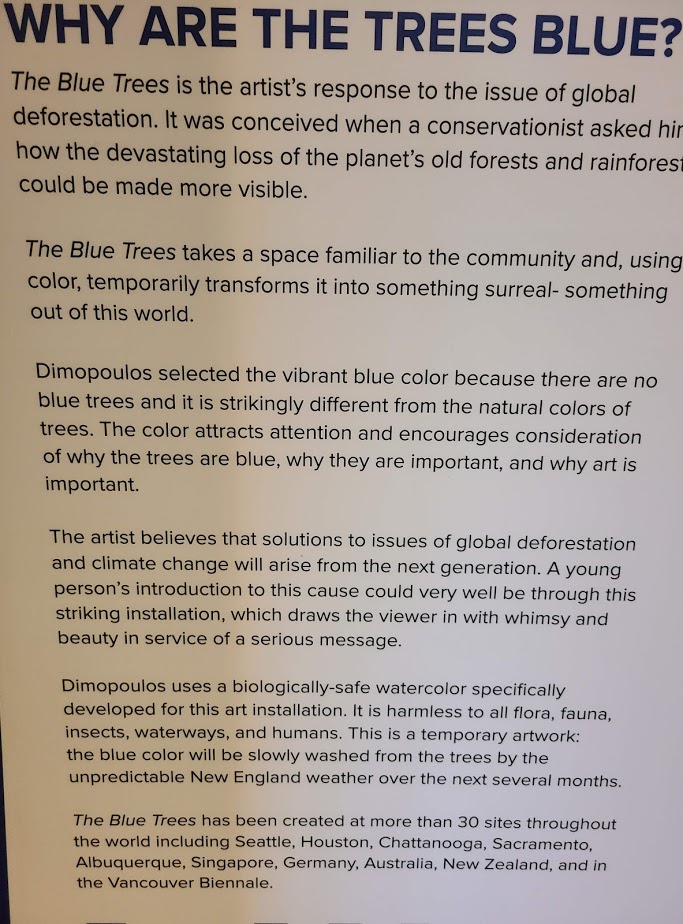
What was that about? Why are these trees all an electric royal blue color? Then I saw this sign:
The artist, Melbourne, Australia-based Konstantin Dimopoulos, says this about the tree project (actually a program): As a conceptual and installation artist I create artworks that are grounded in my sociological and humanist philosophies. In my environmental art installation, The Blue Trees, the colour and the Tree come together to transform and affect each other; the colour changing the Tree into something surreal, while the Tree, rooted in this earth reflects what we may lose. This change highlights ecological issues, such as the ecocide of our forests and climate change, and effects a transformation in the psyche of people by raising our social consciousness referencing how individually and collectively we shape the world we inhabit. The Blue Trees has a strong regenerative aspect to it, an organic work that is continually changing and evolving. From season to season the trees grow through the cycles of nature and the colors begin to change and disappear. Time passing is a part of the concept; time that determines our own existence is measured through these trees. Perhaps the best way to learn about this is with this charming video: "The Blue Trees" in Chattanooga, TN from Public Art Chattanooga on Vimeo. This got me thinking about communications. What an interesting way to communicate a message! Not an email or a text, or an advert, but a community-based display that gets attention and engagement. I'm not suggesting that if your project has some issues you should paint all the trees in your town amber. I'm just thinking that we can think outside the box a little bit when we need to convey a message and take some inspiration from The Blue Trees. And of course, we should pay attention to the message that Dimopolous is sending! After seeing the video, what are your thoughts about this program*? Are you inspired to improve your own messaging? *I call it a program because each city ‘engagement’ is a slightly-different implementation of the art project – it has been done in many cities around the world. Oh. And for those of you who don’t know the Joni Mitchell (or Counting Crows) reference, have a look at this: Learn more about the Blue Tree program at these links: |
Forest Gumption
|
Screenshot from the movie "Forest Gump" via YouTube
My last post – Project Managers – We're full of BS - promised a follow up, a second part called, Backward Pass, Forward Fail, and that is still forthcoming. However, in the meantime, and in the process of researching that post, an article in the June issue of PM Network caught my eye and deserves treatment immediately if only for its awesome title - which I have borrowed for this post. Full credit to the article - read it here. The story is about a very low-tech, and literally down-to-earth application of fighting climate change. And it’s as basic and old-school as planting trees, but with a fancier, more project-management name: reforestation initiatives. The United Kingdom launched a 500 million pound , 25-year project to plant 50 million trees in a large area of northern England. China’s government is launching a project in 2018 to plant trees covering a an area the size of Ireland, aiming to increase forested areas in China over 5% by 2030. And in Africa, a joint 21-nation program, seeks to cover almost 250 million acres with trees by 2030 – a $1B investment in fighting climate change with CO2-capturing trees. That’s equivalent to the total combined area of US states Minnesota, Kansas, Nebraska, Missouri, and Oklahoma! The initiatives also require public-private partnerships, like the Atlantic Forest Restoration Pact program in Brazil which will restore 2.5 million acres of tropical forest in Brazil. What’s important to note here is that these projects – of course – reap ecological benefits. Forests help absorb carbon dioxide, and provide wildlife habitats, but they also provide social and economic benefits. Assembling a coalition of stakeholders is key. In a partnership with the World Bank, for example, Conservation International worked with the Brazilian Ministry of Environment and other NGOs on a six-year project to plant 73 million trees by 2023. In doing so, the coalition of stakeholders hired indigenous community members and farmers to execute the project, bringing in as many as 2,000 local people to aid in the reforestation of each hectare. This generates jobs and income for the communities. Taking stock of the long term benefits from reforestation is an important element in reaching out to the various stakeholder groups. And yes, gaining this stakeholder engagement early on means a longer time between planning and execution - but it makes for a more sustainable sustainability project. It’s not all success stories, however, when it comes to planting trees. My own hometown, Boston, as recently reported in this Boston Globe story, is lagging other cities in keeping its promises with respect to planting trees. The photo of Boston’s iconic Citgo sign with a tree stump in the foreground, is representative of what you’ll find in the story.
Photo Credit: John Tlumacki, Boston Globe The story begins: A decade ago, Mayor Thomas M. Menino stood with other local officials in the Geneva Cliffs Urban Wild in Dorchester and vowed that Boston would plant 100,000 new trees by 2020, expanding the city’s tree canopy by 20 percent. With climate change a growing concern, cities across the country made similar pledges, a simple way to soak up carbon emissions and curb energy use, among many other benefits. That same year, New York City set an even loftier goal to plant 1 million trees by 2017. New York met its goal — two years early. Boston, however, has fallen woefully short. Not only has the city abandoned its goal for this decade, but it has barely kept up with tree mortality.
The article goes on to describe some or the reasons the project has failed so far – a mixture of mismanagement, lack of focus on the project objectives, and some realized threats, such as the amount of trees that have actually had to be removed based on such things as redevelopment projects and disease. It’s actually a good case for students of project risk management, I suggest reading it from that perspective. But it doesn’t take away from the overall thrust of the post – the focus on reforestation projects – mainly successful ones – and the contribution they have to offer in helping to provide long-term benefits of the social, ecological, and economic variety… in other words, People, Planet, and Profits. |




