
Post-Haste Post-Summit Poster Post
Categories:
8th Edition PMBOK
Categories: 8th Edition PMBOK


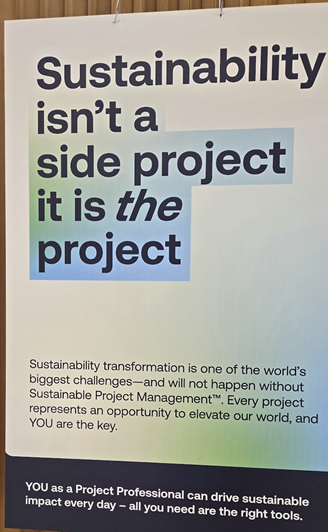 The year was 2008 (or so). Maybe earlier. My colleague, Dave Shirley and I each led groups of about 10-15 project managers, deploying telecom networks around the world. We had neighboring offices and often discussed project management issues. One topic that kept coming up in conversation was the fact that our project managers were such amazing “get it DONE” people. Their focus on the end date and the turnover of the telecom network to customers such as Deutsche Telekom, KPN, Singtel, Verizon and Comcast was intense. At the same time, both of us were noting what was being said about the environment – climate change, declining species, and also the whole concept of economic and social sustainability – thinking past the end of the project. One day, over a mediocre meal at the cafeteria (or maybe it was coffee… or a beer…too long ago to remember) we lamented that there was no ‘thought leadership’ in this area. Perhaps someone should write a book about how project managers could (and should) think past the end of their project to include the effects their project – and importantly their project’s product – would have on the customers and other stakeholders, and the economic long-term effects (maintenance, energy use, ability for the network to make money for our customers). And so we did. We wrote and published (with the help of our publisher CRC press) a book called Green Project Management. At the time, it got mixed reviews, with the most negative coming from those “get it DONE” project managers (not our folks, but others like them) who pretty much expressed frustration with ‘yet another constraint’ and ‘this is not our job – we just get the product out’ types of comments. Others liked the book. Alot. This included PMI, apparently as they gave the book the Cleland Award for Literature in 2011. We focused, however, on those who were skeptical about the idea of long-term, sustainability-oriented thinking in Project Management, following up the book with a second one called “Driving Project, Program, and Portfolio Success – The Sustainability Wheel”. Realizing that the behavior of project managers came from their line management, and a more strategic level, we aimed this book at the Program and Portfolio managers, often the supervisors or at least overseers of project work. We don’t know how much that book (or for that matter, the Green Project Management book) made a difference, but to bring this to current times, I was thrilled to see a poster at the PMI Global Summit 2025 this month, pictured at the top of this blog post.The poster encapsulates the ideas we were pushing (and continue to promote). And it’s not ‘just’ a poster – although this messaging is super-important. It’s the overall increasing importance that leaders in PM are placing on VALUE DELIVERY, and that ‘value’ is multi-faceted. It is not just the delivery of a ‘thing’ or a ‘service’ on time, under budget, and meeting requirements, it is really about the steady-state availability of the benefits of that product-of-the-project for months, years, decades, and it takes into account any 'disbenefits' (negative impacts) to the planet, the people (employees, neighbors, customers) that may come along with that product. Thus the title of this long-running blog post series! In Part 2 of this post (arriving post-haste), I will provide some thoughts and analysis on how this poster connects with the new 8th Edition of the PMBOK® Guide. |


