Note: this is a guest post from Smart Cities expert, Dr. Beverly Pasian. Learn more about her at the bottom of the post. I'm honored to have her expertise in this series on Smart Cities and Project Management!
The pandemic was the excuse, not the reason. In May 2020, Sidewalk Lab’s CEO Dan Doctoroff pointed to the economic impact of the pandemic as making the financial viability of the Toronto smart city project uncertain. While undoubtedly a factor, the downfall of the unprecedented urban experiment began two years earlier with the resignation of key advisors. Notable among them was privacy expert Dr Ann Cavoukian who, concerned that the imagined ‘city of privacy’ was turning into a ‘city of surveillance,’ was unconvinced with Google’s commitment to protect personal information. In doing so, she revealed a new role within the spectrum of project management professionals—the project-manager-as-privacy-officer.
Within this revelation one can further see good and bad news. The bad news? Privacy is given almost no specific mention in any of the major project management standards. The good news? It can be interpreted in all of them. Direction is available for project management professionals seeking to enrich their careers. Imaginings are offered below, influenced by PMI’s project management principles, and easily applied to IPMA’s people, practice, and perspective competences.
Be a diligent, respectful, and a caring steward of data
As a project manager, you will be entrusted with personal and proprietary data possibly at all stages of the project. Upholding ethics and values will be natural extensions of this work.
Data stewardship comprises responsibilities both within and outside the organization and should be reflected in your integrity, care and trustworthiness. More specifically, measures must be taken to ensure compliance with policies and accords such as the General Data Protection Regulation and the California Consumer Privacy Act (CCPA).
Demonstrate privacy leadership
Privacy and data can be secured in a project when key roles are staffed, notably those of the privacy manager, individual privacy officers and a data protection officer. Combined, they represent the privacy organization and are responsible for the interpretation of privacy policy(ies) and compliance across the project or program.
The project governance structure would be a natural place to create this leadership.
Respect the rights of all stakeholders as data subjects
Within a privacy discussion, a stakeholder is a data subject – someone whose personal data is contained within or otherwise affected by the project. They can be positively or negatively affected by the project when, for example, their data is (securely) used for stakeholder feedback. On the other hand, compromising or breaching personal data can dramatically curtail or stop project activities.
Effectively engaging a stakeholder involves the provision of reliable information / policies detailing how their personal data is managed (including in the event of a data breech). This will directly help foster a culture of trust.
Champion the true value of privacy (it’s not the data)
At its core, the value of privacy is in the feelings and esteem of a project team member, not the data. The unexpected / unwanted sharing of personal information is, at best, an embarassing distraction but, at worst, a criminal act violating someone’s boundaries. At any point along this spectrum, it can be a significant departure from the project’s work.
Much as a business case is a starting point for project value, a privacy policy can be for a project organization. Starting with one or more official sources, a contextual interpretation demonstrates clear leadership and advocacy for the unspoken needs of team members. The potential value—based on good will if nothing else—is enormous.
Recognize, evaluate and respond to data breaches
Project teams must realize the holistic view of the project as a system with privacy and data security embedded therein. The team needs to understand that a single change (for example, a breach of data) can cascade across the project and a response mechanism is essential to maintaining the system.
Privacy professionals see breaches as more than risks. Their essential nature—the unwanted sharing of personal data—is largely the same regardless of circumstance. So is the response: (1) stop the breach and (2) prevent its recurrence.
Create a collaborative team environment
Paradoxically, a collaborative team culture can maximize opportunities for respecting privacy and data security. The transparent exchange of ideas and practices can result indata management agreements, organizational structures (i.e, the identification of a privacy steward) and processes (e.g., data protection impact assessments). Sharing experiences as ‘cases’ for other’s enlightenment is invaluable.
Build quality into information management
Quality is the ability of an organization to fulfill the stakeholders’ implicit and explicit needs. The same can be said for privacy and data protection. Compliance criteria (such as laws or regulations) specify ways to assess if quality has been achieved.
Navigate complexity of personal, project and organizational data
Data comes in many forms and from various sources and a project manager can create effective divisions: personal, project and organization. Complexity can (increasingly) emerge from their (mis)use in projects, programs or portfolios. Setting clear privacy and data security principles and breach responses can help. Widespread knowledge and acceptance of this information is essential, along with the careful distinction of responsibilities between the privacy manager and data protection officer. While related, these are separate roles with their own functions and relationships to the project manager.
Embrace adaptability
A project manager must also respond to changing data conditions. Is the data fit for the purpose(s) of the project? Is a source continually reliable? Do the IT functions and infrastructure support the (changing) data conditions? Is the project organization working in accordance with privacy laws, regulations and policies? Conducting regular privacy and data protection audits, serving as a sounding board for continuous learning and improvement, and deepening your own skills and knowledge will all contribute.
Blog posts are inherently limited, and this one is no different. The thoughts above provide insight (not instruction) on a critical new dimension to a project manager’s role. For the broader perspective for both this post and those upcoming in this smart city series, I’ll return to Toronto.
When officially launched in 2017, Alphabet (Sidewalk Lab’s parent company) emphasized the vital importance of improving quality of life in making its city-focused technology decisions. The Toronto project was not a ‘random activity’ but the result of more than a decade’s deliberations. As a native Torontonian, I was grateful at the time to hear this thoughtfulness. And as a researcher of quality-of-life in smart cities, even happier to hear this view from a project sponsor (Alphabet Chair Eric Schmidt).
It was only a year later when project leadership started to deteriorate and project failure could be seen (in hindsight anyway) as inevitable. Anonymization protocols were not secure enough for Dr. Cavoukian. Former Blackberry CEO Jim Balsillie thought the project an experiment in ‘surveillance capitalism’ (one of the more frightening phrases I’ve heard in smart city discussions). Other privacy advocates contributed to these very public fallouts.
Could quality-of-life in the Toronto/Sidewalk Lab model be achieved? Apparently not.
But did it show that project team members could advocate a new type of civic (not just social) responsibility? Yes. Did these project professionals do so by clarifying privacy as an abstraction into something of immediate and tangible importance to a citizen’s daily life? Absolutely yes.
In developing as professionals, project managers can look favorably on the Toronto experiment. Privacy and data security were revealed as key, new dimensions of their job. Perhaps most importantly, project managers can also look at it as a clear example of their other role… that of affected citizen.
Dr. Beverly Pasian
Beverly Pasian’s career is one of a project management practitioner and researcher. For more than 30 years she has managed, taught and conducted research in the public sector around the world. She has dozens of courses, papers and presentations to her credit along with master’s degrees (in education and business), a Doctorate in Project Management (2011) and a Doctorate in Business Administration (2023). Expert and leadership participation in the IEEE and IPMA are ongoing. One of the best decisions of her professional life was to pivot her focus from project management maturity to smart cities. Investigating the role of projects in maximizing quality of life in smart cities is the most responsible step she wants to take as a researcher…with the ultimate goal of working directly with companies and cities to do the same.
December, 2023
Future posts will revisit the question…how do projects contribute to quality-of-life in smart cities? Stay tuned.
My project management “antennae” were raised by this story : Cincinnati’s Unused Subway System Is a Century-Old Dream That Won’t Die. The idea of an abandoned infrastructure project buried under a major US city? The idea of reuse? The aspects of human irrational behavior as they relate to projects?
I’m all in.
Here’s how the story opens:
“American history is rife with grandiose public works projects, some successful—like interstate highways—others less so…. Some wound up somewhere in purgatory; partially complete, with millions of dollars spent and many more required for completion. One such project is the subway in Cincinnati, Ohio; at more than two miles in length, it could be the longest unused subway system in the world. And more than a century since construction began, some hope remains that it may one day be put into service.”
You can watch a short video about this and traipse through the tunnels below:
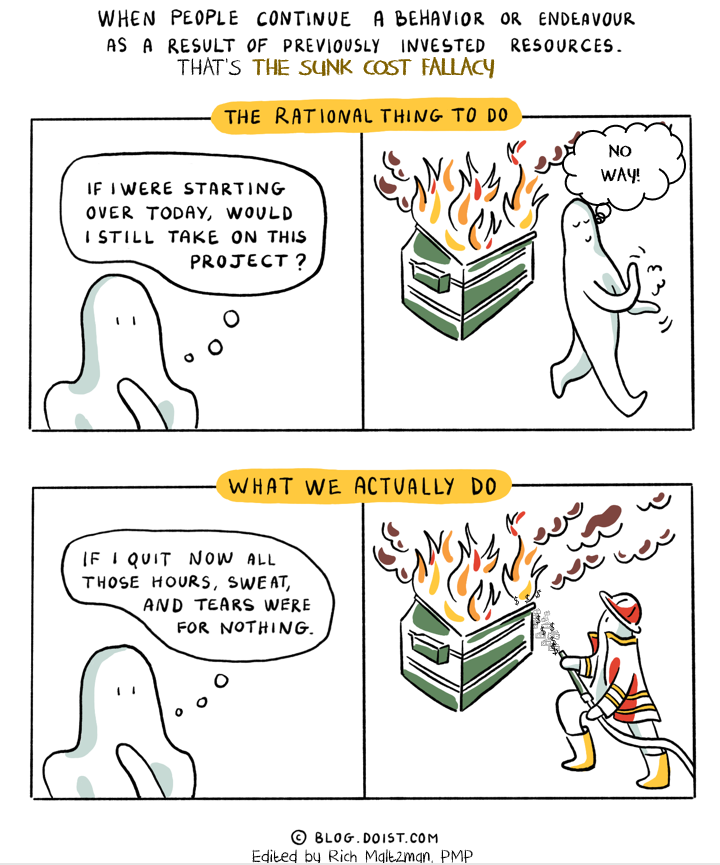
So what is the Sunk-Cost Fallacy? Basically, it’s the drive deep within (adult) humans related to the proverb, “waste not, want not”. As in the figure above, it’s about not ‘losing all of the toil (blood, sweat, tears) you have put into something. So we put MORE effort into it. That’s why the character in the last frame is pouring money into a burning project.
Test it out on yourself. Imagine you bought $35 tickets to a new hit movie. Due to the risk of getting COVID-19, you hesitate going. Also, friends who have gone say that it’s really just not that good. In fact, the roads are icy and you’re a little bit tired. But you bought the tickets. And, you go. And…it turns out that your friends were wrong. It’s worse than “not that good”, it’s absolutely terrible. Yes, you have just experienced the Sunk Cost Fallacy. There’s a nice, easy-to-read article about it here: https://thedecisionlab.com/biases/the-sunk-cost-fallacy/.
In projects this happens when we spend more money on a project that should have gone through a “phase gate” or “kill point” and should have been stopped right there in its tracks (pun intended again!).
You can find very easy-to-read articles on the Sunk-Cost Fallacy here or here.
The bottom (pun intended) line is that as project managers, we sometimes spend good money after bad. That is, we feel like we should finish a project because ‘so much has already been invested’.
This project actually was killed after several years. The timeline is roughly as follows:
In 1916, with an overwhelming vote of almost six to one, the citizens of Cincinnati said yes to spending $6,000,000 to solve its transit problems
The project was delayed due to the US involvement in World War 1.
Actual loop construction began after the war. There were a few minor delays because some Cincinnatians doubted that the $6,000,000 was going to complete the job. They felt that inflation from the war would cause costs to skyrocket, but the rapid transit board was not listening to any critics.
On January 28, 1920, the first steamshovel. of ground was lifted from the canal at Walnut Street.
Early 1921 inflation woes strike.
1922: Negotiations with nearby cities for rights-of-way delay the project further
The two mile subway tunnels were finished early in 1923. The above-ground sections of the loop were near completion by early 1927, but there was no money to equip any of it. Tracks had not been laid, several crucial links to the system were missing and the dollar balance in the books was near zero.
October, 1928: Central Parkway opened on top of the subway using some of the right-of-ways purchased for the rapid transit loop.
1929: problems continue. The city mayor discontinues the Rapid Transit Commission.
1939 the tunnels were researched for possible automobile traffic
In the 1950s, a massive 52-inch (1.3 m) water main was placed in the northbound tunnel to save $300,000 by not digging a new tunnel for the water main.
1966: The original $6M bond is paid off (with actual cost to the city being about $13M including taxes and interest)
1970s: Developers wanted to turn parts of the tunnel into an underground mall and a night club similar to Atlanta Underground (that plan fell through)
1980s: The city pitched the tunnels to filmmakers as a location to shoot subway scenes (that didn’t come to fruition)
2002: A regional light rail system was proposed to use the tunnels which would cost $2.6 billion and take thirty years to build. The tunnels were favored because they were in an ideal location, they could easily be used to connect the east side and the west sides of Cincinnati, and they would have saved the city at least $100 million in construction costs at the time. Interestingly, and showing voters’ low appetite for large government projects, the light rail plan, called MetroMoves, proposed a tax levy that would have raised sales tax in Hamilton county by a half-cent, and yet, the plan was voted down by more than a 2-to-1 ratio.
2017: shortly after the 100th anniversary of the tunnel construction, mayoral candidate Rob Richardson Jr. ran unsuccessfully on a platform that included reviving the subway system; however, this did not provide tangible construction plans or feasibility studies.
Currently: The abandoned tunnel is used to carry the relocated water main and as a route for optical fiber cables.
More detail on the tunnels here from the City of Cincinnati itself:
To view a full walkthrough of the Tunnel system from a couple of folks who call themselves The Forbidden Explorers, have a look at this:
In Part II, I will discuss the sustainability aspects of the decisions and relate them to some of the challenges facing the US in terms of infrastructure projects.
Reference: Arkes, H. R., & Ayton, P. (1999). The sunk cost and Concorde effects: Are humans less rational than lower animals? Psychological Bulletin, 125(5), 591–600. https://doi.org/10.1037/0033-2909.125.5.591
Three pioneers in PM and Sustainability have published a survey of over 200 project managers, called "The Voice of Sustainability Project Managers" and I’d like to share some highlights with you and even offer some partial answers to the challenges they identified in their analysis.
The authors of the survey, Kris Kohl, Pedro Echeverria, and Tom Baker(respectively from the USA, Brazil and Canada) have posted their survey as well as some introductory context here:
In order to keep this posting brief and to-the-point, I am going to quote their central findings and identified challenges below, and then invite you to look at the data in detail by clicking on the link above (or right here).
The central finding of this report is that organizations have adopted Sustainability strategically and are executing Sustainability initiatives, but their project managers do not have the resources they need to competently manage this process. Their challenges range from project methodology gaps to specific needs in achieving organizational change.
Our survey results indicate that 50% of organizations have their Sustainability program to a point that is consistent with a Triple Bottom Line (TBL) approach. Survey results suggest that the project management community is increasingly viewing Sustainability as relevant to their organization with 86% of respondents indicating that their organizations engage in some kind of Sustainability activities. The large percentage of respondents reporting that their organizations are on the Sustainability Continuum suggests that incorporating Sustainability into organizational strategy is a priority for senior management. This finding is not exclusive to this report. From a program and project management perspective, 69% indicate that their role is related either directly or indirectly to Sustainability but that incorporating Sustainability into projects remains a challenge. Respondents affirm that their roles as PMs are increasingly related to Sustainability and that more than 60% have professional experience working in the field of sustainability. Yet, most respondents felt that there are significant barriers in working with Sustainability projects especially from lack of strategic planning and coordination, weak organizational support, and lack of training. With respect to project management, respondents are seeking a better understanding of how to integrate sustainability into project management, especially around developing a culture of sustainability, engaging stakeholders and change management.
Extending risk management to incorporate sustainability risks
---
Let’s look at these one at a time with our “angle” on the topics, as well as pointers to resources:
Working with the Executive on Sustainability
Identify the mission statement of your own organization and use that to assure linkages to your project for decision making that reflects what your senior managers are thinking (as shown in the survey – they are thinking about sustainability).
The Sustainability Wheel (scroll to bottom of page to see a proposed tool to monitor and control how well sustainability is integrated into PM at an organization)
Get a good book or two or three on this topic!Get them for your PMO and distribute!Make sure they are stocked in any on-line systems like SkillSoft’s Books24x7®
Extending risk management to incorporate sustainability risks
18 formally-proposed changes submitted (by me) to the 6th Edition of PMBOK® Guide, especially in the Risk Management Knowledge Area
Go to the link above and help in this cause by commenting on standards such as the PMBOK® Guide but also the Program and Portfolio standards.The more of us who raise our voice, the greater the chance that there will be a “listening”



 Dr. Beverly Pasian