Following up on my last post about lessons learned, this brief post is about the need for collaboration. Lessons learned are meaningless unless they are collected from a diverse set of projects – and teams that tend to work in silos tend to ignore those well-collected lessons.
It focuses, of course, on science, but it is very project-oriented: in fact, the second word of the article is “projects”.
It opens:
Some projects are too big for a single lab. Or, for that matter, a single country. Hongkui Zeng, a neuroscientist at the Allen Institute for Brain Science in Seattle, Washington, is working on an ambitious project that spans the Pacific. Her team is attempting to untangle the subtle structural differences among groups of neurons in the mouse neocortex, where higher cognitive functioning such as sensory perception and spatial reasoning is processed. The pursuit requires major assistance from scientists in China, whose international research presence is strong, despite growing mistrust from the US government.
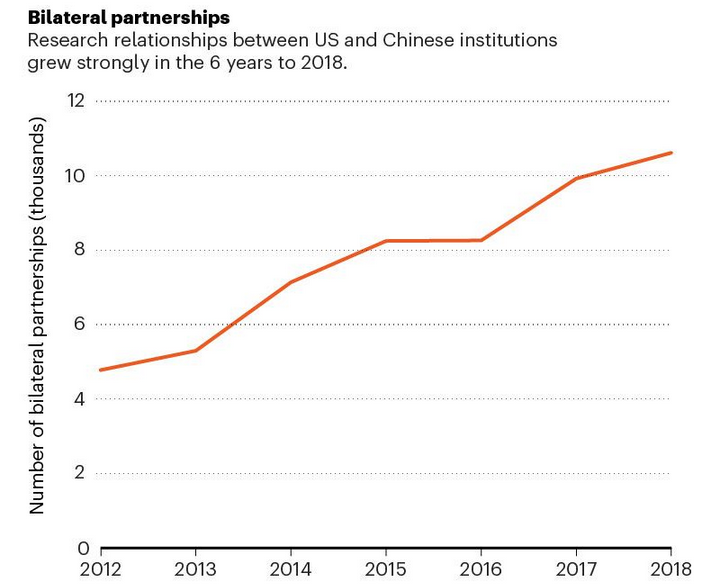
So the backdrop for this article is the fact that although tensions between nations might indicate otherwise, collaboration between Chinese and US project researchers is increasing (see chart below from Nature magazine). Why is it so important that science transcends political boundaries?
Like different silos in an organization, project managers, and scientists rely on a free exchange of wisdom. Project managers, like the neocortex of a mouse’s brain (in structure, not intelligence) rely on a strong network – and that network is increasingly global.
One example of a collaboration that is working is the Harvard China Project, which is quickly summarized in this video:
In this collaboration, which resulted in a Nature Sustainability paper, we find that China may be five to ten years ahead of schedule in meeting its Paris Agreement goals by 2030. The article co-authored by both US and Chinese researchers, who collaborated on the wok from Harvard and Nanjing University.
I was very encouraged by the article and its theme of collaboration. I hope you are, as well and that you push for inter-organizational and international collaboration in your projects.
This is a two-part story. In Part I, the crustacean is the villain. In Part II, the crustacean is the hero. Or… maybe it’s not so cut-and-dry. In any case, it is a two part story, and, as Yoda might say: “Read it, you can - learn from it you must”.
Just like in project management, stakeholders can be on either side of a project issue. Or, more interestingly, they can be on BOTH sides of a project issue.
Crustacean Frustration - Part I: The Crayfish Crime of Crater Lake(including a lesson in Stakeholder Management!)
Our story unfolds at Crater Lake. Crater Lake is a unique environment in south-central Oregon. It’s known for its natural beauty and crystal clear, deep blue water.
In the story you’ll find in this video, you’ll see that a series of decisions to attempt to preserve the environment of Crater Lake has led to some problems, one which threatens the existence of a critter that lives ONLY here – the Mazama Newt. That’s correct; this is the only place on the planet that you will find that species. Until the introduction of the Signal Crayfish (see feature photo above), the Mazama newt thrived here. And actually, the Signal Crayfish population was under control until suspected climate change effects have increased the temperature of the water by several degrees Fahrenheit. Now, the newt is on the run. Please watch this short video so that you can get the most out of this post.
The issue has launched several research projects and will likely launch one or more rescue projects as a result. These are green-by-definition projects (as discussed in both of our books) which are aimed at reacting to a realized threat which in turn is a result of a risk response from an earlier project.
You may ask: why was the Signal Crayfish introduced? Interestingly, the crayfish were introduced to serve as food for fish that were introduced in order to make Crater Lake a destination for fishermen. So, in effect the crayfish were introduced to be prey – to be fish food! Read about it in this extract from High Country News:
Over the past century, crayfish — aka crawfish, crawdads, or, if you study invasive species, “aquatic cockroaches” — have colonized lakes and streams from California to Taipei. In some places, as in Crater Lake, they were introduced deliberately to control weeds or feed fish; in others, they arrived accidentally as bait. They are, in many respects, the perfect invader: hardy, omnivorous, aggressive. “They have those big claws, and they’re really good at essentially brutalizing other animals,” says Jake Vander Zanden, a professor at the University of Wisconsin-Madison who has waged war against crayfish in midwestern lakes.
You don’t need to be an ecologist to guess what happened once the disastrous decapods arrived at Crater. The fish didn’t eat them, and all but two species (rainbow trout and kokanee salmon) eventually perished. The crayfish, meanwhile, persisted in the lake at low levels until the 1990s, when populations exploded — perhaps thanks to climate change, which may have warmed Crater Lake’s waters enough to stimulate rapid breeding. As the crustaceans boomed, they devastated aquatic invertebrates, like worms and midges, which plummeted by nearly 80 percent in infested areas.
So now the hunted have become the hunter. And they are also displacing and greatly endangering the Mazama Newt – which as you learned earlier are only found a this one location on the planet.
We see the effect here – on the environment, and on projects – from a very slight change in climate. In a way, this could be a ‘canary in a coal mine’ signal advising us of further potential problems, an early warning sign of other threats to be triggered by climate change, and of course projects to be launched to remediate them. The immediate threat is the possible elimination of the Mazama newt by the Signal Crayfish.
With all this talk of triggers and early warning signs, this could be a story about monitoring and controlling risks and issues. And it is, but it’s not the main spin of the story from our perspective.
So this is a lesson about the environment. And you can take significant value in the learning derived from the environmental piece. But there is a takeaway for project managers as well. This is where this blog lives – right at that intersection.
Here’s a project management connection: Stakeholder Management
Is the crayfish truly a villain? It is doing what we expect it to do in its environment. It’s the environment that changed. So as a project manager, if we look not only at power and attitude, but also interests, we know that the stakeholder will behave in its best interests – and that changes depending on the environment. In this case, the environment changes such that it continues to maintain its interests, but its power goes significantly up as it seeks to follow its interests. In your projects, look for the ‘signal crayfish’ out there – those whose power may go way up due to a changing environment. It doesn’t only happen in Crater Lake – it can happen on a new app development project just as easily.
The larger issue is the climate change indicated by the temperature rise in Crater Lake. Let’s move on to another story in which the crustacean is no longer a villain, but a victim – even a hero.
Coming soon... Part II: The Case Of The Missing Krill
As project managers, we are all about baselining. That is – determining a reference point from which we make rational judgments. We baseline scope. We baseline schedule. We baseline the budget. We do this so that we can make informed decisions about the actuals – comparing actual to planned and looking for variance. It's from this information that we make decisions - important project decisions.
In projects, this is done in the relatively short term. Even though projects can be decades long, we must remember that in the scheme of things, a 50-year project is – geologically speaking – a flash in the pan, if that. And that’s where the forams come in.
Forams? That's not a typo - we didn't mean forum. Although, there may be a forum for forams.
So - what’s a foram? They are simple marsh-dwelling creatures – technically called foraminifera, which are choosy about how much time they spend underwater, and so they turn out to be surprisingly precise indicators of ancient sea levels. Here's a picture of some...
In this article from today’s Boston Globe, you’d find the story of Professor Andrew Kemp of Tufts University, who is studying the ancient climate, “using lessons written in the sediment to discern historical patterns that could help refine models of climate change and sea levels. Generally, local sea level rise is calculated by taking the overall changes predicted by climate models and then factoring in the local conditions. But those are complex and aren’t all understood — a knowledge gap that research like Kemp’s could help fill.”
In other words, they are baselining.
The studies being conducted by Kemp have taken him from North Carolina to Long Island Sound, and now he would like to extend that work to Massachusetts, to build a fine-grained portrait of how sea levels have changed over the last several thousand years in order to make more informed predictions.
We found this story to be interesting in the dual connection to project management: first, the baseline element and second, the fact that it is indeed a project – one that our book Green Project Management would call a “Green By Definition” project.
And there was another, perhaps even stronger connection.
We’ve always treasured one particular aspect of project management – the fact that we are silo-busters. Read this quote from the article:
‘The work shows the importance in science of borrowing tools and insights from other fields. While biologists might be interested in forams and the ecosystems in which they live for their own right, geologists can use the different species of forams they find and their distribution in the sediment to extrapolate the conditions of the ancient marsh.”
Even within the field of science – there are clearly silos. And it’s this project team that is breaking down the walls between those silos to gain a positive outcome. That’s what projects are all about.