
A Half-Sextillion Nematodes (Part 1 of 2)
Categories:
science,
carbon,
analytics,
big dfata,
data analytics,
nematodes,
worms,
soil,
earth,
laboratory,
data,
Artificial Intelligence
Categories: science, carbon, analytics, big dfata, data analytics, nematodes, worms, soil, earth, laboratory, data, Artificial Intelligence


|
Big Data. Analytics. It’s hot now, and for good reason. The ability to apply machine learning and Artificial Intelligence (AI) to vast amounts of data to, for example, decide to put up an advert of a certain athletic shoe on your desktop, to decide whether a competitor may be worth acquiring, or to choose between investments. And although money is important, AI can be applied to much, much more than money. Think about the data of the Earth. Well, yes, the planet Earth, but also literally, the earth - the soil - on which you are standing (or the building on which you are standing … is standing). What’s under you? Soil, roots, worms. There is a laboratory in the Swiss Federal Institute of Technology, led by a man named Thomas Crowther. That laboratory has embarked on a project, which, in a way, is an accounting project. The thing for which it is doing the accounting is, well, it’s the Earth. Crowther’s lab is funded for 10+ years to collect individual observations (many, MANY of them) and use AI to reach conclusions about the count of trees, fungi, and, for example, nematode worms. So far, his lab has concluded that there are 3 trillion trees and 0.4 sextillion nematode worms. We'll come back to these little wigglers later. Why do this? Well, as project managers we know about baselines. If we are to make improvements and/or to understand the changes taking place so that we can make corrections or note the effect of attempted corrections, we need that baseline. All of this comes mainly from a cover story in the most recent edition of Nature magazine, in an article called, “The Everything Mapper”, by Aisling Irwin. It’s a fascinating story – partially because it’s a fascinating project. The project has already realized benefits, and has some lessons learned for project managers. For starters, when Crowther was getting started, he was at Yale and proposed the idea of using ground data from actual tree counts (satellite data can’t peer below the canopy). To do this, he needed to get scientists from different institutions to collaborate and share their data. He had to build a team from disparate organizations. Sound familiar? The professors around him though it was a ridiculous idea but he managed to do it, to the point where he had data representing an area the size of a US state. Granted, the state was Rhode Island, but still – quite an accomplishment. He then worked with data scientist Henry Glick to compare the ground-level counts with the satellite imagery to make informed decisions about how many trees there really were. The benefit realized was that the mapping done by Crowther and Glick (and others) was used to build the first global model of tree density – and the figure of “3 Trillion Trees”, which in turn changed the name of the UN’s “Billion Tree Campaign” to the “Trillion Tree Campaign”. Their database continues to serve the Forest Biodiversity Initiative, which studies and manages the world's largest tree-level forest inventory database. A snapshot of the status of the Trillion Tree Campaign is shown below.
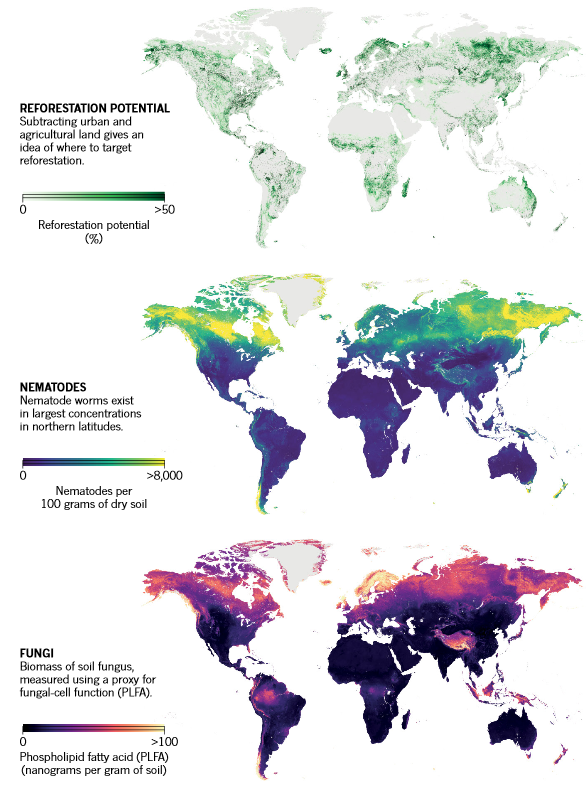
Another outcome – an important one – is a conclusion that “tree planting is easily the best way to remove carbon from the atmosphere, and could be the key to slowing global warming”. This is a conclusion that obviously spawns many new projects, but that’s another story. Let’s get back to nematodes for a bit. They're usually tiny, around 50 micrometers thick and 1 millimeter long - but the nasty parasitic kinds (this is sort of sickening) can be up to 3 feet long. They actually play an interesting role in solving climate change. This recent article from Brigham Young University covers that aspect. One thing of interest to note is that the biomass of the nematodes of the planet is almost equal to our weight. That is, add up the weight of all the nematodes and you have 80% of the weight of the entire human population! The relationship to carbon is summed up here: “Knowing where these tiny worms live matters because nematodes play a critical role in the cycling of carbon and nutrients and heavily influence CO2 emissions. An important finding of the paper is that nematode abundance is strongly correlated with soil carbon (more carbon = more worms). Understanding the little organisms at a global level is critical if humans are going to understand and address climate change.” Below is a figure from the Nature article summarizing the data from Crowther's research for trees, nematodes and fungi.
In Part 2, I will talk about more lessons learned for project management and more about the connection between AI and Earth. |


A Complex, Swirling Mess - Part 2
|
In part 1 of “A Complex, Swirling Mess”, I introduced the ideas from a brief story from NPR (link to the broadcast and transcript repeated here for your convenience). The story discussed how some companies are (in a valid, ethical way) profiting from the effects of climate change, by way of consulting and advising other organizations which need to deal NOW with changes that (whatever their cause) are going to happen in the next 1, 5, 10, 25, or 100 years. For a short story (the audio is only 3.5 minutes long!) it sent me on a journey of discovery about the fascinating business of actuarial science (see Part 1) and how climate change, in the spirit of secondary risk, is opening an opportunity for some companies. One of the companies featured in the story is Jupiter Intelligence. Jupiter is featured in this recent story from the Washington Post, entitled, “Climate change could put businesses underwater. Start-up firm Jupiter aims to come to the rescue”. Before you read about Jupiter, take a look at this report, entitled Risky Business, sponsored by Co-Chairs: Michael R. Bloomberg, founder, Bloomberg Philanthropies; 108th Mayor of the City of New York; founder, Bloomberg L.P., Henry M. Paulson, Jr., Chairman of the Paulson Institute; former U.S. Secretary of the Treasury, and Thomas F. Steyer, retired founder, Farallon Capital Management LLC. You can download the full report here. The key paragraph in the Washington Post story is: “This week, a high-powered, well-funded start-up company has barged onto the scene to help businesses and governments confront their increasing vulnerability to climate change and weather disasters. Using cutting edge technology, it could revolutionize how they receive information about weather and climate threats and make critical planning decisions. Known as Jupiter, the company was founded in 2017 by Rich Sorkin, a serial entrepreneur who has worked with Steve Jobs, Bill Gates, and Elon Musk. Sorkin was Musk’s first boss as chief executive of Zip2, a company that provided business directories to online newspapers in the late 1990s.” If you go to the “Team” page of Jupiter Intelligence you will see that they have hired many top experts in the area of climate science. Many of these have become available as the ‘difference in philosophy’ between the Obama and Trump administrations about climate change and science in general has become apparent. The demand is there. A recent article in Nature describes “The Rise of Demand-Driven Climate Services”. It’s important to note that this is different – very different – from weather forecasting. This is about climate – sweeping, significant, impactful change over longer periods of time. Jupiter offers tools that predict the impact of climate-related incidents in a specific place and accounting for very local issues, Including FloodScore™ and HeatScore™. They’re built on a platform called ClimateScore™ which “leverages cloud computing to run and link multiple prediction models that ingest data from millions of ground-based and satellite sensors”. “FloodScore and HeatScore predict not only precipitation and temperature changes, but also simulate their interactions with the built environment and the surrounding landscape and how they’re altered by climate change. In the assessing flood risk in New Orleans, for example, the analytical framework would take into account the convergence of wetlands and concrete and sea level rise”, says Richard Sorkin, the Founder of Jupiter Intelligence. Below is an example output of one of the analyses for flooding potential in New York City.
Jupiter is also featured in this article from The New York Times. In it, a key extract is: As global warming advances, experts say that governments will ultimately have to invest more in their own local climate prediction tools to help cities and industries adapt. But they also see a role for private climate forecasters, much as weather companies have sprung up to supplement the work the National Weather Service does. “The federal government could be doing a lot more,” said James L. Buizer, who studies climate adaptation at the University of Arizona. “But there’s still an important role for the private sector. If companies are going to benefit from this information, they ought to be paying for it. After all, it’s their infrastructure that’s going to get trashed.” That private sector, exemplified by Jupiter Intelligence, has a chance to turn a profit on climate change. As they do so, it also may bring more attention to the issue, but the point here is that – like project managers - long-term planners are best off making decisions from solid data, based in science, and that’s what Jupiter and others such as Coastal Risk are aiming to provide.
Of course, you can read more about Jupiter or Coastal Risk on their websites. |




