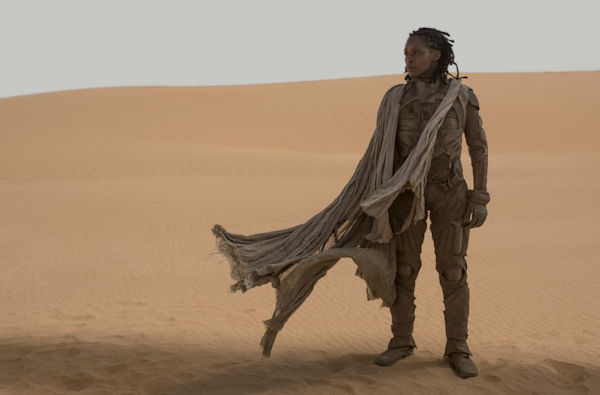
DunEcology - Part 0
Categories:
dune,
arrakis,
desert,
planet,
terraform,
construction 5.0,
frank herbert,
science-fiction,
sci-fi,
cli-fi
Categories: dune, arrakis, desert, planet, terraform, construction 5.0, frank herbert, science-fiction, sci-fi, cli-fi


|
In this first “teaser” post, I want to address and explore the connections between sustainability (or at least the environmental pillar of the Triple Bottom Line) and the wildly popular movie franchise Dune. Or, more accurately, I want to make readers aware of the connection between Frank Herbert’s novel from the novel first serialized in 1963 – before many of you were born, and perhaps before many of your parents were born! At that time, ecology was not really a ‘thing’. Gas (petrol) cost US$0.30 per gallon. The PMBOK(R) Guide didn't mention sustainability. I can guarantee that - because there was no PMBOK(R) Guide yet. Indeed, it would be 6 years until the Project Management Institute was founded. I would like to give you the background of the novel (and now the latest rendition of the film) so that you can better appreciate the story and better connect it to projects, programs, and portfolios, and better connect your project work to the realm of sustainability. By the way, for those of you who think it's silly to take a science fiction book and apply it to real-world project management on Earth, have a look at this extract from Science News. Herbert's imagination is scientifically plausible: "Not only did Herbert create a rich fantasy world, he also built a plausible planet, says Alexander Farnsworth, a climate modeler at the University of Bristol in England. A few years ago, Farnsworth and colleagues made a computer simulation of the climate on Arrakis. People could live on the desert planet, the team concluded, but Herbert probably should have relocated his cities closer to the equator than the poles." So, what could ornithopters, and the behaviors, beliefs, and technologies of a people called the Fremen have to do with projects – or sustainability? Quite a bit. Rather than provide a synopsis here, I advise you read this very short summary of the book from Brittanica (WARNING: there are some spoilers here!). Next, consider some of the concepts conveyed by Herbert: planetology, the idea of a Butlerian Jihad, to expunge humanity of Artificial Intelligence (AI), and the resulting creation of human computers (Mentats) who replace all computing devices, the development of clever technologies such as the stillsuit to preserve water in desert conditions, the creation of a body shield impervious to any (fast) motions, even the concept of ‘terraforming’ which could be considered an extreme application of Construction 5.0… all of these could be considered portfolios of projects and programs – and most of them were triggered by ecological changes on the planets in Herbert’s universe. For now, have a look at this extract from an excellent article from Salon which precedes the release of the latest movie series by about 10 years: Gerry Canavan, assistant professor of English at Marquette University and co-author of "Green Planets: Science Fiction and Ecology," sums up the novel's legacy well when he writes in an email interview, "'Dune' is really a turning point for science fiction that takes ecology seriously as a concept." Frank Herbert's son would be among the first to agree with that assessment. In "Dreamer of Dune," his 2003 biography of his father, Brian Herbert recounted many instances that demonstrated his father's interest in environmental issues, including his backyard experiments with solar and wind power. In a telephone interview from his home near Seattle, the younger Herbert said, "In 1970, on the First Earth Day, Frank Herbert spoke to 30,000 people in Philadelphia and he told them, 'I don't want to be in the position of telling my grandchildren, 'I'm sorry, there's no more Earth left for you. We've used it all up.'" As I mentioned, this is only a ‘teaser’ post. I haven’t even mentioned Dune’s giant Sandworms and the economic impact of Spice yet. But that’s coming, and there are some elements of that that fall directly into that intersection between project leadership and sustainability. So have your crysknife ready as we’ll soon slice and dice these concepts together!
|