
Trouble in Tin City


|
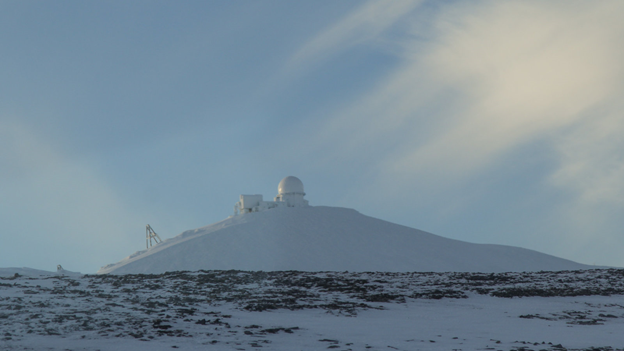
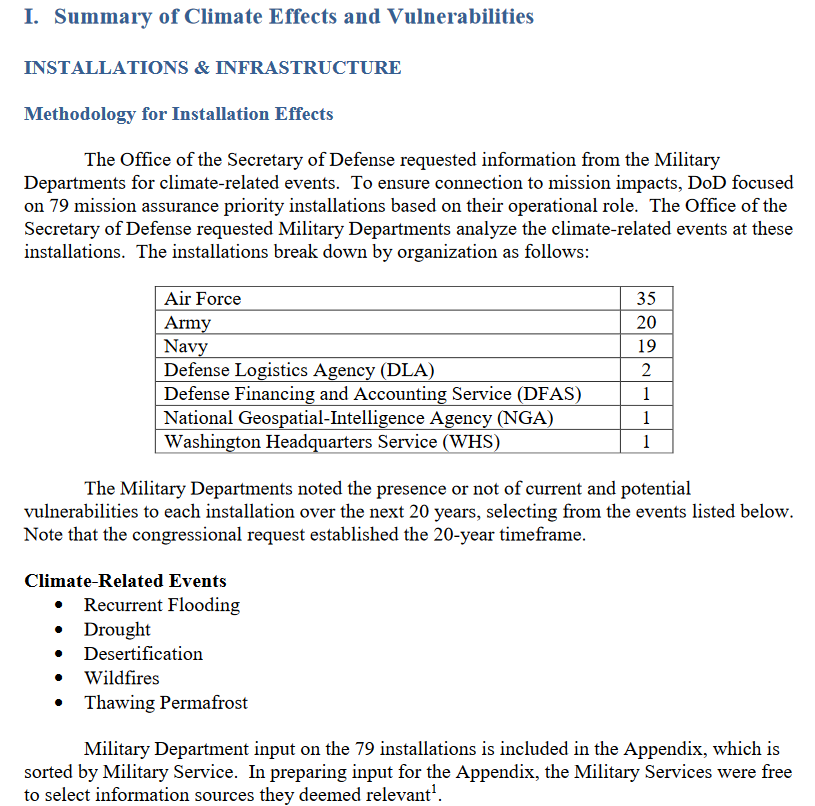
This is the first of what will be at least two posts on the effects of climate change on US Department of Defense installations, based on publicly-released documents from the present administration’s own departments. The focus will be on projects launched because of climate change, recognition of climate change as a driver of projects, and the need for project managers to be well-informed of the facts related to climate change and the facts related to how governments react to the effects of climate change. One point of this series is that regardless of your view of climate change – whether you believe it is happening or not, and if so, what is causing it – is actually much less important than understanding what governments are doing about it regardless, and what that may mean for projects and project managers. In this first part, I’ll cover the issue in general and illustrate this with one example of a these effects, and the possibilities for project managers – the example being in Tin City Alaska. I’ll follow up with a story about a wall, but not one on the border with Mexico, one pretty much on the border with Russia. The story that caught my attention was a very short podcast from NPR entitled “How Climate Change Is Affecting Alaska's Military Radar Stations” which you can listen to right here: The story is that the changing climate poses a threat to the radar installations. 3 out of 15 are facing situations in which shifting ice, based on more-rapidly-than-expected changes in ocean temperatures and sea-level rise, as well as shifts in the way sea ice blocks (or does not block) the approaches of storms, are debilitating those stations, with the other 12 possibly next (excuse this pun) on the radar. You can read more about the Tin City story in this article: Here’s a sample extract from the story if you don’t care to listen to the podcast: Running these radar stations has never been easy, but now, it’s getting even less manageable, as coastal erosion nibbles away the land around vital infrastructure supporting the sites. Col. Lemon is the Air Force commander in charge of remote radar sites stretching from the Pacific to the high Arctic. “I’m a military officer, so global warming, I dunno,” Col. Lemon said with a shrug during a briefing about the sites. The admission aimed at humility, denying that in his position he had the authority to offer grand scientific explanations. But for almost a decade, the Defense Department has acknowledged that a rapidly warming climate poses a threat to the military’s installations and operations around the globe, and they’ve initiated plans to cope with it. “Climate change is happening and there is erosion going on on the North Slope of Alaska. That’s a fact,” Lemon said. “I don’t know what’s causing it, but we have to do something about it, because it’s impacting our mission.” So far, three radar stations, all of them in the North Slope, are grappling with climate-driven threats to infrastructure. The installation at Tin City is not immediately imperiled by this issue. However, during our visit in mid-November, the Bering Strait, easily visible from throughout the lower camp, was an uninterrupted dark blue, the water completely free of sea ice. Much of the motivation for the new projects to be discussed in this series comes from a newly-released 2019 report from the US Department of Defense. Below is the cover, the Background, and a paragraph that shows the main areas of climate-change-related concern from this report from the Trump Administration’s own Department of Defense.
In the next post, I’ll discuss the US$47M seawall project under construction at Cape Lisburne, Alaska. |


Terror Under the Tundra
Categories:
arctic
Categories: arctic
|
In my previous post (The Promise of the Waxworm) I discussed some of the ideas of secondary risk, applied lightly to concepts of sustainability and focused more on the definition of secondary and residual risk. Consider this post a sequel. In this post, I’d like to tie the concept a little more tightly to climate change to illustrate a rather extreme form of secondary risk which almost sounds like residual risk (leftover risk) because of the lengths of time involved. However – it is indeed secondary risk – particularly secondary threat, perhaps a big one, as you’ll see. You may want to be seated for this, it’s a bit alarming. Are you seated? Okay. Proceed. Let’s start with a quote from the BBC Earth article from which most of the inspiration for this blog post arrived. “scientists have discovered intact 1918 Spanish flu virus in corpses buried in mass graves in Alaska's tundra. Smallpox and the bubonic plague are also likely buried in Siberia.” And unfortunately, it is not just ‘scientists discovering’, or laboratories or rats. It is about real people, suffering illness or even death from such problems. As an example from the article: "In August 2016, in a remote corner of Siberian tundra called the Yamal Peninsula in the Arctic Circle, a 12-year-old boy died and at least twenty people were hospitalised after being infected by anthrax. The theory is that, over 75 years ago, a reindeer infected with anthrax died and its frozen carcass became trapped under a layer of frozen soil, known as permafrost. There it stayed until a heatwave in the summer of 2016, when the permafrost thawed. This exposed the reindeer corpse and released infectious anthrax into nearby water and soil, and then into the food supply. More than 2,000 reindeer grazing nearby became infected, which then led to the small number of human cases." So, yes. This is about the fact that global warming (whatever the cause) and other activities are bringing back some ‘golden oldies’ and ‘one-hit wonders’ that we really, really didn’t want to hear ever again. As a reminder, secondary risk is a new risk (usually a threat – and in this case, definitely a threat) caused by a risk treatment or risk response. In this case, the new risk is actually not caused by a risk response, it is caused by global warming. And here’s a little-known fact: global warming is occurring at a much faster rate and with more extreme effect in Arctic regions than anywhere else on the planet. So for those of you who may say “so what?” to the melting ice, and even the sea-level rise, I’m not sure you’d say “so what?” to the rejuvenation of viruses and microbes for which current humans do not have any built-up immunity. And in the BBC Earth article there are many examples – not just Spanish Flu. More “oldies but goodies” include:
Microbes live a long time when they’re properly frozen. A really, really long time. From the article: Recently, scientists managed to revive an 8-million-year-old bacterium that had been lying dormant in ice, beneath the surface of a glacier in the Beacon and Mullins valleys of Antarctica. The other thing to consider as a project manager – especially if you are involved in exploration, mining, or energy, is this: “global warming does not have to directly melt permafrost to pose a threat. Because the Arctic sea ice is melting, the north shore of Siberia has become more easily accessible by sea. As a result, industrial exploitation, including mining for gold and minerals, and drilling for oil and natural gas, is now becoming profitable. At the moment, these regions are deserted and the deep permafrost layers are left alone. However, these ancient layers could be exposed by the digging involved in mining and drilling operations." Do you have this threat listed in your risk register? You may want to at least consider it. Sounds like science fiction but it turns out to be science fact – and that means it's a project management fact. |


Core Values and Permafrost
|
As project managers, we normally think of core values as beliefs that are very important to an organization. As Oxford’s Dictionary puts it, a core value is “a principle or belief that a person or organization views as being of central importance”. ...and this is a theme we’ve discussed many times in this blog and on EarthPM – the need for projects to connect to the core values of their organization, using that connectivity to drive motivation for project team members, because if they know that their project work connects to project success, which connects to organizational success – it provides a sort of golden thread. This post is not, however, about that type of core value. Well, it is – but only tangentially. This post is about the literal values determined by scientists when they take core samples of the thawing Arctic tundra, to better understand the effects of climate change on the tundra, and – unfortunately – vice versa. You see, based on recent research highlighted in this article from the most recent issue of Scientific American, there is a bit of a spiraling effect here. Record warm temperatures are thawing the Arctic tundra’s permafrost, which allows the decomposition of plant and animal remains in the warming soil, which in turn is potentially allowing almost 1,500 billion metric tons of organic carbon to be released into the Earth’s atmosphere. That’s almost twice as much carbon as that which already exists in the atmosphere. And it’s not just carbon – it’s methane, which is much more powerful as a greenhouse gas. In other words, climate change has opened the door to accelerating climate change, which…which causes more climate change, which accelerates... well, you get the picture. In the article, author Ted Schuur discusses the scientific research project, which involves taking core samples, and recording significant amounts of data to better understand this dangerous scenario. In fact, there is something called The Global Terrestrial Network for Permafrost – and it is loaded with the data taken from tundra core samples in the Arctic. Below is a short video explaining their work:
The Permafrost Carbon Network started in 2011 and their main objectives are to synthesize existing research about permafrost carbon and climate in a format that can be assimilated by biospheric and climate models, and that will contribute to future assessments of the Intergovernmental Panel on Climate Change (IPCC). Their site contains research and maps of the core samples which indicate that this problem is serious and needs further study. The point of this post is to remind us as project managers that there are project risks, and there are overarching risks (both threats and opportunities). In this case, we see a massive overarching risk of not just climate change, but accelerated climate change – a nasty feedback loop, if you will – that we should understand. The research projects being undertaken by these scientists is important. Already, the research is yielding answers. The question as to what percentage of the carbon pool will be released by thawing permafrost has been answered, using the data and expert judgment of the Permafrost Carbon Network: it’s 10 percent plus or minus 5 percent. This is 130 to 160 billion metric tons of additional carbon entering the atmosphere, similar to the amount of carbon released worldwide thus far by deforestation and other land-use changes. It will make climate change happen even faster than scientists project from human activities alone. What can we do as project managers? I return to the primary definition of core values. Most of your organizations include sustainability, including ecological sustainability in their core values. Make sure your projects are connected to those core values. Your project includes and outcome. That outcome will have an ecological impact. Have you thought about that impact - the steady-state impact? Or are you focused only on the handover of the product of the project? We hope it's the former. Every change you make is significant, especially put in the context of this accelerated view of climate change. If your project can produce an outcome that is even slightly less impactful to the environment, it’s almost like a ‘matching donation’ program – the effect could be considered even larger, based on what this research shows us. So please – learn more about this issue by visiting the links we’ve embedded, and consider that ‘golden thread’ when you set the ground rules and objectives of your project. Connect them to your organization’s core values! Further reference, from NASA: |



