What Hath Gold Wrought (PG-13)


|
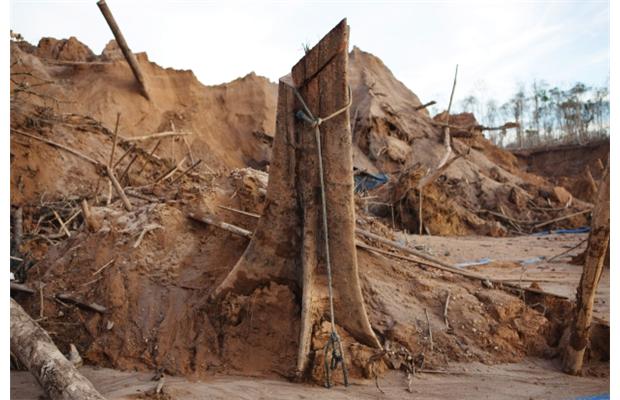
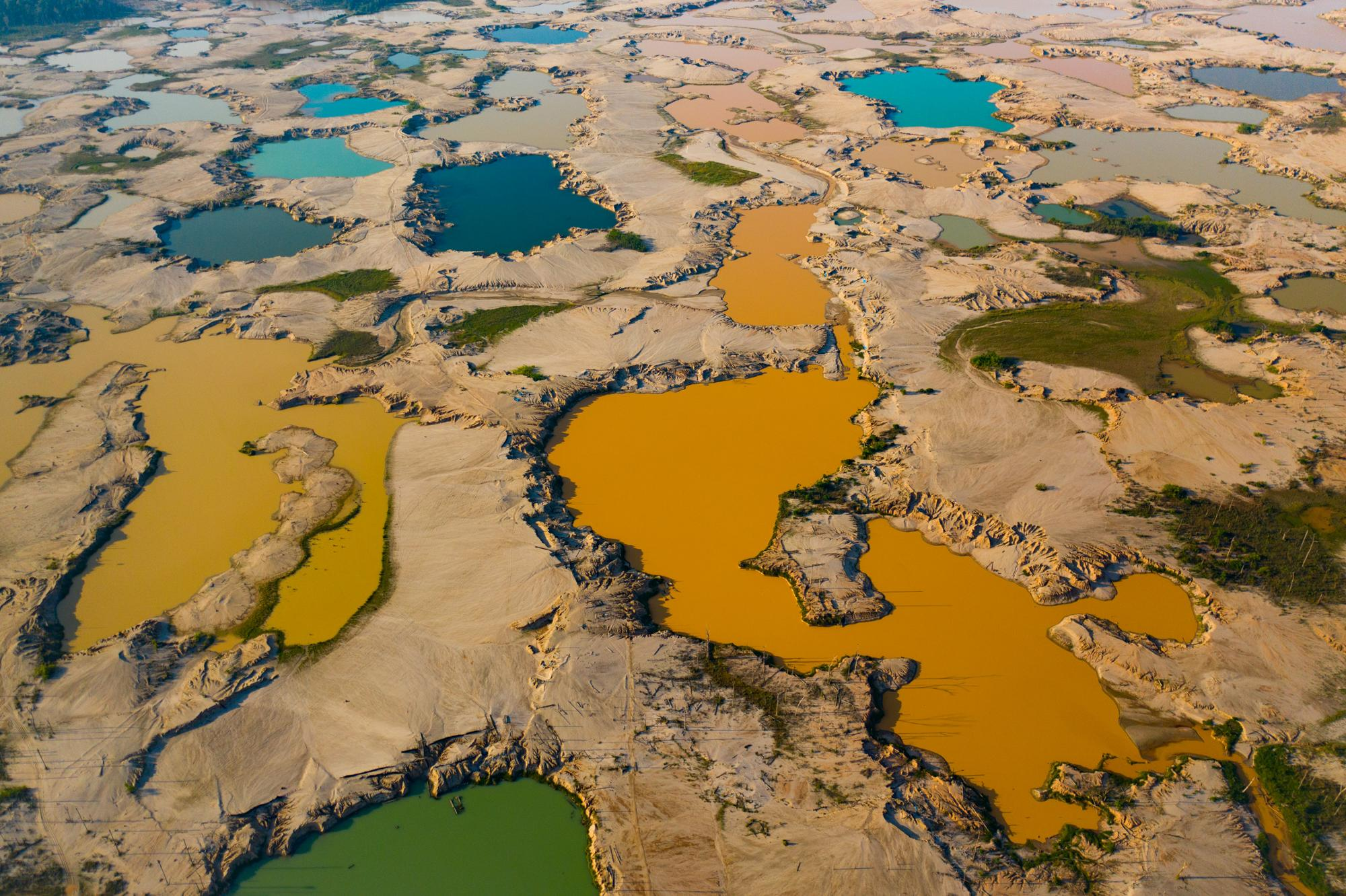
Photo: Rodrigo Abd, AP First up: a quick geography quiz: Most of us know that the Amazon rainforest is mostly in Brazil. That is true… but the question is -True or false: The Amazon also extends into Peru. Answer: Very much true. In fact, only 60% of the Amazon rainforest is in Brazil. The next largest chunk is in Peru (13%), Colombia contains 10%, and the Amazon also extends into Venezuela, Ecuador, Bolivia, Guyana, Suriname and French Guiana. Why this question? I was intrigued by an article in Nature’s most recent edition called “Can A Rainforest Destroyed By Gold-Miners Bounce Back?”. That forced me to better understand the extent of the Amazon, since the article is about gold mining in Peru, and its effects on the Amazon. About the blog post’s title The title of this blog post is a slight take-off (one letter away) from the first telegraph message sent by Samuel F.B. Morse in 1844. The PG-13 is there because of an expletive in the first sentence of the Nature article. Who knew that a respected science journal would start off this way? But I sort of like it – and when you read about it, you will see that it fits. So here is how the article starts: “Holy shit!” Miles Silman gasped as his motorized rickshaw rattled out of the forest and onto a desolate beach. All traces of the trees, vines and swamps that once covered this patch of the Amazon had vanished. In their place were sun-baked dunes and polluted ponds created by illegal gold-mining. Silman, a conservation biologist at Wake Forest University in Winston-Salem, North Carolina, was there to document the carnage. The size of the area is not trivial – we’re talking 5 and a half Manhattans. It’s big, and it’s ugly. How would one describe this? Photographer Jason Houston of the International League of Conservation Photographers, describes it this way: “The temperature as we left the Interoceanic Highway at km98 was climbing towards 101 and the humidity was almost as high, hinting at the hellish landscape I was about to witness. A few hundred yards drive from the main road, through back alleys lined with squatter’s quarters and makeshift sundries shops, we came to a wall of black sandbags and a corrugated metal gate. Beyond this militarized guard post was one of the main tracks into the infamous, lawless, otherworldly gold mining region of La Pampa. A short ride in a three-wheeled cargo cart through some leftover forest, the view exploded open and I entered the belly of a beast that I’d dreamed of exploring since my first, crushing introduction to the region in 2015.” The reason I’m writing about this in a project management blog is simply that the concepts of project management are threaded throughout. NOTE: to best understand this two-part blog post, it’s best if you start with some background and context. I highly recommend you start with this article from The Guardian. That article starts like this: Located along a jungle highway in the Amazon around 60 miles from the nearest city, La Pampa was a place you entered at your own risk. At night it was a riot of neon lights and pulsating cumbía music from “prostibar” brothels, frequented by roaming groups of men flush with cash. Neither authorities nor outsiders – and particularly not journalists – were welcome. This modern-day gold-rush town, home to about 25,000 people, was both a hub for organised crime and people trafficking and a gateway into a treeless, lunar landscape pocked with toxic pools created by illegal gold mining, stretching far into one of the Amazon’s most treasured reserves. But if you are a visual learner (like many of us project managers) you will actually do better looking at some pictures with a bit of narrative.
Photo by Jason Houston / iLCP - see much more here.
This site gives not just ‘pictures’, but amazing, detailed, professional imagery that will make this very, very compelling to you. Visit this ‘storymap’ provided by the aforementioned iLCP, the International League of Conservation Photographers. It’s worth it. Then come back here. A project that will become a Portfolio of Programs and Projects After the Peruvian government raided the area to rid it of illegal miners, it began an initiative – you could think of it as a Portfolio. From the article, the initiative includes: a major reforestation effort — as well as the jobs that it might produce. Working with CINCIA, Peru’s park service and environment ministry have already launched their pilot reforestation project on 30 hectares of the Tambopata National Reserve. The agencies are planning to replicate that work across more than 750 hectares in the reserve. Baselining Mercury One of the problems with gold mining is the use of mercury to bind the gold. Anyone can collect the local silt, which contains gold dust. Even a ‘beginner’ can mix in mercury, to recover as much as several hundred dollars’ worth of gold a day. So the restoration project needs to start with an identified baseline of where the mercury is, and how it got there – so that risk can be properly identified. Risk Risk – and cause/effect – is really a theme throughout this story. In fact, the entire situation of ruined land is a matter of doing this mining without thinking of consequences. But it goes beyond that. In the restoration project itself, project risks (threats and opportunities) are rife. Here’s an example: “What happens if the price of gold is very, very high?” (Silman) asks. “Maybe the illegal miners come back to La Pampa, and there will be conflict with the people who are working in reforestation.” The government would like to make this land useable again. That means farming and fishing. To do that, the land and water must be safe (for example clear of mercury), because if not, the fish from the ponds will contain mercury as well – a major health threat. So far the testing indicates that the land is safe but the ponds are heavily contaminated with mercury. <><><><><><><><><><><><><><><><><><><><><><><><><><><><><><><><><><> Part 1 has focused on the cause (the mining) and the effect (the poisoning and destruction to the Amazon). Part 2 will go much further into the restoration project. |
Intermingling Risks
Categories:
climate change,
risk response,
interacting risk,
seawater,
seawater temperature,
bluefin,
bluefin tuna,
mercury,
MeHg
Categories: climate change, risk response, interacting risk, seawater, seawater temperature, bluefin, bluefin tuna, mercury, MeHg
|
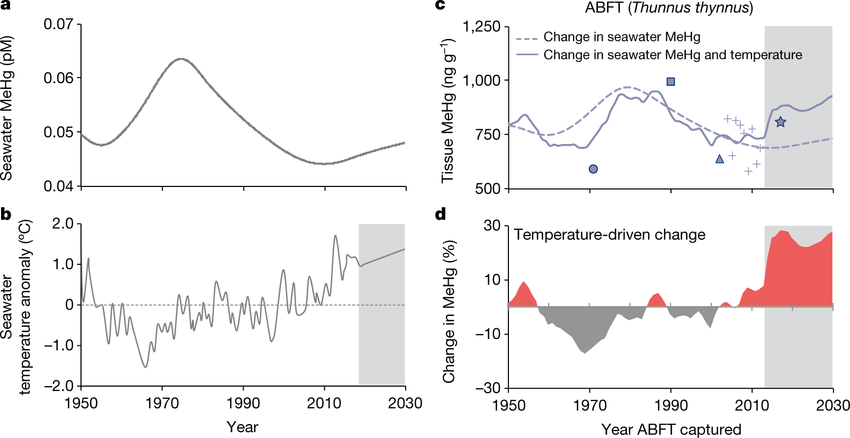
Today, I’m going to go a little bit ‘science-y’ on you, but it has a payoff in terms of understanding risks – and project, program, and portfolio managers must know how to deal with risk. This post has its roots in a recent article from Nature magazine, “Climate change and overfishing increase neurotoxicant in marine predators” (Schartup et al). Three billion people rely on seafood for nutrition, and billions of others have it as part of their diet. But this comes with a risk – consumption of methylmercury (MeHg). Mercury from natural and human-produced sources goes into the ocean, to the tune of 80% Microorganisms convert this mercury (Hg) to MeHg, and in predatory fish such as tuna and swordfish, the MeHg concentrations are amplified a million times or more. People are thus exposed to MeHg in high concentrations, and that is not good. MeHg causes neurocognitive in children, a problem that can persist into adulthood. This costs society, not only in the suffering of families but also in monetary terms – with the costs estimated to be over $20B. So here’s the connection to project management. Although “seafood” is not a project, nor is “fishing”, the increased presence of MeHg is clearly a threat. Nations have responded to this threat with the Minamata Convention on Mercury, in 2017. You can learn about the Minimata Convention here from the video below. Is your country a signatory? Colombia just signed a few days ago. Check that out here: http://www.mercuryconvention.org/Countries/Parties/tabid/3428/language/en-US/Default.aspx As project managers, we importantly check risk response to see if it is effective and/or if other actors or effects. This is a critical process because risk is dynamic, and sometimes risk responses even generate new (secondary) threats. Here, the scientists studying MeHg looked at the effects of overfishing and climate change on MeHg concentrations in fish. What they found, using over 30 years of data analytics, showed that overfhishing of Atlantic Cod caused a 23% increase, and rising temperatures caused by climate change have caused a 56% increase in MeHg in Atlantic Bluefin Tuna (ABFT) (see Figure below – source is Nature Magazine, Volume 572, August 2019).
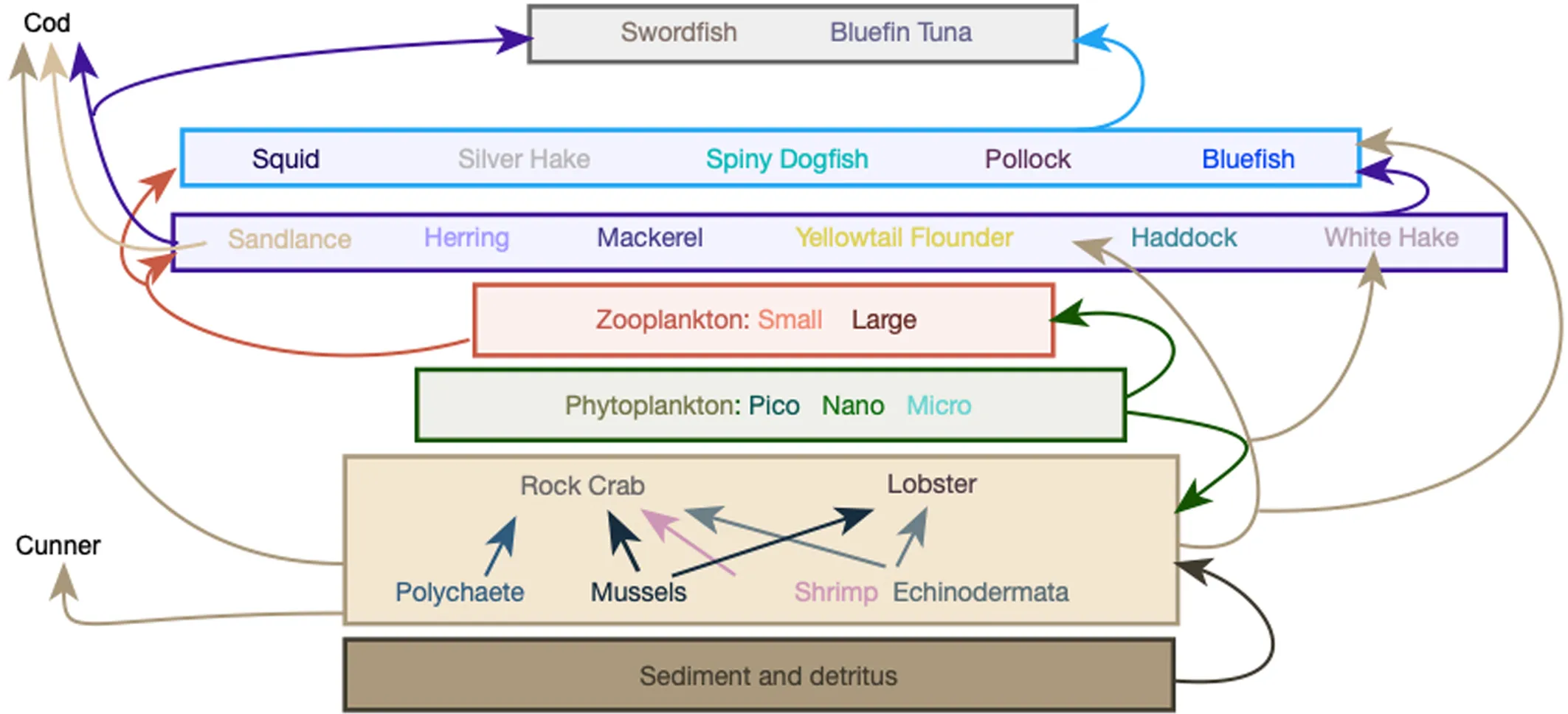
In the chart on the bottom right, you can see that MeHg levels have gone UP, despite the reduction in the amount of mercury in the ecosystem (that lower amount resulting from the Minamata Convention), and that those increases are in alignment with seawater temperature increases. The bottom line is that ocean warming and fisheries management will be key factors in modulating the threat of MeHg in our diet. It turns out that the quantity of this neurotoxicant is not limited only to the depositing of mercury in the oceans, it’s about the ocean “as a system” (See figure below) and the way that this system processes mercury, and how other effects – to which we contribute – change the concentrations.
This is only one example of how human activity can complicate and exacerbate other problems, and the takeaway for project managers is to understand how risks intermingle and interact. Think of the risks in your project(s). Have you stepped back and considered how they interact?
|