

What is AI doing to the sustainability of our profession???


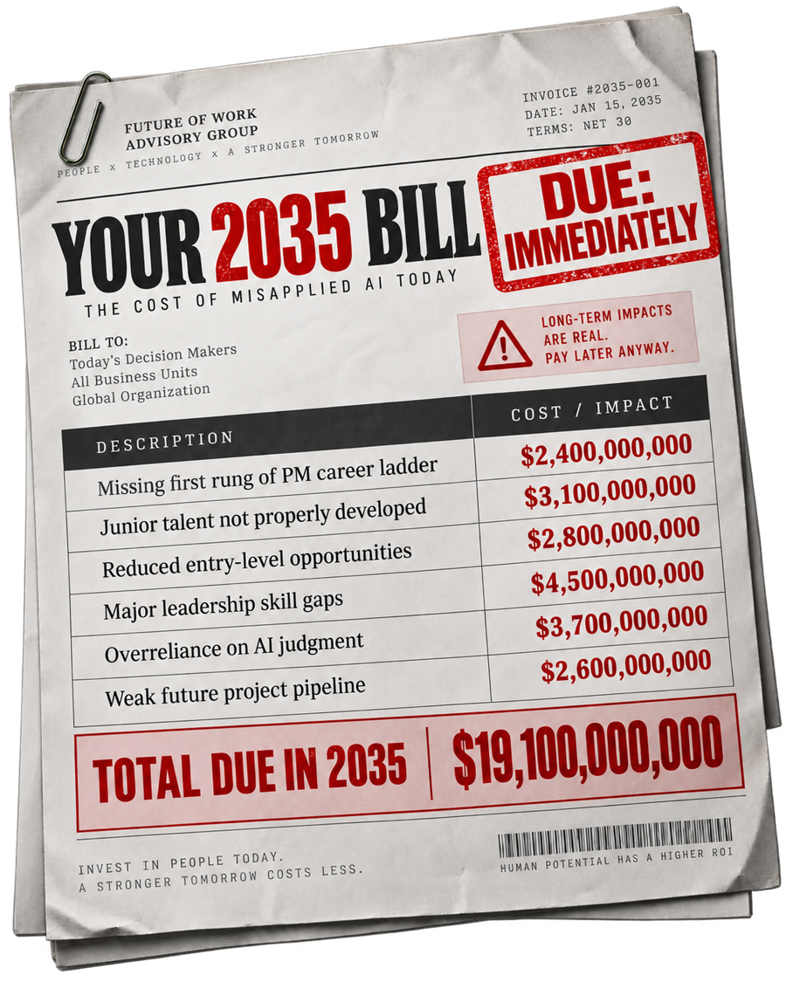 In this post I would like to talk about sustainability, but not in the sense of planting trees, saving whales, reducing or capturing carbon, or recycling plastics. The focus in this post is on the root of sustainability – “sustain”. The post was triggered by Ricardo Vargas’ post today - https://www.linkedin.com/pulse/who-senior-project-manager-2035-ricardo-viana-vargas-ph-d--dxpze/ The thing to “sustain” in this case, is our own career of project management – although, I increasingly push for a name change to project leadership. Ricardo discusses the impact of AI on junior or entry-level project managers. As a “pracademic’ – one who has had a 40-year career in industry and a parallel 30-year career as an instructor of project management curricula, I have seen literally thousands of young project managers go through exactly the same ‘rungs’ as Ricardo describes in his post. I highly recommend you interrupt your reading of this post and come back to it after reading his. I say this realizing that I may lose many of you because his post is just that good! If I still have you here, and I hope I do, here are the main three points of his post: 1. The first rung is missing Ricardo talks about the project management career as a sequence. I'm used to "career path" (or - as the name he used implies - a ladder) but I think he's right in making this subtle differentiation. “You did the administrative work, you were exposed to real projects while the stakes for your mistakes were low, somebody noticed you were reliable, and you were handed something slightly harder. Take away the first stage and the sequence does not start. There is no obvious replacement for it, because the first stage was never designed. It was a by-product.” 2. The seniorization trap Junior roles are not vanishing quietly. Many of them are being rewritten. Ricardo points out, and I know this because I advocate for my graduating PM students, “Entry-level positions now ask for stakeholder management, business judgment, executive communication and the ability to challenge a plan.” Ricardo points out that these are normally senior attributes, gained through human expertise and experience. 3. The bill arrives in 2035 Ricardo goes on to make what I would call the “long-term thinking” (sustainability!) argument. He points out that the use of AI to replace basic planning and scheduling results in ‘instant gratification’. There are immediate and visible monetary benefits if AI ‘replaces’ planning and scheduling tasks. But the cost is not eliminated. It is deferred – and as Ricardo says, The bill arrives in 2035 – when, probably, someone other than those decision-makers are forced to deal with it. I agree with 94.775% of what Ricardo says, and I particularly love this quote: “Judgment is pattern recognition built out of consequence.” He does have one statement with which I take some umbrage, perhaps it is ego or defensiveness on my part. “…judgment is not information, and it is not something a classroom transfers.” I agree with the first part – 'judgment is not information'. This is the whole basis of applying critical thinking in your conversations (and I hope they are conversations, not 'google-like searches'). AI can provide you with outputs (information) but it’s up to the human expertise and experience to make judgments. It’s that second part, ‘not something that a classroom transfers’ that bothers me. If we’re talking about one classroom, and the classroom is a classical one-way lecture, sure, this is true. But good training and knowledge transfer takes place in a sequence of courses and experiences. And those courses – if they’re mine – are NOT classical one-way lectures, they are sketches and skits and building model football stadiums and planning pizza parties in groups. This is what a good project management (or should I say, project leadership) program conveys. And this is where I think we agree 100%. Ricardo goes on to talk about what PMOs and organizations should do to sustain project management (LEADERSHIP!) for the coming decades as AI continues to permeate the world (the world of work as well as the broader world). I highly recommend you read his entire list but I highlight one, since I am in the business of developing and teaching project leadership courses: Make the learning explicit — We used to get it as a by-product and never had to design it. Now it has to be designed: rotation, shadowing, decision reviews, structured post-mortems where the junior presents and defends. This has been my mantra, whether it was as an internal trainer or coordinator of training programs in industry, or now as I plan curricula and run (very interactive) courses in project leadership. Make the learning as real as possible and explicit. Think of it this way: I ‘m trying to reduce that bill you will receive in 2035. Perhaps you are in a PMO or Center of Excellence. Perhaps you are a Portfolio Manager, or a mentor for several younger project leaders. If you are in a position to affect how the career path for project managers is shaped in your organization, take heed of Ricardo’s important message – it will help sustain your organization and project management itself. |
Stepwells – Insight from a Particularly Valid Angle
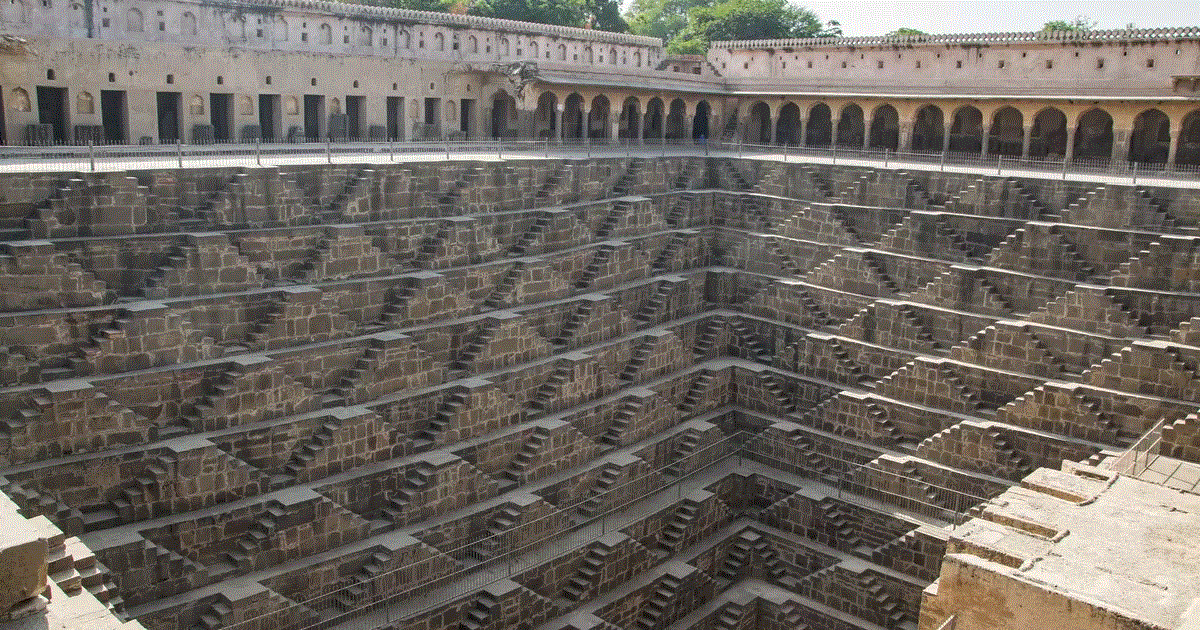 Source: Lonely Planet In the first post in this series, I looked at India’s ancient stepwells as remarkable examples of infrastructure designed not simply to be completed, but to keep delivering value as conditions changed around them. Their builders worked with local geology, seasonal rainfall, groundwater, community needs, and time itself—what we would now call systems thinking, resilience, and sustainable design. There’s a difference between studying 1,000-year-old pieces of infrastructure and talking with someone who grew up in the place that created it. So for this installment, I wanted to add another perspective: that of a civil engineer who was born and raised in Gujarat, where vavs—stepwells—and other traditional water systems were part of the landscape and the culture. Dipak Shah (see bio and photo below) brings something particularly valuable to this discussion. He can look at these structures both through the eyes of someone who grew up in the region and through the eyes of an engineer – a civil engineer at that! That combination lets us move beyond (quite deservingly) admiration of architecture and ask harder questions: What actually made these systems work? Why did many of them fall out of regular use? Which ideas still make engineering sense today? And should we be restoring the old structures themselves—or applying their underlying principles to new infrastructure? Our conversation also touches on something especially relevant to project leaders: knowledge transfer. Much of the expertise behind these systems was passed from generation to generation through practice and oral tradition rather than through the kind of formal documentation we would expect today. As I noted in the previous post, when that chain is broken, the loss is not simply historical—it’s a lessons-learned problem on a very large scale. With that, let’s hear from Dipak. His (insightful) answers are in bold blue. What stands out about the design of a stepwell, from an engineering perspective? What stands out most is the balance of aesthetics and functionality in the structure, designed and constructed by a group of artisans and craftsmen locally known as Vishwakarmas (architects and builders). Their work reflected design and construction experience passed down from generation to generation, along with personal ingenuity. Their work was guided by trade books known as the Shilpa Shastras and Agama Shastras, which were essentially the handbooks available to engineers of that time. Just imagine constructing complex structures like Rani Vav using nothing but a plumb bob and a square; those were the kinds of tools the artisans used for such structures. Another striking feature of the stepwell is its complexity and its ability to serve its intended purpose even after nearly 1,000 years. Today, we talk about public-private partnerships. These structures are prime examples of privately conceived and financed public works. Many stepwells, or vavs, were constructed for public use by wealthy individuals or local rulers in memory of their loved ones. I haven’t visited Rani Vav in Ahmedabad or Patna, even though I have been to both cities. Many times, these structures were closed for repair or restoration. However, I have visited a comparatively smaller vav (stepwell) in my hometown. My father owned a farm where he constructed a well, a kind of miniature version of a stepwell. The well was 16 ft in diameter to a depth of 20 ft, and 10 ft in diameter from 20 ft to 30 ft in depth. Instead of steps, he installed rungs to the bottom of the well and a platform at mid-depth. The water from the well was used primarily for irrigating the farm, as well as for drinking, cleaning, and bathing. Dipak, tell us about the transition from traditional systems to modern infrastructure, especially any personal recollections from Gujarat. I was born and raised in a town in the state of Gujarat, where public and private wells were the primary sources of water for drinking and household use. Water from some of these wells was considered hard because it contained higher concentrations of salts and chemicals, making it suitable only for household use and not for drinking. As a result, some residents had to fetch drinking water from wells located farther from their homes. The public wells were constructed based on community needs and recorded water levels in previously constructed wells. Water levels in the public wells fluctuated, but they met community needs as seepage from rainfall replenished the groundwater until the streets were paved. Eventually, a centralized water system eliminated the use of local wells; some were sealed, and others were fitted for emergency use, such as firefighting. After the centralized system had been in use for several years, water levels in the wells began to drop, and water had to be rationed until additional sources were added to the system. The depletion of groundwater was the primary reason for the water shortage, along with increased demand. Meanwhile, many people installed bore wells to meet their water needs. This was not unique to my hometown. Many other places in the state of Gujarat also experienced similar rationing and needed to upgrade their water-supply systems. During my formative years, I grew up in a household with a private well and an open central veranda, where rainwater was harvested and stored in a tank for non-drinking use. Subsequently, we moved and had to rely on the public water-supply system. Are these traditional principles at all technically relevant today? The traditional principles remain very relevant, as India is still largely an agrarian society that relies on a rainy season lasting approximately four months and on stored water for farming needs. Prior to emigrating to the USA, I worked as an irrigation engineer, designing 15-ft- to 50-ft-high earth dams and masonry check dams to create local water bodies and constructing canals to carry water to nearby farmland. Because of their relatively low heights, a number of such structures could be constructed along a river and its tributaries. These structures served multiple purposes: 1. They helped sustain communities by providing work opportunities to those who could not till their land when the seasonal rains did not arrive or were insufficient. The lack of rain deprived farmers of their livelihoods, and they needed temporary work to sustain themselves. These irrigation projects served the dual purpose of providing temporary work and creating facilities to prepare for drought-like conditions. 2. Farmers were able to grow more than one crop per year because these structures made water available throughout the year, thus improving the standard of living for the farmers and their workers. 3. They also provided opportunities to cultivate different crops, fruits, and vegetables, which benefited the farmers as well as the public at large. 4. Locally created water bodies helped sustain groundwater levels and minimized flooding. Cost-benefit analysis was always performed to determine the viability of such small-scale irrigation projects. Some short questions and answers• What do you remember about vavs or other traditional water systems while growing up in Gujarat? I haven’t visited Rani Vav in Ahmedabad or Patan, Gujarat. However, I have been inside a local vav that was comparatively smaller and less elaborate than Rani Vav. • Were they generally regarded as historical monuments, functioning infrastructure, community spaces, or something else? The vav I visited was not a historical monument, but it functioned as a source of water for the nearby temple and for people living in the surrounding area. • Were particular stepwells well-known in the area where you lived? We did not have any stepwells where I grew up. However, we had a number of wells that were used as sources of water for drinking and daily household use. • As a civil engineer, what strikes you as particularly clever or effective about traditional stepwell design? A stepwell such as Rani Vav served several purposes: 1. It encouraged and sustained the ingenuity of local artisans and provided them with a livelihood. It was also a prime example of a privately and/or publicly funded public project. 2. It provided water storage and uninterrupted access to water despite seasonal variations in water levels. 3. It provided a cool, peaceful, tranquil, and meditative place. 4. It functioned more or less as a temple. 5. In modern times, it could possibly serve as a shelter during emergencies and as housing for homeless people. • What engineering principles are embodied in these structures? As with the design of any structure, site selection, local soil characteristics, the footprint and depth of the structure, control of groundwater during construction, and the sources and availability of materials and artisans would all be key considerations. I doubt that time constraints were a major factor in such construction. It is reported that it took 20 years to construct Rani Vav in Patan, Gujarat. I also tend to believe that the collective design and construction experience of seasoned artisans was key to the successful completion of such projects. • How did stepwells accommodate significant seasonal changes in groundwater levels and monsoon rainfall? The stepwells remind me of gas storage tanks that expand and contract as gas levels fluctuate. Such tanks were once visible near Newark International Airport in New Jersey. Similarly, the stepwell layout allowed runoff water to be accommodated during the monsoon season, and the tiered layout of the steps allowed access as water levels rose or receded. • Why did stepwells and similar decentralized water systems fall out of regular use? I would tend to believe that introducing smaller wells in combination with retention basins, such as ponds or talavs that store rain-generated runoff, would be more cost-effective and could be completed in a relatively short time. The wells became the source of water supply, while the talavs helped harvest rainwater and maintain groundwater levels. Anyone visiting smaller towns in India would notice that each town has a talav serving many purposes, ranging from storing rain runoff and providing recreation to serving as an area for washing clothes and as a drinking-water source for animals. • Did modernization inadvertently cause useful traditional knowledge to be lost? Culturally, Indians in previous generations preferred to pass on their knowledge verbally to their heirs or trusted students. So, I would tend to believe that the combination of a lack of documented inherited knowledge and modernization might have contributed to the loss of this art. • Climate change is producing both longer dry periods and increasingly intense rainfall in many places. Does that make the principles behind stepwells more relevant today? Certainly, especially if all potential variations in design parameters are incorporated, whether related to climate change or any other anticipated change. • One important function of traditional systems appears to have been slowing runoff and allowing more water to infiltrate the ground. How important is that concept in modern water management? Preserving groundwater is becoming increasingly critical, as many parts of the world are expected to run dry and water is expected to become a very expensive and elusive commodity. A “Save Water” movement is underway in many parts of the world. Many countries are considering interconnecting rivers to prevent them from flowing directly into the oceans. Interconnected rivers could also help minimize flooding. Just a thought: if all the world’s rivers were somehow prevented from flowing into the oceans, would that reduce any projected rise in ocean levels due to climate change? • Can traditional structures contribute meaningfully to groundwater recharge? We should seriously consider the viability of no longer constructing combined sewers. Instead, we should revert to systems comprising separate storm sewers and sanitary sewers. I would also suggest considering the use of perforated pipes for storm sewers, allowing at least a portion of rain runoff to seep into the ground and replenish groundwater. I believe Japan has started experimenting with permeable pavements that allow rainwater to drain through openings in the roadway and seep through the base below. • Are there circumstances in which stepwells could improve community resilience during droughts or water shortages? Many of the stepwells are old and would require repairs and restoration, which could be cost-prohibitive compared with constructing rainwater storage tanks beneath public amenities such as parking lots, athletic fields, and parks. Maintaining the quality of water stored in such structures would also be a challenge. • Can historic stepwells realistically be returned to active use, or are many better treated primarily as heritage structures? I believe they should be considered primarily as examples of sound engineering and as learning tools. At the same time, they must be well cared for to preserve them as heritage structures. • What concerns would a modern civil engineer have about water quality, groundwater contamination, structural integrity, safety, and maintenance? This is a loaded question. The short answer would be to consider water a finite resource, and its preservation for safe use should be paramount in any design consideration. • Would it make more sense in some cases to incorporate the principles of stepwells into new infrastructure rather than restore the original structures? Yes. • Are there lessons from traditional Indian water-management systems that today's engineers sometimes overlook? The stepwells are fine examples of sound engineering practice, incorporating many features such as serving the needs of people and harnessing nature to a certain extent. No design effort should lose sight of the overall purpose of the project. • What can contemporary civil engineering learn from systems that were developed around local geography, rainfall, climate, and community needs? As they say, all politics is local, and so is engineering design. Knowledge of local site conditions, building codes, local preferences, and potential changes in land use and communities should be among the key parameters in any design. • Should decentralized water infrastructure play a larger role alongside centralized municipal systems? I would tend to believe that a centralized water-supply system would place everyone in a community on the same footing as far as water usage is concerned. I would also tend to believe that a decentralized system would not be cost-effective and would be relatively difficult to operate, run, manage, and maintain. A decentralized system would also not be conducive to new development. • Is the best solution likely to be a combination of traditional principles and modern engineering? A combination of traditional principles and modern engineering would certainly be a better fit. • Stepwells historically provided more than water storage: they could also serve social, cultural, architectural, and even cooling functions. Is this kind of multifunctional infrastructure particularly relevant to sustainable design today? As with a multimodal transportation system, any project that incorporates multifunctionality along with sustainability would be preferable and certainly welcome. • Does restoring or adapting these systems illustrate a broader lesson about sustainability— namely, that innovation sometimes involves rediscovering and adapting existing knowledge rather than inventing something entirely new? It pains me to say it, but only fools would fail to learn from the past and adapt the knowledge gained by those who came before them. One can certainly improve the wheel, but there is no need to waste time trying to reinvent it. Closing QuestionIf you were advising a city or regional government in India today, what is the one lesson from the traditional vav or stepwell system that you would most want incorporated into modern water infrastructure?Catalog the engineering practices and knowledge that went into the design and construction of structures that have survived, efficiently served their intended purposes, and are still capable of serving those purposes with reasonable repairs and restoration. However, the primary goal should be to learn from the knowledge of our forebears and apply it in ways consistent with today’s conditions and anticipated future changes. A healthy combination of aesthetics and functionality should also be part of any design effort. Blogger's Note: I am proud and thankful to have Dipak Shah as a subject matter expert here for this interview. His insight and analysis were eye-opening and valuable.  Dipak Shah Dipak Shah, a retired licensed professional engineer, was involved for more than 40 years in new construction and reconstruction of infrastructure projects, including interceptor sewer and water tunnels, bridges, elevated commuter railroads, passenger stations, and intelligent transportation systems. Having completed his undergraduate engineering education in India and immigrated to the USA to further engineering education and gain practical work experience. Additionally, his work experience extends to India, where he was involved in the planning, design and construction of irrigation projects featuring earth dams and rubble masonry check dams. |
Climb-it Change: Pre-Interview Connector
| A few days back I wrote about the stepwells of India in "Climb-it Change: New Relevance for the Stepwells of India" — those extraordinary stacked, subterranean staircases descending toward groundwater, built centuries before anyone used the word "resilience" in a project charter. We’re following up soon with an interview that I promised: a conversation with someone born in Gujarat who can speak to these structures with an authority we can’t claim from a town in Massachusetts, USA. That piece is coming within the next couple of weeks. While we wait, it’s worth sitting with what stepwells already teach project managers, sustainability people, and — let’s be honest — anyone managing something meant to outlive them. They were never single-purpose deliverables. A stepwell’s stated scope was water access. Its lived scope, over centuries, expanded to town square, temple, marketplace, cooling shelter, and — now — tourist economy. Most of our projects are scoped to solve one problem and then quietly retired once that problem changes shape. Stepwells suggest a different philosophy – a sustainable one: design the deliverable to deliver value as the context around it shifts, rather than treating scope creep as something to fend off forever. There’s a real distinction between scope creep during delivery, which is still worth guarding against, and a completed asset finding new relevance after handover — sustainable design often depends on leaving room for the second kind. Decentralization was the resilience strategy, not a workaround. Stepwells weren’t backup infrastructure for a central water system — in many regions, they were the system, distributed across a landscape, each one locally owned and locally maintained. Compare that to today’s propensity for large, centralized infrastructure with a single point of failure. The stepwell model is closer to microgrids or distributed water harvesting: more nodes, more redundancy, and failure that stays local instead of cascading. Most of them didn’t fail structurally — they failed institutionally. The engineering held. What was lost, in many cases, was the maintenance knowledge, the community stewardship, and the reason people kept showing up. That’s a project management failure mode we know intimately: knowledge transfer that never happened, a maintenance plan that existed on paper but not in practice, an owning organization that changed hands and lost the thread. The wells didn’t collapse. They were abandoned by process, not by physics. I’m hoping that the interview will help us understand the sustainability connection — from the engineering of these structures into the human systems that kept them serving their communities, or didn’t. My initial conversation with the civil engineer tells me that much of the design and maintenance knowledge behind these structures was never written down in the first place, passed generation to generation by word of mouth rather than documentation. It wasn’t just that institutions forgot to maintain the wells — the knowledge needed to maintain them was never stored anywhere durable enough to survive a generational gap. That’s a lessons-learned failure mode a lot of PMOs would recognize. Be back soon with that interview! |
Climb-it Change: New Relevance for the Stepwells of India
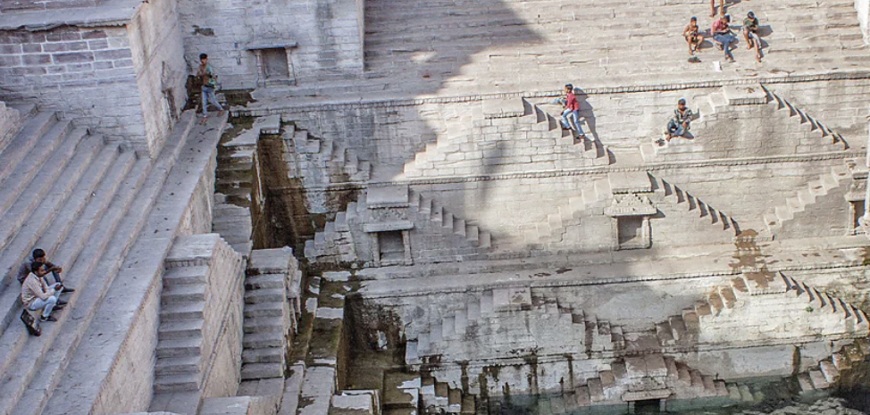 A recent BBC Future article, “India is turning to ancient water systems as modern ones run dry,” is what prompted me to take a closer look at one of India’s most remarkable forms of infrastructure: the ancient stepwell.These are also called baolis or vavs. These are striking, ingenious architectural projects going back 1500 years. And there are lessons for today’s construction project managers – and really any project leaders – here. The premise of the article is startling. Climate change is driving parts of India into a struggle with water scarcity. Modern water systems have come under increasing pressure – so engineers, communities, and project planners are reconsidering technologies that were developed centuries ago. The renewed interest is not based on nostalgia. It is based on the realization that some of these systems were extraordinarily well adapted to local climate, geology, and seasonal water cycles. Stepwells are a particularly powerful example. At first glance, they can appear almost mysterious: enormous staircases descending deep into the earth, sometimes surrounded by intricately carved columns, platforms, and chambers. And because they contain intricate carvings related to religious figures, these have been described as ‘inverted temples’. But beneath their beauty is a very practical idea. A stepwell is essentially a water-storage system, groundwater access point, public space, and piece of infrastructure combined into a single structure. The design is elegant and simple - instead of lowering a bucket down a narrow shaft, people descend a series of steps to reach the water. That distinction matters because in many parts of India, particularly in regions such as Gujarat and Rajasthan, water availability varies dramatically through the year. During the monsoon season, rainfall recharges the groundwater and the water table rises. During the long dry season, it falls. Stepwells were designed around that reality – with long-term value in mind, not a “let’s build an inverted temple on time and on budget and to specification” in mind. Triple Bottom Line thinking dominated over Triple Constraint thinking. When water was plentiful, people need to descend only a short distance. Months later, as the water table dropped, they simply continued farther down the staircase to reach it. The infrastructure did not attempt to force nature into a fixed condition. It was designed to function across a range of conditions that varied in the long term. That alone offers a lesson for modern project managers. Designing for the Ecosystem, Not Just the Structure The builders of stepwells were not simply constructing wells. They were working within a much larger system involving rainfall, geology, groundwater, temperature, evaporation, seasons, community needs, and the passage of time. Consider the steps themselves. Their most obvious purpose was to allow people to reach a changing water level. But the stepped form also provided secondary hydraulic and structural benefits. Depending on the particular stepwell and its setting, the steps and terraces could help:
The system adapts – ironically, a massive stone structure is…flexible. Long-Term and Systems Thinking Was Built Into Stepwells Perhaps the most striking feature of these structures is not their depth or even their engineering sophistication. It is their time horizon. The people who commissioned and constructed stepwells, - and the project leaders who oversaw their construction - were solving an immediate problem—access to water—but they were clearly thinking beyond the next season. Stepwells were substantial civic investments. They required excavation, engineering, stonework, labor, maintenance, and often elaborate architectural design. Some have survived for well over 1000 years. That suggests a fundamentally different question from the one that sometimes dominates modern projects. Instead of asking simply: “Can we deliver this project successfully?” the deeper question becomes: “Will what we are building – our outcome - continue to deliver value over a very long period of time?” A project can finish on schedule, stay within budget, and meet its stated scope—and still produce an asset that performs poorly, creates environmental problems, becomes expensive to maintain, or fails when conditions change. The builders of stepwells appear to have understood something that modern project professionals are increasingly rediscovering: successful projects must be evaluated in terms of the value they create over their entire life cycle. Resilience Rather Than Prediction There is another important lesson hidden amongst the carvings in the design. A stepwell does not depend on predicting exactly where the water level will be. Instead, it is designed to work when the water is high, when the water is low, and at many points in between - that’s resilience. Modern projects are often built around forecasts: expected demand, expected rainfall, expected temperatures, expected population growth, expected energy costs, expected traffic patterns – and that’s okay: forecasting is necessary. But the world has become increasingly difficult to predict. Climate change makes historical weather patterns less reliable. Technology changes rapidly. Supply chains are disrupted. Communities grow and shift. The stepwell suggests another approach – don’t merely design for the condition you expect, design – and lead your project - for a range of conditions. For a modern construction project manager, that might mean asking whether a building can tolerate more extreme heat, heavier rainfall, flooding, changes in energy supply, water scarcity, or different patterns of use. In other words, project leadership increasingly requires us to think beyond efficiency and toward adaptability. Sustainability Without Calling It Sustainability The ancient builders would not have used phrases such as “sustainable infrastructure,” “climate resilience,” or “triple-bottom-line thinking.” Yet stepwells incorporated many ideas that today fall comfortably under those headings.
Multipurpose construction A stepwell could provide water, shade, gathering space, religious or cultural space, and relief from intense heat. Descending into one could produce a dramatic temperature change because of shade, stone, depth, and proximity to water. Today we might describe that as multifunctional infrastructure. The builders probably would have regarded it simply as sensible design. A Project Leader’s View For modern construction project leaders, there is a temptation to look at an ancient structure primarily as an engineering curiosity. Think Sphinx.Think Hanging Gardens of Babylon.But that misses the larger lesson. The real achievement of the stepwell may be the thinking behind it. Its designers recognized that their project existed inside several larger systems: a water system, an environmental system, a social system, and a system that would continue long after the original construction project ended. That mindset produces different project questions. Not simply:
Looking Back to Look Forward The BBC article is compelling precisely because it turns our normal idea of innovation upside down – sort of like the ‘inverted temple’ description of a stepwell! There is an understandable tendency to associate innovation with something new: artificial intelligence, sensors, smart buildings, digital twins, sophisticated forecasting, advanced materials. An sure, of course, all of those technologies can contribute enormously to better projects. But innovation does not always require inventing something that has never existed before. Sometimes innovation begins by looking carefully at what people figured out hundreds of years ago. India’s renewed interest in ancient water systems is a reminder that older infrastructure may contain design knowledge that becomes newly valuable when conditions change. Stepwells, in particular, remind us that some of the most durable infrastructure comes from understanding a place deeply—its climate, its people, its natural systems, and its future needs—and then designing accordingly. The great achievement was not simply creating a staircase down to water. It was recognizing that the water would rise and fall, seasons would change, communities would continue to need the resource, and the structure would have to keep working through all of it. That is long-term thinking. And for today’s construction project leaders facing climate change, resource constraints, and growing expectations for sustainable value, it may be one of the oldest project lessons that still feels surprisingly modern. I plan a Part 2 of this post which will include more pictures of stepwells and some insight from a civil engineer who was born in Gujarat. |
A PATH to more equitable health - via AI project leadership
 Today’s post is about the People - and of course, the Project - portions of People, Planet, Profits, and Projects. My attention was drawn by this article: https://www.npr.org/2026/07/23/g-s1-134929/this-ai-tool-promises-a-second-sight-of-eyes-to-clinicians-did-patients-benefit which looked at a project in Kenya to determine whether an AI ‘medical consultant’ made a difference in diagnosis and treatment. I expanded my search to look for other initiatives in medically-underserved areas of the world. The article starts with a dramatic story (side note: this is how I coach my students to begin a presentation if appropriate). A 4-month-old boy comes into the clinic with a fever and a stuffy nose. (Medic) Vyonne Njeri thinks it's just a cold. Then a yellow box pops up on her computer telling her to check his heart — because his heart rate is elevated. Njeri is a registered clinical officer in Nairobi, Kenya; she sees patients on her own like a nurse practitioner. When she listens with a stethoscope she hears a whoosh — a sign that the infant could have a congenital heart defect. "That's something I would have missed on any other day," Njeri says of the visit a few months ago. "That child would have just gone home." She credits an AI tool that double checks her work for helping her.
Broader Study PATH is evaluating LLM-assisted clinical support not only in Kenya but also in Nigeria and Rwanda. Its work explicitly addresses the limited evidence available concerning the safety, appropriateness, and effectiveness of these tools in African primary healthcare. A pilot project like the one in Kenya proves that a technology can operate. A program of coordinated trials such as PATH is initiating, is needed to establish whether it can create sustainable value. The Threats My research showed that unfortunately, there are areas in which AI can be a negative in terms of underserved populations in two ways. 1. Performance inequality: the tool works less accurately for certain populations. 2. Access inequality: the communities that could benefit most receive the technology last—or not at all. These are repairable problems solved by reducing bias and providing better, more representative data to AI systems and assuring that there is equity in deploying AI systems worldwide – both initiatives in which (in my opinion) project leaders should play key roles. Additional research and cases: Autonomous AI for diabetic-eye screening “Autonomous artificial intelligence for diabetic eye disease increases access and health equity in underserved populations” The study specifically examined how autonomous AI screening for diabetic eye disease could increase access and improve equity in underserved populations. This supports an important sustainability principle: The value of AI may be greatest not where doctors are plentiful, but where expertise is scarce, distant, or unaffordable. Source: Autonomous artificial intelligence for diabetic eye disease increases access and health equity in underserved populations AI and unexplained pain disparities Researchers used deep learning to analyze knee X-rays and better account for pain experienced by underserved patients. Conventional radiographic measures did not fully explain the greater pain reported by some disadvantaged populations; the AI-derived measure accounted for more of that disparity. This example broadens the story beyond access. AI may also challenge clinical measures that have historically failed to represent certain patients’ lived experiences. That provides a powerful “People” question: What if the problem is not that patients’ symptoms are inexplicable, but that the measurement system was never designed to see them? Source: An algorithmic approach to reducing unexplained pain disparities in underserved populations | Nature Medicine Multi-disease screening through an eye scan A recently reported AI system analyzes retinal images to screen for conditions including diabetes, hypertension, high cholesterol, osteoporosis, gout, and thyroid disease. Because it requires a relatively basic fundus camera, researchers see potential applications in primary-care offices, pharmacies, mobile clinics, and remote communities. This is a good example of healthcare infrastructure being redesigned around accessible technology. Source: AI analyses of eye scans can detect diseases like diabetes, osteoporosis and thyroid disease in seconds From a project perspective, the innovation is not merely the algorithm. It only comes to life with project leadership, which includes:
PATH (originally Program for Appropriate Technology in Health) is a global nonprofit public-health organization, started in 1977 that works to make healthcare more accessible, particularly in low-resource and underserved communities. It operates in more than 70 countries and partners with governments, healthcare providers, researchers, businesses, and community organizations. Its work includes:
|


