


In a recent post, I talk about the paradox of AI - how it promises to be a savior of sorts in many ways (see my last post about how it is aiding with floating solar projects), but also is an energy hog and causes much in the way of problems in terms of water use, carbon production, and disruption to the local area.
I want to go back to the 'dark side' of AI, MAINE-ly the area of local disruption - and as you may have guessed, I will focus on Maine, USA.
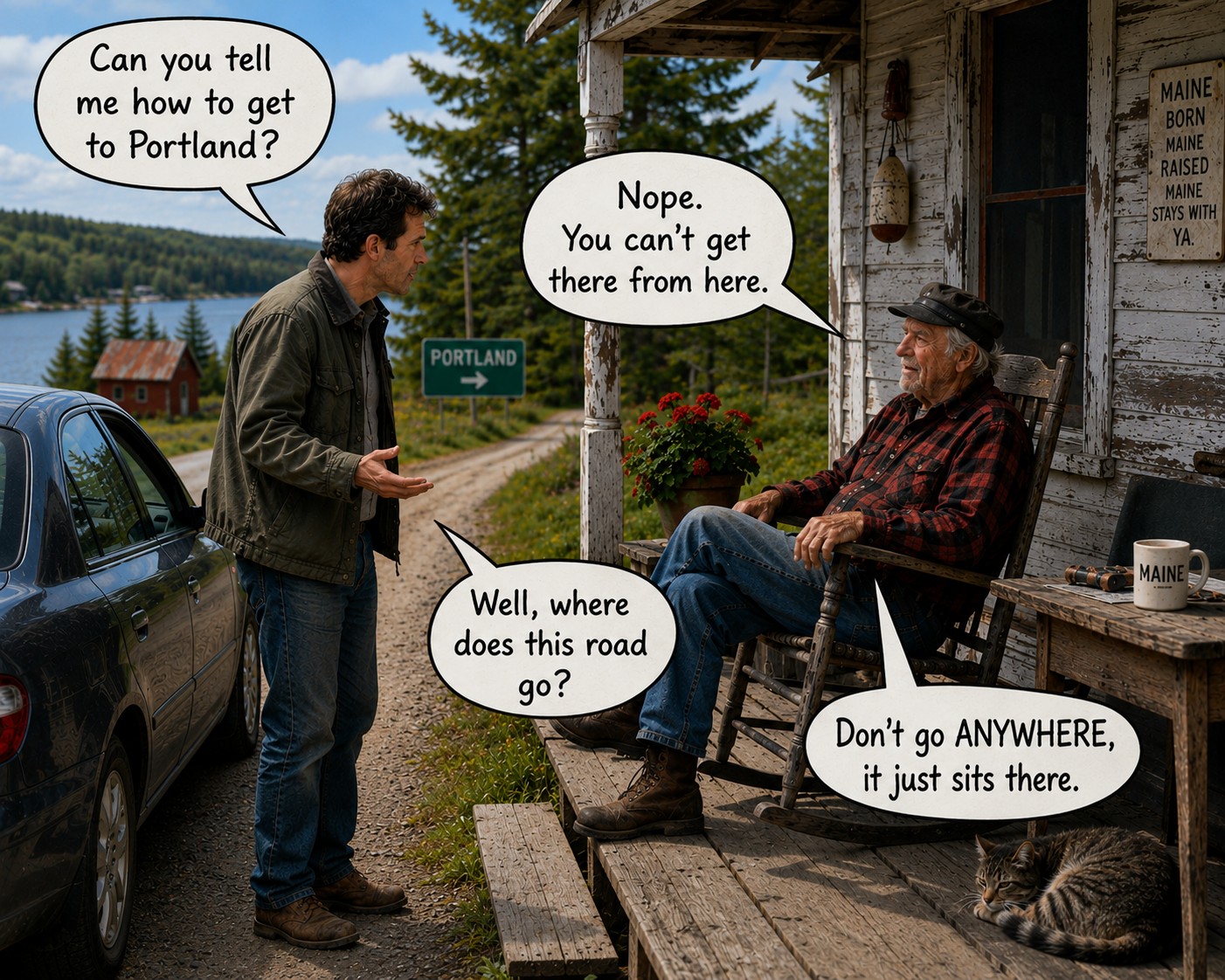
Let me set this up with a bit of culture. Maine - the most northeast of the New England states in the USA, has its own culture (really several cultures). There's a thread of very sarcastic, practical, pointed comedy in this culture. Indeed, there was a humorist duo made up of Marshall Dodge and Bob Bryan, who told (or retold) stories set in that dry, literalism culture of traditional "downeast" Maine. These were published/recorded and broadcast in the 1950s and the 1960s. Here's one story:
A fellow driving through Maine stops and asks an old Mainer sitting on the porch:
“Can you tell me how to get to Portland?”
The Mainer thinks for a while and says:
“Nope… you can’t get there from here.”*
The traveler looks puzzled and says:
“Well then… where does this road go?”
The Mainer says:
"Don't go nowhere - it just sits there".
So with this in mind, let's look at the news - the controversy and legislation regarding AI Data Centers in Maine.
According to this article, published on 17-April-2026,
Maine lawmakers passed a statewide freeze on large data centers this week, the first of its kind in the country. If Gov. Janet Mills signs the bill into law, it would impose a moratorium on building data centers that use more than 20 megawatts of power in the state for a year and a half. During those 18 months, a council of government officials, experts and other stakeholders will be tasked with developing guidelines and recommendations for building future data centers, according to The Hill.
However, Governor Janet Mills did not sign the bill. She vetoed it on April 24, 2026.
The bill (LD 307) would have created the nation’s first statewide moratorium on large AI/data-center projects in Maine, temporarily blocking new facilities using more than 20 megawatts of power while the state studied impacts on electricity costs, water use, and the grid.
The Governor said she actually supported the idea of a temporary pause in general, but objected because the Legislature refused to exempt a major proposed redevelopment project in Jay, Maine, at the former Androscoggin paper mill site.
According to her statement:
- the Jay project is expected to bring:
- about 800 construction jobs
- at least 100 permanent jobs
- substantial tax revenue to the town
- and it already had strong local backing and several permits in place.
- she plans to create a council by executive order to study data-center impacts in Maine
- and she did sign a separate bill preventing data centers from receiving certain Maine tax incentives.
- The moratorium bill did NOT become law
- Maine does not currently have a statewide ban/pause on large data centers
- But the political pressure and regulatory scrutiny around AI infrastructure in Maine are still very active.
The Maine debate captures the AI Sustainability Paradox perfectly.
While AI systems may help humanity:
- optimize electrical grids,
- reduce transportation emissions,
- accelerate battery chemistry,
- model climate systems,
- reduce industrial waste,
- improve agricultural efficiency,
- discover new materials,
- and even aid fusion or renewable energy research.
...and in general be a sustainability "hero"...
To train and run large AI models, society is rapidly building hyperscale data centers that:
- consume massive amounts of electricity,
- require substantial water for cooling,
- alter local landscapes,
- produce local noise and other disruptions,
- increase strain on transmission infrastructure,
- and often reshape small communities economically and socially.
That’s the paradox:
AI may help solve climate and efficiency problems globally while simultaneously intensifying environmental and social pressures locally. The Maine case is especially interesting because it forces a collision between two different scales of thinking:
1. The Global Scale Argument
Supporters of AI infrastructure say:
• the economic future depends on AI,
• the energy transition itself may require AI,
• and states that reject infrastructure risk missing major investment waves.
From this perspective, a data center is seen almost like a railroad, hydroelectric dam, or semiconductor fab — foundational infrastructure for the next era of civilization.
2. The Local Scale Argument
Opponents or skeptics ask:
• Why should one town absorb the environmental burden?
• Will electricity prices rise for residents?
• Will water systems be stressed?
• Are the promised jobs permanent or mostly temporary?
• Who benefits — local citizens or distant tech firms?
• What happens to community identity and land use?
This is a classic “externalities” debate:
• the benefits are diffuse and global,
• while the costs are immediate and local.
The irony is profound:
AI may help reduce worldwide waste and carbon emissions through optimization, but the infrastructure needed to do that may itself require enormous resource consumption. There’s also a deeper systems-thinking lesson here that aligns strongly with portfolio and program management concepts that I discuss here on People, Planet, Profits, and Projects, as well in my courses:
AI resembles a portfolio-level optimization problem - thinking of projects as INVESTMENTS
At the project level, a single data center may appear environmentally costly.
But at the systems level, AI-enabled efficiencies could theoretically produce net-positive outcomes.
The challenge is that:
• local stakeholders - like the Mainer sitting on his porch and radiating sarcasm all day - experience the project costs directly, but global society may receive the portfolio benefits later.
That is going to naturally involve friction between that local and global scale - and will pit Joe Mainer against (at least what are seen as) corporate oligarchs.
The Maine story also reflects a broader transition in how society thinks about technology. For decades, digital technologies were treated as “clean” because they lacked smokestacks and assembly lines. AI is revealing that advanced computation - at least the way it is headed now - has very tangible ecological consequences.
And there’s yet another paradox layered underneath:
the more AI succeeds, the more 'computing power' society demands, which increases infrastructure expansion,
which increases energy demand, which requires even more optimization - an AI "power spiral" of sorts.
That’s why some analysts now argue that the future of AI is inseparable from:
• energy policy,
• nuclear power,
• water management,
• transmission infrastructure,
• and regional economic planning.
In other words, AI is no longer just a software story.
It is becoming an industrial-policy story as you see in this Maine example.
The Maine governor’s response actually reflects an attempt to balance this paradox:
• rejecting a total moratorium,
• while acknowledging the need for oversight and study.
That middle position implicitly recognizes that the issue is not simply “AI good” or “AI bad.”
The real challenge is governance:
How do we capture AI’s transformative benefits without imposing disproportionate environmental or social costs on specific communities?
That may become one of the defining program-management and public-policy questions of the next decade.
And I hope that we can get there from here.
*this is pronounced, "ya can't get they-ah from hee-yah"


