Saving the Sahel (Part 1)
From the People, Planet, Profits & Projects Blog
by Richard Maltzman,
Dave Shirley

View Posts By:
Richard Maltzman
Dave Shirley
Recent Posts
What is AI doing to the sustainability of our profession???
Stepwells – Insight from a Particularly Valid Angle
Climb-it Change: Pre-Interview Connector
Climb-it Change: New Relevance for the Stepwells of India
A PATH to more equitable health - via AI project leadership
Categories
6th,
6th Edfition,
6th Edition PMBOK,
7th Edition,
7th Edition PMBOK,
8th Edition PMBOK,
8th Edition PMBOK Guide,
Activism,
actuarial,
actuary,
adapt,
addition by subtraction,
Africa,
africa,
agriculture,
airforce,
ajaita,
Alaska,
amazon,
analogous,
analytics,
ancient,
and more power,
antarctica,
anti-science,
apple,
apps,
architecture,
arctic,
arrakis,
Artificial Intelligence,
asch paradigm,
Assistant,
asthma,
astronomy,
automobile,
automotive,
autonomous cars,
b,
bankhar,
Banksy Crypto,
basalt,
baseball,
bats,
batter,
beauty products,
benefit,
benefits,
Benefits Realization,
beyond epica,
biases,
bicycle,
big data,
big dfata,
big dig,
bike,
biodiversity,
biomedicine,
birdhouse,
blockchain,
blood,
blue blood,
blue trees,
bluefin,
bluefin tuna,
book review,
boston,
boston university,
Boyce,
Brazil,
brazil,
Breakdown Structures,
BS,
building,
buildings,
built environment,
built environment,
bumblebee,
cake,
capacitor,
car,
Carbon,
carbon,
carbon capture,
carbon negative,
carbon neutral,
carbon pool,
carbon sequestration,
carbonate,
careers,
CEO,
ChatGPT,
chatGPT,
chatgpt,
chatgpt,
chess,
China,
china,
chopsticks,
citrus,
cli-fi,
climate,
climate change,
climate resilience,
climeworks,
Clumsy,
CO2,
co2,
CO2 Utilization,
coalition,
cobalt,
coffee pods,
cognition,
cognitive,
Collabortion,
colombia,
concrete,
Conflict,
construction 5.0,
cool projects xyloscope,
cooling,
coral,
corn,
cost of good quality,
cost of poor quality,
cost of quality,
crazy,
criticism of project management,
cryptocurrency,
CSR,
csr,
data,
data analytics,
data privacy,
datacenter,
dataset,
death spiral,
Decision Making,
decomposition,
Defense and Climate,
definition of a project,
deforestation,
dependencies,
dependency,
desert,
DIKW,
dikw,
dimopoulos,
disposal,
dna,
DOD,
dogs,
dolphins,
dream,
drilling,
drink,
dune,
dune,
dutch,
early start,
earth,
eatlocal,
eco-tourism,
ecological,
economic,
economics,
EKC,
electric grid,
electricity,
electronics,
elysis,
embodied carbon,
emerging technologies,
empower,
Energy,
energy efficiency,
environmental degradation,
escalate,
escalation,
ESG,
extreme weather,
fallacy,
FARC,
farming,
finance,
fish,
fish brains,
fishing,
fix,
fixing the earth,
flint water,
Flint Water Supply,
flood,
flooding,
Food supply chain,
food waste,
forest,
forest for the trees,
forestation,
forrestgump,
frank herbert,
Fruitcake,
fungus,
fusion,
Galvao,
garage,
gas,
gasoline,
geese,
gender equality,
gender partnerships,
generational differences,
Generative AI,
gladwell,
gold,
Goodness,
google,
Government,
GPT,
great pacific garbage patch,
green,
green building,
green buildings,
green energy,
green iguana,
green project,
green project management,
greening,
guest post,
gyre,
harkonnen,
Harvesting Benefits,
hawasina,
hedgehogs,
heursitics,
historical data,
hlb,
holitsic,
holland,
horseshoe crab,
human-caused climate change,
hydrogen,
hydrology,
ice,
iceland,
ignition,
iguana,
imagery,
impact,
india,
inequality,
information,
initiatives,
injection,
insurance,
intelligence,
interacting risk,
internal combustion engine,
invasive species,
investment,
isomer,
issue escalation,
issues,
ITER,
jobs,
Jupiter,
justification,
kids,
kill point,
knowledge,
koch brothers,
Kuznets,
laboratory,
LAL,
landscape mode,
lapampa,
launch,
LCA,
Leadership,
Leadership,
life cycle analyses,
life cycle analysis,
lifecycle,
Linkedin,
liquid,
lizard,
local,
long term,
long-term,
long-term thinking,
look up,
loud,
maintenance,
maker,
makermovement,
malcolm gladwell,
management,
marathon,
marine biology,
market,
mars,
Martin Luther King,
mean,
megawatt,
MeHg,
melting,
mercury,
metal,
Microgrid,
microplastics,
migration,
military,
millennial,
mindset,
minerals,
mission,
mitigate,
MLK,
mongolia,
museum,
museum of london,
nature,
nematodes,
net gain,
Net Project Success Score,
net zero,
netherlands,
network,
New book,
New Jersey,
New Practitioners,
new york,
NFT,
nitrogen,
noise,
noreaster,
norway,
nova,
NPSS,
NREL,
ocean,
ocean cleanup,
ocean life,
oil rig,
oil rigs,
oklahoma,
oman,
only murders in the building,
opportunity,
overall risk,
oxygen,
packaging,
pareto,
PBS,
permafrost,
persistence,
peru,
Pharmaceutical,
planet,
planet.com,
planning,
plant,
plasma,
plastic,
playground,
pm,
pm education,
pmbok,
pmbok guide,
pmnetwork,
PMXPO-2018,
podcast,
pollutants,
pollution,
poop,
poor,
portfolio,
power,
power skills,
privacy,
privacy concerns,
professors,
program,
Program Management,
project,
project leader,
project leadership,
project management,
project management 3.0,
project on fire,
project progress,
Project Success,
project success,
projecticity,
projectleadership,
projectmanagement,
projects,
psychology,
pulse of the profession,
purple bacteria,
purpose,
quiet,
rainforest,
rationale,
reef,
refugees,
renewable,
renewables,
Repair,
repair,
repeatable process,
repeatable processes,
repurpose,
research,
resource breakdown strucuture,
Resource Management,
reversing climate change,
revisionist history,
rich,
rigs2reefs,
ripe,
risk,
risk avoidance,
Risk Management,
risk mitigation,
risk response,
risk responses,
river,
robots,
rocks,
rules of thumb,
rural,
rural India,
russia,
Sarcasm/Irony,
satellite,
saudi,
schedule,
sci-fi,
Science,
science,
science-fiction,
scientific american,
screaming monkeys,
sea,
sea life,
Sea-Level Rise,
sea-level rise,
seagreens,
seawall,
seawater,
seawater temperature,
seaweed. beat;es. farming,
secondary risk,
selena gomez,
sequestration,
shipping,
skyscraper,
SLR,
smart cities,
smart city,
smelting,
social,
social pressure,
soil,
solar,
solar panels,
solar perovkites,
solar saheli,
sonic,
sponge cities,
SRI,
stage-gate,
stagegate,
stakeholder,
stakeholder management,
steward,
stewardship,
storage,
strategy,
stupid,
success,
suffer,
sulphur,
sunk cost,
supercapacitor,
supply chain,
survey,
Sustainability,
sustainability,
Sustainable Investing,
Sustainable Tourism,
sybiosis,
symbiosis,
system 03,
TBL,
temperature,
terraform,
terraforming,
test,
threat,
threats,
totem,
touchscreen,
tour,
tower,
Trains,
transparency,
transportation,
trash,
tree,
tree species,
trees,
trillion,
triple bottom line,
triple constraint,
truth to power,
UMass,
us army corps of engineers,
USDA,
vacuum,
value,
venus,
vision,
voice,
voltage optimization,
vw scandal,
washing machine,
waste,
wastewater,
water,
we mean business,
whales,
Whirlpool,
wind,
wisdom,
women,
Women in Project Management,
wood wide web,
woonerf,
Work Breakdown Structures (WBS),
world breakdown structure,
worms,
xian,
xylotron,
Yale
Date
In a recent post, I
blogged about the Great Green Wall of China.
Today I would like to start a series about another ongoing Program called the Great Green Wall of Africa (more formally the Great Green Wall Initiative).
This Program is in the Sahel region of Africa (see map below) and is described well in
an article from National Geographic.
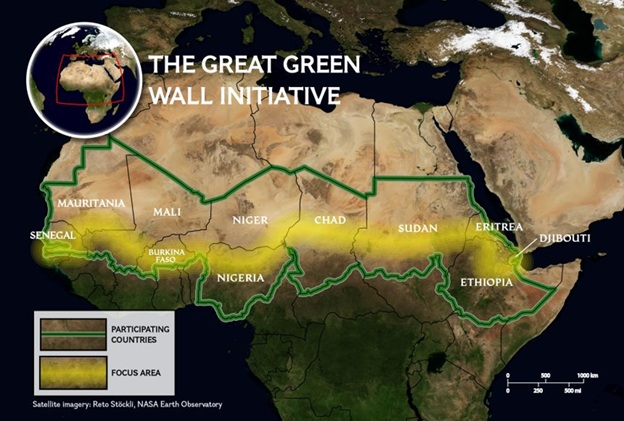
Here's a quick summary for that article:
In recent years, northern Africa has seen the quality of land significantly due to and poor land management. Land degradation stems from human-related and natural factors, including unsustainable farming practices, , climate change and . Land degradation contributes to the loss of and ; more than 9,000 plants and animal species are considered endangered as a result. Land degradation also poses serious threats to agricultural productivity, , and quality of life.
Nowhere is the threat of land degradation more urgent than in the Sahel, where millions of people live on land undergoing , the most extreme form of land degradation. Without action to combat it, desertification will continue to drive people to migrate away from the Sahel. In 2020 alone, more than 2.5 million people in the Sahel region were displaced.
The Sahel region, by the way, is a vast semi-arid transitional zone in North-Central Africa, stretching between the Sahara Desert to the north and the tropical savannas to the south. Acting as an ecological and climatic buffer, the word Sahel - ironically - comes from the Arabic sāḥil, (الساحل) meaning "coast" or "shore" (even though it's all about a desert).
The Great Green Wall: a brief description
The Great Green Wall Initiative is an African-led environmental restoration program launched by the African Union in 2007 to combat desertification, climate change, food insecurity, and poverty across the Sahel region of Africa. Originally envisioned as a continuous “wall” of trees, the initiative has evolved into a broader effort focused on restoring ecosystems, improving sustainable agriculture, and strengthening community resilience.
The initiative stretches approximately 8,000 kilometers (5,000 miles) across the width of Africa, from Senegal on the Atlantic coast to Djibouti on the Red Sea, involving more than 20 countries. Its goals include restoring 100 million hectares of degraded land, capturing 250 million tons of carbon, and creating 10 million green jobs across one of the world’s most climate-vulnerable regions.
It was designed as a long-term initiative with major targets tied to 2030.
But what is it? Project, Program, Portfolio? This is a naming problem we generally have in our discipline. I have seen this as a problem in my own background as a practitioner and continue to see confusion over these terms as I create and teach Project Management (or Program... or Portfolio Management) courses.
It's not a project...
A project:
- has a defined beginning and end
- produces a specific deliverable
- is relatively bounded in scope
The Great Green Wall is:
- multinational
- multi-decade
- continuously evolving
- composed of many independent efforts
- strategically adaptive
It’s far too broad and complex to be considered a single project. I would call it a very large Program.
The Africa Great Green Wall (GGW) is a fascinating case because it looks very different depending on whether you assess it as:
- an environmental vision,
- a geopolitical initiative,
- or a project/program management effort.
So: how is this Program doing?In the remainder of this post (and continuing with more) I will provide an assessment of how the Program is doing as measured by classic PM measurements (scope, cost, time, risk, success metrics). I think there are learning opportunities simply by seeing how these do (and do not) apply to a large sustainability program.
When I teach my PM courses, I try to convey the idea that although the "triple constraint' elements interweave and are interdependent and overlapping, generally the flow is first Scope, then Schedule, and then Cost. In other words we need to know what's in an initiative, and only then can you sequence tasks and milestones, and only then can you really determine costs. Agree or not, I am going to follow that order in my assessment of this sustainability program.
The Great Green Wall of Africa - Scope PerformanceScope DefinitionOriginally:
“A wall of trees across Africa.”
Later evolved (I would say massively scope-crept) into:
- ecosystem restoration
- sustainable agriculture
- climate resilience
- economic development
- peacebuilding
- food security
Assessment of the Great Green WallStatus: Massive Scope ExpansionThe project experienced major
scope evolution [scope creep and
upscope {consciously-accepted inclusion of new scope}].
Positive side of this growth of scope:- broader ecological realism
- greater adaptability
- more stakeholder relevance
Negative side:- harder to measure success
- diluted accountability
- increased governance complexity
- vague deliverables
My thoughts:The initiative transitioned from a deliverable-driven program to a (much more ambitious) transformation program. This ambition was well-intentioned, but weakened measurability.
In the next post of the series - Schedule and Cost of the Great Green Wall Initiative
Posted
by
Richard Maltzman
on: May 24, 2026 11:06 PM |
Permalink
Comments (1)
Please login or join to subscribe to this item
Projects with real social impact like this remind us why project management matters beyond business outcomes. The Sahel restoration is an inspiring example of PM applied to global challenges.
Please Login/Register to leave a comment.
|
"If you want to please only the critics, don't play too loud, too soft, too fast or too slow."
- Arturo Toscanini
|




