


Project PBJ


|
If you take nothing away from this article other than the link to Earth Beat, an outstanding resource from Radio Netherlands, we've done our job. But don't head off there quite yet. We just wanted to bring to your attention the project started by 10-year-old Daniel Cashdan, of Oak Park, California, USA, in which he decided to try to - in effect - grow his own peanut-butter and jelly sandwich. It is a bit about understanding how food is sourced and grown, how food is so convenient but really takes a lot of energy and effort. Here's a link to the specific radio segment on Daniel Cashdan: CLICK HERE TO PLAY RADIO NETHERLANDS SEGMENT Now, zoom out a little. Earth Beat is a program on Radio Netherlands, in English, which covers all sorts of interesting stories on all things sustainable. Many are about projects, and projects not as limited in scope as growing your own PBJ sandwich. This week's particular program, Food, Glorious Food, was about food in general. But Earth Beat's host, Marnie Chesterton, can always be counted on to inform, entertain, intrigue, and while doing so, tickle your funnybone. So we suggest that you sit yourself down to a home-made (and perhaps home-grown?) peanut-butter and jelly sandwich, and listen to a few episodes of Earth Beat.
You can thank us later. Seriously. Please thank us. We'll know you're listening. |


Water-The New Oil?
|
Could water be the new oil? We mean that in a “demand” type of way. If the answer is yes, then we have a very critical issue. I noticed in the Wall Street Journal the other day that Fidelity Investment had a two page ad suggesting that investing in water resources may be the way to go in the future. In other words, they are predicting that water could be the next traded commodity. Looking at it pragmatically, we can see that possibility. With an increasing population, strange happenings with the global climate like a change the weather patterns, urbanization, deforestation, loss of biodiversity, groundwater pollution, and all of the other sustainability issues, there is a good possibility that water may become scarce. The demand for water could exceed the supply, making those who control the water in the driver’s seat. That begs the question as to whom, if anyone should control the water. We may not have much choice in the matter. Water is controlled today. When dry weather persists, municipalities place restrictions on its use. At least there is control on municipal water supplies. Even those with well water are at the mercy of contamination and periods of drought. They, too, will have to look to some collective source of water. Ron Lauder, in a CNBC video, makes the point that only 1% of the world’s water is drinkable. He says that 97% is unusable, 1% each are in the arctic and Antarctic leaving 1% of drinkable water. The statistical collection website, Worldometers, says ““Almost 80% of diseases in so called "developing" countries are associated with water, causing some three million early deaths. For example, 5,000 children die every day from diarrhea, or one every 17 seconds.” You can clearly see the problem. Not many countries remain unaffected. It is a particularly critical issue in the countries with the most populations, like India, Pakistan, Mexico, China, and the United States, especially in the mid-west, southwest, and western US. While oil rich, Saudi Arabia is water poor, and along with Yemen and Israel will face severe future shortages. Who controls the water will be a critical issue in the future. The wisdom of making such a life-sustaining resource a commodity seems to be flawed. Whether or not a government, “Fanny Mae” type, agency should be controlling the water could be flawed, too. The scarcity of water will certainly be a serious issue and what we do about it will have to be carefully and thoughtfully approached. |

Wave Powah!
|
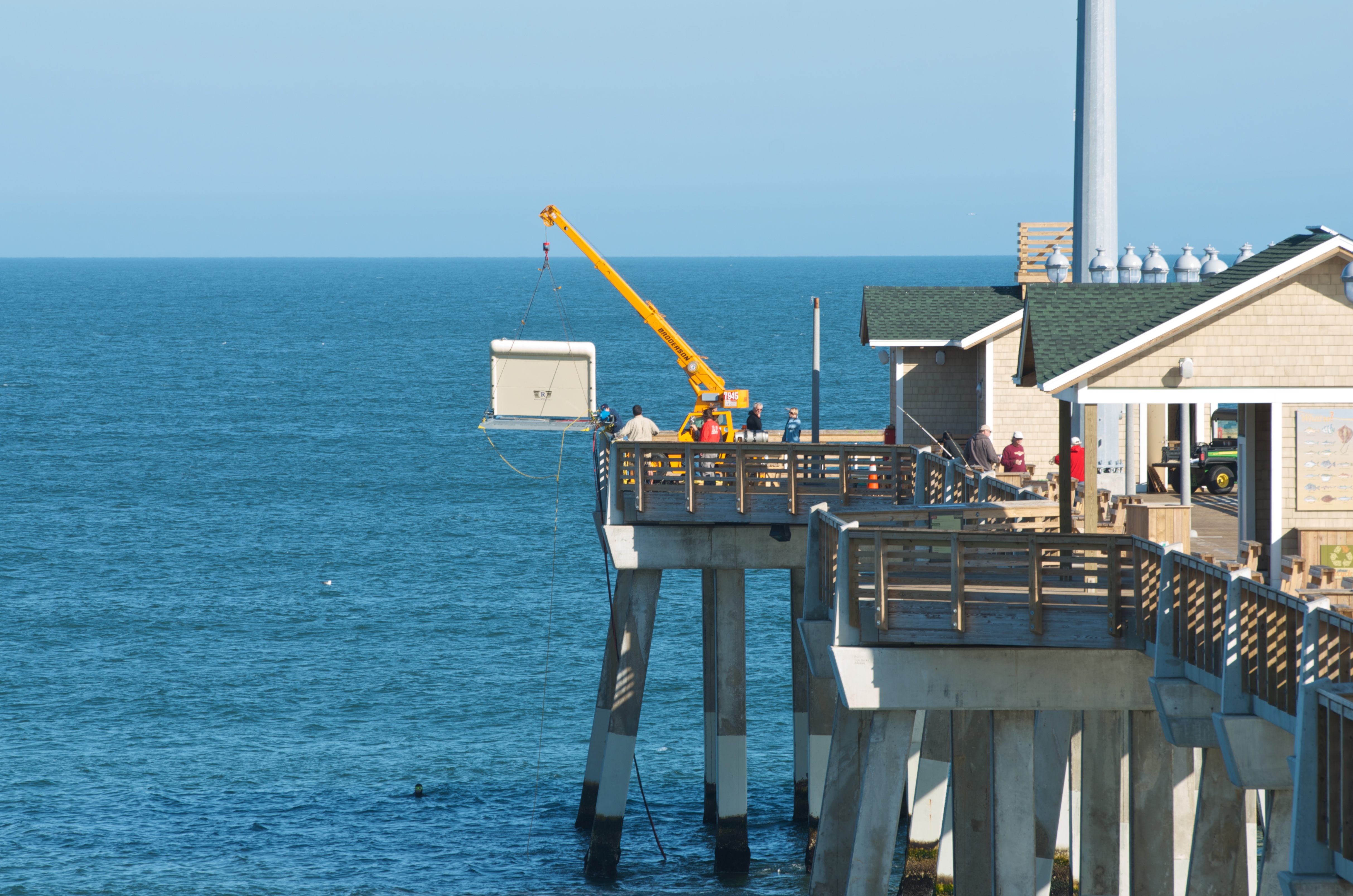
Most Americans (excepting, of course, New Englanders) are familiah whith the New England accent in which we New Englandahs are known to - shall we say - not fully pronounce our "aahhs". I mean, our Rs, especially when they ahh at the end of a word. So that's why we chose to title this posting Wave Powah. It's about a company called Resolute Marine Energy, and this start-up's efforts to harness wave power but in more of a micro solution than a massive solution. A story about Resolute's efforts appeared in today's Boston Globe. You can read the entire story here. Resolute, based in Newburyport, Massachusetts, has prototype "SurgeWEC" wave-energy converters, which feature a fiberglass paddle that swings back and forth with wave motion to power an electric generator. These generators are only 8 x 6 feet, weigh just over 2 tons (minimal compared to other wave systems) and do not require heavy construction on-site, and they can be deployed in quantity where they are needed. Futhermore, the smaller size allows them to be deployed in conjunction with other marine projects such as desalinization plants. In fact, according to the article, "(These are)of particular interest to places where seawater is pumped ashore for desalinization, Staby said. “The power source and the raw material are already co-located,’’ he said. Resolute is working toward a pilot desalinization project in South Africa in the second quarter of next year, with a $150,000 US Interior Department grant to move its design along." Motivating Resolute's ideas for converting wave power to electric power is the following snippet of statistics from the article: "Using Resolute's technology at a conservative 25 percent conversion efficiency, 1000 meters of Plum Island shore would generate 2.5 megawatts of electricity on average, enough to power 2,000+ homes at a typical US household consumption rate of 1.2 kW, says Cliff Goudey, Resolute Marine Energy, Inc., Senior Engineer" We like to see how the economic stimulus package has triggered a (excuse the pun) waterfall effect here: "Funding has been a combination of angel investors and grants, including $1 million from the US Department of Energy in 2010. Noting that the federal grant was part of the economic stimulus package, Staby (Resolute's chief exectutive) pointed with pride to a wall map identifying nearly two dozen Massachusetts companies that Resolute uses as suppliers. He says Newburyport’s MacDiarmid Machine Corp. and Salisbury’s Wilson Welding have been especially important, although the paddle itself was built by Wilbur Yachts in Southwest Harbor, Maine." Another interesting twist for this type of wave power generator is that Resolute's solution, when used in surf deployments, for example, off the shore of Nantucket, they would take energy from the wave and have a positive impact (a reducing one) on beach erosion. So in addition to providing power, they protect the beach - a nice outcome. As project managers, we need to take note of the inventiveness of these types of solutions, their funding sources, the key stakeholders, and their long-term benefits (as we should with any project). You can learn more about Resolute Marine Energy on their site. In the meantime, we will practice our Rs. R R R R R ... |
Sustaining Our Fisheries
|
So reading through the magazine, I came across a short article by Sam Rauch, acting director of the National Marine Fisheries Service (NMFS – “nimfis” as it is know in the marine fisheries arena). The title of the article is “Crossing the border to successfully manage fish stocks.” He starts out by saying “U.S. and Canadian fishermen and natural resources managers face the same challenges.” But he really had me at “Driven by our common interest in sustainability (my emphasis), we have developed a close working relationship over the years with a long record of success.” It only goes to show that we cannot do this alone, even if we wanted to. The resource does not know the boundaries. They just wander all over the place crossing into other jurisdictions, international waters that may have little regulation, or wherever the food supply or migratory patterns take them. A couple of the examples of working together that Mr. Rauch cites are a shared commercial fisheries resource, the yellowtail flounder, and protected species, like the Atlantic sturgeon. As to the yellowtail flounder, joint Canadian/U.S. legislation was passed to increase the U.S. flounder fisherman’s catch limits, while still protecting the transboundary stock. For the sturgeon, there is a developing Canadian caviar industry in the St. Lawrence River, and the U.S. and Canada are planning a strategy to be able to sustain the stock of sturgeons while accommodating this new interest. Mr. Rauch ends the article by saying, “As we face threats from climate change and growing interest in offshore siting of alternative energy projects, a strong working relationship with Canadian fishermen and resource managers will be key to ensuring that marine species and their habitats are protected and fishing opportunities maximized.” It has to be a balance between the factors of the triple bottom-line in order for people, planet or profits to sustain. That message is clear to us, but needs to be shouted from the roof tops or shoreline as the case may be. |
 I picked up a recent copy of National Fisherman magazine. I hadn’t seen a copy in years and I picked it up for a couple of reasons; (1) as a sportfisherman, catch and release, I like to see what the fisheries and commercial fisherman are doing, and this is their magazine, (2) at our post office, if you get a duplicate copy of a magazine or you get one you don’t want to read, you leave it on the counter to see if it might interest another person to pick it up, reuse/recycle, (3) I watch my share of The Deadliest Catch and (4) the subtitle of the magazine is Informed Fishermen-Profitable Fisheries-Sustainable Fish (people, profit, planet – Triple Bottom-line).
Grab Your Green Funding
|
The LDI Corporation of Portsmouth, New Hampshire, just received an award of a grant from Green Launching Pad (GLP). LDI manufactures upholstery fabric for architects and designers who are looking for green products for their facilities. According to LDI VP of Sales and Marketing, John Dame, “We have developed an energy efficient environment and environmental-friendly process that will allow us to offer a wide variety of decorative print patterns to our customers. The GLP funding will be used to help us purchase some of the required equipment to launch this new initiative.” Last year LDI experienced a 3o% growth that Dame attributes partially to a changing market place. GLP is an effort funded by federal stimulus funds through the Department if Energy and hosted by the University of New Hampshire. On GLP’s “about” page, they say that they want to be the hub of green activities and under the heading of “community” even has a button for “find a project”. This round of GLP funding was specifically targeted for manufacturing companies. This is a state effort, funded by the feds, and by targeting manufacturers, the message is that manufacturing is an important segment to New Hampshire’s economy. According to John Lynch, New Hampshire’s governor, “It only makes sense to do what we can to bolster this important sector of our economy, and that’s exactly what we are doing by working aggressively….” To LDI, it validates that the work they are doing is important, because there were 18 companies that applied for the grant. The application and review process was rigorous and LDI is one of 3 companies to received a grant Bottom-line or should I say quadruple bottom-line, is that there are grants available out there to help defray some of the costs of greening your company. Make sure that you explore all of the options, local, state, federal, as well as private funding. |
 We’ve always said that, while the altruistic reasons for greening up your projects is a good thing, keeping in the spirit of people, planet, profits and projects, money is also good. We’ve also stressed the importance of keeping your ears to the ground for rebates and other incentives to green up your projects and processes. To that end, there is an organization called

