In my last post, I explored the growing concerns around artificial intelligence—energy consumption, carbon footprint, data privacy, and even the “noise” it introduces into our systems. These concerns are real, and in some cases, they’re driving moratoriums on new data center construction.
But that’s only one side of the story.
This post explores the other side of the paradox: AI as a positive force—not as a drain on resources, but as a multiplier of sustainable outcomes.
And one of the most compelling examples is floating solar.
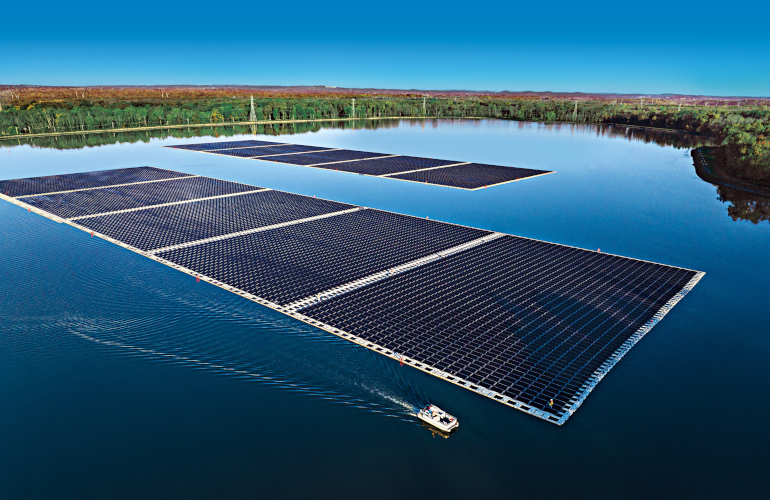
A Pilot in Colorado Just outside Denver, in Golden, Colorado, a modest project is quietly pointing toward the future. Developed by Noria Energy, the Aurea Solar Project sits atop the Fairmount Reservoir. At roughly 50 kW, it’s small by utility-scale standards—but its significance goes far beyond its size. This is the first floating solar array in the United States to incorporate tracking technology. Instead of remaining fixed, the panels rotate on the water to follow the sun, increasing energy production by an estimated 10–20%. But what makes this project especially compelling is not just the technology—it’s the systemit supports. The energy generated helps power a local water utility, directly linking renewable energy production with water infrastructure systems. At the same time, the panels reduce evaporation from the reservoir—an important benefit in the water-constrained American West. This is not just a solar project. It’s an integrated energy–water system. You’ll soon find out why the heck I keep highlighting the word SYSTEM.
A real one in NJ Because (as you know if your follow this blog) I like to feature moving pictures (aka videos), have a look at this video to see a real floating solar project.
Back to the Paradox: Where AI Enters the Picture At first glance, you might not see AI at work here. But like with most things today… it’s THERE. Today, the system tracks the sun mechanically. Tomorrow, AI will: -Optimize panel orientation in real time based on weather and cloud cover -Predict energy output and dynamically adjust operations -Balance what are normally competing objectives—maximizing energy generation while minimizing water loss -Anticipate maintenance needs before failures occur
Across renewable energy and smart infrastructure projects, AI-driven optimization has been shown to:
In advanced or controlled implementations, achieve very large performance gains (approaching 50%) through AI-driven optimization and real-time control (Nature Scientific Reports study)
Let’s take a look at these from the viewpoint of this blog: People, Planet, Profits, and Projects People The Aurea project supports a water utility serving tens of thousands of residents and promotes workforce development. Planet Floating solar reduces land use and water evaporation, while AI enhances efficiency and sustainability. Profits The system approach and clever, reasoned, thoughtful application of AI makes this system more efficient and profitable. Projects This pilot project involves multiple stakeholders and uncertainty—an ideal environment for AI-enabled decision-making, taking decision to action, thoughtfully, and based on real-time information.
And now…as promised…the systems piece…. From Static Infrastructure to Intelligent Systems The Colorado project is becoming a proving ground for intelligent, adaptive infrastructure systems. This is also a powerful example of systems thinking in action—what the Systems Thinking & Systems Intelligence (STSI) community highlights as the need to see relationships, not just components. We are working within a system of systems—energy, water, environment, and community—all interconnected. STSI Insight:
“The performance of a system is driven not by its parts alone, but by the quality of the relationships among those parts.” Learn more about this at stsi.pro.
Reframing the AI Conversation AI stands properly accused of being an energy hog, a privacy stealer, and other nasty stuff. On the other side of the paradox, however, AI can generate clean energy, conserve water, improve resilience, and support communities. The key is where and how we apply it, how we guardrail it, how we thoughtfully work with it.
Closing Thought AI, when aligned with purpose, becomes a force for integrating systems, and systems of systems—connecting people, planet, and projects in powerful new ways.
"More than any time in history mankind faces a crossroads. One path leads to despair and utter hopelessness, the other to total extinction. Let us pray that we have the wisdom to choose correctly."