








Guessing is not a strategy: How to build decision velocity with AI and real-time data
June 10, 2026 | Live Webinar

You Can't Get They-ah From Hee-yah
Floating an idea into reality: the other side of the AI Project Paradox
The Environment of the Built Environment: an AI Paradox
6th, 6th Edfition, 6th Edition PMBOK, 7th Edition, 7th Edition PMBOK, 8th Edition PMBOK, 8th Edition PMBOK Guide, Activism, actuarial, actuary, adapt, addition by subtraction, Africa, africa, agriculture, airforce, ajaita, Alaska, amazon, analogous, analytics, ancient, and more power, antarctica, anti-science, apple, apps, architecture, arctic, arrakis, Artificial Intelligence, asch paradigm, Assistant, asthma, astronomy, automobile, automotive, autonomous cars, b, bankhar, Banksy Crypto, basalt, baseball, bats, batter, beauty products, benefit, benefits, Benefits Realization, beyond epica, biases, bicycle, big data, big dfata, big dig, bike, biodiversity, biomedicine, birdhouse, blockchain, blood, blue blood, blue trees, bluefin, bluefin tuna, book review, boston, boston university, Boyce, Brazil, brazil, Breakdown Structures, BS, building, buildings, built environment, built environment, bumblebee, cake, capacitor, car, Carbon, carbon, carbon capture, carbon negative, carbon neutral, carbon pool, carbon sequestration, carbonate, careers, CEO, ChatGPT, chatGPT, chatgpt, chatgpt, chess, China, china, chopsticks, citrus, cli-fi, climate, climate change, climate resilience, climeworks, Clumsy, CO2, co2, CO2 Utilization, coalition, cobalt, coffee pods, cognition, cognitive, Collabortion, colombia, concrete, Conflict, construction 5.0, cool projects xyloscope, cooling, coral, corn, cost of good quality, cost of poor quality, cost of quality, crazy, criticism of project management, cryptocurrency, CSR, csr, data, data analytics, data privacy, datacenter, dataset, death spiral, Decision Making, decomposition, Defense and Climate, definition of a project, deforestation, dependencies, dependency, desert, DIKW, dikw, dimopoulos, disposal, dna, DOD, dogs, dolphins, dream, drilling, drink, dune, dune, dutch, early start, earth, eatlocal, eco-tourism, ecological, economic, economics, EKC, electric grid, electricity, electronics, elysis, embodied carbon, emerging technologies, empower, Energy, energy efficiency, environmental degradation, escalate, escalation, ESG, extreme weather, fallacy, FARC, farming, finance, fish, fish brains, fishing, fix, fixing the earth, flint water, Flint Water Supply, flood, flooding, Food supply chain, food waste, forest, forest for the trees, forestation, forrestgump, frank herbert, Fruitcake, fungus, fusion, Galvao, garage, gas, gasoline, geese, gender equality, gender partnerships, generational differences, Generative AI, gladwell, gold, Goodness, google, Government, GPT, great pacific garbage patch, green, green building, green buildings, green energy, green iguana, green project, green project management, greening, guest post, gyre, harkonnen, Harvesting Benefits, hawasina, hedgehogs, heursitics, historical data, hlb, holitsic, holland, horseshoe crab, human-caused climate change, hydrogen, hydrology, ice, iceland, ignition, iguana, imagery, impact, india, inequality, information, initiatives, injection, insurance, intelligence, interacting risk, internal combustion engine, invasive species, investment, isomer, issue escalation, issues, ITER, jobs, Jupiter, justification, kids, kill point, knowledge, koch brothers, Kuznets, laboratory, LAL, landscape mode, lapampa, launch, LCA, Leadership, Leadership, life cycle analyses, life cycle analysis, lifecycle, Linkedin, liquid, lizard, local, long term, long-term, long-term thinking, look up, loud, maintenance, maker, makermovement, malcolm gladwell, management, marathon, marine biology, market, mars, Martin Luther King, mean, megawatt, MeHg, melting, mercury, metal, Microgrid, microplastics, migration, military, millennial, mindset, minerals, mission, mitigate, MLK, mongolia, museum, museum of london, nature, nematodes, net gain, Net Project Success Score, net zero, netherlands, network, New book, New Jersey, New Practitioners, new york, NFT, nitrogen, noise, noreaster, norway, nova, NPSS, NREL, ocean, ocean cleanup, ocean life, oil rig, oil rigs, oklahoma, oman, only murders in the building, opportunity, overall risk, oxygen, packaging, pareto, PBS, permafrost, persistence, peru, Pharmaceutical, planet, planet.com, planning, plant, plasma, plastic, playground, pm, pm education, pmbok, pmbok guide, pmnetwork, PMXPO-2018, podcast, pollutants, pollution, poop, poor, portfolio, power, power skills, privacy, privacy concerns, professors, program, Program Management, project, project leader, project leadership, project management, project management 3.0, project on fire, project progress, Project Success, project success, projecticity, projectleadership, projectmanagement, projects, psychology, pulse of the profession, purple bacteria, purpose, quiet, rainforest, rationale, reef, refugees, renewable, renewables, Repair, repair, repeatable process, repeatable processes, repurpose, research, resource breakdown strucuture, Resource Management, reversing climate change, revisionist history, rich, rigs2reefs, ripe, risk, risk avoidance, Risk Management, risk mitigation, risk response, risk responses, river, robots, rocks, rules of thumb, rural, rural India, russia, Sarcasm/Irony, satellite, saudi, schedule, sci-fi, Science, science, science-fiction, scientific american, screaming monkeys, sea, sea life, Sea-Level Rise, sea-level rise, seagreens, seawall, seawater, seawater temperature, seaweed. beat;es. farming, secondary risk, selena gomez, sequestration, shipping, skyscraper, SLR, smart cities, smart city, smelting, social, social pressure, soil, solar, solar panels, solar perovkites, solar saheli, sonic, sponge cities, SRI, stage-gate, stagegate, stakeholder, stakeholder management, steward, stewardship, storage, strategy, stupid, success, suffer, sulphur, sunk cost, supercapacitor, supply chain, survey, Sustainability, sustainability, Sustainable Investing, Sustainable Tourism, sybiosis, symbiosis, system 03, TBL, temperature, terraform, terraforming, test, threat, threats, totem, touchscreen, tour, tower, Trains, transparency, transportation, trash, tree, tree species, trees, trillion, triple bottom line, triple constraint, truth to power, UMass, us army corps of engineers, USDA, vacuum, value, venus, vision, voice, voltage optimization, vw scandal, washing machine, waste, wastewater, water, we mean business, whales, Whirlpool, wind, wisdom, women, Women in Project Management, wood wide web, woonerf, Work Breakdown Structures (WBS), world breakdown structure, worms, xian, xylotron, Yale


|
In the first two parts of this series, I’ve talked about the immense contribution forests make to sequestering carbon and in helping to mitigate climate change. And in Part 1 it was pointed out that although we want to do more to help promote forest growth, it should be intuitively obvious that First deforestation must stop. But it’s not that easy. A fascinating article in the April 2019 issue of Nature, with the intriguing title “Cops and Loggers” talks about the drama – and the science – and the projects initiated– around policing deforestation. It starts with a story of international mystery involving Sri Lanka, Tanzania, Madagascar, China, and Oregon in the US. The scene of the crime turned out to be Madagascar. What happened here was that a shipment of almost 4000 rosewood logs (28 shipping containers worth!) were on their way to Hong Kong from (ostensibly) Tanzania, when they arrived at Sri Lank in transit. There, customs officers had been tipped off by Interpol that these particular logs had been cut not in Tanzania, but instead were a different species, one illegal to export, from Madagascar. Indeed, the Sri Lankan customs authorities sent samples of the wood to a testing lab in Oregon which was equipped with a $200,000 mass spectrometer. This new weapon in the battle against illegal logging, under the supervision of the Wildlife Service Forensics Lab in Ashland Oregon were able to quickly determine that the species of wood was not from Tanzania but from Madagascar. The Chinese seller of these logs was found to be in violation of the law. Interpol estimates that between 15 and 30% of the global timber trade is in violation of either national laws or international treaties, and it’s not evenly spread across countries. From the Nature article, “for countries such as Democratic Republic of the Conga, Laos, and Papua New Guinea, illegal timber could account for more than 70% of the nation’s production.” And the absolute numbers are huge, with the market being worth somewhere around $50B per year, give or take $40B. The rules come from (amongst other regulations and treaties), The Convention on International Trade in Endangered Species of Wild Fauna and Flora (CITES), signed by 183 countries. Rosewood genus Dalbergia is on the list. The CITES site is rich with information about importers and exporters, statistics, and because we’re project managers and just love these things, it also includes dashboards. I tried one, and easily navigated to place where I could generate up-to-date info on timber exports (see figure below).
This shows the top 10 exporters of wood. So the scenario is this: Good guys (nations and their laws) against bad guys (illegal loggers and their saws). What projects, tools, and techniques are the good guys using? Thankfully, there are advances in chemical, optical, and generic fingerprinting that can make it possible, for example, to determine where a tree grew, right down to a particular PART of a particular forest. For these to work best, however, a baseline has to be generated (sound familiar?). Reference samples must be collected and stored. IN February of this year, the US and other governments have committed to supporting efforts (projects!) to collect the ‘fingerprint’ database. There are somewhere between 30,000 and 60,000 species of trees on our Earth. Doing this fingerprinting effort is a project unto itself, and creating tools that do so, yields dozens if not hundreds of others. One that caught my attention was the XyloTron (sometimes called XyloScope) which allows field identification of wood types, with a simple hand-held device connected to (and powered by) a laptop PC. You really should watch this short video by one of its inventors. Turning the device into an inexpensive and readily available product would itself be another project. Separately, a joint project of concerned conservationists, a collaboration of the Amazon Regional Program (BMZ/DGIS/GIZ), the SINCHI Institute of Colombia and the Laboratory of Forest Products of the Brazilian Forest Service, with the cooperation of the Thunen Institute of Germany, developed a pilot of the Electronic Identification Key of Amazon Timber Species. This video from the Organização do Tratado de Cooperação Amazônica (in Spanish and Portuguese but subtitled in English) explains this project. Want to try one of these yourself? You can (with the addition of a macro lens) download an app and go to work immediately. Check out this project from Malaysia: https://globaltimbertrackingnetwork.org/2018/03/17/wood-identification-via-the-app-store/ See a cool video here: Again, populating the database is key, and Kew Gardens (I’ve blogged about them before) has a program to do just that. This project is worth an entire blog post. However I will just send you to this article from the UK’s Daily Telegraph. It’s a little like an episode of CSI Forest. There’s much more to this I haven’t even touched on here: 3D microscopes and the use of stable isotope ratio analysis – I highly recommend the article in Nature. |
|
First of all, as we know in project management, estimation is big part of our work. I think it is 34.2228% of work. Approximately. That’s just an estimate. As for this blog post series - I estimated this to be a 3 part series. Looks like I was optimistic (or pessimistic, depending on your viewpoint). The latest issue of Nature, which arrived as I started this post, has a cover story, Tree Dimensions. And, to top it all off, as I was realizing that there was at least one more post justified by the topic, the BBC show, “Science Hour” featured a segment called “The World Wood Web” on roughly the same topic as Tree Dimensions. So there is definitely going to be one further post on this topic – a total of four. At least, that’s my new estimate. This post, as promised at the end of Part 1, talks a bit more about how forests play a role in sustainability. It’s a big role with a lot of big numbers, so get out your seat belts and fasten your calculators. In the way of full disclosure, much of the inspiration for this came from a commentary piece in the April edition of Scientific American, written by Han de Groot, CEO of the Rainforest Alliance. The article is called “A Low-Tech Climate Fix”. It’s a one-pager, but it’s loaded with resources. De Groot begins by affirming that climate change is asymmetrical in its effects on the world population. It affects the world’s most vulnerable people, he says, “particularly poor rural communities that depend on the land for t heir livelihoods and coastal populations throughout the tropics”. We’ve seen this with hurricanes and floods in particular, and sea-level rise in poor island nations (we’ll see more in the next decades, but already it’s a life-threatening situation). So how can we use forests to help? Forests have an amazing capacity to absorb and hold (sequester is the preferred word) carbon. Forests, says de Groot, can help us achieve 37% of our climate target – limiting global warming to a maximum of 2 degrees C above benchmarked levels before the rise of industry. A single tree can sequester an average of almost 50 pounds a year. The policies recommended by de Groot – ones that would launch many ‘green projects’:
Why? Again, forests are capable of:
…all good things! Despite the Bonn Challenge that I covered in the last post, not all countries are keeping their commitments. So what can we do to re-invigorate these efforts? One technique that de Groot mentions, and on which I did a little research, is Agro-forestry. What is this? Actually, the US Government’s USDA (United States Department of Agriculture) has some very good information on this – recently updated. Have a look at these two links, if you are interested: https://www.usda.gov/topics/forestry/agroforestry https://www.usda.gov/sites/default/files/documents/usda-agroforestry-strategic-framework.pdf The basics are below (extracted from the links above if you don’t feel like following them): Agroforestry Farming SystemsAlley cropping means planting crops between rows of trees to provide income while the trees mature. The system can be designed to produce fruits, vegetables, grains, flowers, herbs, bioenergy feedstocks, and more. Forest farming operations grow food, herbal, botanical, or decorative crops under a forest canopy that is managed to provide ideal shade levels as well as other products. Forest farming is also called multi-story cropping. Silvopasture combines trees with livestock and their forages on one piece of land. The trees provide timber, fruit, or nuts as well as shade and shelter for livestock and their forages, reducing stress on the animals from the hot summer sun, cold winter winds, or a downpour. Linear Agroforestry PracticesRiparian forest buffers are natural or re-stablished areas along rivers and streams made up of trees, shrubs, and grasses. These buffers can help filter farm runoff while the roots stabilize the banks of streams, rivers, lakes and ponds to prevent erosion. These areas can also support wildlife and provide another source of income. Windbreaks shelter crops, animals, buildings, and soil from wind, snow, dust, and odors. These areas can also support wildlife and provide another source of income. They are also called shelterbelts, hedgerows, or living snow fences. The article asserts that increased investment in agro-forestry could help sequester up to 9.28 gigatons (!!!) of CO2. And while accomplishing this ecological bottom line, it also doesn’t look too shabby in the economic bottom line – it would save almost $710 billion by 2050. This would also help communities work their way out of poverty. Boom! You now have the triple bottom line (TBL) effect, all through efforts to keeping and growing our forests. Here’s an article (and a corresponding video) on one success story of an agro-forestry project from Bolivia involving cacao production. In (approximately) Part 3, I will shift to some interesting projects surrounding enforcement of illegal logging and deforestation, featuring a cleverly-titled article from Nature magazine called “Cops and Loggers”. |
|
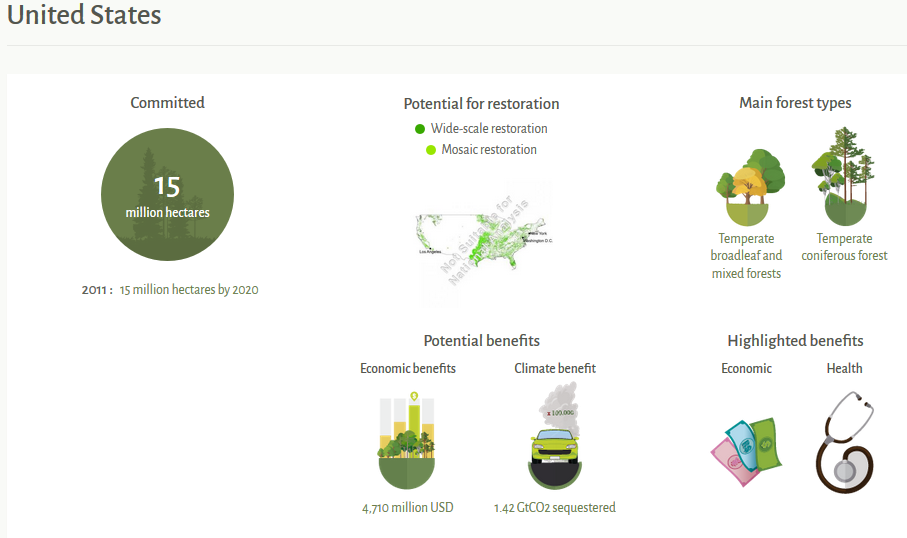
(Flickr photo/Joshua Mayer) Projects (and/or programs) are sometimes about launching new software, building bridges, or researching a new technology. Many of my most recent posts have been about the ocean – here we return to solid ground. This article is about a program to create new natural forests to store carbon. In a recent issue of Nature, the “Comment” section is about the need to keep global warming below 1.5 degrees C to avoid dangerous changes in climate. The IPCC (Intergovernmental Panel on Climate Change) says that around 73o billion tons of CO2 must be taken out of the atmosphere by the end of this century to achieve this goal. To put this amount in context, we’re talking about an amount of CO2 equal to that produced since the industrial revolution from the following countries: The US, the UK, Germany, and China. Using forests to sequester CO2 is not only safe and proven, it also has the benefit of providing jobs, aiding in water management, and preserving biodiversity. But how? First of all, and this should seem pretty obvious, if more forest is needed, deforestation must stop. In addition, significant efforts to allow natural forestation must be launched. And one has. It’s called the Bonn Challenge (see http://www.bonchallenge.org). From their web page: The Bonn Challenge is a global effort to restore 150 million hectares of the world's degraded and deforested lands by 2020 and 350 million hectares by 2030. It is overseen by the Global Partnership on Forest Landscape Restoration, with the International Union for Conservation of Nature as its Secretariat. For a review of this Challenge, you can view this video: You can look up your own country’s commitment levels by going to the “Commitments” section of the webpage. Here is the detail on the US: http://www.bonnchallenge.org/content/united-states
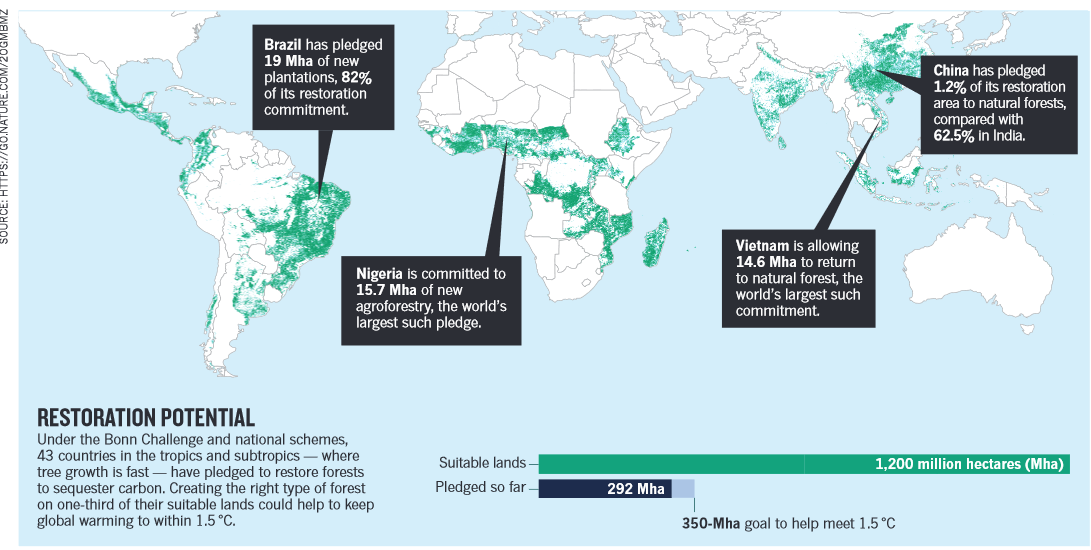
But there’s a threat to this project. Half of the pledged area in the full set of commitments is set to become plantations of commercial trees, not natural forest. Plantations end up releasing the carbon back into the atmosphere approximately 15 years, as opposed to a natural forest which will sequester carbon for many decades.
Where should the forests be created? According to the article, they should be planted in the tropics and subtropics. In Part 2, I’ll discuss the “how” of reforesting, and in Part 3 I’ll cover some of the governance (and enforcement) issues of deforestation. |
|
I started this two-part series with a short post about noisy seas – a different sort of ‘pollution’ that doesn’t get as much attention as the other important changes taking place in the ocean (microplastics, warming temperatures). It started with a very interesting article from Nature, called The Quest for Quieter Seas, which is published online here. That post focused on
In this post I’ll continue on into the study of effects and potential remedies. The US National Oceanic and Atmospheric Administration (NOAA) has suggest a rule of thumb that pulses of sound above 160dB can cause marine mammals to actually make significant changes in their behavior, and if the noise is continuous (not pulses), even 120dB can change the behavior of marine mammals. The previous post had a nice reference chart that showed how these levels of noise compare to more familiar sounds, like jet engines. So – when it comes to these behavior changes, are they temporary inconveniences, or does this possibly cause something more permanently damaging to the ocean ecosystem? Data on killer whales found off of Canada’s west coast indicates that resident whales spend 18-25% less time feeding when surrounded by boat noise. The population of these whales is about 75 (you read that correctly, under 100), and they are already dealing with a lowered food supply. Noise pollution complicates this problem and perhaps magnifies it. We know from our project management work that risks can interact with each other in a spiraling fashion (for example… lower budget ► less effective contractor ► more errors ► more draw-down from already-low budget). It appears that there are some spiraling effects here as well. So what can we do about this? Has anyone tried anything to make changes in the causes of ocean noise? The answer, fortunately, is yes. In the shipping lanes off of Vancouver Island, responding to a request by Vancouver’s ECHO (Enhancing Cetacean Habitat and Observation Program), container ships voluntarily slowed their speed to 11 knots from 18 knots. This did add 30 minutes to their journey, but the reduced engine noise was significant, dropping 24% in intensity. This gave the whales a better chance at feeding and helps prevent the reduction of this limited population of orcas. Have a look at the ECHO program’s website here. How can we implement these sort of changes? We can use the wisdom of Vilfredo Pareto and his 80-20 rule. Studies show that in a modern fleet of 1,500 ships, 50% of the noise came from 15% of the fleet. So yes, the Pareto principle is just that – a principle. Nobody is holding Vilfredo to exactly 80.000% and 20.00000%. In any case, these “Paretoed-out” ships could be targeted, and we can avoid a drastic measure of retrofitting entire fleets with new engines or restricting the speed of a 1000-plus vessel fleets. Earlier I discussed air guns, used in seismic surveys, often to search for deposits of oil and gas. These air guns can be functionally replaced with underwater vibrators that create much smaller footprints. Engines of ships can be elevated off the ship floor, and redesigned to reduce cavitation (the creation of popping bubbles – which sound innocent but when they pop in huge quantities, this quickly becomes noise pollution. Cavitation, by the way, is actually a fascinating principle. Watch this short video to learn more. And here’s the kicker: reducing noise in ocean-going vessels usually goes hand-in-hand with fuel efficiency. So the conclusion of this story is that there’s a “kill-two-birds-with-one-stone” effect. Or maybe the more appropriate expression would be, “save two mammals with one initiative”. |
|
Here’s a story about protecting ocean life that – in a twist – does not involve acidification, plastic, chemical pollution, melting ice, or climate change. Those things are still all threats to ocean life, of course, but this post, which has some intriguing connections to project management, is about noise. It started with a very interesting article from Nature, called The Quest for Quieter Seas, which is published online here. The connections to project management have to do with:
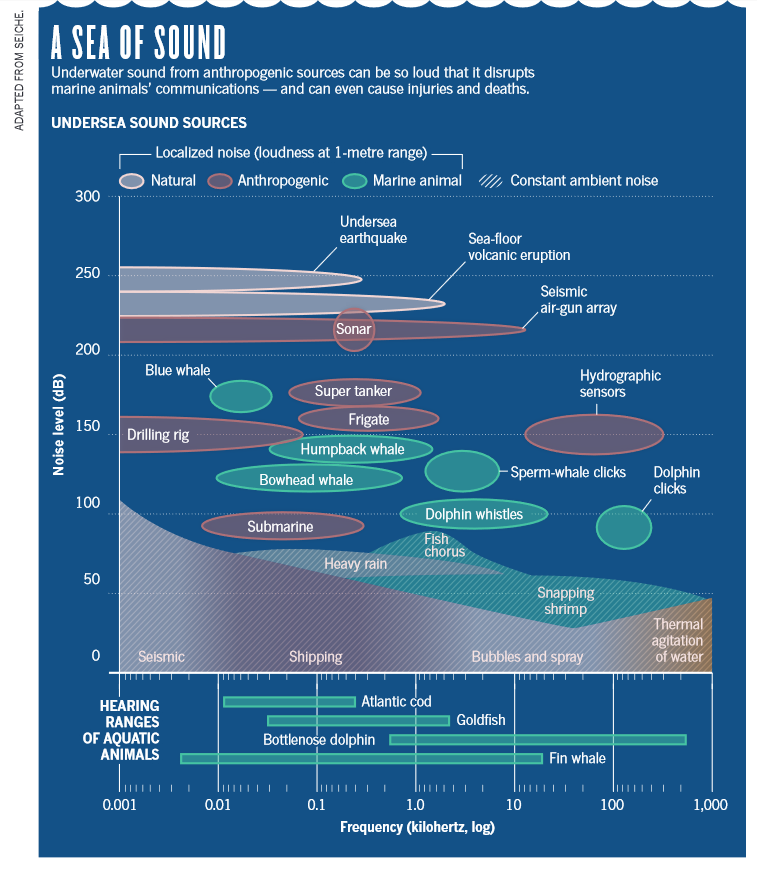
…see if you can find these connections here. Who’s making all of that noise? First, let’s start with the sources of noise in our oceans. Of course, some if it is quite natural and has always been around; things like dolphin whistles and clicks, whales’ songs, rainfall, snapping shrimp, and the rumbling of an undersea earthquake. But some of the noise is most definitely anthropogenic (caused by humans), such as sonar, oil drilling rigs, vehicles (everything from frigates and supertankers to submarines), hydrographic mapping sensors, and seismic air-gun arrays. See the chart below to place these in volume level and against the hearing frequency ranges of various forms of ocean life.
(From Nature, Volume 568, 11-April-2019) The article expresses the need for a baseline so well, I’ll let it speak for itself: Because noise is so pervasive, it is hard to study the impact as it ramps up. It isn’t clear whether marine systems can work around or adapt to it – or whether it will drive crashes in already-stressed populations. So researchers are becoming acoustic prospectors, searching for quite zones and noisy habitats in efforts to chronicle what exactly happens when sound levels change. Efforts (projects) range from natural experiments on the effects of a plan to reroute shipping lanes in the Baltic Sea, to investigate the impact of a trial scheme in Canada to reduce ship speed in coastal waters off Vancouver. Complicating matters is the fact that there are other new and concurrent stressors on marine life, such as the aforementioned acidification and warming ocean temperatures. The effects are not simply arithmetically added, though. A plus B is not a simple equation. The interactions are often causing a negative effect greater than the sum of its parts – also known as synergy. So how much are we adding to the not-so-silent seas, in terms of noise? Based on the amount of noise contributed by an average ship and looking at the number of ships (this does not include sonar and other items mentioned above) the sound contribution has risen about 3 dB per decade. If you know your decibels, you know this is a logarithmic increase – a doubling of sound levels each decade. Seismic air blasts, used to map the sea floor for possible oil or gas drilling opportunities, can be audible for hundreds of kilometers (think Boston to New York or Amsterdam to Dusseldorf). These are causes. What are the effects? It’s beginning to become obvious that loud marine noises can cause a panic dive in cetaceans (whales, dolphins, porpoises), as indicated by the increase in ‘beaching’. These panic dives have the secondary effect of causing hemorrhages in the animals’ brains and hearts. Research projects have also shown that loud waterborne noises can damage the ears and cause hearing loss (as you may expect). In part II I’ll discuss more about the effects and the research and other projects that are being implemented to remedy ocean noise and make the oceans a little quieter. As you can tell from the above, this is not a simple ‘quality of life’ issue – it’s life itself. |
|
"A closed mind is like a closed book; just a block of wood." - Chinese Proverb |