
Viewing Posts by Richard Maltzman


Project PBJ


|
If you take nothing away from this article other than the link to Earth Beat, an outstanding resource from Radio Netherlands, we've done our job. But don't head off there quite yet. We just wanted to bring to your attention the project started by 10-year-old Daniel Cashdan, of Oak Park, California, USA, in which he decided to try to - in effect - grow his own peanut-butter and jelly sandwich. It is a bit about understanding how food is sourced and grown, how food is so convenient but really takes a lot of energy and effort. Here's a link to the specific radio segment on Daniel Cashdan: CLICK HERE TO PLAY RADIO NETHERLANDS SEGMENT Now, zoom out a little. Earth Beat is a program on Radio Netherlands, in English, which covers all sorts of interesting stories on all things sustainable. Many are about projects, and projects not as limited in scope as growing your own PBJ sandwich. This week's particular program, Food, Glorious Food, was about food in general. But Earth Beat's host, Marnie Chesterton, can always be counted on to inform, entertain, intrigue, and while doing so, tickle your funnybone. So we suggest that you sit yourself down to a home-made (and perhaps home-grown?) peanut-butter and jelly sandwich, and listen to a few episodes of Earth Beat.
You can thank us later. Seriously. Please thank us. We'll know you're listening. |


Wave Powah!
|
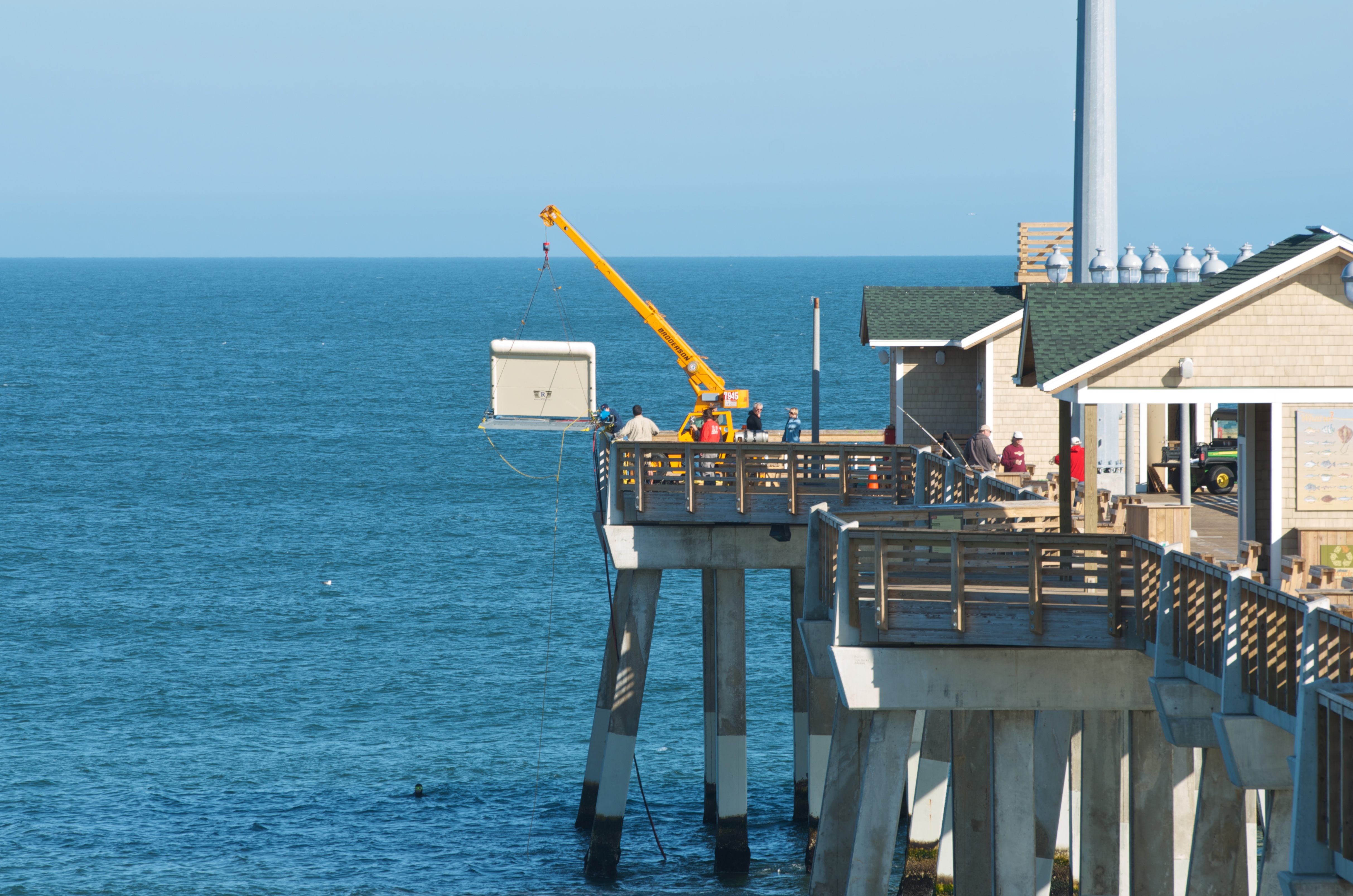
Most Americans (excepting, of course, New Englanders) are familiah whith the New England accent in which we New Englandahs are known to - shall we say - not fully pronounce our "aahhs". I mean, our Rs, especially when they ahh at the end of a word. So that's why we chose to title this posting Wave Powah. It's about a company called Resolute Marine Energy, and this start-up's efforts to harness wave power but in more of a micro solution than a massive solution. A story about Resolute's efforts appeared in today's Boston Globe. You can read the entire story here. Resolute, based in Newburyport, Massachusetts, has prototype "SurgeWEC" wave-energy converters, which feature a fiberglass paddle that swings back and forth with wave motion to power an electric generator. These generators are only 8 x 6 feet, weigh just over 2 tons (minimal compared to other wave systems) and do not require heavy construction on-site, and they can be deployed in quantity where they are needed. Futhermore, the smaller size allows them to be deployed in conjunction with other marine projects such as desalinization plants. In fact, according to the article, "(These are)of particular interest to places where seawater is pumped ashore for desalinization, Staby said. “The power source and the raw material are already co-located,’’ he said. Resolute is working toward a pilot desalinization project in South Africa in the second quarter of next year, with a $150,000 US Interior Department grant to move its design along." Motivating Resolute's ideas for converting wave power to electric power is the following snippet of statistics from the article: "Using Resolute's technology at a conservative 25 percent conversion efficiency, 1000 meters of Plum Island shore would generate 2.5 megawatts of electricity on average, enough to power 2,000+ homes at a typical US household consumption rate of 1.2 kW, says Cliff Goudey, Resolute Marine Energy, Inc., Senior Engineer" We like to see how the economic stimulus package has triggered a (excuse the pun) waterfall effect here: "Funding has been a combination of angel investors and grants, including $1 million from the US Department of Energy in 2010. Noting that the federal grant was part of the economic stimulus package, Staby (Resolute's chief exectutive) pointed with pride to a wall map identifying nearly two dozen Massachusetts companies that Resolute uses as suppliers. He says Newburyport’s MacDiarmid Machine Corp. and Salisbury’s Wilson Welding have been especially important, although the paddle itself was built by Wilbur Yachts in Southwest Harbor, Maine." Another interesting twist for this type of wave power generator is that Resolute's solution, when used in surf deployments, for example, off the shore of Nantucket, they would take energy from the wave and have a positive impact (a reducing one) on beach erosion. So in addition to providing power, they protect the beach - a nice outcome. As project managers, we need to take note of the inventiveness of these types of solutions, their funding sources, the key stakeholders, and their long-term benefits (as we should with any project). You can learn more about Resolute Marine Energy on their site. In the meantime, we will practice our Rs. R R R R R ... |
China: Dubious Distinction Drives Plethora of Projects and Programs
|
Half a trillion dollars. That's a lot of money -a lot of projects - and clearly a lot of opportunity for project managers. And that is the amount of money (about 3 trillion yuan) to be spent over the next 5 years on clean energy initiatives in China, such as a solar power generation system covering 100 counties in the country. According to a nice feature article in PM Network magazine by Sarah Fister Gale, China has the dubious distinction as the leading contributor in the world to CO2 emissions. So it is launching a program to cut its carbon intensity by 16 to 17 percent by 2015. Using a combination approach - both of which launch projects and programs - to reduce pollution and increase efficiency of existing plants (power and otherwise) and to initiate more renewable energy creation, the country is launching projects to:
We suggest you read the whole article here. And, as we have for years, we urge all project managers to develop their conversancy in the area of sustainability - because many of the projects, not just in China, but in the world, will be triggered by efforts such as this. Half a trillion dollars is a pretty good incentive! Or as our Chinese colleagues may say: |

Projects that have microbes doing our dirty work
|
In this nifty article from this past Sunday's Boston Globe, you can read about several companies in the Boston area and the projects they've initiated to harness the power of microbes. As you remember from the infamous H. G. Wells story, The War Of The Worlds, microbes have helped us before (in fiction) and now they are helping us again (in fact). These micro-organisms are being engineered and "hired" to clean waste water, produce fuel, or to sterilize hospital equipment. Project development time has increased orders of magnitude, even since the 1990s. Where it used to take 10 or 15 years to develop a new biological product, this can be done "at a much more accelerated pace", challenging not just the scientists and engineers invloved, but of course the project teams and necessarily the project manager. The companies involved here are Manus Biosynthesis, Cambrian Innovation, Ginkgo BioWorks, Novophage, and others. Cambrian, for example, is cultivating colonies of naturally-occurring bacteria that can serve as catalysts for chemical reactions, making them significantly more efficient. They activate with electrical impulses. These microbes were only discovered in 1999. When the microbes are grouped, they can convert CO2 into methane, making it easier to collect and therefore preventing CO2 from escaping into the air, and can also, in turn, generate electricity. Read the story. You can see the implications for large numbers of projects, and it reinforces our assertion that project managers should become more attuned to the language of sustainability and understand the opportunities it provides for PMs in fields such as this. Oh, and one more thing. Don't let the idea of engineered bio-products scare you too much. It was beginning to creep us out a bit as we read through it, but the authors make a really good point. Sitting in your house, or one very close to it, is an example of a genetically-engineered organism. There's a picture of one below:
Yep. Dogs are just genetically-modified wolves. And we (generally) trust these even with our little kids. In any case - check out the article and continue to build your knowledge in sustainability and project management; you may find yourself leading a project just like the ones in the story! |

State of the Green Business Report
|
Earlier this week, US President Barak Obama gave the annual "State of the Union Address", which you can read about here. Timed to go along with this, is the GreenBiz.org "State of the Green Business Report". The report, which measures 20 aspects of environmental performance, from carbon emissions to paper use and recycling, and attempts to answer the question, "Are we bringing a green economy into being?" The news for 2012: not so good. The report shows a slowing of momentum -- or even steps in the backwards direction, in some cases -- on some of the indicators. Among the downgraded topics include investments in clean technology innovations, overall energy intensity, certifications of LEED buildings, and paper use and recycling. We stress that project managers by virtue of their "Change Agent" mindset need to bring sustainability issues (economic, ecological and social) to the forefront. Heck, it's even in the name of our blog - People, Planet, Profits, & Projects - so we think we as Project Managers should be stepping up here, and reversing this negative trend, getting the momentum back - all in the positive direction. We suggest that an informed PM is the best PM. You can download the full report here. Want some good news? There is a short video clip from Joel Makower here, which explains how the CFOs of organizations are starting to take sustainability on as a traditional ongoing measure of success. Of course if you want to be informed we also would recommend our Cleland Award-winning book... The facts remain: good progress has been made. Looks like we slipped a little over the past year, but we can regain this momentum and you as project managers play a key role in bringing sustainability thinking to the forefront. |



