Smart Farming Part 2
From the People, Planet, Profits & Projects Blog
by Richard Maltzman,
Dave Shirley

View Posts By:
Richard Maltzman
Dave Shirley
Recent Posts
What is AI doing to the sustainability of our profession???
Stepwells – Insight from a Particularly Valid Angle
Climb-it Change: Pre-Interview Connector
Climb-it Change: New Relevance for the Stepwells of India
A PATH to more equitable health - via AI project leadership
Categories
6th,
6th Edfition,
6th Edition PMBOK,
7th Edition,
7th Edition PMBOK,
8th Edition PMBOK,
8th Edition PMBOK Guide,
Activism,
actuarial,
actuary,
adapt,
addition by subtraction,
Africa,
africa,
agriculture,
airforce,
ajaita,
Alaska,
amazon,
analogous,
analytics,
ancient,
and more power,
antarctica,
anti-science,
apple,
apps,
architecture,
arctic,
arrakis,
Artificial Intelligence,
asch paradigm,
Assistant,
asthma,
astronomy,
automobile,
automotive,
autonomous cars,
b,
bankhar,
Banksy Crypto,
basalt,
baseball,
bats,
batter,
beauty products,
benefit,
benefits,
Benefits Realization,
beyond epica,
biases,
bicycle,
big data,
big dfata,
big dig,
bike,
biodiversity,
biomedicine,
birdhouse,
blockchain,
blood,
blue blood,
blue trees,
bluefin,
bluefin tuna,
book review,
boston,
boston university,
Boyce,
Brazil,
brazil,
Breakdown Structures,
BS,
building,
buildings,
built environment,
built environment,
bumblebee,
cake,
capacitor,
car,
Carbon,
carbon,
carbon capture,
carbon negative,
carbon neutral,
carbon pool,
carbon sequestration,
carbonate,
careers,
CEO,
ChatGPT,
chatGPT,
chatgpt,
chatgpt,
chess,
China,
china,
chopsticks,
citrus,
cli-fi,
climate,
climate change,
climate resilience,
climeworks,
Clumsy,
CO2,
co2,
CO2 Utilization,
coalition,
cobalt,
coffee pods,
cognition,
cognitive,
Collabortion,
colombia,
concrete,
Conflict,
construction 5.0,
cool projects xyloscope,
cooling,
coral,
corn,
cost of good quality,
cost of poor quality,
cost of quality,
crazy,
criticism of project management,
cryptocurrency,
CSR,
csr,
data,
data analytics,
data privacy,
datacenter,
dataset,
death spiral,
Decision Making,
decomposition,
Defense and Climate,
definition of a project,
deforestation,
dependencies,
dependency,
desert,
DIKW,
dikw,
dimopoulos,
disposal,
dna,
DOD,
dogs,
dolphins,
dream,
drilling,
drink,
dune,
dune,
dutch,
early start,
earth,
eatlocal,
eco-tourism,
ecological,
economic,
economics,
EKC,
electric grid,
electricity,
electronics,
elysis,
embodied carbon,
emerging technologies,
empower,
Energy,
energy efficiency,
environmental degradation,
escalate,
escalation,
ESG,
extreme weather,
fallacy,
FARC,
farming,
finance,
fish,
fish brains,
fishing,
fix,
fixing the earth,
flint water,
Flint Water Supply,
flood,
flooding,
Food supply chain,
food waste,
forest,
forest for the trees,
forestation,
forrestgump,
frank herbert,
Fruitcake,
fungus,
fusion,
Galvao,
garage,
gas,
gasoline,
geese,
gender equality,
gender partnerships,
generational differences,
Generative AI,
gladwell,
gold,
Goodness,
google,
Government,
GPT,
great pacific garbage patch,
green,
green building,
green buildings,
green energy,
green iguana,
green project,
green project management,
greening,
guest post,
gyre,
harkonnen,
Harvesting Benefits,
hawasina,
hedgehogs,
heursitics,
historical data,
hlb,
holitsic,
holland,
horseshoe crab,
human-caused climate change,
hydrogen,
hydrology,
ice,
iceland,
ignition,
iguana,
imagery,
impact,
india,
inequality,
information,
initiatives,
injection,
insurance,
intelligence,
interacting risk,
internal combustion engine,
invasive species,
investment,
isomer,
issue escalation,
issues,
ITER,
jobs,
Jupiter,
justification,
kids,
kill point,
knowledge,
koch brothers,
Kuznets,
laboratory,
LAL,
landscape mode,
lapampa,
launch,
LCA,
Leadership,
Leadership,
life cycle analyses,
life cycle analysis,
lifecycle,
Linkedin,
liquid,
lizard,
local,
long term,
long-term,
long-term thinking,
look up,
loud,
maintenance,
maker,
makermovement,
malcolm gladwell,
management,
marathon,
marine biology,
market,
mars,
Martin Luther King,
mean,
megawatt,
MeHg,
melting,
mercury,
metal,
Microgrid,
microplastics,
migration,
military,
millennial,
mindset,
minerals,
mission,
mitigate,
MLK,
mongolia,
museum,
museum of london,
nature,
nematodes,
net gain,
Net Project Success Score,
net zero,
netherlands,
network,
New book,
New Jersey,
New Practitioners,
new york,
NFT,
nitrogen,
noise,
noreaster,
norway,
nova,
NPSS,
NREL,
ocean,
ocean cleanup,
ocean life,
oil rig,
oil rigs,
oklahoma,
oman,
only murders in the building,
opportunity,
overall risk,
oxygen,
packaging,
pareto,
PBS,
permafrost,
persistence,
peru,
Pharmaceutical,
planet,
planet.com,
planning,
plant,
plasma,
plastic,
playground,
pm,
pm education,
pmbok,
pmbok guide,
pmnetwork,
PMXPO-2018,
podcast,
pollutants,
pollution,
poop,
poor,
portfolio,
power,
power skills,
privacy,
privacy concerns,
professors,
program,
Program Management,
project,
project leader,
project leadership,
project management,
project management 3.0,
project on fire,
project progress,
Project Success,
project success,
projecticity,
projectleadership,
projectmanagement,
projects,
psychology,
pulse of the profession,
purple bacteria,
purpose,
quiet,
rainforest,
rationale,
reef,
refugees,
renewable,
renewables,
Repair,
repair,
repeatable process,
repeatable processes,
repurpose,
research,
resource breakdown strucuture,
Resource Management,
reversing climate change,
revisionist history,
rich,
rigs2reefs,
ripe,
risk,
risk avoidance,
Risk Management,
risk mitigation,
risk response,
risk responses,
river,
robots,
rocks,
rules of thumb,
rural,
rural India,
russia,
Sarcasm/Irony,
satellite,
saudi,
schedule,
sci-fi,
Science,
science,
science-fiction,
scientific american,
screaming monkeys,
sea,
sea life,
Sea-Level Rise,
sea-level rise,
seagreens,
seawall,
seawater,
seawater temperature,
seaweed. beat;es. farming,
secondary risk,
selena gomez,
sequestration,
shipping,
skyscraper,
SLR,
smart cities,
smart city,
smelting,
social,
social pressure,
soil,
solar,
solar panels,
solar perovkites,
solar saheli,
sonic,
sponge cities,
SRI,
stage-gate,
stagegate,
stakeholder,
stakeholder management,
steward,
stewardship,
storage,
strategy,
stupid,
success,
suffer,
sulphur,
sunk cost,
supercapacitor,
supply chain,
survey,
Sustainability,
sustainability,
Sustainable Investing,
Sustainable Tourism,
sybiosis,
symbiosis,
system 03,
TBL,
temperature,
terraform,
terraforming,
test,
threat,
threats,
totem,
touchscreen,
tour,
tower,
Trains,
transparency,
transportation,
trash,
tree,
tree species,
trees,
trillion,
triple bottom line,
triple constraint,
truth to power,
UMass,
us army corps of engineers,
USDA,
vacuum,
value,
venus,
vision,
voice,
voltage optimization,
vw scandal,
washing machine,
waste,
wastewater,
water,
we mean business,
whales,
Whirlpool,
wind,
wisdom,
women,
Women in Project Management,
wood wide web,
woonerf,
Work Breakdown Structures (WBS),
world breakdown structure,
worms,
xian,
xylotron,
Yale
Date

Cloud Ag visualization showing variable soil carbon levels across a single field. Image credit: Cloud AgCloud
This is the second in a series on Smart Farming; this one focusing on things way above the Earth and well, the earth of the Earth. This is a post about how technology projects can be applied to increasingly important sustainability issues of all sorts, including, literally the soil under our feet. It’s also a post about collaboration, combining different disciplines, and listening to stakeholders, all important principles of the 7th Edition PMBOK® Guide.
I open with a quote from the article from UMass Magazine.
A few years ago, (UMass) geosciences Assistant Professor Isaac Larsen was driving along in the Midwest, near where he grew up. “The hilltops in the landscape no longer had organic rich soil—just subsoil. I could tell by the color,” he recalls. A big driver of soil erosion and degradation is the plow. “Every time a plow goes across the landscape, it fluffs up the soil,” Larsen explains, "and the soil moves down the slope.” Over the course of a century and a half, that’s a lot of soil.
What to do? Supported by NASA, Larsen and his team are utilizing satellite imagery to analyze the problem. “We can relate soil color that we see in satellite imagery to the amount of carbon in the soil, and then relate that amount of carbon to a soil horizon,”—or soil layer—explains Evan Thaler, a doctoral student working with Larsen. The team has been able to show that around a third of all cultivated land in the United States has lost its rich topsoil. “The next step,” says Thaler, “is for policy makers to incorporate this information. If we can rebuild the carbon in the hilltops, we’re actually pulling carbon dioxide out of the atmosphere and putting it back in the soil, so it’s absolutely a climate change issue as well.” Larsen backs that up. “We have to mitigate the effect we’ve had,” he says. “Restoration of carbon to soils is one piece of the solution.”
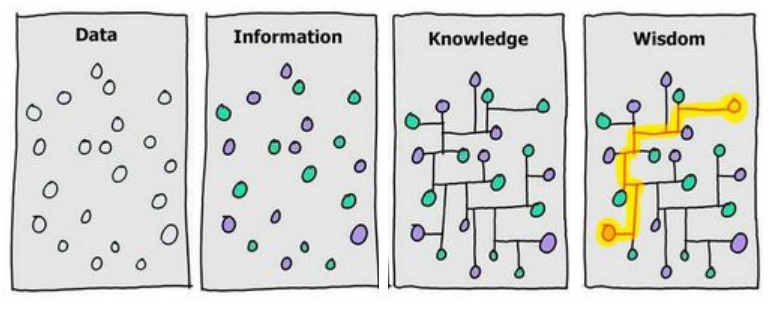
So, this project was about applying satellite technology and business intelligence (BI) to collate and advance data into information, into knowledge, providing wisdom – a key theme for project managers. If you are not familiar with the DIKW pyramid, today is the day you should investigate it. You can start with this excellent article (Click here to read an outstanding article on the topic).

I found this theme reiterated in several diverse sources. In this article from NPR, Evan Thaler is quoted again:
The soil that's darkest in color is widely known as topsoil. Soil scientists call this layer the "A-horizon." It's the "black, organic, rich soil that's really good for growing crops," says Evan Thaler, a Ph.D. student at the University of Massachusetts, Amherst.
It's full of living microorganisms and decaying plant roots, also called organic carbon. When settlers first arrived in the Midwest, it was everywhere, created from centuries of accumulated prairie grass. Plowing, though, released much of the trapped carbon, and topsoil was also lost to wind and water erosion. The soil that remains is often much lighter in color.
It's clear that this is important, but even more so when you note the connection to climate change, this gets even more interesting. I found this article in a site dedicated to applying Artificial Intelligence to practical matters – in this case, soil carbon monitoring, the very topic of this Smart Farming post.
In short, it describes how soil systems (healthy ones, that is!) act as a carbon “sink” by sequestering atmospheric CO2, thus reducing greenhouse gas concentrations. Healthy soil, says the article, is capable of storing twice the amount of carbon in the atmosphere and three times that in above-ground vegetation. The article answers the question: “why initiate projects to carefully measure soil carbon?
Why should we monitor soil carbon:
- Improving Crop Performance: Building up healthy levels of soil organic matter can provide growers with higher yielding harvests showing greater resilience in changing climates (Paustian et al., 2019)
- Carbon Trading: With the proposed advent of an international carbon market and carbon trading, accurate monitoring of soil carbon will become increasingly important (Johns et al,. 2017).
- Mitigating Climate Change: Optimising natural carbon sequestration by improving soil conservation practices and restoring degraded soils can help to reduce concentrations of atmospheric carbon dioxide. As little as a 0.1% increase in organic matter can result in an additional 8.9 tonnes of CO2 sequestered per hectare annually by growers.
Ironically, this post about the Earth’s soil provides some help for project managers who want to ‘build from the ground up’ in terms of advancing data into information, knowledge, and wisdom.
For more digging (pun intended):
“Soil organic carbon and carbon sequestration in Western Australia”
https://www.agric.wa.gov.au/climate-change/soil-organic-carbon-and-carbon-sequestration-western-australia
“Extent of Soil Loss Across the US Corn Belt”
https://www.pnas.org/content/118/8/e1922375118
“Quantifying carbon for agricultural soil management: from the current status toward a global soil information system”
https://www.tandfonline.com/doi/full/10.1080/17583004.2019.1633231
Davis, et al , “Review of Soil Organic Carbon Measurement Protocols: A U.S. and Brazil Comparison and Recommendation”
https://www.mdpi.com/2071-1050/10/1/53/pdf
Posted
by
Richard Maltzman
on: November 28, 2021 10:11 PM |
Permalink
Comments (0)
Please login or join to subscribe to this item
Please Login/Register to leave a comment.
|
Disbelief in magic can force a poor soul into believing in government and business.
- Tom Robbins
|




