
View Posts By:
Richard Maltzman
Dave Shirley
Recent Posts
What is AI doing to the sustainability of our profession???
Stepwells – Insight from a Particularly Valid Angle
Climb-it Change: Pre-Interview Connector
Climb-it Change: New Relevance for the Stepwells of India
A PATH to more equitable health - via AI project leadership
Categories
6th,
6th Edfition,
6th Edition PMBOK,
7th Edition,
7th Edition PMBOK,
8th Edition PMBOK,
8th Edition PMBOK Guide,
Activism,
actuarial,
actuary,
adapt,
addition by subtraction,
Africa,
africa,
agriculture,
airforce,
ajaita,
Alaska,
amazon,
analogous,
analytics,
ancient,
and more power,
antarctica,
anti-science,
apple,
apps,
architecture,
arctic,
arrakis,
Artificial Intelligence,
asch paradigm,
Assistant,
asthma,
astronomy,
automobile,
automotive,
autonomous cars,
b,
bankhar,
Banksy Crypto,
basalt,
baseball,
bats,
batter,
beauty products,
benefit,
benefits,
Benefits Realization,
beyond epica,
biases,
bicycle,
big data,
big dfata,
big dig,
bike,
biodiversity,
biomedicine,
birdhouse,
blockchain,
blood,
blue blood,
blue trees,
bluefin,
bluefin tuna,
book review,
boston,
boston university,
Boyce,
Brazil,
brazil,
Breakdown Structures,
BS,
building,
buildings,
built environment,
built environment,
bumblebee,
cake,
capacitor,
car,
Carbon,
carbon,
carbon capture,
carbon negative,
carbon neutral,
carbon pool,
carbon sequestration,
carbonate,
careers,
CEO,
ChatGPT,
chatGPT,
chatgpt,
chatgpt,
chess,
China,
china,
chopsticks,
citrus,
cli-fi,
climate,
climate change,
climate resilience,
climeworks,
Clumsy,
CO2,
co2,
CO2 Utilization,
coalition,
cobalt,
coffee pods,
cognition,
cognitive,
Collabortion,
colombia,
concrete,
Conflict,
construction 5.0,
cool projects xyloscope,
cooling,
coral,
corn,
cost of good quality,
cost of poor quality,
cost of quality,
crazy,
criticism of project management,
cryptocurrency,
CSR,
csr,
data,
data analytics,
data privacy,
datacenter,
dataset,
death spiral,
Decision Making,
decomposition,
Defense and Climate,
definition of a project,
deforestation,
dependencies,
dependency,
desert,
DIKW,
dikw,
dimopoulos,
disposal,
dna,
DOD,
dogs,
dolphins,
dream,
drilling,
drink,
dune,
dune,
dutch,
early start,
earth,
eatlocal,
eco-tourism,
ecological,
economic,
economics,
EKC,
electric grid,
electricity,
electronics,
elysis,
embodied carbon,
emerging technologies,
empower,
Energy,
energy efficiency,
environmental degradation,
escalate,
escalation,
ESG,
extreme weather,
fallacy,
FARC,
farming,
finance,
fish,
fish brains,
fishing,
fix,
fixing the earth,
flint water,
Flint Water Supply,
flood,
flooding,
Food supply chain,
food waste,
forest,
forest for the trees,
forestation,
forrestgump,
frank herbert,
Fruitcake,
fungus,
fusion,
Galvao,
garage,
gas,
gasoline,
geese,
gender equality,
gender partnerships,
generational differences,
Generative AI,
gladwell,
gold,
Goodness,
google,
Government,
GPT,
great pacific garbage patch,
green,
green building,
green buildings,
green energy,
green iguana,
green project,
green project management,
greening,
guest post,
gyre,
harkonnen,
Harvesting Benefits,
hawasina,
hedgehogs,
heursitics,
historical data,
hlb,
holitsic,
holland,
horseshoe crab,
human-caused climate change,
hydrogen,
hydrology,
ice,
iceland,
ignition,
iguana,
imagery,
impact,
india,
inequality,
information,
initiatives,
injection,
insurance,
intelligence,
interacting risk,
internal combustion engine,
invasive species,
investment,
isomer,
issue escalation,
issues,
ITER,
jobs,
Jupiter,
justification,
kids,
kill point,
knowledge,
koch brothers,
Kuznets,
laboratory,
LAL,
landscape mode,
lapampa,
launch,
LCA,
Leadership,
Leadership,
life cycle analyses,
life cycle analysis,
lifecycle,
Linkedin,
liquid,
lizard,
local,
long term,
long-term,
long-term thinking,
look up,
loud,
maintenance,
maker,
makermovement,
malcolm gladwell,
management,
marathon,
marine biology,
market,
mars,
Martin Luther King,
mean,
megawatt,
MeHg,
melting,
mercury,
metal,
Microgrid,
microplastics,
migration,
military,
millennial,
mindset,
minerals,
mission,
mitigate,
MLK,
mongolia,
museum,
museum of london,
nature,
nematodes,
net gain,
Net Project Success Score,
net zero,
netherlands,
network,
New book,
New Jersey,
New Practitioners,
new york,
NFT,
nitrogen,
noise,
noreaster,
norway,
nova,
NPSS,
NREL,
ocean,
ocean cleanup,
ocean life,
oil rig,
oil rigs,
oklahoma,
oman,
only murders in the building,
opportunity,
overall risk,
oxygen,
packaging,
pareto,
PBS,
permafrost,
persistence,
peru,
Pharmaceutical,
planet,
planet.com,
planning,
plant,
plasma,
plastic,
playground,
pm,
pm education,
pmbok,
pmbok guide,
pmnetwork,
PMXPO-2018,
podcast,
pollutants,
pollution,
poop,
poor,
portfolio,
power,
power skills,
privacy,
privacy concerns,
professors,
program,
Program Management,
project,
project leader,
project leadership,
project management,
project management 3.0,
project on fire,
project progress,
Project Success,
project success,
projecticity,
projectleadership,
projectmanagement,
projects,
psychology,
pulse of the profession,
purple bacteria,
purpose,
quiet,
rainforest,
rationale,
reef,
refugees,
renewable,
renewables,
Repair,
repair,
repeatable process,
repeatable processes,
repurpose,
research,
resource breakdown strucuture,
Resource Management,
reversing climate change,
revisionist history,
rich,
rigs2reefs,
ripe,
risk,
risk avoidance,
Risk Management,
risk mitigation,
risk response,
risk responses,
river,
robots,
rocks,
rules of thumb,
rural,
rural India,
russia,
Sarcasm/Irony,
satellite,
saudi,
schedule,
sci-fi,
Science,
science,
science-fiction,
scientific american,
screaming monkeys,
sea,
sea life,
Sea-Level Rise,
sea-level rise,
seagreens,
seawall,
seawater,
seawater temperature,
seaweed. beat;es. farming,
secondary risk,
selena gomez,
sequestration,
shipping,
skyscraper,
SLR,
smart cities,
smart city,
smelting,
social,
social pressure,
soil,
solar,
solar panels,
solar perovkites,
solar saheli,
sonic,
sponge cities,
SRI,
stage-gate,
stagegate,
stakeholder,
stakeholder management,
steward,
stewardship,
storage,
strategy,
stupid,
success,
suffer,
sulphur,
sunk cost,
supercapacitor,
supply chain,
survey,
Sustainability,
sustainability,
Sustainable Investing,
Sustainable Tourism,
sybiosis,
symbiosis,
system 03,
TBL,
temperature,
terraform,
terraforming,
test,
threat,
threats,
totem,
touchscreen,
tour,
tower,
Trains,
transparency,
transportation,
trash,
tree,
tree species,
trees,
trillion,
triple bottom line,
triple constraint,
truth to power,
UMass,
us army corps of engineers,
USDA,
vacuum,
value,
venus,
vision,
voice,
voltage optimization,
vw scandal,
washing machine,
waste,
wastewater,
water,
we mean business,
whales,
Whirlpool,
wind,
wisdom,
women,
Women in Project Management,
wood wide web,
woonerf,
Work Breakdown Structures (WBS),
world breakdown structure,
worms,
xian,
xylotron,
Yale
Date
In part 1 of this blog post, “A Clean Start for the 2022 Project Leader”, I make a point – or rather I try to make a point – in the very title of the post. Project Leader is a term I am beginning to favor greatly over Project Manager. I won’t go through my full rant here, but think about it: what do you do as a project manager? Do you oversee daily arrival time of employees? Do you assess their performance for raises? Do you see if they are following company policies day-to-day? No, no, and no. You aren’t generally performing supervisory/management functions. Do you need to inspire your team, to serve them? Do you get roadblocks out of the way, and often work with diverse teams from different groups that don’t directly report to you? Yes, yes, yes, and yes. That’s leadership. Congratulations. You’re a Project Leader.
OK, good. We covered the title. Now back to the topic. In that blog post, I refer to a podcast episode by Malcom Gladwell’s Revisionist History. In that episode, he visits the Procter and Gamble HQ and talks with Todd Cline, Director of R&D, North America Fabric Care.
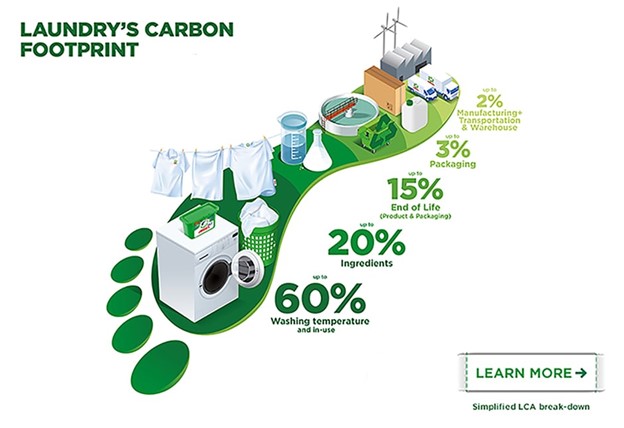
Cline walks Gladwell through a lab where testing is taking place on detergents that can work in cool or even cold water. It’s not a trivial thing – in the US, we do 300 loads of laundry a year and each load uses 41 gallons of water. Do the math. And that is just household laundry. Commercial clothes washing adds a bigger chunk of impact. The carbon impact of a washing machine or detergent has very little to do with manufacturing or shipping it, or even disposing of it (although these should also be considered).
Environmental impact is almost all in the “use” phase of the life of a washing machine. This is because most of the carbon footprint comes from the energy to heat the water. A 70% reduction in carbon footprint is achieved simply by using cold water. And to bring it closer to home, use of cold water would also make your clothes last longer. So, the “holy grail” of laundry is washing clothes in cold water.
This whole idea of a Life Cycle Assessment (LCA) and in particular, the LCA of a washing machine, was actually covered in our 2010 book, Green Project Management, with the intent to wake up project leaders (yep, it’s that term again) to the idea that their project’s product goes on (sustains) well beyond the project’s existence. We refer to this paper (see reference below) and use the figure below to make the point that Gladwell is hearing about at P&G headquarters, 9 years later.

This is also covered nicely in a National Geographic piece called Lightening the Load. And it’s also covered by P&G laundry detergent Ariel in this piece. P&G is of course, pushing their product, but they are indeed tackling an important problem and the article does have good information – and it provided us with a really cool (pun intended) lead-off picture..
PMI® has been talking about life cycle thinking for a while, but it has never been as relevant and PMI has never been as holistic and expansive in its standards and PMBOK® Guides as it now has been in the PMBOK® Guide, 7th Edition. Now, PMI is saying things like: “It is becoming more common…to consider social and environmental impacts in addition to the financial impacts…this may take the form of a product life cycle assessment which evaluates the potential environmental impacts of a product, process, or system…” (PMBOK® Guide 7th Edition, section 2.4.1, Planning Overview).
So, here’s the thought for our clean new (well, somewhat new) year. Think clean through the end of your project. Plan in considerations for how the product of your project (which could be a chunk of hardware like a washing machine or a piece of software, or a highway surface, or a house-cleaning service) impacts social and environmental AND financial long-term outcomes. Imagine the product of your project in action, 3 years from now. What does it use? What does it produce? Who does it impact? Now expand that to 10, 30, 100 years. I know. This is hard for us. We are get’R’done folk. On to the next project. But we are doing a disservice to our stakeholders (some of whom are our grandchildren) when we don’t take the bigger picture into account when we plan.
Reference: Koroneos, Christopher & Achillas, Ch & Nanaki, Evanthia. (2013). Life Cycle Thinking in the Use of Natural Resources. Open Environmental Sciences. 7. 1-6. 10.2174/1876325101307010001.
Posted
by
Richard Maltzman
on: January 26, 2022 11:34 PM |
Permalink




