Five Mental Hiccups
From the People, Planet, Profits & Projects Blog
by Richard Maltzman,
Dave Shirley

View Posts By:
Richard Maltzman
Dave Shirley
Recent Posts
What is AI doing to the sustainability of our profession???
Stepwells – Insight from a Particularly Valid Angle
Climb-it Change: Pre-Interview Connector
Climb-it Change: New Relevance for the Stepwells of India
A PATH to more equitable health - via AI project leadership
Categories
6th,
6th Edfition,
6th Edition PMBOK,
7th Edition,
7th Edition PMBOK,
8th Edition PMBOK,
8th Edition PMBOK Guide,
Activism,
actuarial,
actuary,
adapt,
addition by subtraction,
Africa,
africa,
agriculture,
airforce,
ajaita,
Alaska,
amazon,
analogous,
analytics,
ancient,
and more power,
antarctica,
anti-science,
apple,
apps,
architecture,
arctic,
arrakis,
Artificial Intelligence,
asch paradigm,
Assistant,
asthma,
astronomy,
automobile,
automotive,
autonomous cars,
b,
bankhar,
Banksy Crypto,
basalt,
baseball,
bats,
batter,
beauty products,
benefit,
benefits,
Benefits Realization,
beyond epica,
biases,
bicycle,
big data,
big dfata,
big dig,
bike,
biodiversity,
biomedicine,
birdhouse,
blockchain,
blood,
blue blood,
blue trees,
bluefin,
bluefin tuna,
book review,
boston,
boston university,
Boyce,
Brazil,
brazil,
Breakdown Structures,
BS,
building,
buildings,
built environment,
built environment,
bumblebee,
cake,
capacitor,
car,
Carbon,
carbon,
carbon capture,
carbon negative,
carbon neutral,
carbon pool,
carbon sequestration,
carbonate,
careers,
CEO,
ChatGPT,
chatGPT,
chatgpt,
chatgpt,
chess,
China,
china,
chopsticks,
citrus,
cli-fi,
climate,
climate change,
climate resilience,
climeworks,
Clumsy,
CO2,
co2,
CO2 Utilization,
coalition,
cobalt,
coffee pods,
cognition,
cognitive,
Collabortion,
colombia,
concrete,
Conflict,
construction 5.0,
cool projects xyloscope,
cooling,
coral,
corn,
cost of good quality,
cost of poor quality,
cost of quality,
crazy,
criticism of project management,
cryptocurrency,
CSR,
csr,
data,
data analytics,
data privacy,
datacenter,
dataset,
death spiral,
Decision Making,
decomposition,
Defense and Climate,
definition of a project,
deforestation,
dependencies,
dependency,
desert,
DIKW,
dikw,
dimopoulos,
disposal,
dna,
DOD,
dogs,
dolphins,
dream,
drilling,
drink,
dune,
dune,
dutch,
early start,
earth,
eatlocal,
eco-tourism,
ecological,
economic,
economics,
EKC,
electric grid,
electricity,
electronics,
elysis,
embodied carbon,
emerging technologies,
empower,
Energy,
energy efficiency,
environmental degradation,
escalate,
escalation,
ESG,
extreme weather,
fallacy,
FARC,
farming,
finance,
fish,
fish brains,
fishing,
fix,
fixing the earth,
flint water,
Flint Water Supply,
flood,
flooding,
Food supply chain,
food waste,
forest,
forest for the trees,
forestation,
forrestgump,
frank herbert,
Fruitcake,
fungus,
fusion,
Galvao,
garage,
gas,
gasoline,
geese,
gender equality,
gender partnerships,
generational differences,
Generative AI,
gladwell,
gold,
Goodness,
google,
Government,
GPT,
great pacific garbage patch,
green,
green building,
green buildings,
green energy,
green iguana,
green project,
green project management,
greening,
guest post,
gyre,
harkonnen,
Harvesting Benefits,
hawasina,
hedgehogs,
heursitics,
historical data,
hlb,
holitsic,
holland,
horseshoe crab,
human-caused climate change,
hydrogen,
hydrology,
ice,
iceland,
ignition,
iguana,
imagery,
impact,
india,
inequality,
information,
initiatives,
injection,
insurance,
intelligence,
interacting risk,
internal combustion engine,
invasive species,
investment,
isomer,
issue escalation,
issues,
ITER,
jobs,
Jupiter,
justification,
kids,
kill point,
knowledge,
koch brothers,
Kuznets,
laboratory,
LAL,
landscape mode,
lapampa,
launch,
LCA,
Leadership,
Leadership,
life cycle analyses,
life cycle analysis,
lifecycle,
Linkedin,
liquid,
lizard,
local,
long term,
long-term,
long-term thinking,
look up,
loud,
maintenance,
maker,
makermovement,
malcolm gladwell,
management,
marathon,
marine biology,
market,
mars,
Martin Luther King,
mean,
megawatt,
MeHg,
melting,
mercury,
metal,
Microgrid,
microplastics,
migration,
military,
millennial,
mindset,
minerals,
mission,
mitigate,
MLK,
mongolia,
museum,
museum of london,
nature,
nematodes,
net gain,
Net Project Success Score,
net zero,
netherlands,
network,
New book,
New Jersey,
New Practitioners,
new york,
NFT,
nitrogen,
noise,
noreaster,
norway,
nova,
NPSS,
NREL,
ocean,
ocean cleanup,
ocean life,
oil rig,
oil rigs,
oklahoma,
oman,
only murders in the building,
opportunity,
overall risk,
oxygen,
packaging,
pareto,
PBS,
permafrost,
persistence,
peru,
Pharmaceutical,
planet,
planet.com,
planning,
plant,
plasma,
plastic,
playground,
pm,
pm education,
pmbok,
pmbok guide,
pmnetwork,
PMXPO-2018,
podcast,
pollutants,
pollution,
poop,
poor,
portfolio,
power,
power skills,
privacy,
privacy concerns,
professors,
program,
Program Management,
project,
project leader,
project leadership,
project management,
project management 3.0,
project on fire,
project progress,
Project Success,
project success,
projecticity,
projectleadership,
projectmanagement,
projects,
psychology,
pulse of the profession,
purple bacteria,
purpose,
quiet,
rainforest,
rationale,
reef,
refugees,
renewable,
renewables,
Repair,
repair,
repeatable process,
repeatable processes,
repurpose,
research,
resource breakdown strucuture,
Resource Management,
reversing climate change,
revisionist history,
rich,
rigs2reefs,
ripe,
risk,
risk avoidance,
Risk Management,
risk mitigation,
risk response,
risk responses,
river,
robots,
rocks,
rules of thumb,
rural,
rural India,
russia,
Sarcasm/Irony,
satellite,
saudi,
schedule,
sci-fi,
Science,
science,
science-fiction,
scientific american,
screaming monkeys,
sea,
sea life,
Sea-Level Rise,
sea-level rise,
seagreens,
seawall,
seawater,
seawater temperature,
seaweed. beat;es. farming,
secondary risk,
selena gomez,
sequestration,
shipping,
skyscraper,
SLR,
smart cities,
smart city,
smelting,
social,
social pressure,
soil,
solar,
solar panels,
solar perovkites,
solar saheli,
sonic,
sponge cities,
SRI,
stage-gate,
stagegate,
stakeholder,
stakeholder management,
steward,
stewardship,
storage,
strategy,
stupid,
success,
suffer,
sulphur,
sunk cost,
supercapacitor,
supply chain,
survey,
Sustainability,
sustainability,
Sustainable Investing,
Sustainable Tourism,
sybiosis,
symbiosis,
system 03,
TBL,
temperature,
terraform,
terraforming,
test,
threat,
threats,
totem,
touchscreen,
tour,
tower,
Trains,
transparency,
transportation,
trash,
tree,
tree species,
trees,
trillion,
triple bottom line,
triple constraint,
truth to power,
UMass,
us army corps of engineers,
USDA,
vacuum,
value,
venus,
vision,
voice,
voltage optimization,
vw scandal,
washing machine,
waste,
wastewater,
water,
we mean business,
whales,
Whirlpool,
wind,
wisdom,
women,
Women in Project Management,
wood wide web,
woonerf,
Work Breakdown Structures (WBS),
world breakdown structure,
worms,
xian,
xylotron,
Yale
Date

Evolution has changed our minds. I don’t mean like, whether you prefer nachos or potato chips. I mean… it has literally changed the way we think. As humans have evolved, we’ve developed heuristics – mental shortcuts, and biases based on those heuristics. These all have to do with preserving our energy and survival, which is ironic, because we need to understand and work around some of these biases which could actually threaten our economic, social, and environmental survival.
This post is related to, but not part of, the series I’m currently running on this blog, Partnering for Sustainable Progress. That series is featuring examples of partnerships between industry, academia, and government. This short post supports the fact that those partnerships pay off – in particular, that focusing on ESG (Environment, Social, Governance) aspects actually helps for-profit organizations do better.
Mainly, I want to draw your attention to a new Harvard Business Review article posted this month by Andrew Winston and Paul Polman, called, “Yes, Investing in ESG Pays Off”, and highlight the five “mental hiccups” (rooted in heuristics and biases) that cause us as project managers and other key decision makers to ignore important facts that are staring us right in the face.
The article summary is:
Why are leaders so reluctant to make ESG investments? Even those who know they’ll pay off are reluctant to do so, for five key reasons. The authors outline each — the numbers hide the truth about the real cost, our biases trick us, we focus on short-term benefits, we think about costs in silos, and we miss the bigger existential costs — and propose a solution for getting past these flawed mental models.
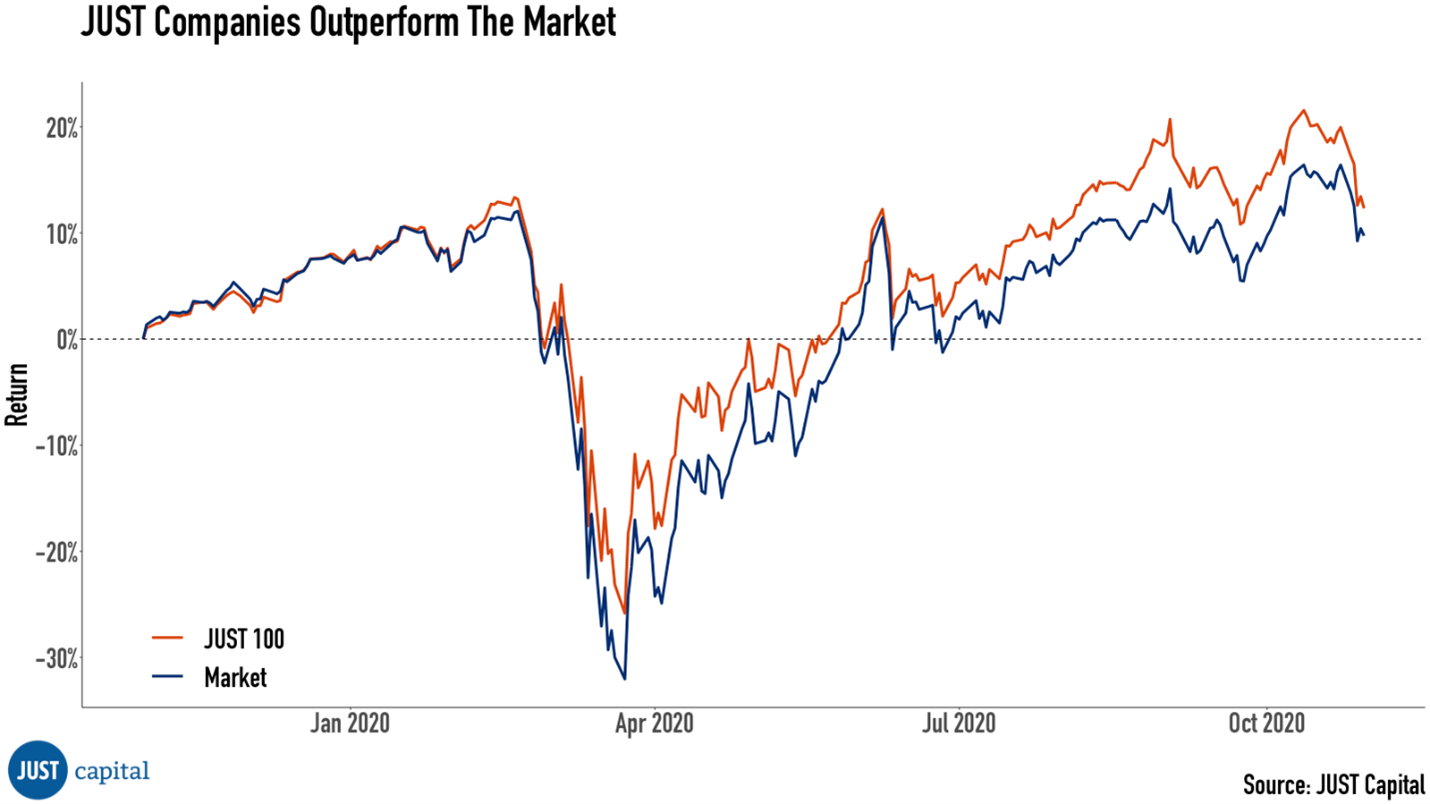
Just Capital, for example has created a list of companies prioritizing stakeholders (not just shareholders) that they call the Just 100. This group has outperformed the market.
See chart below.
As Project Managers we know that shareholders are not the only stakeholders. In fact, as project managers, we have a chance to be true change agents by pointing this out to senior management, who often have what I will call “shareholder myopia”. Good project leaders scan the landscape for anyone who cares about or is affected by the project (or has the project affect them) in any way.
Much of the reason comes down to heuristics and biases – mental hiccups. Below (I will challenge you to read the article to get the full context) is the list of 5 hiccups.
1. The Numbers Hide the Truth About Real Costs
Solution: Price the unpriced.
2. Our Own Biases Trick Us
Solution: Diversify the group making decisions.
3. We Focus on Short-Term Costs and Benefits
Solution: Redefine your tools for investment decisions.
4. We Think About Costs in Silos (Instead of Systems)
Solution: Broaden thinking on value and think in systems. Comment from your blogger: this is where we as project managers shine! We are silo-busters!!
5. We Miss the Bigger, Existential Costs
Solution: Understand the world’s thresholds and learn to think in net positive terms.
Again, from the article:
These five mental hiccups are not the only missteps that affect outcomes, but they are the primary ones that drag down sustainability investment. The mental models expose a win-lose, narrow, and negative mindset. In our book Net Positive, we explore ways to build businesses that solve societal problems and improve the well-being of everyone they impact. It takes courage and humility, but also a mindset that we can, in collaboration, solve many problems and improve the economics on sustainability for all. It’s not as simplistic as “win-win” but working together, we can get more done (what we call 1+1=11).
It’s easier (and frankly lazier) to think in old ways. We can fight these issues and make sustainability fit into a normal model of seeking a good return on investment. But let’s step back a moment. Why exactly do we have to stick with traditional terms? It’s increasingly absurd and surreal to have to justify investing in our very survival — or have to prove that we should stop funding what’s killing us. At the macro level we’ve long passed the point where the cost of action is far lower than the cost of inaction — i.e., huge swaths of the planet becoming uninhabitable, which, again, is kind of bad for business. It definitely pays to invest in our shared future.
The government, industry, and academic partnerships I’m referring to – they seem to get the idea of the long-term (and even short-term) payoff of ESG investment. They even seem to understand the workarounds listed above for the five hiccups.
How about you? Are you using old thinking and (hic) finding yourself getting that (hic) short-term windfall only to find that (hic) you should have considered the longer-term impacts and (hic) advantages and short-term benefits of thinking long-term?
Boo! (That was supposed to stop the hiccups, but instead: read the article…get the book).
Posted
by
Richard Maltzman
on: April 17, 2022 04:18 PM |
Permalink
Comments (1)
Please login or join to subscribe to this item
The economists, like John Maynard Keynes, arguing that in the long run we will all be dead - and certainly the shallow interpretation of his aphorism, do not contributed to the dissemination of a culture in which the people, the planet and profits could be "postponed" (preserved) correctly in terms of the side effects of the short term vision over these elements. The mindset evolution of managers and leaders depends on the movements of the own society evolution valuing the current goals established in the multilateral debate of international meetings. PMs can contribute a lot to this process, including sustainable systematic approaches to the projects, programs and portfolios. Thanks for sharing and include this important theme related to the evolution with sustainability.
Please Login/Register to leave a comment.
|
"It is an important and popular fact that things are not always what they seem. For instance, on the planet Earth, man had always assumed that he was more intelligent than dolphins because he had achieved so much -- the wheel, New York, wars and so on -- whilst all the dolphins had ever done was muck about in the water having a good time. But conversely, the dolphins had always believed that they were far more intelligent than man -- for precisely the same reasons."
- Douglas Adams
|




