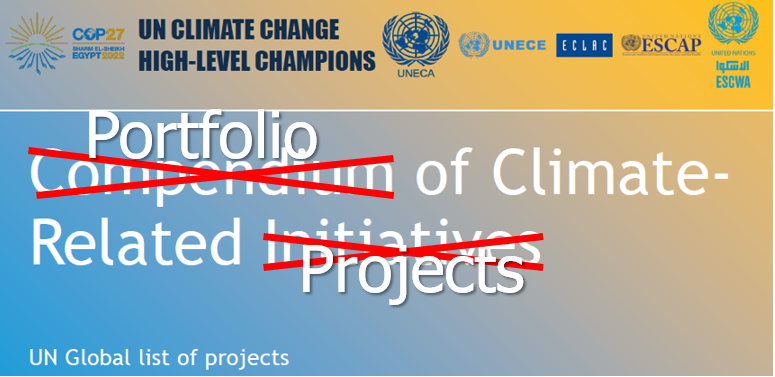
The UN’s Conference of the Parties (COP) number 27 has just ended in Sharm el-Sheikh, Egypt. One of its outputs is a large document called “The Compendium of Climate-Related Initiatives”. That does not sound like something belonging in a project management blog of any kind.
But substitute two synonyms (portfolio for compendium, and projects for initiatives), and the document becomes A Portfolio of Climate-Related Projects (see below).
Indeed, this is a collection of projects and programs organized for a strategic purpose, to help achieve goals. Strategy is always about HOW you achieve goals and objectives. Here, the goals and objectives are to reduce climate change (and as much as possible, its causes) and counter its already-existing effects. And, as always, the connection between strategy and reality is – well, quite humbly, it’s us – project leaders, executing portfolios of programs and projects.
The “Compendium” includes 128 projects, with a budget of $128B (that’s B as in Billions ... or Busy!) dollars. That’s a lot of projects and a lot of dollars, all aimed at very noble goals and objectives, so it may interest potential project leaders in terms of their career. The purpose of this post is to help familiarize you with the types of projects in this compendium, and some of the basic language used – to help make you conversant in this (excuse the pun) environment.
Let’s start with how this was announced. A press release from the UN High-Level Climate Champions said:
In 2022, the COP 27 Presidency, the High-Level Champions and the United Nations Regional Commissions have released a compendium of 50 projects. At COP 27 the High-Level Champions released an extended compendium comprising 128 projects in need of USD$128 billion. This provides the basis for a project pipeline, with projects across mitigation and adaptation, rooted in NDC and regional priorities.
I understand the projects and billions of dollars, and I’m loving the idea of a ‘project pipeline’. In fact, the word pipeline is a bit ironic, given that pipelines are often associated with carbon-based fuels - thus the title of this blog post series. But… what is an NDC? Inquiring minds want to know.
"Nationally determined contributions (NDCs) are at the heart of the Paris Agreement and the achievement of its long-term goals. NDCs embody efforts by each country to reduce national emissions and adapt to the impacts of climate change."
This short video describes NDCs in layperson’s terms:
If you’re curious about your own country, you can explore the country-by-country goals by referring to the NDC registry. Here’s a snippet of some of the African countries.