Learning to talk effectively about sustainability (1 of 2)
From the People, Planet, Profits & Projects Blog
by Richard Maltzman,
Dave Shirley

View Posts By:
Richard Maltzman
Dave Shirley
Recent Posts
What is AI doing to the sustainability of our profession???
Stepwells – Insight from a Particularly Valid Angle
Climb-it Change: Pre-Interview Connector
Climb-it Change: New Relevance for the Stepwells of India
A PATH to more equitable health - via AI project leadership
Categories
6th,
6th Edfition,
6th Edition PMBOK,
7th Edition,
7th Edition PMBOK,
8th Edition PMBOK,
8th Edition PMBOK Guide,
Activism,
actuarial,
actuary,
adapt,
addition by subtraction,
Africa,
africa,
agriculture,
airforce,
ajaita,
Alaska,
amazon,
analogous,
analytics,
ancient,
and more power,
antarctica,
anti-science,
apple,
apps,
architecture,
arctic,
arrakis,
Artificial Intelligence,
asch paradigm,
Assistant,
asthma,
astronomy,
automobile,
automotive,
autonomous cars,
b,
bankhar,
Banksy Crypto,
basalt,
baseball,
bats,
batter,
beauty products,
benefit,
benefits,
Benefits Realization,
beyond epica,
biases,
bicycle,
big data,
big dfata,
big dig,
bike,
biodiversity,
biomedicine,
birdhouse,
blockchain,
blood,
blue blood,
blue trees,
bluefin,
bluefin tuna,
book review,
boston,
boston university,
Boyce,
Brazil,
brazil,
Breakdown Structures,
BS,
building,
buildings,
built environment,
built environment,
bumblebee,
cake,
capacitor,
car,
Carbon,
carbon,
carbon capture,
carbon negative,
carbon neutral,
carbon pool,
carbon sequestration,
carbonate,
careers,
CEO,
ChatGPT,
chatGPT,
chatgpt,
chatgpt,
chess,
China,
china,
chopsticks,
citrus,
cli-fi,
climate,
climate change,
climate resilience,
climeworks,
Clumsy,
CO2,
co2,
CO2 Utilization,
coalition,
cobalt,
coffee pods,
cognition,
cognitive,
Collabortion,
colombia,
concrete,
Conflict,
construction 5.0,
cool projects xyloscope,
cooling,
coral,
corn,
cost of good quality,
cost of poor quality,
cost of quality,
crazy,
criticism of project management,
cryptocurrency,
CSR,
csr,
data,
data analytics,
data privacy,
datacenter,
dataset,
death spiral,
Decision Making,
decomposition,
Defense and Climate,
definition of a project,
deforestation,
dependencies,
dependency,
desert,
DIKW,
dikw,
dimopoulos,
disposal,
dna,
DOD,
dogs,
dolphins,
dream,
drilling,
drink,
dune,
dune,
dutch,
early start,
earth,
eatlocal,
eco-tourism,
ecological,
economic,
economics,
EKC,
electric grid,
electricity,
electronics,
elysis,
embodied carbon,
emerging technologies,
empower,
Energy,
energy efficiency,
environmental degradation,
escalate,
escalation,
ESG,
extreme weather,
fallacy,
FARC,
farming,
finance,
fish,
fish brains,
fishing,
fix,
fixing the earth,
flint water,
Flint Water Supply,
flood,
flooding,
Food supply chain,
food waste,
forest,
forest for the trees,
forestation,
forrestgump,
frank herbert,
Fruitcake,
fungus,
fusion,
Galvao,
garage,
gas,
gasoline,
geese,
gender equality,
gender partnerships,
generational differences,
Generative AI,
gladwell,
gold,
Goodness,
google,
Government,
GPT,
great pacific garbage patch,
green,
green building,
green buildings,
green energy,
green iguana,
green project,
green project management,
greening,
guest post,
gyre,
harkonnen,
Harvesting Benefits,
hawasina,
hedgehogs,
heursitics,
historical data,
hlb,
holitsic,
holland,
horseshoe crab,
human-caused climate change,
hydrogen,
hydrology,
ice,
iceland,
ignition,
iguana,
imagery,
impact,
india,
inequality,
information,
initiatives,
injection,
insurance,
intelligence,
interacting risk,
internal combustion engine,
invasive species,
investment,
isomer,
issue escalation,
issues,
ITER,
jobs,
Jupiter,
justification,
kids,
kill point,
knowledge,
koch brothers,
Kuznets,
laboratory,
LAL,
landscape mode,
lapampa,
launch,
LCA,
Leadership,
Leadership,
life cycle analyses,
life cycle analysis,
lifecycle,
Linkedin,
liquid,
lizard,
local,
long term,
long-term,
long-term thinking,
look up,
loud,
maintenance,
maker,
makermovement,
malcolm gladwell,
management,
marathon,
marine biology,
market,
mars,
Martin Luther King,
mean,
megawatt,
MeHg,
melting,
mercury,
metal,
Microgrid,
microplastics,
migration,
military,
millennial,
mindset,
minerals,
mission,
mitigate,
MLK,
mongolia,
museum,
museum of london,
nature,
nematodes,
net gain,
Net Project Success Score,
net zero,
netherlands,
network,
New book,
New Jersey,
New Practitioners,
new york,
NFT,
nitrogen,
noise,
noreaster,
norway,
nova,
NPSS,
NREL,
ocean,
ocean cleanup,
ocean life,
oil rig,
oil rigs,
oklahoma,
oman,
only murders in the building,
opportunity,
overall risk,
oxygen,
packaging,
pareto,
PBS,
permafrost,
persistence,
peru,
Pharmaceutical,
planet,
planet.com,
planning,
plant,
plasma,
plastic,
playground,
pm,
pm education,
pmbok,
pmbok guide,
pmnetwork,
PMXPO-2018,
podcast,
pollutants,
pollution,
poop,
poor,
portfolio,
power,
power skills,
privacy,
privacy concerns,
professors,
program,
Program Management,
project,
project leader,
project leadership,
project management,
project management 3.0,
project on fire,
project progress,
Project Success,
project success,
projecticity,
projectleadership,
projectmanagement,
projects,
psychology,
pulse of the profession,
purple bacteria,
purpose,
quiet,
rainforest,
rationale,
reef,
refugees,
renewable,
renewables,
Repair,
repair,
repeatable process,
repeatable processes,
repurpose,
research,
resource breakdown strucuture,
Resource Management,
reversing climate change,
revisionist history,
rich,
rigs2reefs,
ripe,
risk,
risk avoidance,
Risk Management,
risk mitigation,
risk response,
risk responses,
river,
robots,
rocks,
rules of thumb,
rural,
rural India,
russia,
Sarcasm/Irony,
satellite,
saudi,
schedule,
sci-fi,
Science,
science,
science-fiction,
scientific american,
screaming monkeys,
sea,
sea life,
Sea-Level Rise,
sea-level rise,
seagreens,
seawall,
seawater,
seawater temperature,
seaweed. beat;es. farming,
secondary risk,
selena gomez,
sequestration,
shipping,
skyscraper,
SLR,
smart cities,
smart city,
smelting,
social,
social pressure,
soil,
solar,
solar panels,
solar perovkites,
solar saheli,
sonic,
sponge cities,
SRI,
stage-gate,
stagegate,
stakeholder,
stakeholder management,
steward,
stewardship,
storage,
strategy,
stupid,
success,
suffer,
sulphur,
sunk cost,
supercapacitor,
supply chain,
survey,
Sustainability,
sustainability,
Sustainable Investing,
Sustainable Tourism,
sybiosis,
symbiosis,
system 03,
TBL,
temperature,
terraform,
terraforming,
test,
threat,
threats,
totem,
touchscreen,
tour,
tower,
Trains,
transparency,
transportation,
trash,
tree,
tree species,
trees,
trillion,
triple bottom line,
triple constraint,
truth to power,
UMass,
us army corps of engineers,
USDA,
vacuum,
value,
venus,
vision,
voice,
voltage optimization,
vw scandal,
washing machine,
waste,
wastewater,
water,
we mean business,
whales,
Whirlpool,
wind,
wisdom,
women,
Women in Project Management,
wood wide web,
woonerf,
Work Breakdown Structures (WBS),
world breakdown structure,
worms,
xian,
xylotron,
Yale
Date
This is a guest post (1 of 2) from Sarah Shahmohammad (pictured below)...

...who I introduced at the beginning of 2025 as follows:
- passionate about building systems where businesses thrive in harmony with the environment.
- background in materials science and engineering and hands-on experience in sustainability management
- successfully aligned financial growth with environmental stewardship
- Zero-Waste Solutions: Designed and implemented circular systems for businesses to minimize waste and maximize efficiency.
- Strategic Business Growth: Led sustainability projects that delivered measurable impact for both corporate and community initiatives.
- Circular Economy Expertise: Helped organizations transition from linear models to circular systems, reducing resource dependency and enhancing resilience
Here's her post (Part 1)
---
We Have GOT to Learn How to Talk About This Thing!
To talk about sustainability, we first need to understand how different people engage with it—because if we’re speaking to the wrong audience in the wrong way, we’re just shouting into the void. We need to meet people where they are and from there, help them take steps forward. With luck and good stakeholder engagement, maybe LEAPS forward!
Generally, people fall into four broad categories when it comes to their thinking about sustainability (see figure):

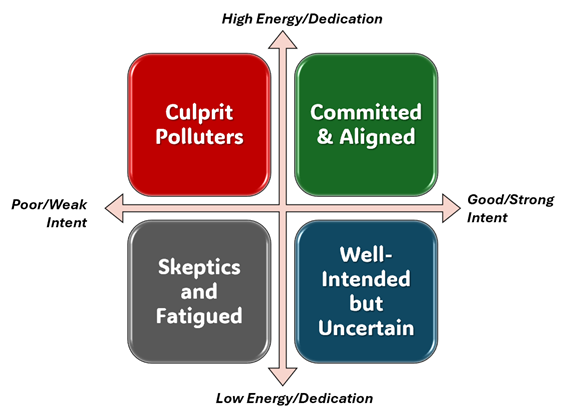
🔹 The Committed & Aligned – Sustainability professionals, activists, project leaders, and organizations already integrating sustainability into their work and lives. These are the people actively shaping change, setting policies, building businesses, and advocating for systemic shifts.
🔹 The Well-Intended but Uncertain – People who care and genuinely want to do more, but don’t quite know how. They might recycle, use reusable bags, or opt for greener choices if available—but they’re not proactive about pushing sustainability forward. On their projects, project managers in this category may be somewhat ambivalent about raising issues to senior managers. They need clearer guidance and practical ways to engage.
🔹 The Skeptics & Fatigued – Those who feel overwhelmed, frustrated, or disconnected from sustainability messaging. They might see it as moralizing, impractical, elitist, or exaggerated—or they might just be too busy trying to survive the mess of everyday life – and ‘everyday projects management’ to think much about it.
🔹 The Culprit Polluters – A select few who know exactly what they’re doing and consciously make decisions that negatively impact the collective, to their own benefit. “Why should I care?”, they say, “…not MY problem!”. These are the ones setting the world on fire—sometimes literally.
Most people fall into the middle two categories (the bottom half of the figure). The well-intended but uncertain, and the skeptics who either don’t trust sustainability messaging or feel too disconnected from it.
The audience of this conversation is mostly the committed ones—the activists, the professionals, the sustainability nerds. And naturally, we tend to get stuck in our echo chambers—we surround ourselves with people who resonate with our ideas, we work in environments with people who share our vision, and at the very least, we all agree on the absolute basics: Trees good. Oil spills bad.
But sustainability isn’t a niche field—it’s a global shift. It’s not like some cutting-edge, science-y thing that we can just be nerdy about in our labs, develop cool new products with, and expect people to use without understanding it (like a new iPhone or a medical breakthrough).
This only works if literally everyone is on board.
We need to step outside our bubble and figure out how to:
- Make sustainability tangible and relevant for everyday people
- Bridge the trust gap with skeptics and fatigued audiences
- Provide clear, practical ways for people to engage without overwhelming them
- Make sustainability about smart system design, not just guilt and sacrifice
Let’s touch base, we’re dreaming about something that doesn’t exist yet.
As sustainability professionals, scientists, and enthusiasts, right-minded project leaders, we’re not just pushing for small tweaks to existing systems—we’re imagining and designing entirely new ones. Smarter, more holistic, more well-rounded systems that can give us the comfort we’ve become comfy in—without taking away the air we breathe.
Reducing harm is such a low-hanging fruit, we’re going for rebuilding smarter.
And in that process, we can’t afford to just stay at the peak of the arrow, charging forward while neglecting the majority of people who aren’t fully on board yet. Sustainability only works as a collective action—which means it’s on us to figure out how to bring others into the fold.
And this is where communication becomes critical. If sustainability was easy to understand and universally valued, we wouldn’t be having these conversations. But it’s not. So we are. That’s why this blog is here, and that’s why this post is posted – for you to think about this and respond with what actions you can take – what changes you can make – as a project leader.
Posted
by
Richard Maltzman
on: March 27, 2025 03:18 PM |
Permalink
Comments (0)
Please login or join to subscribe to this item
Please Login/Register to leave a comment.
|
"The only thing to do with good advice is pass it on; it is never of any use to oneself."
- Oscar Wilde
|




