My project management “antennae” were raised by this story : Cincinnati’s Unused Subway System Is a Century-Old Dream That Won’t Die. The idea of an abandoned infrastructure project buried under a major US city? The idea of reuse? The aspects of human irrational behavior as they relate to projects?
I’m all in.
Here’s how the story opens:
“American history is rife with grandiose public works projects, some successful—like interstate highways—others less so…. Some wound up somewhere in purgatory; partially complete, with millions of dollars spent and many more required for completion. One such project is the subway in Cincinnati, Ohio; at more than two miles in length, it could be the longest unused subway system in the world. And more than a century since construction began, some hope remains that it may one day be put into service.”
You can watch a short video about this and traipse through the tunnels below:
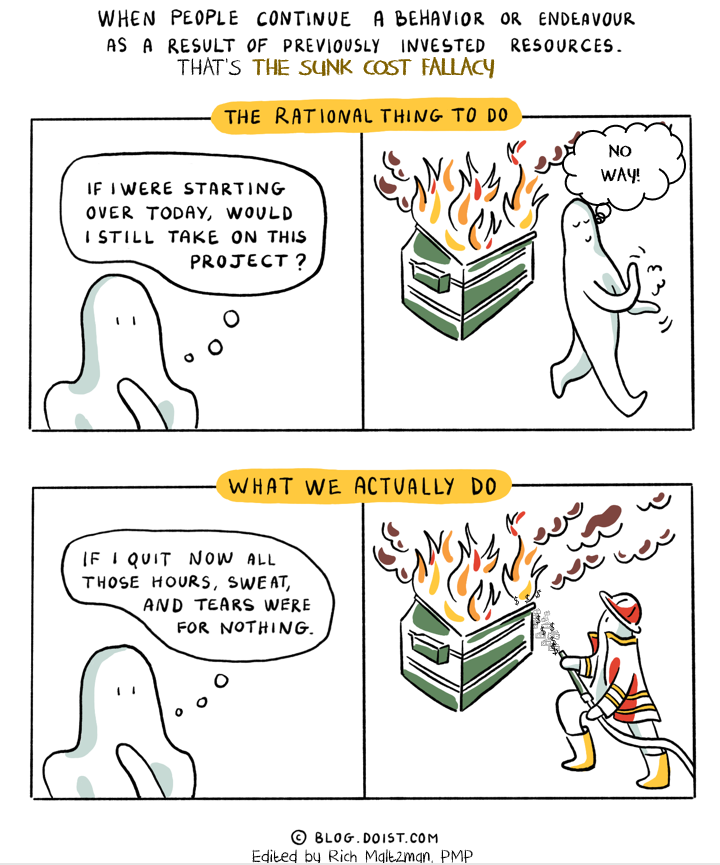
So what is the Sunk-Cost Fallacy? Basically, it’s the drive deep within (adult) humans related to the proverb, “waste not, want not”. As in the figure above, it’s about not ‘losing all of the toil (blood, sweat, tears) you have put into something. So we put MORE effort into it. That’s why the character in the last frame is pouring money into a burning project.
Test it out on yourself. Imagine you bought $35 tickets to a new hit movie. Due to the risk of getting COVID-19, you hesitate going. Also, friends who have gone say that it’s really just not that good. In fact, the roads are icy and you’re a little bit tired. But you bought the tickets. And, you go. And…it turns out that your friends were wrong. It’s worse than “not that good”, it’s absolutely terrible. Yes, you have just experienced the Sunk Cost Fallacy. There’s a nice, easy-to-read article about it here: https://thedecisionlab.com/biases/the-sunk-cost-fallacy/.
In projects this happens when we spend more money on a project that should have gone through a “phase gate” or “kill point” and should have been stopped right there in its tracks (pun intended again!).
You can find very easy-to-read articles on the Sunk-Cost Fallacy here or here.
The bottom (pun intended) line is that as project managers, we sometimes spend good money after bad. That is, we feel like we should finish a project because ‘so much has already been invested’.
This project actually was killed after several years. The timeline is roughly as follows:
In 1916, with an overwhelming vote of almost six to one, the citizens of Cincinnati said yes to spending $6,000,000 to solve its transit problems
The project was delayed due to the US involvement in World War 1.
Actual loop construction began after the war. There were a few minor delays because some Cincinnatians doubted that the $6,000,000 was going to complete the job. They felt that inflation from the war would cause costs to skyrocket, but the rapid transit board was not listening to any critics.
On January 28, 1920, the first steamshovel. of ground was lifted from the canal at Walnut Street.
Early 1921 inflation woes strike.
1922: Negotiations with nearby cities for rights-of-way delay the project further
The two mile subway tunnels were finished early in 1923. The above-ground sections of the loop were near completion by early 1927, but there was no money to equip any of it. Tracks had not been laid, several crucial links to the system were missing and the dollar balance in the books was near zero.
October, 1928: Central Parkway opened on top of the subway using some of the right-of-ways purchased for the rapid transit loop.
1929: problems continue. The city mayor discontinues the Rapid Transit Commission.
1939 the tunnels were researched for possible automobile traffic
In the 1950s, a massive 52-inch (1.3 m) water main was placed in the northbound tunnel to save $300,000 by not digging a new tunnel for the water main.
1966: The original $6M bond is paid off (with actual cost to the city being about $13M including taxes and interest)
1970s: Developers wanted to turn parts of the tunnel into an underground mall and a night club similar to Atlanta Underground (that plan fell through)
1980s: The city pitched the tunnels to filmmakers as a location to shoot subway scenes (that didn’t come to fruition)
2002: A regional light rail system was proposed to use the tunnels which would cost $2.6 billion and take thirty years to build. The tunnels were favored because they were in an ideal location, they could easily be used to connect the east side and the west sides of Cincinnati, and they would have saved the city at least $100 million in construction costs at the time. Interestingly, and showing voters’ low appetite for large government projects, the light rail plan, called MetroMoves, proposed a tax levy that would have raised sales tax in Hamilton county by a half-cent, and yet, the plan was voted down by more than a 2-to-1 ratio.
2017: shortly after the 100th anniversary of the tunnel construction, mayoral candidate Rob Richardson Jr. ran unsuccessfully on a platform that included reviving the subway system; however, this did not provide tangible construction plans or feasibility studies.
Currently: The abandoned tunnel is used to carry the relocated water main and as a route for optical fiber cables.
More detail on the tunnels here from the City of Cincinnati itself:
To view a full walkthrough of the Tunnel system from a couple of folks who call themselves The Forbidden Explorers, have a look at this:
In Part II, I will discuss the sustainability aspects of the decisions and relate them to some of the challenges facing the US in terms of infrastructure projects.
Reference: Arkes, H. R., & Ayton, P. (1999). The sunk cost and Concorde effects: Are humans less rational than lower animals? Psychological Bulletin, 125(5), 591–600. https://doi.org/10.1037/0033-2909.125.5.591
Financial Management Specialist | US Peace CorpsYaounde, Centre, Cameroon
nice article
Jason BelangerConsultant| JB ConsultingTustin, Ca, United States
Super interesting article. There are many lessons learned in the Cincinnati Subway case study to draw on for present and future infrastructure projects so as not to throw money, time and effort down a black hole.




 Community Champion



