


Fusion Powering PM (Part 2 of 2)


|
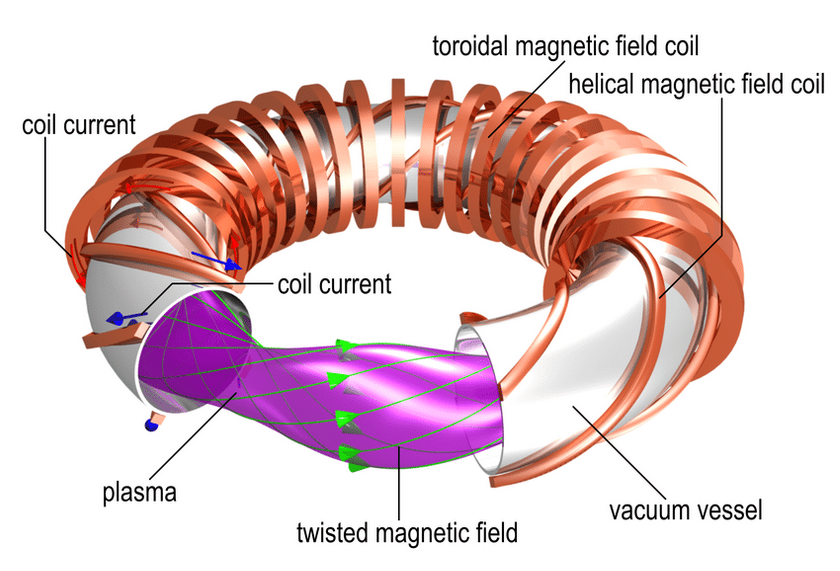
stellarator pic: 2: A schematic classical stellarator, figure courtesy of C. Brandt In the prior post, I discussed the recent breakthrough at Lawrence Livermore Labs regarding a ‘net gain’ event in the development of fusion power. You can go back to Part 1, or alternatively let one of my favorite people, Neil deGrasse Tyson review the breakthrough – see video below.
As promised at the end of Part 1, here I will talk more about the mysterious Tokamak, a rival technology called the Stellarator, and about the private companies that are working on projects to be first to reach commercial viability, and most pragmatically, the opportunities (jobs, careers) that already abound and will continue to grow for project leaders.
The Tokamak
The Tokamak – sounding to me like a word from Aleut, is actually a sort of acronym from the Russian words (Toroidalnaya Kamera i Magnitnaya Katushka)(in Cyrillic - Тороидальная Камера и Магнитная Катушка) which effectively means toroidal magnetic chamber or confinement) was developed in the mid-1960s by Soviet physicists. It can produce some of the highest plasma temperatures, densities, and confinement durations of any confinement device. As a reminder from Part 1, plasma is ‘the fourth state of matter’. It’s a gas in which many of its particles are ionized, meaning they have lost or gained electrons. Plasma is found in many stars, lightning, and some types of flames. You are seeing light emitted by plasma when you look at an illuminated neon sign.
Let’s get a definition from the US Department of Energy’s site: A tokamak is a machine that confines a plasma using magnetic fields in a donut shape that scientists call a torus. Fusion energy scientists believe that tokamaks are the leading plasma confinement concept for future fusion power plants. In a tokamak, magnetic field coils confine plasma particles to allow the plasma to achieve the conditions necessary for fusion. One set of magnetic coils generates an intense “toroidal” field, directed the long way around the torus. A central solenoid (a magnet that carries electric current) creates a second magnetic field directed along the “poloidal” direction, the short way around the torus. The two field components result in a twisted magnetic field that confines the particles in the plasma. A third set of field coils generates an outer poloidal field that shapes and positions the plasma. The first tokamak, T-1, began operation in Russia in 1958. Subsequent advances led to the construction of the Tokamak Fusion Test Reactor at Princeton Plasma Physics Laboratory and Joint European Torus in England, both of which achieved record fusion power in the 1990s. These successes motivated 35 nations to collaborate on the superconducting ITER tokamak (covered in Part 1), which aims to explore the physics of burning plasmas. But the Tokamak has a challenger – the Stellarator. Here’s an outstanding video that reveals the beauty of the Stellarator – which literally is a quite twisted idea: The Stellarator
And here, again courtesy of the US Department of Energy, is a better explanation of the Stellarator than I could ever give you:
Fusion power may be able to provide the world with safe, clean, and renewable power. The stellarator is one of the technologies scientists believe could lead to real-world fusion power. A stellarator is a machine that uses magnetic fields to confine plasma in the shape of a donut, called a torus. These magnetic fields allow scientists to control the plasma particles and create the right conditions for fusion reactions. Stellarators use extremely strong electromagnets to generate twisting magnetic fields that wrap the long way around the donut shape. Stellarators have several advantages over tokamaks, the other main technology that scientists are exploring for fusion power. Stellarators require less injected power to sustain the plasma, have greater design flexibility, and allow for simplification of some aspects of plasma control. However, these benefits come at the cost of increased complexity, especially for the magnetic field coils. To advance Stellarator design, scientists have turned to high performance computing and state-of-the-art plasma theory. These tools have helped researchers optimize the Helically Symmetric Experiment (HSX) stellarator in Wisconsin and the Wendelstein 7-X stellarator in Germany.
As a side note, I have been increasingly interested in AI-based research, including ChatGPT (and GPTZero, which can detect AI-generated text). So I asked ChatGPT to tell me the difference between a Stellarator and a Tokamak. From ChatGPT A stellarator and a tokamak are both devices used to confine and heat plasma in order to create conditions suitable for nuclear fusion, but they use different methods to achieve this. A tokamak uses magnetic fields to confine the plasma in a toroidal (doughnut-shaped) shape, while a stellarator uses a complex arrangement of magnetic coils to create a similar confinement. In general, tokamaks are simpler and more widely used, but stellarators have the potential to be more stable and efficient.
The good news: The answer generated by AI was good. The better news – as an educator, we can tell whether or not an essay or essay segement is generated by AI:
GPTZero was able to determine: Your text is most likely to be AI generated! Now back to what this means to project leaders... What does this mean for project leaders? One word: Opportunities! I did a little research on two companies that are working on Stellarator versions of fusion power: GeneralFusion in Canada and Helion in the USA. Aside from the project management job opportunities in the research area, there are jobs blossoming in the commercialization of fusion power as well. Here’s an example from General Fusion: Career opportunity, General Fusion, Canada: Manager, Targeted Compression Testbeds - https://workforcenow.adp.com/mascsr/default/mdf/recruitment/ Key Responsibilities:
The DOE recently sponsored a conference and there are several downloads of presentations about the PPPs (Public-Private Partnerships) underway in the fusion area. Click here for those downloads.
Of course, many of these jobs are going to want technical knowledge in the area. You won’t necessarily have to be a nuclear scientist, but it would help to build some knowledge in the area. These two blog posts are not the answer, certainly not in and of themselves! But they may tickle your interest in the topic – and that’s a start.
|
Fusion Powering PM (and vice-versa)
|
Lawrence Livermore National Laboratory via AP
This blog post starts with a press release from the Lawrence Livermore National Laboratory: “…the National Nuclear Security Administration (NNSA) and Lawrence Livermore National Labs (LLNL) announced that scientists performing an inertial confinement fusion (ICF) experiment at the National Ignition Faclility (NIF) just after 1 a.m. on Dec. 5 produced more energy from the self-sustaining fusion reaction than they put in to create the reaction: a condition known as ignition. … speakers at the stunning announcement celebrated the achievement as the culmination of 60 years of exploration and experimentation in ICF by generations of scientists at LLNL and collaborators in industry, academia and other DOE national labs, including Los Alamos and Sandia. Officials from the DOE (US Department of Energy) and the OSTP (Office of Science and Technology Policy) congratulated researchers on the milestone and said replicating ignition in the lab could set the stage for fusion to someday become a viable clean-energy option. ‘Last week, at the Lawrence Livermore National Laboratory in California, scientists at the National Ignition Facility achieved fusion ignition — creating more energy from fusion reactions than the energy used to start the process,’ said DOE Secretary Jennifer M. Granholm. ‘It's the first time it has ever been done in a laboratory anywhere in the world — simply put, this is one of the most impressive scientific feats of the 21st century.’” The entire concept of fusion power has always been fascinating to me. It also has a huge connection to project management, since the development of fusion power itself could be considered a collaborative program (note the number of organizations above just in the US working on this successful ignition). Many international efforts are also underway (more about that later in this Part 1 and in Part 2 of this post). In this post, I just want to provide you with the background and whet your appetite for more about fusion projects and why you may want to be interested in it as a human and a project leader (they are not mutually exclusive!). The 22-minute video below is most definitely worth a watch, although I will try to summarize it below. The video starts by rationalizing all this effort with the simple statement that fusion is probably the only single source that can replace fossil fuels. Other forms of clean energy can, and must, contribute to the solution until then, because it will likely be decades before fusion power is commercially viable (although the LLNL proved that it is possible to generate a ‘net gain’ or ‘ignition’ as it was called in the announcement above). Next, the video goes through some of the other international efforts to prove feasibility of fusion power; the Joint European Torus (JET) in Oxford, and the much larger ITER in the south of France. ITER itself is worth discovering check out this video below:
The Bloomberg video continues – it does a tremendous job explaining the science behind fusion power, using a (literally) glowing example we see (almost) every day – the sun. In the sun, hydrogen atoms are moving about very fast and crash into each other from time to time at high speeds, combining (or fusing) to form helium atoms. When they do, they lose a tiny bit of mass – and when they lose even this small amount of mass, it generates a whole bunch of energy. And this is happening millions of times. If this sounds a little like Albert Einstein, it should: The combined hydrogen isotopes smash together to form a helium nuclei. Since the mass of the helium nuclei is slightly less than the combined mass of two fusing hydrogen nuclei, this extra mass is released as energy according to Einstein’s famous equation E=mc2. To attempt to duplicate what the Sun does all day long (even at night) here on Earth is tough. We don’t have the mass of the sun to provide that smashing power to cause fusion, so we need to get to the fourth state of matter – plasma. We all can think of ice (solid), water (liquid), steam (gas). Plasma is that fourth state – examples are lightning and neon gas when electrified, or the jagged line of blue that you see in a Jacob’s ladder. The thing about plasma is that it has to be contained and controlled. Tupperware® won’t work. What’s needed are extremely strong magnets. More about this in Part 2. For now, you can see the effects of magnets on plasma in this video: To get fusion here on earth, we need to get to temperatures of 100 to 200 million degrees (ten times hotter than the Sun). It’s going to take plasma and a lot of energy input to get to those high temperatures. Now you can begin to see where ‘net gain’ comes into play. Just as in a project budget, it makes no sense to spend $300,000,000 if the project is only going to have a lifetime benefit of $250,000,000. And this what makes the recent announcement from the US on ‘net gain’ so important. The promise of fusion power is that it is clean and is fueled by hydrogen, which is the most abundant element in the universe and of course quite available on Earth (in the form of seawater). So: a clean, (eventually) cheap, renewable source of power? Yes, please. In the next post I will back up and talk more about the mysterious Tokamak, about the private companies that are working on projects to be first to reach commercial viability, and most pragmatically, the opportunities (jobs, careers) that already abound and will continue to grow for project leaders. Stay fused! I mean…stay tuned! |

Building Sustainable Value
|
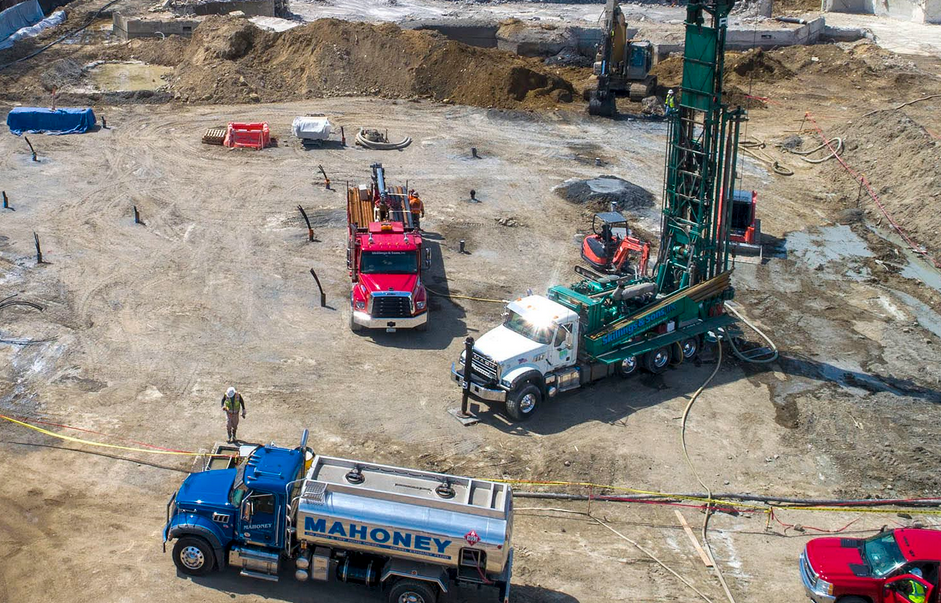
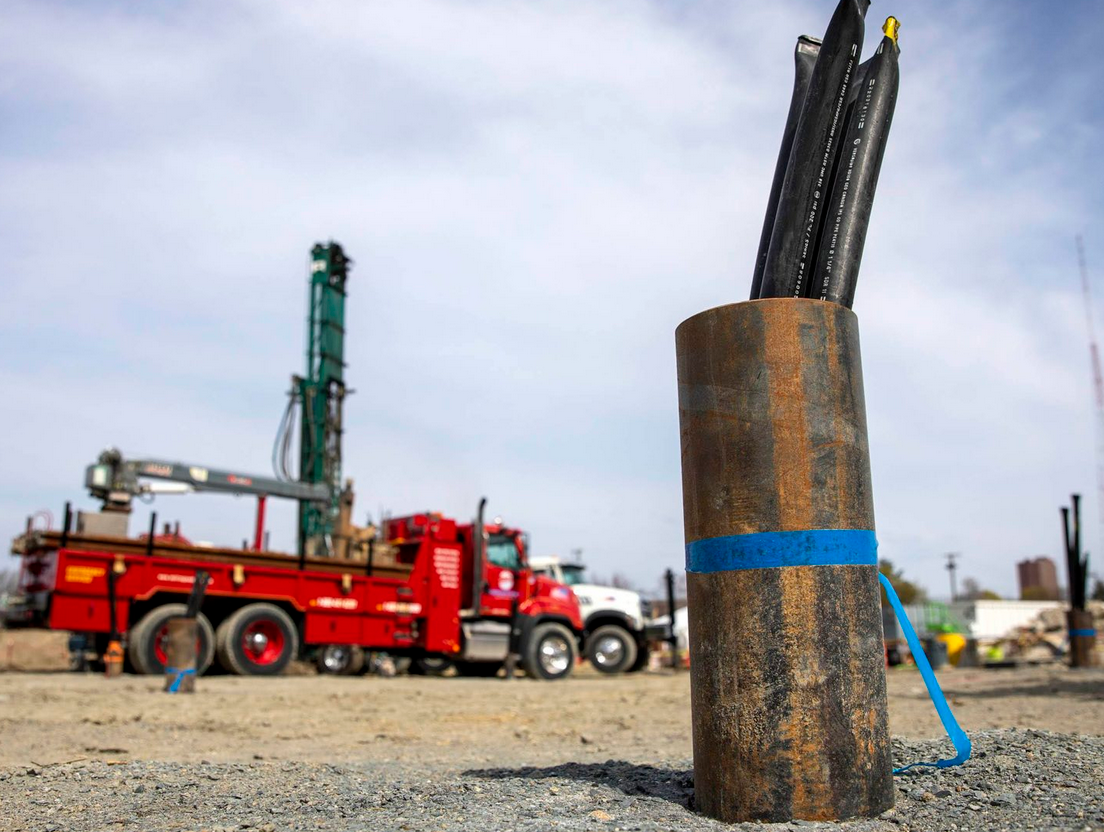
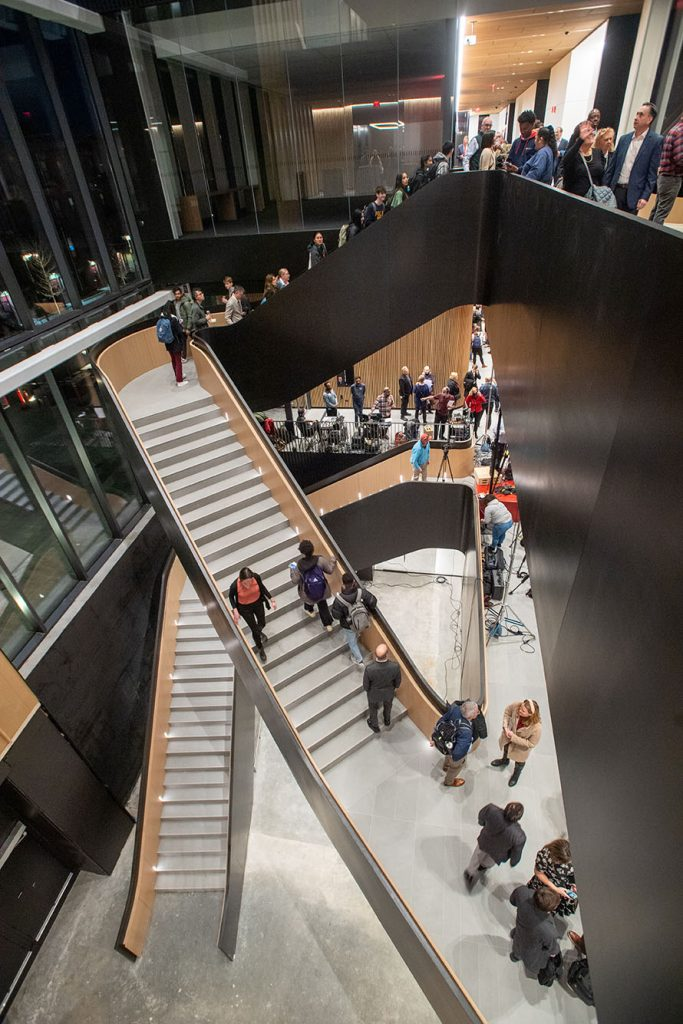
One of the key trends in project management now (as it should be!) is the idea of value delivery. The 7th Edition PMBOK® Guide has a chapter called “A System for Value Delivery”. Thought leaders like Alexandra Chapman, Dr. Harold Kerzner, and Carlos Serra have been talking about this for countless years. It seems that their thoughts have finally been brought to action. One aspect of value delivery is the idea that projects need to be firmly linked to the mission, vision, and values of an organization. This post is about building sustainable value. Emphasis on building. Let’s take Boston University as an example. For reference, Boston University is a large organization – a student body of nearly 37,000, approaching a half-million alumni, over 10,000 employees, including over 4,000 faculty. It’s big. It’s an organization. I’ll be borrowing from a recent article published by BU Today in this blog post. The title is intriguing: “No Gas. No Fuels. No Emissions. BU’s Greenest Building Ever”. The Link Boston University has published a Climate Action Plan, which aims to reduce the University’s carbon emissions to net zero by 2040. That’s a University-wide goal, tied to the University’s mission statement. “We envision a sustainable and equitable future where environmental, social, and economic conditions foster health and well-being for all people and the natural world, where all living beings have the resources they need to thrive. Boston University will reflect these conditions by serving as a model, locally and globally, through its leadership in climate action and knowledge sharing.’ So that’s the foundation here. And I use the word foundation quite intentionally and dad-joke-ingly. The Project The project to which I am referring is a building needs not only an aspirational foundation but a physical foundation. And as you’ll see, it’s also what’s UNDER the foundation that counts. The project is Boston University’s Center for Computing and Data Sciences, pictured below.
Here are six features that help this project’s outcome – a building – deliver value that is linked to the organization’s mission.
These are the sustainability-related features but what are the overall characteristics of the building? From Boston University’s own website, here’s the lowdown: Designed by KPMB Architects in Toronto to serve BU’s sustainability goals, and built by Suffolk Construction, the $305 million center is 19 stories (or 305 feet) tall and has nearly 350,000 square feet of floor space. What most people talk about is its unusual and controversial profile of cantilevered sections rising above the campus and the Charles River like a giant stack of books (BU leadership’s preference) or a precarious game of Jenga (everyone else’s). The Value Some like it – some hate it – but aside from the unique appearance, you cannot deny that it is an example of building sustainable value! |

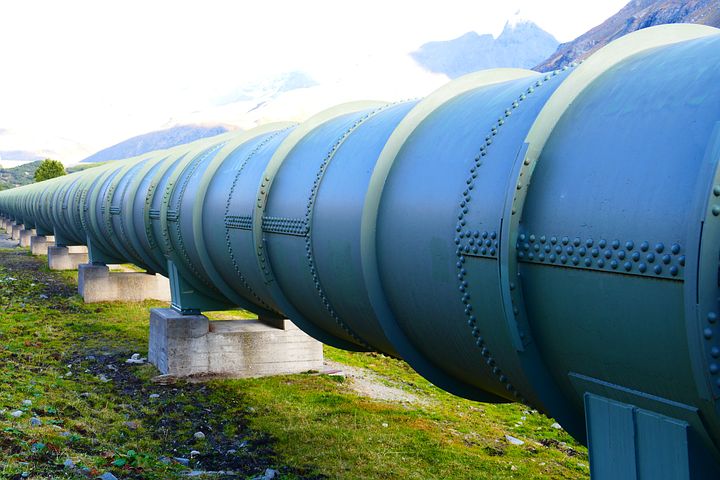
An Ironic Pipeline - Part 2
|
In Part 1, I summarized one of the documents that resulted from COP27 (for all of the acronyms you haven’t heard before, they’re covered in Part 1). The document of interest to me, and I humbly assert, to you as well, is called “Compendium of Climate-related Initiatives) and summarizes 128 projects worth a total of US$128B. In researching the reports of NDCs, I came across a chart that led me to some new and even more exciting acronyms: INDCs and SSPs. Here’s that chart:
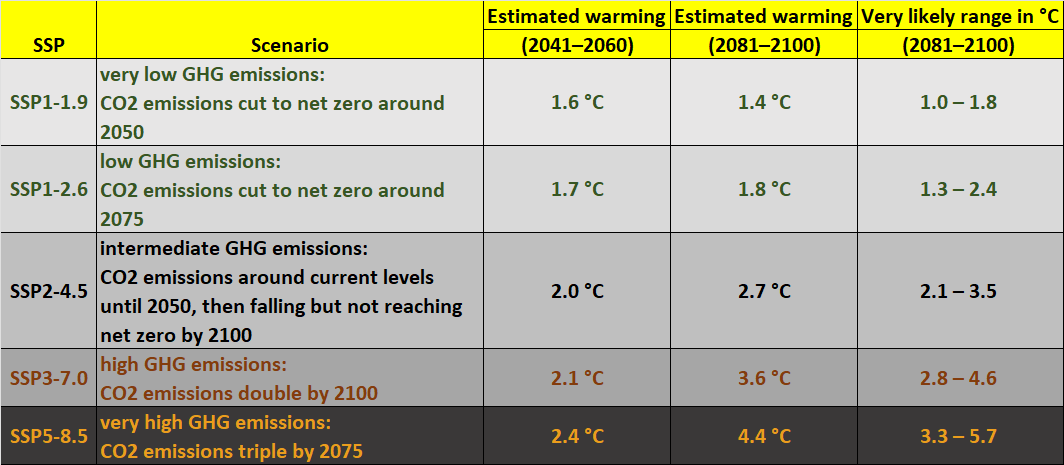
The chart shows the effect of the NDCs (see, I told you, you need to read Part 1!) and INDCs are shown over time, through the year 2060. NDCs are Nationally Determined Contributions. To help meet the Paris Agreement goals, every country is expected to prepare and communicate a nationally determined contribution (NDC) every five years. These include targets, measures and policies and are the basis for national climate action plans. INDCs? It’s a sort of ‘predictive’ form of an NDC – a plan for one. The World Resources Institute makes it very clear: In the lead up to the historic Paris Agreement on climate change, adopted in 2015, more than 160 countries and the European Union submitted their own plans to address climate change, known as Intended Nationally Determined Contributions (INDCs). According to the global climate pact, a country’s INDC is converted to a Nationally Determined Contribution (NDC) when it formally joins the Paris Agreement by submitting an instrument of ratification, acceptance, approval or accession, unless a country decides otherwise. This article from the World Resources Institute details which countries have been making changes to their INDCs and how they are converting them into NDCs, including making them more stringent. The different paths you see in the chart above reflect which SSP will drive the impacts on climate. OK, so what’s an SSP? There's a nice explanation of SSPs on CarbonBrief.org. I've chosen to provide this from “The Shared Socioeconomic Pathways and their energy, land use, and greenhouse gas emissions implications: An overview”: by Riahi, et al:The current set of SSP scenarios consists of a set of baselines, which provides a description of future developments in absence of new climate policies beyond those in place today, as well as mitigation scenarios which explore the implications of climate change mitigation policies. The baseline SSP scenarios should be considered as reference cases for mitigation, climate impacts and adaptation analyses. Therefore, and similar to the vast majority of other scenarios in the literature, the SSP scenarios presented here do not consider feedbacks from the climate system on its key drivers such as socioeconomic impacts of climate change. Think of SSPs as a simulation resulting in the spaghetti map that forecasters use to show potential paths of hurricanes depending on a multitude of factors. Below is a table created from various sources, including this one from Reuters.
So what about that pipeline? Since this is a Project Management (or Project Leadership) blog, I want to leave you with some additional value besides the conversancy in climate related projects. The Portfolio of Climate Related Projects (as I re-titled the subject document) has an outstanding format, one that I assert we can learn from as project leaders. To wit, I attach below a few example “dashboard sheets”. Below is an overview graphic that is an excellent way for any Portfolio Manager to show their executives how their projects “stack up”.
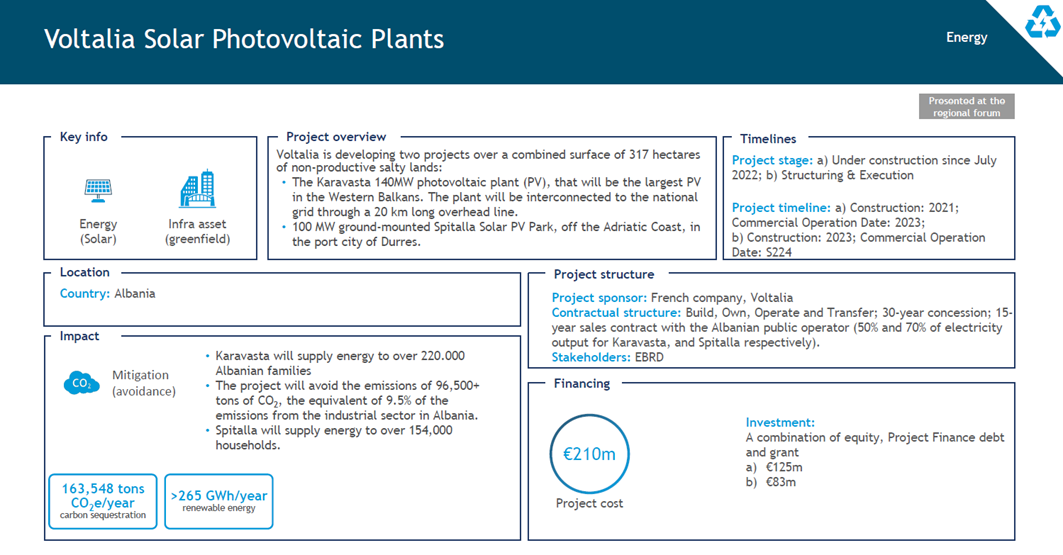
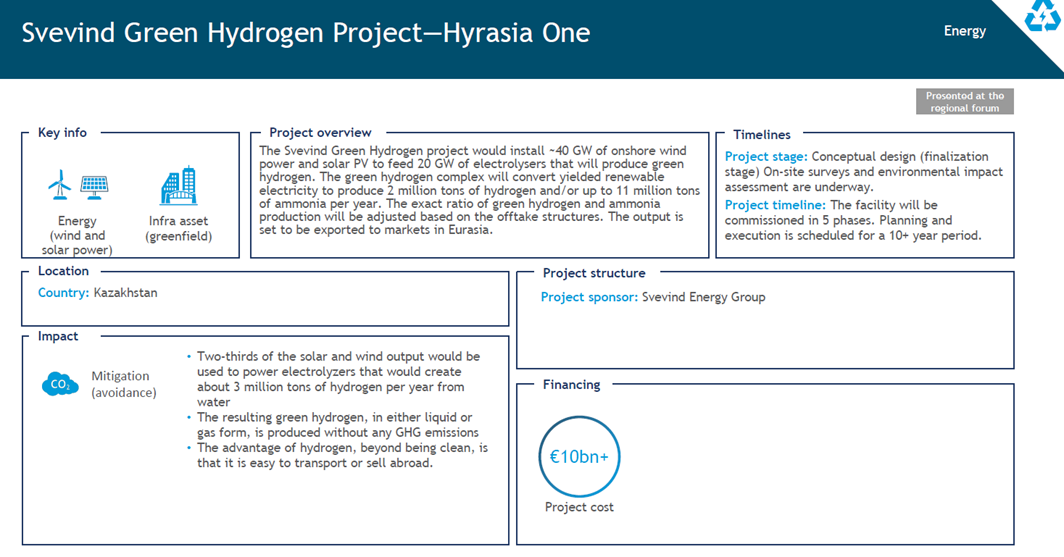
And, as promised, here are two examples of a project summary in an excellent dashboard format that shows funding, intent and other key elements in a very concise and clear manner.
I hope you found this very brief pipeline series informative and even a little inspiring.
|


An Ironic Pipeline - Part 1
|
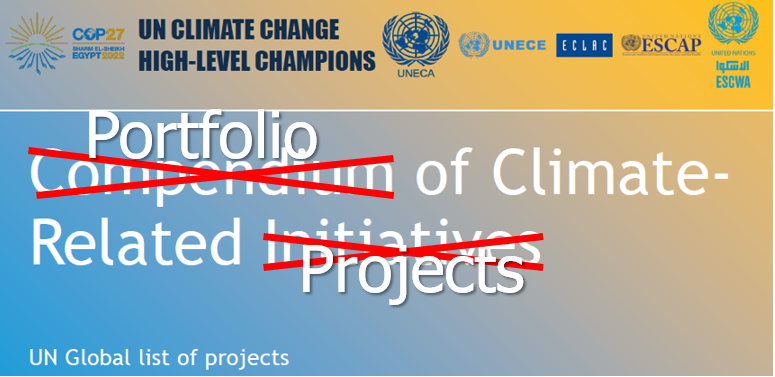
The UN’s Conference of the Parties (COP) number 27 has just ended in Sharm el-Sheikh, Egypt. One of its outputs is a large document called “The Compendium of Climate-Related Initiatives”. That does not sound like something belonging in a project management blog of any kind. But substitute two synonyms (portfolio for compendium, and projects for initiatives), and the document becomes A Portfolio of Climate-Related Projects (see below).
Indeed, this is a collection of projects and programs organized for a strategic purpose, to help achieve goals. Strategy is always about HOW you achieve goals and objectives. Here, the goals and objectives are to reduce climate change (and as much as possible, its causes) and counter its already-existing effects. And, as always, the connection between strategy and reality is – well, quite humbly, it’s us – project leaders, executing portfolios of programs and projects. The “Compendium” includes 128 projects, with a budget of $128B (that’s B as in Billions ... or Busy!) dollars. That’s a lot of projects and a lot of dollars, all aimed at very noble goals and objectives, so it may interest potential project leaders in terms of their career. The purpose of this post is to help familiarize you with the types of projects in this compendium, and some of the basic language used – to help make you conversant in this (excuse the pun) environment. Let’s start with how this was announced. A press release from the UN High-Level Climate Champions said: In 2022, the COP 27 Presidency, the High-Level Champions and the United Nations I understand the projects and billions of dollars, and I’m loving the idea of a ‘project pipeline’. In fact, the word pipeline is a bit ironic, given that pipelines are often associated with carbon-based fuels - thus the title of this blog post series. But… what is an NDC? Inquiring minds want to know. For the answer, we go to the source, the UN Climate Change website: "Nationally determined contributions (NDCs) are at the heart of the Paris Agreement and the achievement of its long-term goals. NDCs embody efforts by each country to reduce national emissions and adapt to the impacts of climate change." This short video describes NDCs in layperson’s terms: If you’re curious about your own country, you can explore the country-by-country goals by referring to the NDC registry. Here’s a snippet of some of the African countries.
"Nothing travels faster than the speed of light with the possible exception of bad news, which follows its own laws." - Douglas Adams |

 Posted
by
Posted
by 

