Ten Years After


|
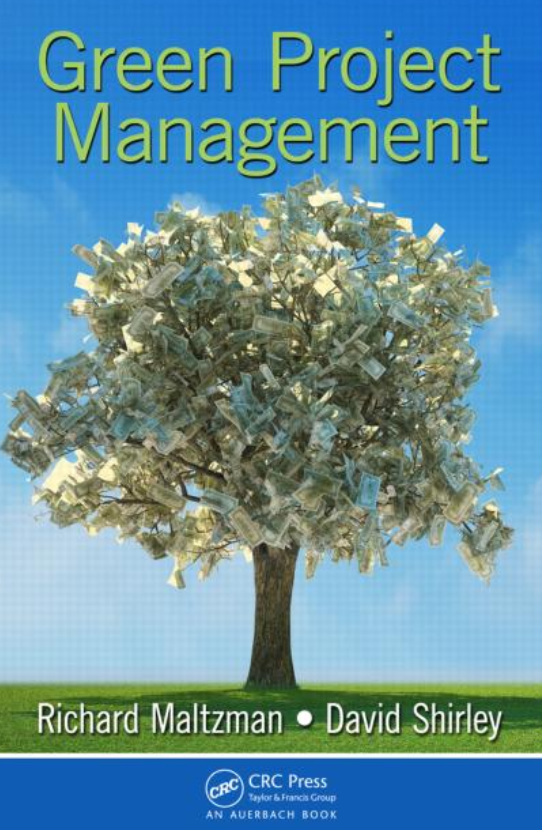
Ten years ago, Dave Shirley and I embarked on an effort to bring an element of long-term thinking into project management. Dave and I both had had decades of experience as project managers and supervisors of project managers, knew from self-awareness and then observing our teams of PMs that project managers are “Get-R’Done” people. This is important because focus on the project is key. However, we also knew that there was an increasing focus on the Triple Bottom Line – economic, ecological, and social outcomes. We knew that project managers would benefit from including planning that was holistic, and included long-term thinking, well past the end date of the project. So we began work on Green Project Management, a book with this in mind.
Months and months later, and with the insistence of Dave to stop researching and get writing, and then to get this project (yes, writing a book is a project) done, the book was published. Although not a best-seller, this book did do something we never expected it to do - it won PMI’s Cleland Award for literature. Since then we’ve started to notice a slow, but steady increase in interest in the topic, with the book showing up as being cited by academics, and with requests for us to make presentations, which we’ve done in countries like South Africa, Malaysia, Costa Rica, Canada, and even the United States. Almost 10 years to the day, I was lucky enough to present this topic to the 3rd National Conference of the Italy PMI Chapters, who had the foresight to theme their conference, “Re-Think #Project #Sustainability #Future”. Some 700 attendees focused on this topic last Friday, 18-October. I was proud to be able to make this presentation and pleased to experience a tremendous reception to the concepts and tools presented.
It’s Ten Years After, and today when I was debating whether or not to blog about this, a song by Alvin Lee came on the radio. Alvin Lee was the front man for a band whose name was (you guessed it) Ten Years After. And thus, this blog post. The song in the video is, "I'd Love To Change The World". I'm certainly not implying that the book changed the world, but I do know this: Project managers are change agents. And if project managers put their focus not only on their project's outcomes, but the impact of the project outcomes, with a perspective that is holistic and long-term, we have a chance to make our projects more successful and indeed may be able to make the world a better place. Let me close by thanking the Italy chapters of PMI for inviting me to speak and for being outstanding hosts, and thanks to the attendees, i hope you enjoyed the presentation and the day focused on sustainability in PM.
|
Half a Sextillion Nematodes - Part 2 of 2
|
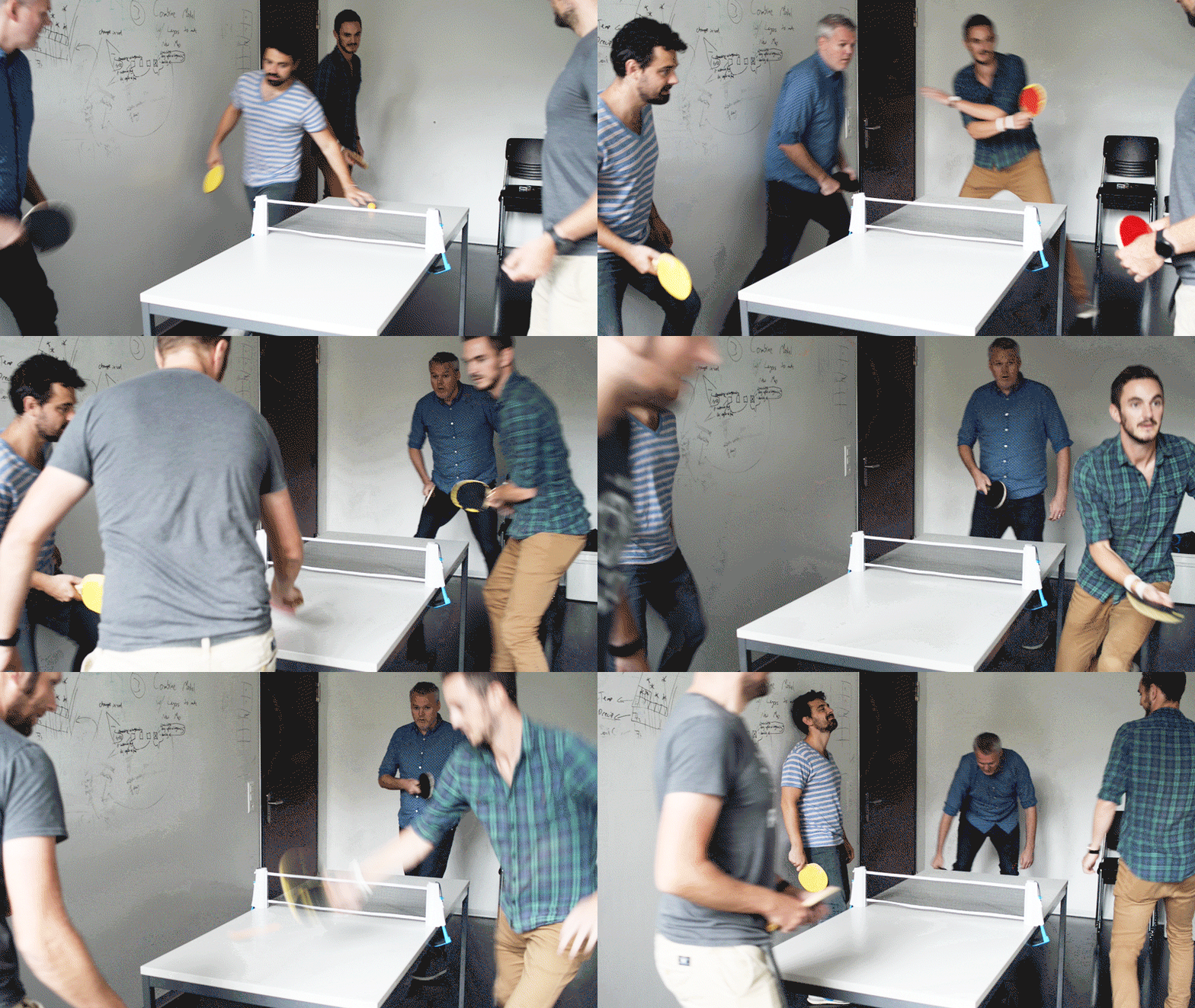
In Part 1, we covered a story about research centered on identifying life on earth by geography, featuring the lowly (literally) nematode. In this short Part 2, as promised, we’ll briefly discuss lessons learned for project management and more about the connection between AI and Earth. One lesson learned was clarity of communication, and the potential for misunderstanding. After one of his reports was summarized in a way that unintentionally, made it look like we could relax in our efforts on climate change, as long as we planted lots of trees. This was not his intent, but Crowther and his team faced significant criticism for something they didn’t intend to do. From the article: Two months on, Crowther is chastened by the furore his paper created among scientists who thought its message might encourage the public to relax about curbing carbon emissions as long as they planted enough trees. “We certainly did our communications a little bit wrong, and we’ve learned from that,” he says. “I want to be extremely clear that cutting greenhouse-gas emissions is absolutely essential if we are going to have any chance to stop climate change.” Another lesson is that Crowther and his team keep things fun and focus on building teams. From the article: “…worktops are crowded with clusters of chopped tree parts. In the office that Crowther rejected in favour of a desk in the communal room, four staff hurl themselves around a ping-pong table, playing “the smashing game” — a chaotic version that incorporates walls, ceiling and floor. It is one of several that Crowther invented and prescribes are played daily to break up the mental effort, forge bonds and keep life fun. (see blog post main photo)” …all of this for a good cause: to gain a baseline of life on earth – trees, worms, whatever. Here’s a video that shows the good work of this team: |
A Half-Sextillion Nematodes (Part 1 of 2)
Categories:
science,
carbon,
analytics,
big dfata,
data analytics,
nematodes,
worms,
soil,
earth,
laboratory,
data,
Artificial Intelligence
Categories: science, carbon, analytics, big dfata, data analytics, nematodes, worms, soil, earth, laboratory, data, Artificial Intelligence
|
Big Data. Analytics. It’s hot now, and for good reason. The ability to apply machine learning and Artificial Intelligence (AI) to vast amounts of data to, for example, decide to put up an advert of a certain athletic shoe on your desktop, to decide whether a competitor may be worth acquiring, or to choose between investments. And although money is important, AI can be applied to much, much more than money. Think about the data of the Earth. Well, yes, the planet Earth, but also literally, the earth - the soil - on which you are standing (or the building on which you are standing … is standing). What’s under you? Soil, roots, worms. There is a laboratory in the Swiss Federal Institute of Technology, led by a man named Thomas Crowther. That laboratory has embarked on a project, which, in a way, is an accounting project. The thing for which it is doing the accounting is, well, it’s the Earth. Crowther’s lab is funded for 10+ years to collect individual observations (many, MANY of them) and use AI to reach conclusions about the count of trees, fungi, and, for example, nematode worms. So far, his lab has concluded that there are 3 trillion trees and 0.4 sextillion nematode worms. We'll come back to these little wigglers later. Why do this? Well, as project managers we know about baselines. If we are to make improvements and/or to understand the changes taking place so that we can make corrections or note the effect of attempted corrections, we need that baseline. All of this comes mainly from a cover story in the most recent edition of Nature magazine, in an article called, “The Everything Mapper”, by Aisling Irwin. It’s a fascinating story – partially because it’s a fascinating project. The project has already realized benefits, and has some lessons learned for project managers. For starters, when Crowther was getting started, he was at Yale and proposed the idea of using ground data from actual tree counts (satellite data can’t peer below the canopy). To do this, he needed to get scientists from different institutions to collaborate and share their data. He had to build a team from disparate organizations. Sound familiar? The professors around him though it was a ridiculous idea but he managed to do it, to the point where he had data representing an area the size of a US state. Granted, the state was Rhode Island, but still – quite an accomplishment. He then worked with data scientist Henry Glick to compare the ground-level counts with the satellite imagery to make informed decisions about how many trees there really were. The benefit realized was that the mapping done by Crowther and Glick (and others) was used to build the first global model of tree density – and the figure of “3 Trillion Trees”, which in turn changed the name of the UN’s “Billion Tree Campaign” to the “Trillion Tree Campaign”. Their database continues to serve the Forest Biodiversity Initiative, which studies and manages the world's largest tree-level forest inventory database. A snapshot of the status of the Trillion Tree Campaign is shown below.
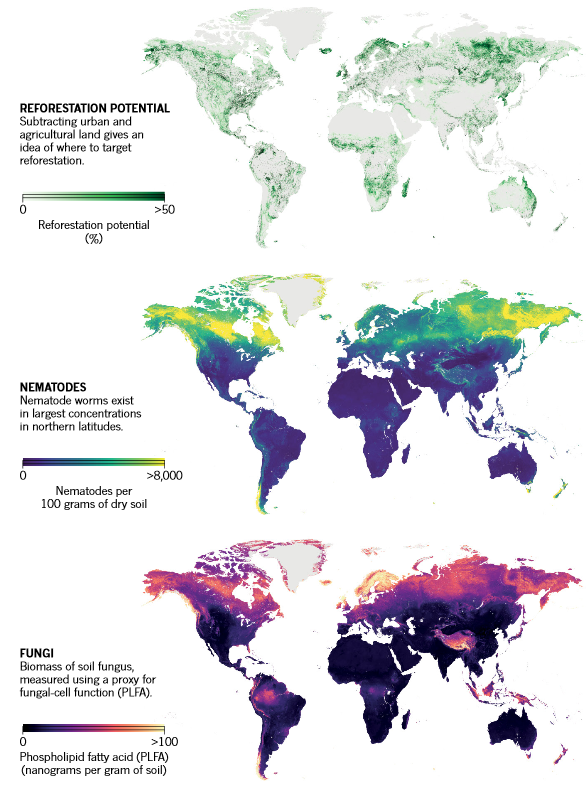
Another outcome – an important one – is a conclusion that “tree planting is easily the best way to remove carbon from the atmosphere, and could be the key to slowing global warming”. This is a conclusion that obviously spawns many new projects, but that’s another story. Let’s get back to nematodes for a bit. They're usually tiny, around 50 micrometers thick and 1 millimeter long - but the nasty parasitic kinds (this is sort of sickening) can be up to 3 feet long. They actually play an interesting role in solving climate change. This recent article from Brigham Young University covers that aspect. One thing of interest to note is that the biomass of the nematodes of the planet is almost equal to our weight. That is, add up the weight of all the nematodes and you have 80% of the weight of the entire human population! The relationship to carbon is summed up here: “Knowing where these tiny worms live matters because nematodes play a critical role in the cycling of carbon and nutrients and heavily influence CO2 emissions. An important finding of the paper is that nematode abundance is strongly correlated with soil carbon (more carbon = more worms). Understanding the little organisms at a global level is critical if humans are going to understand and address climate change.” Below is a figure from the Nature article summarizing the data from Crowther's research for trees, nematodes and fungi.
In Part 2, I will talk about more lessons learned for project management and more about the connection between AI and Earth. |


The Mitsunobu Reaction
|
For those of you who follow the Big Bang Theory, you know that they title each episode of the show with a theme name that sounds like a subject of a lecture at an MIT PhD-level course. Examples of episode names are:
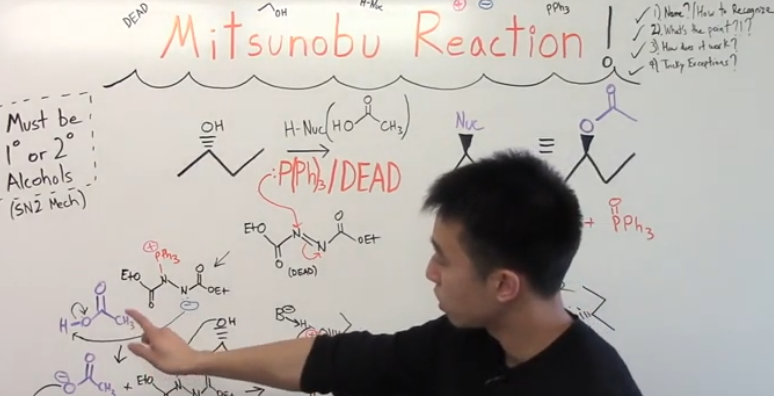
An article in Nature caught my attention, partially because it mentions (see the title) a chemical reaction with such a name. This particular reaction has to do with the process of synthesizing pharmaceuticals. The alcohols they use have to be activated by the addition of other chemicals in these industrial contexts. The process to do that activation is called the Mitsunobu reaction. This process requires two activating chemicals, one of which is explosive. It also generates two byproducts, one of which is toxic. You can find an explanation that is way, WAY beyond the scope of this blog here, and there is a diagram of the reaction below.
There’s also a video tutorial here:
The bottom line is that this is not exactly a sustainably oriented process. Striving to improve the process (which is really the point of this blog post), scientists at the University of Nottingham, in the United Kingdom, including Ross Denton, used a compound called a phosphine oxide to start the reaction, instead. This removes the explosive element from the process, and uses one of the byproducts to regenerate the original catalyst, and, leaves behind nothing but water as a final byproduct. Through this new process, the phosphine oxide will allow for a much more environmentally-friendly process to produce pharmaceuticals and fertilizers. Project managers should be on the lookout for process improvements such as this and for sustainability, in general, in their projects. Sometimes a breakthrough like this is only a Big Bang theory away!
|


Intermingling Risks
Categories:
climate change,
risk response,
interacting risk,
seawater,
seawater temperature,
bluefin,
bluefin tuna,
mercury,
MeHg
Categories: climate change, risk response, interacting risk, seawater, seawater temperature, bluefin, bluefin tuna, mercury, MeHg
|
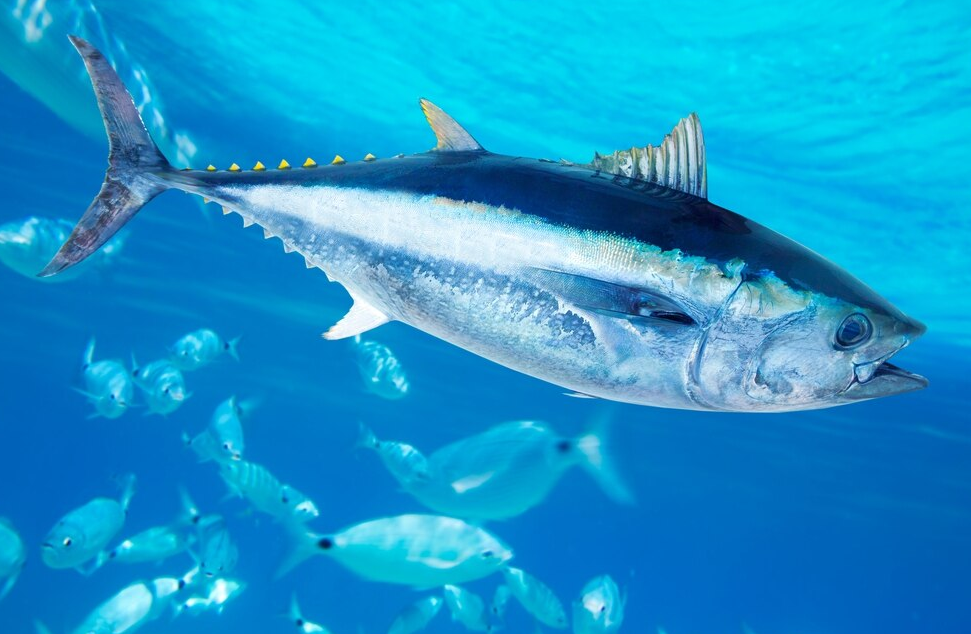
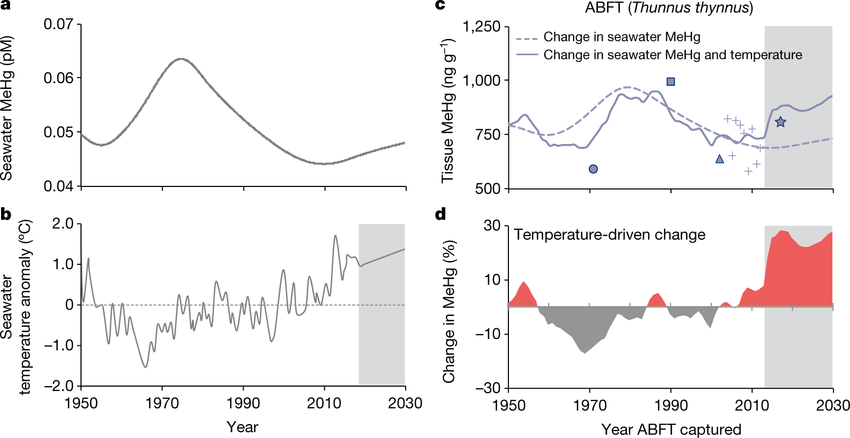
Today, I’m going to go a little bit ‘science-y’ on you, but it has a payoff in terms of understanding risks – and project, program, and portfolio managers must know how to deal with risk. This post has its roots in a recent article from Nature magazine, “Climate change and overfishing increase neurotoxicant in marine predators” (Schartup et al). Three billion people rely on seafood for nutrition, and billions of others have it as part of their diet. But this comes with a risk – consumption of methylmercury (MeHg). Mercury from natural and human-produced sources goes into the ocean, to the tune of 80% Microorganisms convert this mercury (Hg) to MeHg, and in predatory fish such as tuna and swordfish, the MeHg concentrations are amplified a million times or more. People are thus exposed to MeHg in high concentrations, and that is not good. MeHg causes neurocognitive in children, a problem that can persist into adulthood. This costs society, not only in the suffering of families but also in monetary terms – with the costs estimated to be over $20B. So here’s the connection to project management. Although “seafood” is not a project, nor is “fishing”, the increased presence of MeHg is clearly a threat. Nations have responded to this threat with the Minamata Convention on Mercury, in 2017. You can learn about the Minimata Convention here from the video below. Is your country a signatory? Colombia just signed a few days ago. Check that out here: http://www.mercuryconvention.org/Countries/Parties/tabid/3428/language/en-US/Default.aspx As project managers, we importantly check risk response to see if it is effective and/or if other actors or effects. This is a critical process because risk is dynamic, and sometimes risk responses even generate new (secondary) threats. Here, the scientists studying MeHg looked at the effects of overfishing and climate change on MeHg concentrations in fish. What they found, using over 30 years of data analytics, showed that overfhishing of Atlantic Cod caused a 23% increase, and rising temperatures caused by climate change have caused a 56% increase in MeHg in Atlantic Bluefin Tuna (ABFT) (see Figure below – source is Nature Magazine, Volume 572, August 2019).
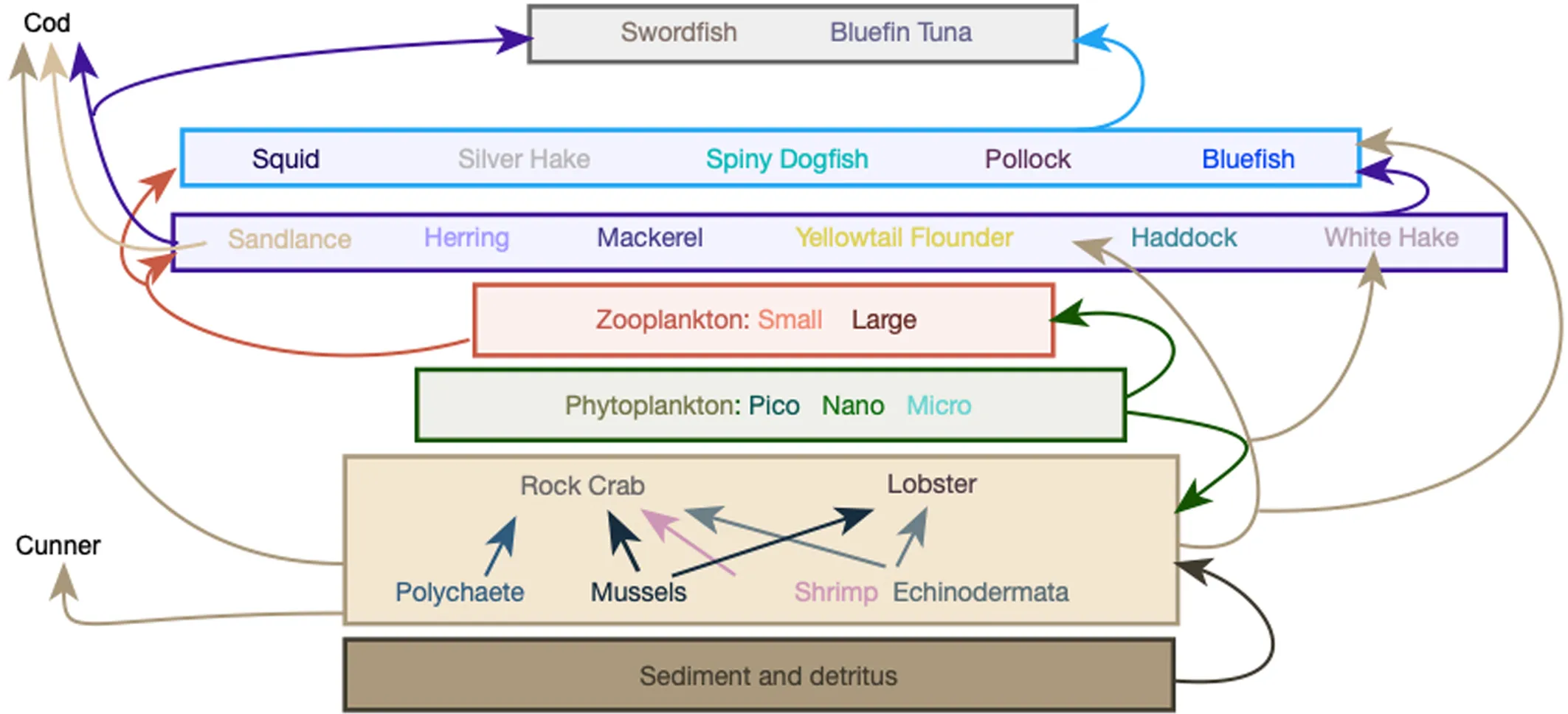
In the chart on the bottom right, you can see that MeHg levels have gone UP, despite the reduction in the amount of mercury in the ecosystem (that lower amount resulting from the Minamata Convention), and that those increases are in alignment with seawater temperature increases. The bottom line is that ocean warming and fisheries management will be key factors in modulating the threat of MeHg in our diet. It turns out that the quantity of this neurotoxicant is not limited only to the depositing of mercury in the oceans, it’s about the ocean “as a system” (See figure below) and the way that this system processes mercury, and how other effects – to which we contribute – change the concentrations.
This is only one example of how human activity can complicate and exacerbate other problems, and the takeaway for project managers is to understand how risks intermingle and interact. Think of the risks in your project(s). Have you stepped back and considered how they interact?
|