A Half-Sextillion Nematodes (Part 1 of 2)
From the People, Planet, Profits & Projects Blog
by Richard Maltzman,
Dave Shirley

View Posts By:
Richard Maltzman
Dave Shirley
Recent Posts
What is AI doing to the sustainability of our profession???
Stepwells – Insight from a Particularly Valid Angle
Climb-it Change: Pre-Interview Connector
Climb-it Change: New Relevance for the Stepwells of India
A PATH to more equitable health - via AI project leadership
Categories
6th,
6th Edfition,
6th Edition PMBOK,
7th Edition,
7th Edition PMBOK,
8th Edition PMBOK,
8th Edition PMBOK Guide,
Activism,
actuarial,
actuary,
adapt,
addition by subtraction,
Africa,
africa,
agriculture,
airforce,
ajaita,
Alaska,
amazon,
analogous,
analytics,
ancient,
and more power,
antarctica,
anti-science,
apple,
apps,
architecture,
arctic,
arrakis,
Artificial Intelligence,
asch paradigm,
Assistant,
asthma,
astronomy,
automobile,
automotive,
autonomous cars,
b,
bankhar,
Banksy Crypto,
basalt,
baseball,
bats,
batter,
beauty products,
benefit,
benefits,
Benefits Realization,
beyond epica,
biases,
bicycle,
big data,
big dfata,
big dig,
bike,
biodiversity,
biomedicine,
birdhouse,
blockchain,
blood,
blue blood,
blue trees,
bluefin,
bluefin tuna,
book review,
boston,
boston university,
Boyce,
Brazil,
brazil,
Breakdown Structures,
BS,
building,
buildings,
built environment,
built environment,
bumblebee,
cake,
capacitor,
car,
Carbon,
carbon,
carbon capture,
carbon negative,
carbon neutral,
carbon pool,
carbon sequestration,
carbonate,
careers,
CEO,
ChatGPT,
chatGPT,
chatgpt,
chatgpt,
chess,
China,
china,
chopsticks,
citrus,
cli-fi,
climate,
climate change,
climate resilience,
climeworks,
Clumsy,
CO2,
co2,
CO2 Utilization,
coalition,
cobalt,
coffee pods,
cognition,
cognitive,
Collabortion,
colombia,
concrete,
Conflict,
construction 5.0,
cool projects xyloscope,
cooling,
coral,
corn,
cost of good quality,
cost of poor quality,
cost of quality,
crazy,
criticism of project management,
cryptocurrency,
CSR,
csr,
data,
data analytics,
data privacy,
datacenter,
dataset,
death spiral,
Decision Making,
decomposition,
Defense and Climate,
definition of a project,
deforestation,
dependencies,
dependency,
desert,
DIKW,
dikw,
dimopoulos,
disposal,
dna,
DOD,
dogs,
dolphins,
dream,
drilling,
drink,
dune,
dune,
dutch,
early start,
earth,
eatlocal,
eco-tourism,
ecological,
economic,
economics,
EKC,
electric grid,
electricity,
electronics,
elysis,
embodied carbon,
emerging technologies,
empower,
Energy,
energy efficiency,
environmental degradation,
escalate,
escalation,
ESG,
extreme weather,
fallacy,
FARC,
farming,
finance,
fish,
fish brains,
fishing,
fix,
fixing the earth,
flint water,
Flint Water Supply,
flood,
flooding,
Food supply chain,
food waste,
forest,
forest for the trees,
forestation,
forrestgump,
frank herbert,
Fruitcake,
fungus,
fusion,
Galvao,
garage,
gas,
gasoline,
geese,
gender equality,
gender partnerships,
generational differences,
Generative AI,
gladwell,
gold,
Goodness,
google,
Government,
GPT,
great pacific garbage patch,
green,
green building,
green buildings,
green energy,
green iguana,
green project,
green project management,
greening,
guest post,
gyre,
harkonnen,
Harvesting Benefits,
hawasina,
hedgehogs,
heursitics,
historical data,
hlb,
holitsic,
holland,
horseshoe crab,
human-caused climate change,
hydrogen,
hydrology,
ice,
iceland,
ignition,
iguana,
imagery,
impact,
india,
inequality,
information,
initiatives,
injection,
insurance,
intelligence,
interacting risk,
internal combustion engine,
invasive species,
investment,
isomer,
issue escalation,
issues,
ITER,
jobs,
Jupiter,
justification,
kids,
kill point,
knowledge,
koch brothers,
Kuznets,
laboratory,
LAL,
landscape mode,
lapampa,
launch,
LCA,
Leadership,
Leadership,
life cycle analyses,
life cycle analysis,
lifecycle,
Linkedin,
liquid,
lizard,
local,
long term,
long-term,
long-term thinking,
look up,
loud,
maintenance,
maker,
makermovement,
malcolm gladwell,
management,
marathon,
marine biology,
market,
mars,
Martin Luther King,
mean,
megawatt,
MeHg,
melting,
mercury,
metal,
Microgrid,
microplastics,
migration,
military,
millennial,
mindset,
minerals,
mission,
mitigate,
MLK,
mongolia,
museum,
museum of london,
nature,
nematodes,
net gain,
Net Project Success Score,
net zero,
netherlands,
network,
New book,
New Jersey,
New Practitioners,
new york,
NFT,
nitrogen,
noise,
noreaster,
norway,
nova,
NPSS,
NREL,
ocean,
ocean cleanup,
ocean life,
oil rig,
oil rigs,
oklahoma,
oman,
only murders in the building,
opportunity,
overall risk,
oxygen,
packaging,
pareto,
PBS,
permafrost,
persistence,
peru,
Pharmaceutical,
planet,
planet.com,
planning,
plant,
plasma,
plastic,
playground,
pm,
pm education,
pmbok,
pmbok guide,
pmnetwork,
PMXPO-2018,
podcast,
pollutants,
pollution,
poop,
poor,
portfolio,
power,
power skills,
privacy,
privacy concerns,
professors,
program,
Program Management,
project,
project leader,
project leadership,
project management,
project management 3.0,
project on fire,
project progress,
Project Success,
project success,
projecticity,
projectleadership,
projectmanagement,
projects,
psychology,
pulse of the profession,
purple bacteria,
purpose,
quiet,
rainforest,
rationale,
reef,
refugees,
renewable,
renewables,
Repair,
repair,
repeatable process,
repeatable processes,
repurpose,
research,
resource breakdown strucuture,
Resource Management,
reversing climate change,
revisionist history,
rich,
rigs2reefs,
ripe,
risk,
risk avoidance,
Risk Management,
risk mitigation,
risk response,
risk responses,
river,
robots,
rocks,
rules of thumb,
rural,
rural India,
russia,
Sarcasm/Irony,
satellite,
saudi,
schedule,
sci-fi,
Science,
science,
science-fiction,
scientific american,
screaming monkeys,
sea,
sea life,
Sea-Level Rise,
sea-level rise,
seagreens,
seawall,
seawater,
seawater temperature,
seaweed. beat;es. farming,
secondary risk,
selena gomez,
sequestration,
shipping,
skyscraper,
SLR,
smart cities,
smart city,
smelting,
social,
social pressure,
soil,
solar,
solar panels,
solar perovkites,
solar saheli,
sonic,
sponge cities,
SRI,
stage-gate,
stagegate,
stakeholder,
stakeholder management,
steward,
stewardship,
storage,
strategy,
stupid,
success,
suffer,
sulphur,
sunk cost,
supercapacitor,
supply chain,
survey,
Sustainability,
sustainability,
Sustainable Investing,
Sustainable Tourism,
sybiosis,
symbiosis,
system 03,
TBL,
temperature,
terraform,
terraforming,
test,
threat,
threats,
totem,
touchscreen,
tour,
tower,
Trains,
transparency,
transportation,
trash,
tree,
tree species,
trees,
trillion,
triple bottom line,
triple constraint,
truth to power,
UMass,
us army corps of engineers,
USDA,
vacuum,
value,
venus,
vision,
voice,
voltage optimization,
vw scandal,
washing machine,
waste,
wastewater,
water,
we mean business,
whales,
Whirlpool,
wind,
wisdom,
women,
Women in Project Management,
wood wide web,
woonerf,
Work Breakdown Structures (WBS),
world breakdown structure,
worms,
xian,
xylotron,
Yale
Date
Categories:
analytics,
Artificial Intelligence,
big dfata,
carbon,
data,
data analytics,
earth,
laboratory,
nematodes,
science,
soil,
worms

Big Data. Analytics. It’s hot now, and for good reason. The ability to apply machine learning and Artificial Intelligence (AI) to vast amounts of data to, for example, decide to put up an advert of a certain athletic shoe on your desktop, to decide whether a competitor may be worth acquiring, or to choose between investments.
And although money is important, AI can be applied to much, much more than money. Think about the data of the Earth. Well, yes, the planet Earth, but also literally, the earth - the soil - on which you are standing (or the building on which you are standing … is standing).
What’s under you? Soil, roots, worms.
There is a laboratory in the Swiss Federal Institute of Technology, led by a man named Thomas Crowther. That laboratory has embarked on a project, which, in a way, is an accounting project. The thing for which it is doing the accounting is, well, it’s the Earth.
Crowther’s lab is funded for 10+ years to collect individual observations (many, MANY of them) and use AI to reach conclusions about the count of trees, fungi, and, for example, nematode worms.
So far, his lab has concluded that there are 3 trillion trees and 0.4 sextillion nematode worms. We'll come back to these little wigglers later.
Why do this?
Well, as project managers we know about baselines. If we are to make improvements and/or to understand the changes taking place so that we can make corrections or note the effect of attempted corrections, we need that baseline.
All of this comes mainly from a cover story in the most recent edition of Nature magazine, in an article called, “The Everything Mapper”, by Aisling Irwin. It’s a fascinating story – partially because it’s a fascinating project. The project has already realized benefits, and has some lessons learned for project managers. For starters, when Crowther was getting started, he was at Yale and proposed the idea of using ground data from actual tree counts (satellite data can’t peer below the canopy). To do this, he needed to get scientists from different institutions to collaborate and share their data. He had to build a team from disparate organizations. Sound familiar? The professors around him though it was a ridiculous idea but he managed to do it, to the point where he had data representing an area the size of a US state. Granted, the state was Rhode Island, but still – quite an accomplishment.
He then worked with data scientist Henry Glick to compare the ground-level counts with the satellite imagery to make informed decisions about how many trees there really were.
The benefit realized was that the mapping done by Crowther and Glick (and others) was used to build the first global model of tree density – and the figure of “3 Trillion Trees”, which in turn changed the name of the UN’s “Billion Tree Campaign” to the “Trillion Tree Campaign”. Their database continues to serve the Forest Biodiversity Initiative, which studies and manages the world's largest tree-level forest inventory database. A snapshot of the status of the Trillion Tree Campaign is shown below.

Another outcome – an important one – is a conclusion that “tree planting is easily the best way to remove carbon from the atmosphere, and could be the key to slowing global warming”.
This is a conclusion that obviously spawns many new projects, but that’s another story.
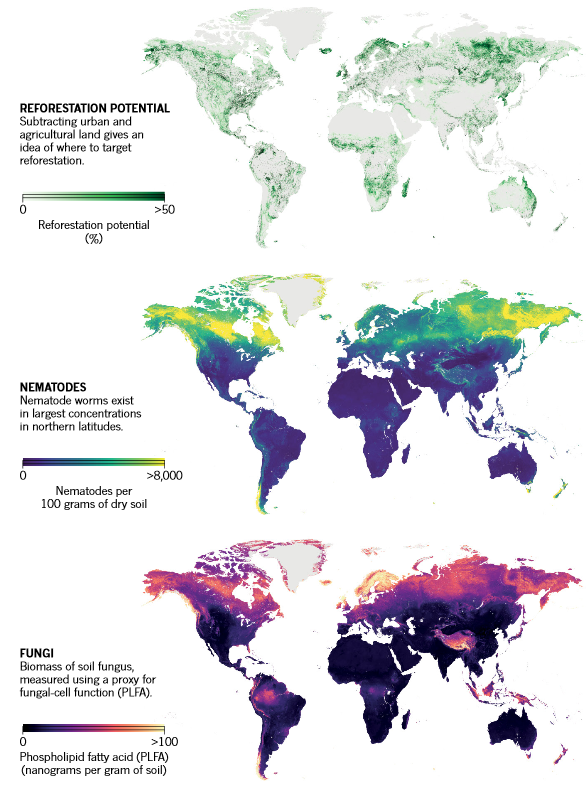
Let’s get back to nematodes for a bit. They're usually tiny, around 50 micrometers thick and 1 millimeter long - but the nasty parasitic kinds (this is sort of sickening) can be up to 3 feet long. They actually play an interesting role in solving climate change. This recent article from Brigham Young University covers that aspect. One thing of interest to note is that the biomass of the nematodes of the planet is almost equal to our weight. That is, add up the weight of all the nematodes and you have 80% of the weight of the entire human population! The relationship to carbon is summed up here:
“Knowing where these tiny worms live matters because nematodes play a critical role in the cycling of carbon and nutrients and heavily influence CO2 emissions. An important finding of the paper is that nematode abundance is strongly correlated with soil carbon (more carbon = more worms). Understanding the little organisms at a global level is critical if humans are going to understand and address climate change.”
Below is a figure from the Nature article summarizing the data from Crowther's research for trees, nematodes and fungi.
In Part 2, I will talk about more lessons learned for project management and more about the connection between AI and Earth.
Posted
by
Richard Maltzman
on: October 11, 2019 04:42 PM |
Permalink
Comments (4)
Please login or join to subscribe to this item

Luis Branco
CEO| Business Insight, Consultores de Gestão, Ldª
Carcavelos, Lisboa, Portugal
Dear Richard
It's new to me ...
I'm going to run read part 2
Thanks for sharing
Luis Branco
CEO| Business Insight, Consultores de Gestão, Ldª
Carcavelos, Lisboa, Portugal
Dear Richard
Where or how can I access Part 2 of the article?
Suggestion:
Put the link that gives us immediate access to part 2
Thanks for sharing
A fascinating piece Richard, I certainly look forward to part 2, we are all responsible for the anthropogenic impact to the environment in which we live.
Very interesting article., thanks for sharing
Please Login/Register to leave a comment.
|
If trees could scream, would we be so cavalier about cutting them down? We might, if they screamed all the time, for no good reason.
- Jack Handey
|




