The Millennium Project: A Model for the Future of Global Collaboration


| Today, I’m quite pleased and proud to feature a guest blog post by an MBA student at Bard College’s MBA in Sustainability. I’m thankful to Kristina Kohl, PMP, author of Becoming a Sustainable Organization, who made the connection and introduced me to Kirstie Dabbs.
Kirstie Dabbs, Bard MBA in Sustainability
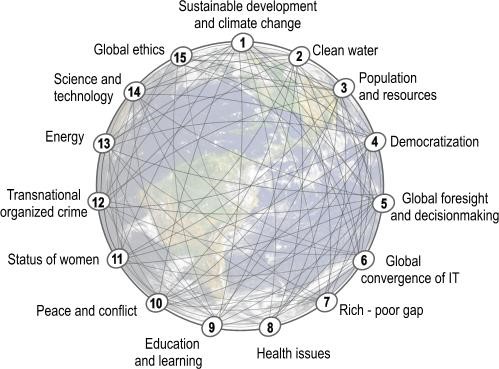
Kirstie Dabbs is a student at Bard College's MBA in Sustainability. Her areas of expertise include corporate ESG disclosure and the application of strategic foresight to inform sustainable decision-making. She has enjoyed developing sustainability strategies for public, private, and nonprofit organizations. Here is her post: How might we harness the power of global participation to achieve a better future for all? The answer may lie in transcending the labels that divide individuals and organizations. Long before the establishment of the United Nations Sustainable Development Goals in 2015, or even the Millennium Development Goals in 2000, a think tank called The Millennium Project methodically worked to compile a list of 15 global challenges looming beyond the year 2000. The next millennium was fast approaching, and co-founders Jerome Glenn and Theodore J. Gordon saw this milestone as a potential teaching moment for humanity. Rather than merely creating a report about the state of the world, Glenn (then a futurist and consultant at United Nations University and its American Council) and Gordon (CEO of the Futures Group and formerly at the RAND Corporation) figured that society would benefit from something even more ambitious than a think tank’s report: the establishment of a global system to support ongoing research about the state of the world. As futurists, they hoped this system would gather useful information to inspire decision-making for a better future. The Millennium Project launched in 1996, and to this day the organization remains the only one of its kind. After three years of feasibility studies conducted under the United Nations University, the Project became operational under the American Council for the UNU as a participatory global think tank connecting civilians, universities, private enterprise, governments, and policy makers. In 2009, The Millennium Project became an independent NGO. Now in its 25th year, the organization should be studied as a model of global collaboration for good that transcends place, institution, and ideology. The non-hierarchical structure of research, combined with the online Global Futures Intelligence System (GFIS, launched in 2014), enable The Millennium Project to collect, organize and synthesize information from around globe in near real-time. Much of the data gathered are organized into categories based on the 15 global challenges identified in the 1990s. The challenges remain relevant today, as evidenced by their overlap with many of the UN 2030 Sustainable Development Goals. Their continued significance is a testament to the successful foresight work performed by The Millennium Project in its early days. The Millennium Project 15 Global Challenges
Image Courtesy of The Millennium Project After 25 years of tracking these issues through global news feeds and participant inputs, the Project’s global collective intelligence system serves as a rich resource and it is available to scholars, NGOs, government agencies, and individuals who subscribe to its network. The Project’s data on environmental risk alone has informed numerous departments of defense around the globe. The organization is also well-positioned to support collaborative efforts to achieve the UN Sustainable Development Goals by 2030, offering a network for global partnership.
Image courtesy of The Millennium Project Re-Imagining Organizational Structures Another way that The Millennium Project is leading the way for global change is through its aspiration to evolve beyond the boundaries of a rigid organizational structure, becoming the world’s first transinstitution. The legal status or “legal personhood” of a transinstitution does not yet exist. This, according to Glenn, is unfortunate. “Our society has accelerating technological change, but institutional change is lagging.” He believes that just as all countries have for-profit law and non-profit law, there should be a third category: transinstitutional law. While The Millennium Project is currently a nonprofit 501(c)(3) public charity, it has embodied different structures through its existence and Glenn as CEO would promptly register it as a transinstitution if a country were to take the step to create this new category. In contrast to the way the term public-private partnerships is used today, which simply refers to collaboration between institutions, Glenn’s use of the term transinstitution describes an organization that is able to span different boundaries, as needed. As Glenn explains, “The advantage of being a transinstitution is that when you have to be in the United Nations, you’d be in the United Nations. When you have to be based in a country, you’d be in a country. When you have to focus on an issue, you could act like an NGO. When you want to be in education, you could act like a university – you can act through all of these categories while also being acted upon by all of these categories.” Glenn believes a transinstitution structure would enable more action because it would allow for adaptation. “Some things are harder for a business to do, and others are harder for universities to do,” he explains. If an organization were able to exercise different capacities simultaneously for different purposes, barriers that inhibit collaboration and action would be reduced. “We are already adaptive – we are politically sensitive because we engage with government and policy makers regularly. We are internationally and culturally sensitive because we have Nodes around the world,” including, as Glenn points out, nodes in both Tel Aviv and Tehran. “That’s a little unusual for an organization.” As for the possibility of other organizations registering as this designation, Glenn sees a transinstitution being useful to support any cause. “The main idea is to attract people who are interested in what you are doing and then put them together in a healthy environment, even if they are different – just like an opera,” he says. “A trumpet should not be a violin. But when you put them together it makes beautiful music. It’s the same with a transinstitution: you can have left-wing, right-wing, and more, but the relationship of how you put them together can allow for a successful output.” Looking Forward When The Millennium Project was first envisioned, its founders wondered how to create a global system. “We didn’t know how. That’s why we did the feasibility study,” Glenn explains. The Cold War was still underway during the early exploratory phase, creating geopolitical tension and posing a threat to a truly global network – yet Glenn and his collaborators discovered that there were people around the world who were eager to participate; the network self-organized and has continued to do so ever since. This type of network that is accessible to anyone interested in joining makes global collaboration possible. No matter what legal structure an organization may embody, or what challenges may loom, The Millennium Project inspires us to adopt inclusive, forward-looking participation in order to achieve the ambitious action required to create a more sustainable world. ---- Thanks, Kirstie. We invite readers to comment on Kirstie's post! |

Crazy Biology
|
Photo by Paul Starosta / Getty Images This is the story of a tiny water fern called Azolla filiculoides. I came across this little plant critter in this article from Inverse magazine. The article refers to a research project (and there are many projects based on this plant) in which scientists were able to sequence the genome of this species. That article, from Nature, is available here: Fern genomes elucidate land plant evolution and cyanobacterial symbioses Having done this sequencing brings scientists one step closer to “understanding some of the crazy biology of these particular species”, according to Dr. Carl Rothfels, a co-author of the Nature article. From that article: Rothfels says that one of the most “extraordinary features” of this fern is its ability to have a symbiotic relationship with cyanobacteria, which in turn gives it the ability to “fix” nitrogen. Nitrogen fixation is the process by which plants use the chemical element as a fertilizer: Most plants typically can’t do this alone, but the blue-green cyanobacteria that live in the Azolla leaves allow for this process to happen. In turn, Azolla can sustain rapid growth in favorable conditions. That’s important for multiple reasons, the first being that the fern shows “great promise as a biofuel,” says Rothfels. While it’s been used as a fertilizer for rice paddies in Asia for the past 1,000 years, he and his team are now curious to know whether it could be used as a sustainable fertilizer elsewhere. Its ability to help agricultural crops is compounded by its resistance to pests: Farmers have noticed for decades that bugs generally don’t like ferns, and now the sequencing of the Azolla genome reveals it carries certain genetic mutations that allow it to repel insects. Azolla is more than 1,000 years old. Much, much older, in fact. About 50 million years ago, there was a huge “bloom” of this fern that may have reduced the CO2 in our atmosphere and helped cool of the earth. To understand this, have a look at this brief video: Amazing, huh? Or have a look at this one: The fern did it (reduce CO2 in the atmosphere and reduce the Earth’s temperature) then – could it do it again? And even if not, are there other things about this crazy fern that could help us out? One project that considers the use of this fern as a way to help farmers in Bangladesh, is being done at Colorado State University. See that video here: It also has some pretty fascinating fertilization capabilities – see this video: But the real exciting idea here is using Azolla to fight climate change by becoming a carbon sink. From the article “Using Plants to Fight Climate Change”: Azolla is a genus of seven species of tiny aquatic ferns that can resemble moss or algae at first glance. This specialized plant grows on the surface of freshwater and forms a symbiotic relationship with a cyanobacteria that fixes atmospheric nitrogen, which gives the azolla easy access to this essential nutrient and allowing for rapid growth in ideal conditions. But one of the most impressive skills of the azolla fern is its ability to draw down as much as 6 tonnes per acre of carbon dioxide per acre per year, in addition to a tonne of nitrogen per acre per year. With these powers, the azolla fern could be a major player in slowing down or even reversing climate change. Nitrogen fixation In the previous videos you’ve seen that much of the power of this fern comes from a symbiosis with a bacteria called Anabaena. This is called Nitrogen Fixation, something that’s worth learning about – and it’s doesn’t take a degree in biochemistry. I found a very short and informative video that explains this: Some of the most fascinating projects – and plants – are all around us! |

Cherry Blossom Projects
|
I’m currently in Washington, DC, and was reading an article about the Cherry Blossoms, which reminded me of a really optimistic, peppy Herb Albert tune from 1967. You can watch it right here in this post – and you may need it after reading this. Turns out, the Tidal Basin, one of Washington’s main tourist attractions, home to the just-blooming cherry blossoms, and surrounded with America’s most beloved Memorial monuments, is in big trouble, and not so far in the future, either. From the April 2021 Washingtonian article by Daniella Byck, the timeline of events is scary: Timeline (high tide figures shown):
…if the area is left without any intervention and climate change continues at predicted pace Already, the cherry blossoms are in danger, with the 3800 cherry tree roots in brackish water from the Potomac River twice a day at high tide. Sea-level rise is faster in Washington than anywhere else on the US East Coast, causing Washington to literally sink, predicted to sink half a foot by 2100. What’s being done about it? Well, aside from the overall effort to reduce climate change – a global effort of its own which seemed to fade into oblivion due to the onset of COVID-19 – there is a fascinating design challenge taking place amongst five architectural design firms, summarized in the article. Have a look at this video which describes the backdrop of the challenge, called the Tidal Basin Ideas Lab: As you watch, note how they discuss it in a project context – after all, these architectural design firms are projectized organizations. Think of it as a pre-project design workshop. It is sponsored by the National Mall Trust Below are some of the proposals – you can actually read the detailed proposals (in glorious PDF) here.
Entropy Solution: James Corner Field Operations Multiple options including allowing the Basin to flood Naturalist Approach: GGN Incremental change over the next 70 years, including the creation of floodplain forests Hush Harbor: Hood Design Studio Scenarios based on the ‘hush harbors’ which enslaved people met to worship, new floodgates, an elevated track and others. The Jetties: DLANDstudio Create more land to absorb water and provide alternate pathways to the memorials, some of which are moved to elevated jetties. The High Lines: Reed Hilderbrand Create ‘adventure’ walkways for a variety of experiences for tourists, rebuild the seawall as a pathway with terraces. So, there is some hope. And now, maybe you’re ready for that upbeat video. After all, once we get one of those excellent Project (actually probably a Program) Managers on it, it’ll be reality before you know it!
|
Diversolar
|
|