Project Management

People, Planet, Profits & Projects

by ,

About this Blog

RSS

View Posts By:

Richard Maltzman
Dave Shirley

Recent Posts

Saving the Sahel (Part 1)

You Can't Get They-ah From Hee-yah

Floating an idea into reality: the other side of the AI Project Paradox

The Environment of the Built Environment: an AI Paradox

Is plastic on your mind?

Categories

6th, 6th Edfition, 6th Edition PMBOK, 7th Edition, 7th Edition PMBOK, 8th Edition PMBOK, 8th Edition PMBOK Guide, Activism, actuarial, actuary, adapt, addition by subtraction, Africa, africa, agriculture, airforce, ajaita, Alaska, amazon, analogous, analytics, ancient, and more power, antarctica, anti-science, apple, apps, architecture, arctic, arrakis, Artificial Intelligence, asch paradigm, Assistant, asthma, astronomy, automobile, automotive, autonomous cars, b, bankhar, Banksy Crypto, basalt, baseball, bats, batter, beauty products, benefit, benefits, Benefits Realization, beyond epica, biases, bicycle, big data, big dfata, big dig, bike, biodiversity, biomedicine, birdhouse, blockchain, blood, blue blood, blue trees, bluefin, bluefin tuna, book review, boston, boston university, Boyce, Brazil, brazil, Breakdown Structures, BS, building, buildings, built environment, built environment, bumblebee, cake, capacitor, car, Carbon, carbon, carbon capture, carbon negative, carbon neutral, carbon pool, carbon sequestration, carbonate, careers, CEO, ChatGPT, chatGPT, chatgpt, chatgpt, chess, China, china, chopsticks, citrus, cli-fi, climate, climate change, climate resilience, climeworks, Clumsy, CO2, co2, CO2 Utilization, coalition, cobalt, coffee pods, cognition, cognitive, Collabortion, colombia, concrete, Conflict, construction 5.0, cool projects xyloscope, cooling, coral, corn, cost of good quality, cost of poor quality, cost of quality, crazy, criticism of project management, cryptocurrency, CSR, csr, data, data analytics, data privacy, datacenter, dataset, death spiral, Decision Making, decomposition, Defense and Climate, definition of a project, deforestation, dependencies, dependency, desert, DIKW, dikw, dimopoulos, disposal, dna, DOD, dogs, dolphins, dream, drilling, drink, dune, dune, dutch, early start, earth, eatlocal, eco-tourism, ecological, economic, economics, EKC, electric grid, electricity, electronics, elysis, embodied carbon, emerging technologies, empower, Energy, energy efficiency, environmental degradation, escalate, escalation, ESG, extreme weather, fallacy, FARC, farming, finance, fish, fish brains, fishing, fix, fixing the earth, flint water, Flint Water Supply, flood, flooding, Food supply chain, food waste, forest, forest for the trees, forestation, forrestgump, frank herbert, Fruitcake, fungus, fusion, Galvao, garage, gas, gasoline, geese, gender equality, gender partnerships, generational differences, Generative AI, gladwell, gold, Goodness, google, Government, GPT, great pacific garbage patch, green, green building, green buildings, green energy, green iguana, green project, green project management, greening, guest post, gyre, harkonnen, Harvesting Benefits, hawasina, hedgehogs, heursitics, historical data, hlb, holitsic, holland, horseshoe crab, human-caused climate change, hydrogen, hydrology, ice, iceland, ignition, iguana, imagery, impact, india, inequality, information, initiatives, injection, insurance, intelligence, interacting risk, internal combustion engine, invasive species, investment, isomer, issue escalation, issues, ITER, jobs, Jupiter, justification, kids, kill point, knowledge, koch brothers, Kuznets, laboratory, LAL, landscape mode, lapampa, launch, LCA, Leadership, Leadership, life cycle analyses, life cycle analysis, lifecycle, Linkedin, liquid, lizard, local, long term, long-term, long-term thinking, look up, loud, maintenance, maker, makermovement, malcolm gladwell, management, marathon, marine biology, market, mars, Martin Luther King, mean, megawatt, MeHg, melting, mercury, metal, Microgrid, microplastics, migration, military, millennial, mindset, minerals, mission, mitigate, MLK, mongolia, museum, museum of london, nature, nematodes, net gain, Net Project Success Score, net zero, netherlands, network, New book, New Jersey, New Practitioners, new york, NFT, nitrogen, noise, noreaster, norway, nova, NPSS, NREL, ocean, ocean cleanup, ocean life, oil rig, oil rigs, oklahoma, oman, only murders in the building, opportunity, overall risk, oxygen, packaging, pareto, PBS, permafrost, persistence, peru, Pharmaceutical, planet, planet.com, planning, plant, plasma, plastic, playground, pm, pm education, pmbok, pmbok guide, pmnetwork, PMXPO-2018, podcast, pollutants, pollution, poop, poor, portfolio, power, power skills, privacy, privacy concerns, professors, program, Program Management, project, project leader, project leadership, project management, project management 3.0, project on fire, project progress, Project Success, project success, projecticity, projectleadership, projectmanagement, projects, psychology, pulse of the profession, purple bacteria, purpose, quiet, rainforest, rationale, reef, refugees, renewable, renewables, Repair, repair, repeatable process, repeatable processes, repurpose, research, resource breakdown strucuture, Resource Management, reversing climate change, revisionist history, rich, rigs2reefs, ripe, risk, risk avoidance, Risk Management, risk mitigation, risk response, risk responses, river, robots, rocks, rules of thumb, rural, rural India, russia, Sarcasm/Irony, satellite, saudi, schedule, sci-fi, Science, science, science-fiction, scientific american, screaming monkeys, sea, sea life, Sea-Level Rise, sea-level rise, seagreens, seawall, seawater, seawater temperature, seaweed. beat;es. farming, secondary risk, selena gomez, sequestration, shipping, skyscraper, SLR, smart cities, smart city, smelting, social, social pressure, soil, solar, solar panels, solar perovkites, solar saheli, sonic, sponge cities, SRI, stage-gate, stagegate, stakeholder, stakeholder management, steward, stewardship, storage, strategy, stupid, success, suffer, sulphur, sunk cost, supercapacitor, supply chain, survey, Sustainability, sustainability, Sustainable Investing, Sustainable Tourism, sybiosis, symbiosis, system 03, TBL, temperature, terraform, terraforming, test, threat, threats, totem, touchscreen, tour, tower, Trains, transparency, transportation, trash, tree, tree species, trees, trillion, triple bottom line, triple constraint, truth to power, UMass, us army corps of engineers, USDA, vacuum, value, venus, vision, voice, voltage optimization, vw scandal, washing machine, waste, wastewater, water, we mean business, whales, Whirlpool, wind, wisdom, women, Women in Project Management, wood wide web, woonerf, Work Breakdown Structures (WBS), world breakdown structure, worms, xian, xylotron, Yale

Date

No Cranberries for You - Part 2 of 2

linkedin twitter facebook Request to reuse this  

As mentioned in the previous post (see Part 1), one outcome of climate change for Cape Cod, and in fact for anyone who likes cranberries, is the potential demise of the cranberry industry here.  This is covered in the Cape Cod Commission Climate Plan, which we introduced in Part 1, but the issue shows up in other reliable, recent sources – for example, this article from National Geographic, or this one from the Washington Post.

Reinforcing the idea that ‘triple bottom line’ thinking is not only ‘environmental’ but also economic an social, climate change and sea-level rise is not only about saving species and ‘being green’ but also about real peoples’ lives and real dollars and sense (pun and misspelling intentional).  The increasing temperatures could ‘spell the end’ for what is a US$6.7 million Cape Cod cranberry industry which employs somewhere between 6000 and 10000 people in the Commonwealth of Massachusetts.

Cranberries are prone to a ‘double-threat’ from climate change.  Increased temperatures, as above, are one aspect.  As I write this, I see that the forecast for the Cape calls for 90 degree days this week.  When that happens, it can be about 10 to 20 degrees hotter in a cranberry bog, and that can lead to a condition called ‘scald’, in which the cranberries actually cook right on the vine (and become unusable).

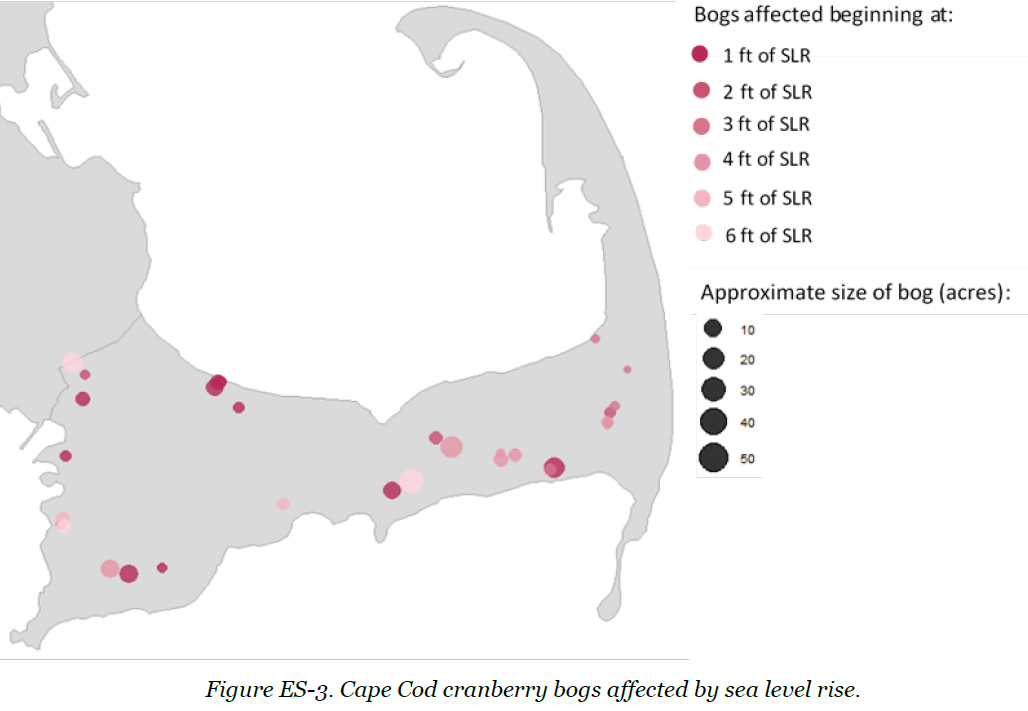
The other aspect of the double-threat is sea-level rise.  Below is a chart from the Cape Cod Commission report that shows bogs that are at risk due to SLR (Sea Level Rise).

But here’s the thing: the economic aspect of this is much, much, MUCH bigger than cranberries. 

For example, from the report:

Reduced tax revenue from vulnerable properties: ERG estimates that from 2021 through 2100, properties vulnerable to sea level rise and tidal flooding will cumulatively pay approximately $8.6 billion less in tax revenue than they would have if they were not threatened by this flooding. These vulnerable properties will be inundated or are near roads that will be inundated by sea level rise and tidal flooding. Therefore, their property values will grow more slowly (or decrease faster) than non-affected properties. This will either lower the tax revenue of towns or shift the burden to non-affected houses. The annual average tax revenue loss from these properties will be about $13 million between 2021 and 2030, $81 million between 2031 and 2050, and $330 million between 2051 and 2100. The technical report presents losses by town and community activity center (CAC).

So – what does the Climate Plan recommend?  Again – this is available in a full report and an executive summary, but here is my executive summary of the executive summary – these are the mitigations the Commission recommends:


  • A comprehensive and diverse set of strategies will be needed to meet 2030 and 2050 emissions reduction goals.
  • Implementation of electric air-source heat pumps is cost-effective for residents, leads to substantial health benefits, and is essential to reaching 2030 and 2050 GHG (Greenhouse Gas) emissions reduction goals.
  • Renewable energy adoption is becoming price competitive and will be an important strategy for meeting GHG emissions reduction goals.
  • Outreach and infrastructure around EV adoption is necessary to reach emissions goals and save consumers money, and the adoption of EVs will provide a major health benefit.
  • Implementing aggressive electrification and renewable energy will bring green jobs into the region.

In the conclusion of the Executive Report, we find this particularly interesting quote:

Additionally, there are paths to meet 2030 and 2050 emissions reductions goals that align with the goals for the Commonwealth of Massachusetts; however, achieving these goals will require aggressive electrification and renewable energy implementation. Finally, many strategies with strong returns on investment can help offset the impacts of climate change or mitigate emissions.

That’s our cue, project managers!  Aggressive implementation!  Getting it done!  Getting goals – value-added goals, aligned with organizational strategy – achieved!  That’s program and project management in a nutshell.  Or a cranberryskin...

Posted by Richard Maltzman on: August 23, 2021 11:21 PM | Permalink | Comments (1)

No Cranberries for YOU! (Part 1 of 2)

linkedin twitter facebook Request to reuse this  

I am sharing my reaction to this article from the Cape Cod Times which paints a not-so-pretty picture of the future of the ecology (and economy) of Cape Cod.  The article, “Cape Official: A Sense of Urgency” is particularly interesting to PMs because of the sub headline “Commission Plan Maps Out How To Take Action On Climate Change”.  A plan to take action? An initiative to accomplish a valuable deliverable that is urgent and bound by a schedule?  Sounds like project management to me!

The trigger for this story and the ‘sense of urgency’ in the article’s title is the current and expected effect (or impact) of climate change.  Although the changes in temperature are in line with the (fairly scary) prediction of the climate scientists, the impacts of climate change are proving to be larger and more far-reaching than the predictions. 

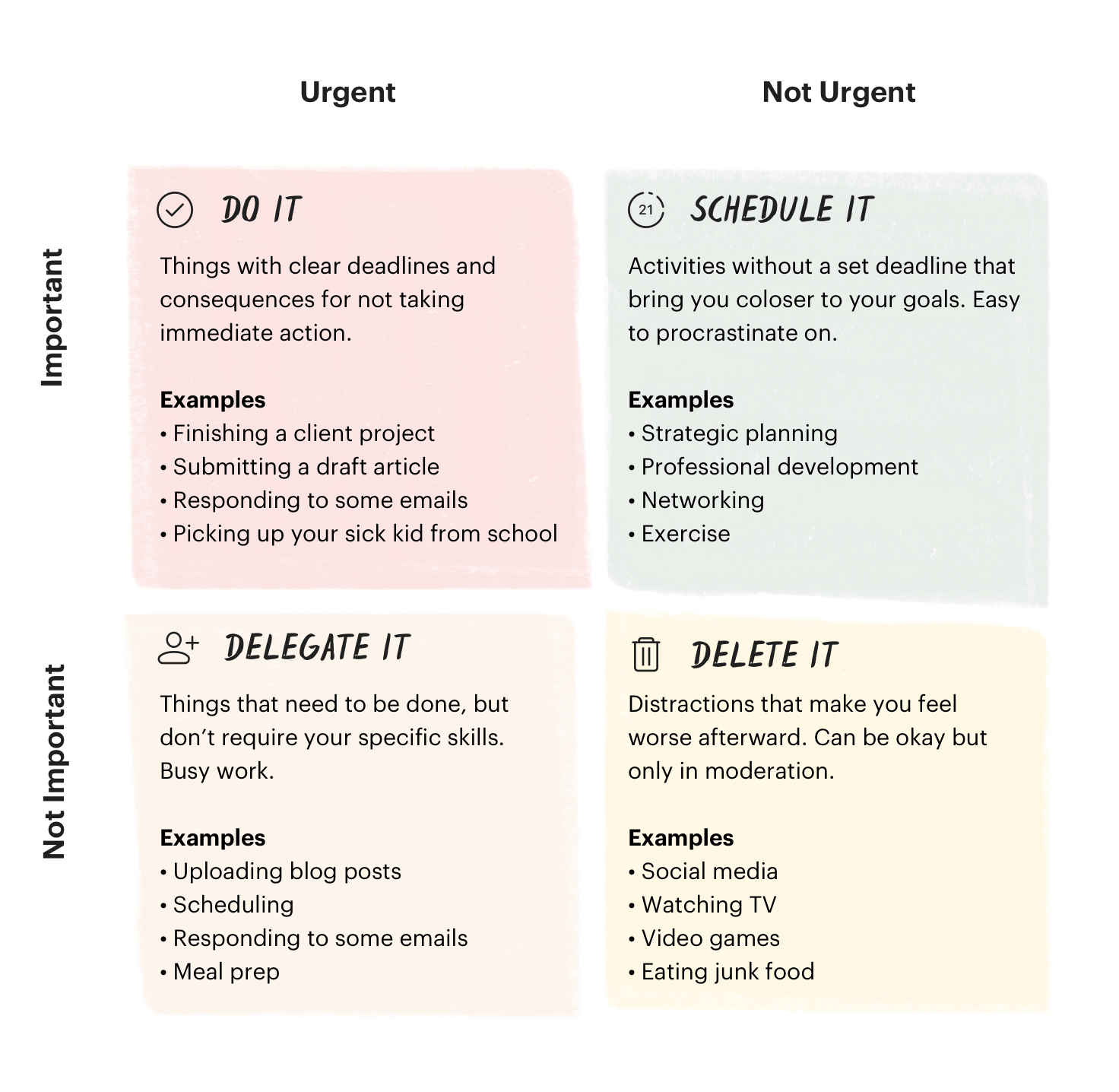
The Cape Cod Commission this week released its action report.  But before we get to that, let’s talk about these impacts.  The head of the commission, Kristy Senatori, says, “Our economy is based on the environment.  Making sure we get ahead of this climate crisis is extremely important”.  I thought this a good chance to take a slight tangent and bring up the Eisenhower Matrix which plots importance and urgency.  It’s actually a good tool for project managers to use for sorting out their issues.  Here’s an excellent article on the Eisenhower Matrix and below an image from it.

Image from https://todoist.com/productivity-methods/eisenhower-matrix

The concept is pretty simple: the items that are urgent and important (in the upper-left corner here) are the ones you need to work on now – or they will create BIGGER, more dangerous problems in the future – like picking up a sick kid from school – or not dealing with the contributors to climate change NOW.

As to the Cape Cod Commission report, I found it to be very well-prepared and hopefully actionable.  I’ve decided to break this into two parts because there are several good PM lessons from this initiative.

For now, I’d like to point you to this work, giving you a chance to have a look at it before Part 2 of this post is published (in about a week), and tease out the rationale for the title of this post.


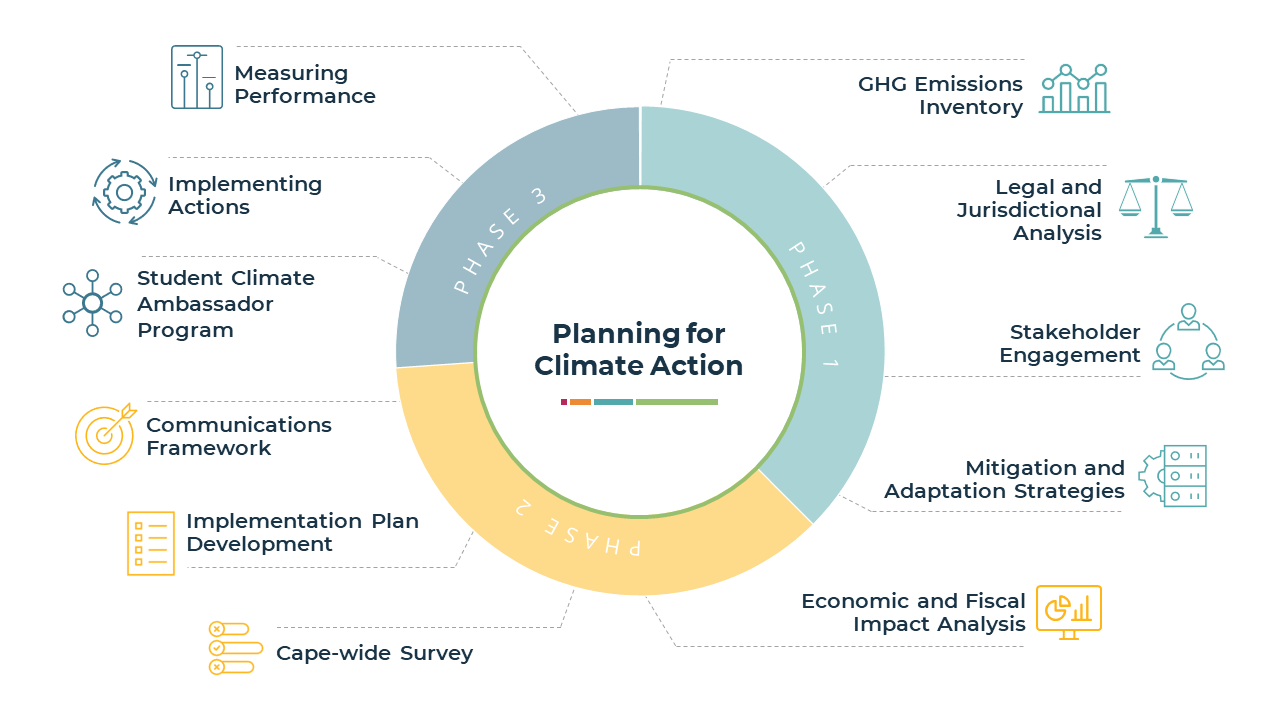
Below is an image from the Commission’s website that shows how the plan is decomposed into phases.  The topic and action plan are summarized on their site here and here.


I also summarize the purpose statement of the Action Plan below:

PURPOSE STATEMENT

To identify, study and monitor the causes and consequences of climate change on Cape Cod as a basis to guide and develop science-based policies, strategies and actions that governments, businesses, organizations, and individuals can pursue to:

  • improve the region’s resilience to climate hazards; and
  • mitigate climate change on Cape Cod through reducing net regional greenhouse gas emissions in support of the framework and targets established by the Commonwealth.

The full, 129-page Technical Report can be downloaded here, and a 14-page Executive Report can be found here.

And now, finally, an explainer of the title.  For those of you familiar with the very popular US comedy show “Seinfeld”, I don’t have to tell you much about the recurring “No Soup For You” theme in that show.  For those who aren’t familiar with it, you can find all of the details here.  The bottom line is that the characters in the show had to be very careful in this restaurant because of the delicate sensitivities of the chef, or to no longer have access to his delicious soup.  In our case – we have to be very careful in our delicate Cape Cod environment, or lose (for example) those tasty Cape Cod cranberries – and the industry and jobs that they support - as you will see in Part 2.

Posted by Richard Maltzman on: August 08, 2021 12:24 PM | Permalink | Comments (1)

Value-able

Categories: 7th Edition

linkedin twitter facebook Request to reuse this  

This is going to be a short blog post, because your time is valuable.  I am going to send you to not one, but two valuable videos just contributed by folks I admire: Ricardo Vargas, and Nader Rad,  core team contributors to the PMBOK® Guide 7th edition.  Each will walk you through the new Guide and Standard, with valuable insight.

The connection to value here is no coincidence.  I also was one of about 70 reviewers of the document and submitted scores of changes, and I’m pleased and proud to see that they appeared to have made a difference.   Clearly (at least to me) there is now a solid encouragement for project managers to consider their project more holistically, in a larger context, and importantly, to look past the end of their project – in the longer term.  There is revolutionary feel to this – moving from outputs to outcomes, considering benefits over time: which is (in my mind) the definition of project value delivery.

And in fact, “Value” is one of the 12 Principles which form the basis for the Standard for Project Management.

Do me (and yourself) a favor. Please take some more of your valuable time to watch at least one of these, and I would value any comments you may have.


Ricardo Vargas


Nader Rad


Posted by Richard Maltzman on: July 24, 2021 10:15 PM | Permalink | Comments (0)

Stubborn Optimism

linkedin twitter facebook Request to reuse this  


In my last post I discussed things you can do – perhaps in your own home – to reduce the use of plastics.  You can take those initiatives to a higher level by looking for such reductions in your projects and programs.  Can this be taken to an even higher level – for example, your enterprise?

Actually, yes it can.  But it goes beyond plastics.  Here’s one way that you as an individual can produce an enterprise-level outcome.  It has to do with a pledge and with something called “stubborn optimism”.

In fact, let’s start there, with a very nice, short video by Christiana Figueres, whom I have blogged about on People, Planet, Profits and Projects before.

It’s short, informative and quite interesting background:

I mention “Stubborn Optimism” because it is at the heart of the organization “Global Optimism”, which in turn is the partner for something called The Climate Pledge.

The Climate Pledge, as summarized by this article in The Verge, is a call to businesses and organizations to take collective action on the world’s greatest crisis and to work together to build towards a safe and healthy planet for the next generations.  The Climate Pledge was  co-founded by Amazon's Jeff Bezos with Global Optimism in 2019. The Climate Pledge is a platform for signatories to work together on ambitious actions to achieve net zero carbon emissions by 2040, 10 years ahead of the Paris Agreement.

There is a lot of good (who would expect anything else from an organization with Optimism In their name) on the Global Optimism site, I encourage you to have a look at.

For example, on their Events page, they state:

 “Achieving a zero emissions future is not a far-off challenge. It’s one we must get on track for now. Science demands that we cut global greenhouse gas emissions by half in the decade between 2020 and 2030, in order to eventually meet the goal of net zero emissions by 2050 at the latest. This goal was adopted by 195 countries through the Paris Agreement. It is now the responsibility of all of us to act with the courage, urgency and solidarity to build the transformative solutions to thrive now and in the future. We work with like-minded people and collectives from all sectors, investing in the steps required to be on this challenging – and life-affirming – journey.”

Also on their Events page, you will find some high-quality podcasts including:

So there are some excellent resources for you.  But let’s get back to the Climate Pledge. 

The commitments of the signatories of the Climate Change:

  • Measure and report greenhouse gas emissions on a regular basis;
  • Implement decarbonization strategies in line with the Paris Agreement through real business changes and innovations, including efficiency improvements, renewable energy, materials reductions, and other carbon emission elimination strategies;
  • Neutralize any remaining emissions with additional, quantifiable, real, permanent, and socially-beneficial offsets to achieve net zero annual carbon emissions by 2040.

A quick perusal revealed these enterprises were indeed on the list:

  • Heineken
  • Visa
  • Colgate-Palmolive
  • Telefónica
  • Pepsico
  • IBM
  • Unilever
  • Microsoft

Is your organization on the list? Check it  here: https://www.theclimatepledge.com/us/en/Signatories

  • If so, make sure your project team members are aware of it – your job as a project (and especially program or portfolio manager) is assure alignment of project outcomes and value with the enterprise’s high level mission and vision.  This is amplified greatly in the PMI's 7th Edition PMBOK® Guide.
  • If not, you can be an agent of change by suggesting to your C-level leadership that they would be in good company by signing on.

Either way, you have more “sway” than you think.


Posted by Richard Maltzman on: July 18, 2021 09:00 PM | Permalink | Comments (2)

Your plastic footprint

linkedin twitter facebook Request to reuse this  

This blog is usually about big things, like converting oil rigs to reefs, or aligning projects and programs with the UN Sustainable Development Goals (SDGs)

This time it’s about you.  In particular, it’s about your feet.  Well, not really your feet, literally, but your plastic footprint, and some personal, small projects that can help you reduce your plastic impact.

I came across a fantastic article (paired with a podcast from NPR’s Life Kit) which you can read – and play – from this link.  You will find a 24-minute audio clip right there, and/or you can read the article, entitled: The Plastic Problem Isn't Your Fault, But You Can Be Part Of The Solution.  From my experience, most project managers are problem solvers and love to be part of a solution – so, read on.  The United States was responsible for more plastic trash than any country in the world, says the article,  that's millions and millions of tons of plastic waste. Per capita, that boils down to nearly 300 pounds of plastic trash per person(!) per year.

In summary, because you can derive the steps and background from the article, it’s about 6 steps, which are only slightly dependent on each other, in fact much of it can be done in parallel, some of which are intended to be ongoing (so not really a project, but a steady-state operation).

The six steps are:


  1. Do your research
  2. Do an audit
  3. Look for sustainable swaps
  4. Be a conscientious recycler
  5. Check locally
  6. Make some noise


I expand these below in outline form:

  • Do your research
    • Know the story behind the plastics you use.  They are likely derived from fossil fuels and may have a bigger impact than you think, on you and your neighbors.  For example, (from the article) Yvette Arellano runs an environmental justice organization called Fenceline Watch. It's an advocacy group based in Houston that helps communities of color and low-income neighborhoods disproportionately affected by petrochemical pollution from facilities congregating along Houston's Ship Channel.
  • Do an audit
    • As project managers we know all about this – getting a baseline, or grasping the current state, so we can better target a future state.   How much plastics, and of which types, are you using now, and how are they disposed of?
    • Start in the kitchen and the bathroom.  The bathroom can be a festival of plastic especially if you are using shampoos, conditioners, body wash, exfoliating liquids, skin lotions.  In many cases, you may be able to simplify and/or reduce.  In the kitchen, consider condiment bottles, plastic wrapping, snack or chip bags, even packaging of vegetables.


  • Look for sustainable swaps (see animated photo at bottom)
    • Look at the items on your plastic inventory list and ask yourself, "What can I replace the plastic with?".  A bar of soap may do the same thing as many of those lotions.  You can buy bundled instead of plastic-wrapped vegetables.  Consider reusable containers for tea, coffee, and water.  The article has further suggestions.
  • Be a conscientious recycler
    • Have you ever “wishcycled”?  That means you have something plastic in your hand, not knowing if it is really recyclable in your location, so you drop it in and wish that it is?    Avoid that by digging in and discovering the facts. They exist!  As project managers we instinctively know to work from facts and minimize assumptions, so this is in our wheelhouse.  Wish-cycling may alleviate some of your guilt, but it clogs up the recycling system and makes recycling more expensive. When in doubt, find out or leave it out.


  • Check locally
    • As above – validate what works in your specific area.  And check periodically to see if the rules have changed.  Like project scheduling, recycling guidelines are dynamic.


  • Make some noise
    • Here I will paraphrase from the article: If you bring home a product you like, but its package isn't recyclable (in general or in your area), tell companies how you feel, because companies are listening more than ever before.
    • Use the comment section on a company's website or its social media accounts. Harrison suggests you tell them, "I like your product, but I'm worried about this label. Is it recyclable? Ask them. Wait for an answer." Let them know that you care about this as a customer.

And finally (this is not one of the six steps, but it’s still important): Don’t beat yourself up over this.  Do what you can, but realize that you are but one pair of plastic footprints.

Posted by Richard Maltzman on: July 14, 2021 09:41 PM | Permalink | Comments (1)
ADVERTISEMENTS

"All you need in this life is ignorance and confidence, and then success is sure."

- Mark Twain

ADVERTISEMENT

Sponsors