
View Posts By:
Richard Maltzman
Dave Shirley
Recent Posts
What is AI doing to the sustainability of our profession???
Stepwells – Insight from a Particularly Valid Angle
Climb-it Change: Pre-Interview Connector
Climb-it Change: New Relevance for the Stepwells of India
A PATH to more equitable health - via AI project leadership
Categories
6th,
6th Edfition,
6th Edition PMBOK,
7th Edition,
7th Edition PMBOK,
8th Edition PMBOK,
8th Edition PMBOK Guide,
Activism,
actuarial,
actuary,
adapt,
addition by subtraction,
Africa,
africa,
agriculture,
airforce,
ajaita,
Alaska,
amazon,
analogous,
analytics,
ancient,
and more power,
antarctica,
anti-science,
apple,
apps,
architecture,
arctic,
arrakis,
Artificial Intelligence,
asch paradigm,
Assistant,
asthma,
astronomy,
automobile,
automotive,
autonomous cars,
b,
bankhar,
Banksy Crypto,
basalt,
baseball,
bats,
batter,
beauty products,
benefit,
benefits,
Benefits Realization,
beyond epica,
biases,
bicycle,
big data,
big dfata,
big dig,
bike,
biodiversity,
biomedicine,
birdhouse,
blockchain,
blood,
blue blood,
blue trees,
bluefin,
bluefin tuna,
book review,
boston,
boston university,
Boyce,
Brazil,
brazil,
Breakdown Structures,
BS,
building,
buildings,
built environment,
built environment,
bumblebee,
cake,
capacitor,
car,
Carbon,
carbon,
carbon capture,
carbon negative,
carbon neutral,
carbon pool,
carbon sequestration,
carbonate,
careers,
CEO,
ChatGPT,
chatGPT,
chatgpt,
chatgpt,
chess,
China,
china,
chopsticks,
citrus,
cli-fi,
climate,
climate change,
climate resilience,
climeworks,
Clumsy,
CO2,
co2,
CO2 Utilization,
coalition,
cobalt,
coffee pods,
cognition,
cognitive,
Collabortion,
colombia,
concrete,
Conflict,
construction 5.0,
cool projects xyloscope,
cooling,
coral,
corn,
cost of good quality,
cost of poor quality,
cost of quality,
crazy,
criticism of project management,
cryptocurrency,
CSR,
csr,
data,
data analytics,
data privacy,
datacenter,
dataset,
death spiral,
Decision Making,
decomposition,
Defense and Climate,
definition of a project,
deforestation,
dependencies,
dependency,
desert,
DIKW,
dikw,
dimopoulos,
disposal,
dna,
DOD,
dogs,
dolphins,
dream,
drilling,
drink,
dune,
dune,
dutch,
early start,
earth,
eatlocal,
eco-tourism,
ecological,
economic,
economics,
EKC,
electric grid,
electricity,
electronics,
elysis,
embodied carbon,
emerging technologies,
empower,
Energy,
energy efficiency,
environmental degradation,
escalate,
escalation,
ESG,
extreme weather,
fallacy,
FARC,
farming,
finance,
fish,
fish brains,
fishing,
fix,
fixing the earth,
flint water,
Flint Water Supply,
flood,
flooding,
Food supply chain,
food waste,
forest,
forest for the trees,
forestation,
forrestgump,
frank herbert,
Fruitcake,
fungus,
fusion,
Galvao,
garage,
gas,
gasoline,
geese,
gender equality,
gender partnerships,
generational differences,
Generative AI,
gladwell,
gold,
Goodness,
google,
Government,
GPT,
great pacific garbage patch,
green,
green building,
green buildings,
green energy,
green iguana,
green project,
green project management,
greening,
guest post,
gyre,
harkonnen,
Harvesting Benefits,
hawasina,
hedgehogs,
heursitics,
historical data,
hlb,
holitsic,
holland,
horseshoe crab,
human-caused climate change,
hydrogen,
hydrology,
ice,
iceland,
ignition,
iguana,
imagery,
impact,
india,
inequality,
information,
initiatives,
injection,
insurance,
intelligence,
interacting risk,
internal combustion engine,
invasive species,
investment,
isomer,
issue escalation,
issues,
ITER,
jobs,
Jupiter,
justification,
kids,
kill point,
knowledge,
koch brothers,
Kuznets,
laboratory,
LAL,
landscape mode,
lapampa,
launch,
LCA,
Leadership,
Leadership,
life cycle analyses,
life cycle analysis,
lifecycle,
Linkedin,
liquid,
lizard,
local,
long term,
long-term,
long-term thinking,
look up,
loud,
maintenance,
maker,
makermovement,
malcolm gladwell,
management,
marathon,
marine biology,
market,
mars,
Martin Luther King,
mean,
megawatt,
MeHg,
melting,
mercury,
metal,
Microgrid,
microplastics,
migration,
military,
millennial,
mindset,
minerals,
mission,
mitigate,
MLK,
mongolia,
museum,
museum of london,
nature,
nematodes,
net gain,
Net Project Success Score,
net zero,
netherlands,
network,
New book,
New Jersey,
New Practitioners,
new york,
NFT,
nitrogen,
noise,
noreaster,
norway,
nova,
NPSS,
NREL,
ocean,
ocean cleanup,
ocean life,
oil rig,
oil rigs,
oklahoma,
oman,
only murders in the building,
opportunity,
overall risk,
oxygen,
packaging,
pareto,
PBS,
permafrost,
persistence,
peru,
Pharmaceutical,
planet,
planet.com,
planning,
plant,
plasma,
plastic,
playground,
pm,
pm education,
pmbok,
pmbok guide,
pmnetwork,
PMXPO-2018,
podcast,
pollutants,
pollution,
poop,
poor,
portfolio,
power,
power skills,
privacy,
privacy concerns,
professors,
program,
Program Management,
project,
project leader,
project leadership,
project management,
project management 3.0,
project on fire,
project progress,
Project Success,
project success,
projecticity,
projectleadership,
projectmanagement,
projects,
psychology,
pulse of the profession,
purple bacteria,
purpose,
quiet,
rainforest,
rationale,
reef,
refugees,
renewable,
renewables,
Repair,
repair,
repeatable process,
repeatable processes,
repurpose,
research,
resource breakdown strucuture,
Resource Management,
reversing climate change,
revisionist history,
rich,
rigs2reefs,
ripe,
risk,
risk avoidance,
Risk Management,
risk mitigation,
risk response,
risk responses,
river,
robots,
rocks,
rules of thumb,
rural,
rural India,
russia,
Sarcasm/Irony,
satellite,
saudi,
schedule,
sci-fi,
Science,
science,
science-fiction,
scientific american,
screaming monkeys,
sea,
sea life,
Sea-Level Rise,
sea-level rise,
seagreens,
seawall,
seawater,
seawater temperature,
seaweed. beat;es. farming,
secondary risk,
selena gomez,
sequestration,
shipping,
skyscraper,
SLR,
smart cities,
smart city,
smelting,
social,
social pressure,
soil,
solar,
solar panels,
solar perovkites,
solar saheli,
sonic,
sponge cities,
SRI,
stage-gate,
stagegate,
stakeholder,
stakeholder management,
steward,
stewardship,
storage,
strategy,
stupid,
success,
suffer,
sulphur,
sunk cost,
supercapacitor,
supply chain,
survey,
Sustainability,
sustainability,
Sustainable Investing,
Sustainable Tourism,
sybiosis,
symbiosis,
system 03,
TBL,
temperature,
terraform,
terraforming,
test,
threat,
threats,
totem,
touchscreen,
tour,
tower,
Trains,
transparency,
transportation,
trash,
tree,
tree species,
trees,
trillion,
triple bottom line,
triple constraint,
truth to power,
UMass,
us army corps of engineers,
USDA,
vacuum,
value,
venus,
vision,
voice,
voltage optimization,
vw scandal,
washing machine,
waste,
wastewater,
water,
we mean business,
whales,
Whirlpool,
wind,
wisdom,
women,
Women in Project Management,
wood wide web,
woonerf,
Work Breakdown Structures (WBS),
world breakdown structure,
worms,
xian,
xylotron,
Yale
Date

As mentioned in the previous post (see Part 1), one outcome of climate change for Cape Cod, and in fact for anyone who likes cranberries, is the potential demise of the cranberry industry here. This is covered in the Cape Cod Commission Climate Plan, which we introduced in Part 1, but the issue shows up in other reliable, recent sources – for example, this article from National Geographic, or this one from the Washington Post.
Reinforcing the idea that ‘triple bottom line’ thinking is not only ‘environmental’ but also economic an social, climate change and sea-level rise is not only about saving species and ‘being green’ but also about real peoples’ lives and real dollars and sense (pun and misspelling intentional). The increasing temperatures could ‘spell the end’ for what is a US$6.7 million Cape Cod cranberry industry which employs somewhere between 6000 and 10000 people in the Commonwealth of Massachusetts.
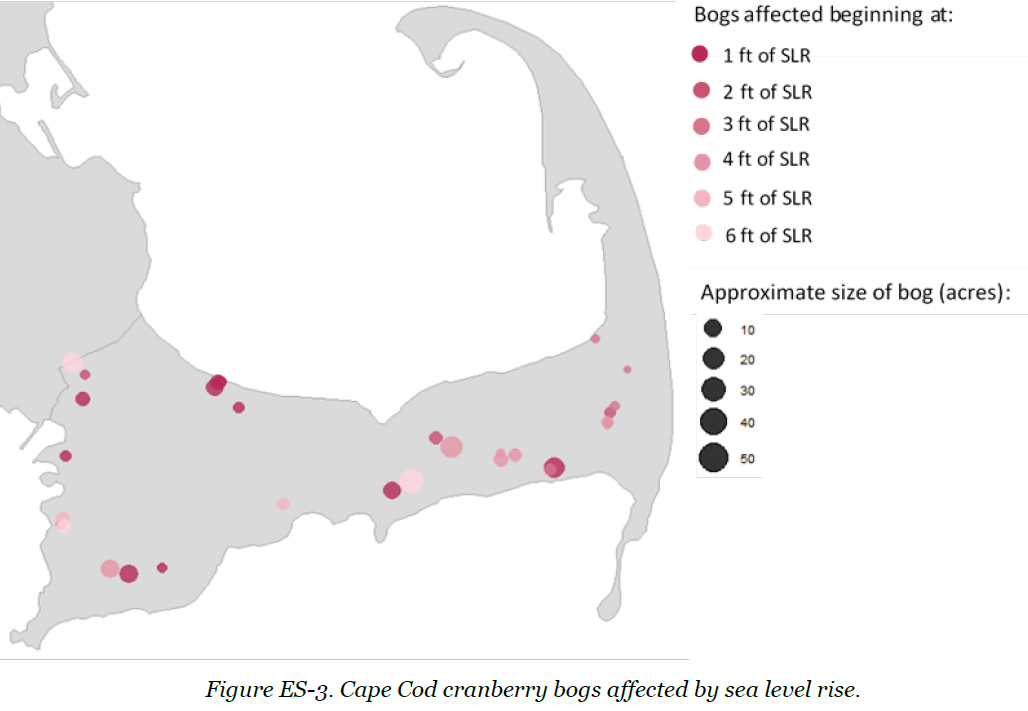
Cranberries are prone to a ‘double-threat’ from climate change. Increased temperatures, as above, are one aspect. As I write this, I see that the forecast for the Cape calls for 90 degree days this week. When that happens, it can be about 10 to 20 degrees hotter in a cranberry bog, and that can lead to a condition called ‘scald’, in which the cranberries actually cook right on the vine (and become unusable).
The other aspect of the double-threat is sea-level rise. Below is a chart from the Cape Cod Commission report that shows bogs that are at risk due to SLR (Sea Level Rise).
But here’s the thing: the economic aspect of this is much, much, MUCH bigger than cranberries.
For example, from the report:
Reduced tax revenue from vulnerable properties: ERG estimates that from 2021 through 2100, properties vulnerable to sea level rise and tidal flooding will cumulatively pay approximately $8.6 billion less in tax revenue than they would have if they were not threatened by this flooding. These vulnerable properties will be inundated or are near roads that will be inundated by sea level rise and tidal flooding. Therefore, their property values will grow more slowly (or decrease faster) than non-affected properties. This will either lower the tax revenue of towns or shift the burden to non-affected houses. The annual average tax revenue loss from these properties will be about $13 million between 2021 and 2030, $81 million between 2031 and 2050, and $330 million between 2051 and 2100. The technical report presents losses by town and community activity center (CAC).
So – what does the Climate Plan recommend? Again – this is available in a full report and an executive summary, but here is my executive summary of the executive summary – these are the mitigations the Commission recommends:
- A comprehensive and diverse set of strategies will be needed to meet 2030 and 2050 emissions reduction goals.
- Implementation of electric air-source heat pumps is cost-effective for residents, leads to substantial health benefits, and is essential to reaching 2030 and 2050 GHG (Greenhouse Gas) emissions reduction goals.
- Renewable energy adoption is becoming price competitive and will be an important strategy for meeting GHG emissions reduction goals.
- Outreach and infrastructure around EV adoption is necessary to reach emissions goals and save consumers money, and the adoption of EVs will provide a major health benefit.
- Implementing aggressive electrification and renewable energy will bring green jobs into the region.
In the conclusion of the Executive Report, we find this particularly interesting quote:
Additionally, there are paths to meet 2030 and 2050 emissions reductions goals that align with the goals for the Commonwealth of Massachusetts; however, achieving these goals will require aggressive electrification and renewable energy implementation. Finally, many strategies with strong returns on investment can help offset the impacts of climate change or mitigate emissions.
That’s our cue, project managers! Aggressive implementation! Getting it done! Getting goals – value-added goals, aligned with organizational strategy – achieved! That’s program and project management in a nutshell. Or a cranberryskin...
Posted
by
Richard Maltzman
on: August 23, 2021 11:21 PM |
Permalink




