






Guessing is not a strategy: How to build decision velocity with AI and real-time data
June 10, 2026 | Live Webinar

You Can't Get They-ah From Hee-yah
Floating an idea into reality: the other side of the AI Project Paradox
The Environment of the Built Environment: an AI Paradox
6th, 6th Edfition, 6th Edition PMBOK, 7th Edition, 7th Edition PMBOK, 8th Edition PMBOK, 8th Edition PMBOK Guide, Activism, actuarial, actuary, adapt, addition by subtraction, Africa, africa, agriculture, airforce, ajaita, Alaska, amazon, analogous, analytics, ancient, and more power, antarctica, anti-science, apple, apps, architecture, arctic, arrakis, Artificial Intelligence, asch paradigm, Assistant, asthma, astronomy, automobile, automotive, autonomous cars, b, bankhar, Banksy Crypto, basalt, baseball, bats, batter, beauty products, benefit, benefits, Benefits Realization, beyond epica, biases, bicycle, big data, big dfata, big dig, bike, biodiversity, biomedicine, birdhouse, blockchain, blood, blue blood, blue trees, bluefin, bluefin tuna, book review, boston, boston university, Boyce, Brazil, brazil, Breakdown Structures, BS, building, buildings, built environment, built environment, bumblebee, cake, capacitor, car, Carbon, carbon, carbon capture, carbon negative, carbon neutral, carbon pool, carbon sequestration, carbonate, careers, CEO, ChatGPT, chatGPT, chatgpt, chatgpt, chess, China, china, chopsticks, citrus, cli-fi, climate, climate change, climate resilience, climeworks, Clumsy, CO2, co2, CO2 Utilization, coalition, cobalt, coffee pods, cognition, cognitive, Collabortion, colombia, concrete, Conflict, construction 5.0, cool projects xyloscope, cooling, coral, corn, cost of good quality, cost of poor quality, cost of quality, crazy, criticism of project management, cryptocurrency, CSR, csr, data, data analytics, data privacy, datacenter, dataset, death spiral, Decision Making, decomposition, Defense and Climate, definition of a project, deforestation, dependencies, dependency, desert, DIKW, dikw, dimopoulos, disposal, dna, DOD, dogs, dolphins, dream, drilling, drink, dune, dune, dutch, early start, earth, eatlocal, eco-tourism, ecological, economic, economics, EKC, electric grid, electricity, electronics, elysis, embodied carbon, emerging technologies, empower, Energy, energy efficiency, environmental degradation, escalate, escalation, ESG, extreme weather, fallacy, FARC, farming, finance, fish, fish brains, fishing, fix, fixing the earth, flint water, Flint Water Supply, flood, flooding, Food supply chain, food waste, forest, forest for the trees, forestation, forrestgump, frank herbert, Fruitcake, fungus, fusion, Galvao, garage, gas, gasoline, geese, gender equality, gender partnerships, generational differences, Generative AI, gladwell, gold, Goodness, google, Government, GPT, great pacific garbage patch, green, green building, green buildings, green energy, green iguana, green project, green project management, greening, guest post, gyre, harkonnen, Harvesting Benefits, hawasina, hedgehogs, heursitics, historical data, hlb, holitsic, holland, horseshoe crab, human-caused climate change, hydrogen, hydrology, ice, iceland, ignition, iguana, imagery, impact, india, inequality, information, initiatives, injection, insurance, intelligence, interacting risk, internal combustion engine, invasive species, investment, isomer, issue escalation, issues, ITER, jobs, Jupiter, justification, kids, kill point, knowledge, koch brothers, Kuznets, laboratory, LAL, landscape mode, lapampa, launch, LCA, Leadership, Leadership, life cycle analyses, life cycle analysis, lifecycle, Linkedin, liquid, lizard, local, long term, long-term, long-term thinking, look up, loud, maintenance, maker, makermovement, malcolm gladwell, management, marathon, marine biology, market, mars, Martin Luther King, mean, megawatt, MeHg, melting, mercury, metal, Microgrid, microplastics, migration, military, millennial, mindset, minerals, mission, mitigate, MLK, mongolia, museum, museum of london, nature, nematodes, net gain, Net Project Success Score, net zero, netherlands, network, New book, New Jersey, New Practitioners, new york, NFT, nitrogen, noise, noreaster, norway, nova, NPSS, NREL, ocean, ocean cleanup, ocean life, oil rig, oil rigs, oklahoma, oman, only murders in the building, opportunity, overall risk, oxygen, packaging, pareto, PBS, permafrost, persistence, peru, Pharmaceutical, planet, planet.com, planning, plant, plasma, plastic, playground, pm, pm education, pmbok, pmbok guide, pmnetwork, PMXPO-2018, podcast, pollutants, pollution, poop, poor, portfolio, power, power skills, privacy, privacy concerns, professors, program, Program Management, project, project leader, project leadership, project management, project management 3.0, project on fire, project progress, Project Success, project success, projecticity, projectleadership, projectmanagement, projects, psychology, pulse of the profession, purple bacteria, purpose, quiet, rainforest, rationale, reef, refugees, renewable, renewables, Repair, repair, repeatable process, repeatable processes, repurpose, research, resource breakdown strucuture, Resource Management, reversing climate change, revisionist history, rich, rigs2reefs, ripe, risk, risk avoidance, Risk Management, risk mitigation, risk response, risk responses, river, robots, rocks, rules of thumb, rural, rural India, russia, Sarcasm/Irony, satellite, saudi, schedule, sci-fi, Science, science, science-fiction, scientific american, screaming monkeys, sea, sea life, Sea-Level Rise, sea-level rise, seagreens, seawall, seawater, seawater temperature, seaweed. beat;es. farming, secondary risk, selena gomez, sequestration, shipping, skyscraper, SLR, smart cities, smart city, smelting, social, social pressure, soil, solar, solar panels, solar perovkites, solar saheli, sonic, sponge cities, SRI, stage-gate, stagegate, stakeholder, stakeholder management, steward, stewardship, storage, strategy, stupid, success, suffer, sulphur, sunk cost, supercapacitor, supply chain, survey, Sustainability, sustainability, Sustainable Investing, Sustainable Tourism, sybiosis, symbiosis, system 03, TBL, temperature, terraform, terraforming, test, threat, threats, totem, touchscreen, tour, tower, Trains, transparency, transportation, trash, tree, tree species, trees, trillion, triple bottom line, triple constraint, truth to power, UMass, us army corps of engineers, USDA, vacuum, value, venus, vision, voice, voltage optimization, vw scandal, washing machine, waste, wastewater, water, we mean business, whales, Whirlpool, wind, wisdom, women, Women in Project Management, wood wide web, woonerf, Work Breakdown Structures (WBS), world breakdown structure, worms, xian, xylotron, Yale


|
There used to be a (highly misogynistic) TV advertisement for Virginia Slims cigarettes, which rather exploited the ‘women’s liberation’ movement to advertise a harmful product. It’s theme was “You’ve Come a Long Way, Baby”, and ostensibly gave women their own cigarette, which they have somehow ‘earned’. Thankfully, this post isn’t about that advert but I couldn’t help myself from using it for the title – with a twist. Not a ‘long way, baby’, but a ‘long way babushka’. What’s a babushka? Many of us know this as a “Russian nesting doll” or ‘matryoshka’. (матрёшка). It’s a set of wooden dolls of decreasing size placed one inside another. And it should evoke the idea of the fact that everything is a system – and everything is part of a system. Now let’s shift from cigarettes and wooden dolls to: systems. The second chapter in the PMBOK® Guide, 7th Edition, is entitled, “A System for Value Delivery”. It says, in part, “projects exist within a larger system, such as a governmental agency, organization, or contractual arrangement….Organizations create value for stakeholders.” It goes on to say that “components such as portfolios, programs, projects, products and operations that can be used individually or collectively to create value”. So projects are part of a system – and as you know, projects are made up of work, and tasks, and milestones, and systems to describe who does what (RACI matrices), how work is organized (WBS), scheduled (Gantt Chart), and those may be part of a project information management system (PMIS), which in turn is part of a larger information management system… and that may now be aided by AI agents, which requires that project managers get educated and certified, as part of an educational system…are you beginning to see babushkas? I am. They’re all around me. And they’re IN me because I am a system – a system of systems. This has been the foundation for me in teaching a suite of graduate-level project management courses, and was a real boost for me for course that I had already written called Project Value Strategies. In this post, I’d like to discuss the key word in that PMBOK® Guide chapter: System. More and more as I research and discuss what differentiates a project leader from a project manager, I think a big element of that distinction is whether or not they sense, see, feel, hear, appreciate the bigger picture of where there project fits in the larger scheme of things. That “picture’ is the system, and it’s a lot like the idea of the babushka doll. I have been now ‘hooked’ on the idea of systems thinking as a way to improve how project managers can become more successful – and become project leaders. I will likely end up with a series of posts on this topic, with this being only an introductory one. To that end, project leaders, I invite you to watch this video. Consider it an eye-opener as it was for me. What you can expect in the next posts will be an expansion of that video and a strengthened connection between it and project value delivery. See you later - in the system! |
|
In the last blog post, I covered the huge advancements in project management - as a practice - getting it right about integrating sustainability into PM and now, adding some AI power to that combination. In this brief post I want to summarize an excellent thought leadership publication by PMI's Brightline, called Sustainability in the Age of AI - the Integration Imperative. This is free and downloadable here for PMI members. I highly suggest downloading it and giving it a thorough read. However, if you want a peek at the highlights - read on. I created this summary with AI. I must stress that this was a human-first, human-in-the-loop application of AI. Nothing was taken without the required back and forth and critical thinking needed to make AI really work. Here you go: Summary of Key Takeaways, Key Findings, Success Factors, and Actionable Steps
Sustainability + AI: The Integration Imperative Key Takeaways
Key Findings
Success Factors:
Actionable Steps
Two things really struck me immediately when reading the report - the idea of walking a key line between what the report calls "unbridled optimism" and "categorical skepticism". Either approach will reduce your ability to think clearly and make progress in this effort to integrate sustainability and project management with the productive assistance of AI. I think it's not all that different from general application of AI. Taking either of those extreme perspectives is counterproductive. I tried to visualize this for you with the AI assisted diagram below.
That's right. There is a chasm on each side. Walk the rational path that is neither so optimistic that you will be blind to the problems AI may contribute, nor so pessimistic that you have zero faith or confidence in what is offered up by AI. The other concept that was really helpful in the report was the idea of a Virtuous Cycle. What is that? Well, let's let a conversation with AI define that for us: A virtuous cycle is a self-reinforcing positive loop where each successful outcome sets us up for even greater success in the future.
Here's how this particular virtuous cycle works - in visual terms:
Again, I suggest that you read the Report, because it has significant amounts of research data that may help you dive deeper into how this integration could work in your practice area. It's my hope that this whets your appetite to do so.
|
|
15 days seems like a short time - just over two weeks... a sprint. But this is 15 Earth Days, so we're talking about a decade and a half. This is a brief post with pointers to resources and thought leadership on the intersection of project management (which, luckily, is evolving to project LEADERSHIP) and sustainability. Do you see what is embedded in the word sustainability? That’s right: sustAInability – it’s right in the middle of the word, bridging the ‘sust’ from sustenance with the ‘ability’ to provide continued sustenance. Today is Earth Day. 15 Earth Days ago – meaning in 2010, we wrote a book called Green Project Management, and although it won PMI’s Cleland Award for Literature, it mostly got the same reception as a vegan dish at a Texas BBQ. Meh. But patience and perseverance paid off. Sure, it’s 15 years later but now I’m glad (even a little proud) to see sustainability becoming a mainstream element of project management standards and thought leadership. For example, PMI just launched “Sustainability in the Age of AI – the Integration Imperative”
In the introduction, PMI President and CEO Pierre LeManh says, “PMI Thought Leadership’s latest contribution to this space – Sustainability in the Age of AI: The Integration Imperative – seeks to understand how leading organizations are applying AI to tackle one of the most pressing challenges of our time: the urgent need to advance sustainability efforts as we careen toward potential environmental catastrophe, whether we accept to recognize it or not. We examined the experiences of more than 650 organizations across multiple sectors and regions, all of which are pursuing sustainability and AI strategies currently. The findings challenge some common assumptions while validating others, providing a roadmap for organizations at any stage of their AI and sustainability journeys. This report demonstrates that AI can be a critical enabler in helping organizations more effectively pursue their sustainability goals. It can be used to generate short-term cost savings while illuminating the long-term benefits of a comprehensive sustainability strategy.” So this is about the application of AI to organizations’ efforts to become more sustainable. Our role as project manager is to think past the end of the project – to be outcomes, benefits, and value focused, while, of course, not taking our eyes off of engaging project stakeholders, overseeing schedule, budget, scope, and risk. In fact – as our original ancient tome indicated – a long-term, holistic approach to project management can help better identify and engage with stakeholders and to better scan the horizon for risks and plan intelligent risk responses. And – armed with AI, we can do even better at all of those things, if it is applied properly. Further making my day – my Earth Day – is the draft version of the The Standard for Project Management – Eighth Edition (PMBOK® Guide) ANSI BSR-8 being made available for comment. I have started to look at it and was pleased to see the amount of integration (not just passing reference) of sustainability in the document. I will continue to blog about this but I do want to remind readers that the comment period is open until 2-June-2025. Click here to comment – you must be a PMI member to do so. PMI also posted a list of resources here that are worth your time, including the above mentioned AI and Sustainability Report, and can help you make your Earth Day as well. Check them out, and stay tuned for some comments on the new PMBOK® Guide’s excellent embedding of sustainability thinking for project leaders. |
|
This is the second in the series by guest poster Sarah Shahmohammad. Sustainability Communication Needs a Makeover If I’ve learned anything from working in an environment where sustainability is practically non-existent, it’s that the way we talk about it can make or break its impact - whether it gets attention and has influence - or, like the image above - sounds like blah blah blah blah. Living in Iran—a place that would probably never come to mind when you think of sustainable management—has made this journey particularly interesting for me. Not just for the lack of sustainable infrastructure, but because even the very concept of sustainability is so foreign, so removed from daily life or from professional prospects and possibilities. For a long time, I was interested in nature, but I didn’t even have the right language for it. I didn’t know sustainability could be an actual career path. I didn’t know that I could combine my skills and interests with something that aligned with my values. I wanted to work in a way that had a real impact—but the only visible option was to become a ranger. (And honestly, I’m too lazy for that.) Figuring out that sustainability was a field, something real that people worked on, was one battle. Finding the resources, institutions, courses, and networks to move forward in it, a whole other one. But then, even once I pushed through all of that, there was yet another challenge—finding people to actually talk to about it. At first, I thought the problem was just a lack of infrastructure. Then I thought it was a lack of education. But over time, I realized the biggest barrier wasn’t what people didn’t know—it was how sustainability was being presented. People weren’t rejecting the ideas because they disagreed; they were rejecting them because they weren’t connecting. And that meant the problem wasn’t just sustainability—it was communication. That’s why learning how to communicate is one of the most important tools a sustainability professional can have. Over the years, I’ve learned a few things about what makes sustainability messaging stick—and what makes people tune out completely. Here are some of the most important lessons (see infographic we created "Making Sustainability Stick" below):
The future of sustainability depends on how well we communicate it. If we can master that, we’re no longer just dreaming of a sustainable world—we’re making it real.
|
| This is a guest post (1 of 2) from Sarah Shahmohammad (pictured below)...
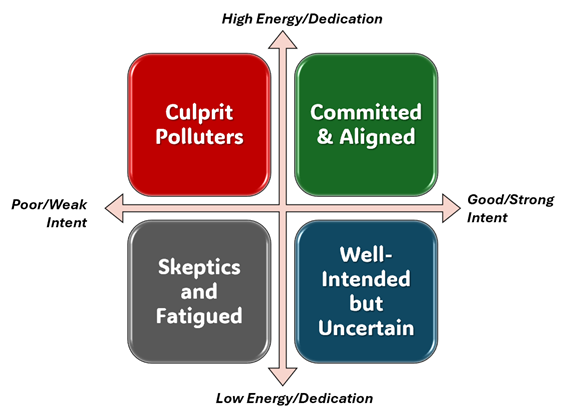
...who I introduced at the beginning of 2025 as follows: Here's her post (Part 1) --- We Have GOT to Learn How to Talk About This Thing! To talk about sustainability, we first need to understand how different people engage with it—because if we’re speaking to the wrong audience in the wrong way, we’re just shouting into the void. We need to meet people where they are and from there, help them take steps forward. With luck and good stakeholder engagement, maybe LEAPS forward! Generally, people fall into four broad categories when it comes to their thinking about sustainability (see figure):
🔹 The Committed & Aligned – Sustainability professionals, activists, project leaders, and organizations already integrating sustainability into their work and lives. These are the people actively shaping change, setting policies, building businesses, and advocating for systemic shifts. 🔹 The Well-Intended but Uncertain – People who care and genuinely want to do more, but don’t quite know how. They might recycle, use reusable bags, or opt for greener choices if available—but they’re not proactive about pushing sustainability forward. On their projects, project managers in this category may be somewhat ambivalent about raising issues to senior managers. They need clearer guidance and practical ways to engage. 🔹 The Skeptics & Fatigued – Those who feel overwhelmed, frustrated, or disconnected from sustainability messaging. They might see it as moralizing, impractical, elitist, or exaggerated—or they might just be too busy trying to survive the mess of everyday life – and ‘everyday projects management’ to think much about it. 🔹 The Culprit Polluters – A select few who know exactly what they’re doing and consciously make decisions that negatively impact the collective, to their own benefit. “Why should I care?”, they say, “…not MY problem!”. These are the ones setting the world on fire—sometimes literally. Most people fall into the middle two categories (the bottom half of the figure). The well-intended but uncertain, and the skeptics who either don’t trust sustainability messaging or feel too disconnected from it. The audience of this conversation is mostly the committed ones—the activists, the professionals, the sustainability nerds. And naturally, we tend to get stuck in our echo chambers—we surround ourselves with people who resonate with our ideas, we work in environments with people who share our vision, and at the very least, we all agree on the absolute basics: Trees good. Oil spills bad. But sustainability isn’t a niche field—it’s a global shift. It’s not like some cutting-edge, science-y thing that we can just be nerdy about in our labs, develop cool new products with, and expect people to use without understanding it (like a new iPhone or a medical breakthrough). This only works if literally everyone is on board. We need to step outside our bubble and figure out how to:
Let’s touch base, we’re dreaming about something that doesn’t exist yet. As sustainability professionals, scientists, and enthusiasts, right-minded project leaders, we’re not just pushing for small tweaks to existing systems—we’re imagining and designing entirely new ones. Smarter, more holistic, more well-rounded systems that can give us the comfort we’ve become comfy in—without taking away the air we breathe. Reducing harm is such a low-hanging fruit, we’re going for rebuilding smarter. And in that process, we can’t afford to just stay at the peak of the arrow, charging forward while neglecting the majority of people who aren’t fully on board yet. Sustainability only works as a collective action—which means it’s on us to figure out how to bring others into the fold. And this is where communication becomes critical. If sustainability was easy to understand and universally valued, we wouldn’t be having these conversations. But it’s not. So we are. That’s why this blog is here, and that’s why this post is posted – for you to think about this and respond with what actions you can take – what changes you can make – as a project leader. |
|
"If opportunity doesn't knock, build a door." - Milton Berle |