







Guessing is not a strategy: How to build decision velocity with AI and real-time data
June 10, 2026 | Live Webinar

You Can't Get They-ah From Hee-yah
Floating an idea into reality: the other side of the AI Project Paradox
The Environment of the Built Environment: an AI Paradox
6th, 6th Edfition, 6th Edition PMBOK, 7th Edition, 7th Edition PMBOK, 8th Edition PMBOK, 8th Edition PMBOK Guide, Activism, actuarial, actuary, adapt, addition by subtraction, Africa, africa, agriculture, airforce, ajaita, Alaska, amazon, analogous, analytics, ancient, and more power, antarctica, anti-science, apple, apps, architecture, arctic, arrakis, Artificial Intelligence, asch paradigm, Assistant, asthma, astronomy, automobile, automotive, autonomous cars, b, bankhar, Banksy Crypto, basalt, baseball, bats, batter, beauty products, benefit, benefits, Benefits Realization, beyond epica, biases, bicycle, big data, big dfata, big dig, bike, biodiversity, biomedicine, birdhouse, blockchain, blood, blue blood, blue trees, bluefin, bluefin tuna, book review, boston, boston university, Boyce, Brazil, brazil, Breakdown Structures, BS, building, buildings, built environment, built environment, bumblebee, cake, capacitor, car, Carbon, carbon, carbon capture, carbon negative, carbon neutral, carbon pool, carbon sequestration, carbonate, careers, CEO, ChatGPT, chatGPT, chatgpt, chatgpt, chess, China, china, chopsticks, citrus, cli-fi, climate, climate change, climate resilience, climeworks, Clumsy, CO2, co2, CO2 Utilization, coalition, cobalt, coffee pods, cognition, cognitive, Collabortion, colombia, concrete, Conflict, construction 5.0, cool projects xyloscope, cooling, coral, corn, cost of good quality, cost of poor quality, cost of quality, crazy, criticism of project management, cryptocurrency, CSR, csr, data, data analytics, data privacy, datacenter, dataset, death spiral, Decision Making, decomposition, Defense and Climate, definition of a project, deforestation, dependencies, dependency, desert, DIKW, dikw, dimopoulos, disposal, dna, DOD, dogs, dolphins, dream, drilling, drink, dune, dune, dutch, early start, earth, eatlocal, eco-tourism, ecological, economic, economics, EKC, electric grid, electricity, electronics, elysis, embodied carbon, emerging technologies, empower, Energy, energy efficiency, environmental degradation, escalate, escalation, ESG, extreme weather, fallacy, FARC, farming, finance, fish, fish brains, fishing, fix, fixing the earth, flint water, Flint Water Supply, flood, flooding, Food supply chain, food waste, forest, forest for the trees, forestation, forrestgump, frank herbert, Fruitcake, fungus, fusion, Galvao, garage, gas, gasoline, geese, gender equality, gender partnerships, generational differences, Generative AI, gladwell, gold, Goodness, google, Government, GPT, great pacific garbage patch, green, green building, green buildings, green energy, green iguana, green project, green project management, greening, guest post, gyre, harkonnen, Harvesting Benefits, hawasina, hedgehogs, heursitics, historical data, hlb, holitsic, holland, horseshoe crab, human-caused climate change, hydrogen, hydrology, ice, iceland, ignition, iguana, imagery, impact, india, inequality, information, initiatives, injection, insurance, intelligence, interacting risk, internal combustion engine, invasive species, investment, isomer, issue escalation, issues, ITER, jobs, Jupiter, justification, kids, kill point, knowledge, koch brothers, Kuznets, laboratory, LAL, landscape mode, lapampa, launch, LCA, Leadership, Leadership, life cycle analyses, life cycle analysis, lifecycle, Linkedin, liquid, lizard, local, long term, long-term, long-term thinking, look up, loud, maintenance, maker, makermovement, malcolm gladwell, management, marathon, marine biology, market, mars, Martin Luther King, mean, megawatt, MeHg, melting, mercury, metal, Microgrid, microplastics, migration, military, millennial, mindset, minerals, mission, mitigate, MLK, mongolia, museum, museum of london, nature, nematodes, net gain, Net Project Success Score, net zero, netherlands, network, New book, New Jersey, New Practitioners, new york, NFT, nitrogen, noise, noreaster, norway, nova, NPSS, NREL, ocean, ocean cleanup, ocean life, oil rig, oil rigs, oklahoma, oman, only murders in the building, opportunity, overall risk, oxygen, packaging, pareto, PBS, permafrost, persistence, peru, Pharmaceutical, planet, planet.com, planning, plant, plasma, plastic, playground, pm, pm education, pmbok, pmbok guide, pmnetwork, PMXPO-2018, podcast, pollutants, pollution, poop, poor, portfolio, power, power skills, privacy, privacy concerns, professors, program, Program Management, project, project leader, project leadership, project management, project management 3.0, project on fire, project progress, Project Success, project success, projecticity, projectleadership, projectmanagement, projects, psychology, pulse of the profession, purple bacteria, purpose, quiet, rainforest, rationale, reef, refugees, renewable, renewables, Repair, repair, repeatable process, repeatable processes, repurpose, research, resource breakdown strucuture, Resource Management, reversing climate change, revisionist history, rich, rigs2reefs, ripe, risk, risk avoidance, Risk Management, risk mitigation, risk response, risk responses, river, robots, rocks, rules of thumb, rural, rural India, russia, Sarcasm/Irony, satellite, saudi, schedule, sci-fi, Science, science, science-fiction, scientific american, screaming monkeys, sea, sea life, Sea-Level Rise, sea-level rise, seagreens, seawall, seawater, seawater temperature, seaweed. beat;es. farming, secondary risk, selena gomez, sequestration, shipping, skyscraper, SLR, smart cities, smart city, smelting, social, social pressure, soil, solar, solar panels, solar perovkites, solar saheli, sonic, sponge cities, SRI, stage-gate, stagegate, stakeholder, stakeholder management, steward, stewardship, storage, strategy, stupid, success, suffer, sulphur, sunk cost, supercapacitor, supply chain, survey, Sustainability, sustainability, Sustainable Investing, Sustainable Tourism, sybiosis, symbiosis, system 03, TBL, temperature, terraform, terraforming, test, threat, threats, totem, touchscreen, tour, tower, Trains, transparency, transportation, trash, tree, tree species, trees, trillion, triple bottom line, triple constraint, truth to power, UMass, us army corps of engineers, USDA, vacuum, value, venus, vision, voice, voltage optimization, vw scandal, washing machine, waste, wastewater, water, we mean business, whales, Whirlpool, wind, wisdom, women, Women in Project Management, wood wide web, woonerf, Work Breakdown Structures (WBS), world breakdown structure, worms, xian, xylotron, Yale


|
In April of this year, NASA scientist Chad Greene was cruising along in a NASA Gulfstream III (see below) with a team of engineers, monitoring a sophisticated radar system (see below) as it probed the Greenland Ice Sheet below.
At one point in the flight, Greene took a photo from the aircraft’s window showing the vast, barren expanse of the ice sheet’s surface. Not much there. But it holds surprises – a big one in this case. The radar unexpectedly detected something buried within the ice. “We were looking for the bed of the ice…,” said Alex Gardner, a cryospheric scientist at NASA’s Jet Propulsion Laboratory (JPL), who helped lead the project. “We didn’t know what it was at first.” Fortunately for this team (and maybe for all of us), the Gulfstream was carrying, NASA’s UAVSAR (Uninhabited Aerial Vehicle Synthetic Aperture Radar) mounted to the belly of the aircraft. The system looks downward and toward the side, not just straight down as previous systems. This produces maps with more depth and dimensionality. The image turned out to be a lost city. Yes – a lost city, with a cinema, a post office, and housing for 200 people. Do I have your interest? A lost city, buried under ice, in a vast expanse of desolate land in Greenland? The story is covered nicely by this short video clip. From this Smithsonian article, here’s a summary of Camp Century: Dubbed the “city under the ice,” Camp Century was a military base built into the Greenland ice sheet by the U.S. Army Corps of Engineers in 1959. At the time, it was near the surface layer—now, after snow and ice accumulated over the decades, it’s buried at least 100 feet deep. Back then, Camp Century was advertised as a polar research site, per Popular Science’s Andrew Paul. Its scientists did collect the world’s first ice core samples, which are still referenced in research today, but the facilities also hosted a much darker venture: a top-secret Cold War mission called Project Iceworm. The classified effort aimed to house and launch a system of missiles within a network of tunnels beneath the ice. The weapons, a type of nuclear missile known as “Iceman,” could launch through the ice sheet, per Space.com’s Brett Tingley. Their potential target was the Soviet Union. You will find a well-assembled 50-minute documentary about Camp Century in the video linked below: Left Behind When the camp was abandoned, the reactor was taken. However, left behind were 9,200 tons of physical waste (building infrastructure), 200,000 liters of diesel fuel, 24,000,000 liters of biological waste, and 1,200,000,000 Bq (unit of radioactivity) of radioactive material were left at Camp Century. Experts believe that the continued degradation of ice sheets will create conditions where this liquid waste will be able to permeate deeper into the ice, possibly into aquifers within the ice sheet, and even the sea. Project connection This effort for Camp Century was built under the name Project Iceworm. A project. With a defined start and end date. With a scope, a schedule and a budget. And with an eye towards the future, including its deconstruction and disposal. Well, not really. The plan was that when the Camp was abandoned in 1967, it would remain under ice and the biological and radioactive wastes would stay there forever. At that time, there was little thought given to melting ice. The assumption made was incorrect. In the not-too-distant future, this camp may be (literally) exposed and those wastes (as above) may make it back into aquifers. What goes around… Long-term and holistic thinking is important for every project. Don’t make your project a Camp Century! Key takeaway: Be a project LEADER and think through your project to its use, the use of the product of your project, and even the disassembly and disposal of your project’s infrastructure. For more information: https://earthobservatory.nasa.gov/images/153616/new-view-of-the-city-under-the-ice https://cires.colorado.edu/news/greenland-and-legacy-camp-century Paper: https://agupubs.onlinelibrary.wiley.com/doi/full/10.1002/2016GL069688 |
|
In Part 1 of “Wight A Minute”, which had the intended double-meaning of ‘waiting a minute’ – as in being thoughtful if you are a supply-chain project manager, as well as the Isle of Wight, where Teemill is headquartered, I introduced you (or re-introduced you) to the circular economy. Teemill (see Part 1) is focused not only on making T-shirts, in a sustainable way, but also providing a platform for other ‘makers’ to go circular. You can see the two videos below to provide the basics on a circular economy, using fashion as an example. Note the frequent mention of projects, project managers, and project leadership here. To get ‘here’ from ‘there’ – in this case from a linear to a circular economy – takes insight, foresight, and vision (to quote good friend and project leadership pioneer Gordon Mackay (see a recent post from him here). At the risk of some repetition, here are the steps of a linear economy:
In a circular economy, things are different – and that’s why it takes project leadership to help accomplish the change. Here’s a 20-minute video that explains this and also provides the context of history here. Much of this is not new – what’s new is the capacity and technology, and project leadership – that can enable us to really take advantage of a circular economy.
The process can be seen in the figure below:
The process illstrated above is also 'narrated' quite well in this video: You will find a ton of great resources here, at the Ellen MacArthur Foundation. Fundamentally the circular economy is “a system where materials never become waste and nature is regenerated. In a circular economy, products and materials are kept in circulation through processes like maintenance, reuse, refurbishment, remanufacture, recycling, and composting. The circular economy tackles climate change and other global challenges, like biodiversity loss, waste, and pollution, by decoupling economic activity from the consumption of finite resources.” The major point of this Part 2, is the “Wait a Minute” moment for those of you who might’ve thought of this as only oriented to fashion. It’s not. And as a good example of how it is indeed nearly unlimited, let’s take a radical turn from fashion to … chopsticks. Yep. Chopsticks. I wanted to focus on one company – ChopValue – which has turned its attention to the millions of chopsticks used every day in just about every country. An example of one city NOT in Asia: 100,000 chopsticks are used EACH DAY in Vancouver. Chop Value has turned this into a circular value equation by figuring out how to sustainably convert used chopsticks into everything from office and home furniture to wall décor. See the photo below for an example.
This video from Business Insider shows how this initiative – originally, of course, a project – was brought to life. If you are uncertain whether something as small as a chopstick could contribute to to sustainability, check out ChopValue’s sustainability report here.
Those numbers are going up significantly. At the time of this writing, the '137m chopsticks recycled' figure is approaching 200m – and the other positives are going up commensurately. So the bottom line is that there is more to the bottom line than cash. And those things that aren’t cash (per se) still have value – and much of that value actually can turn right back into cash if you are clever enough to do what Teemill and ChopValue have done. And… to that, it requires project leadership. You’ll learn more about that here on People, Planet, Profits & Projects. Stay tuned. |
|
This is a post about a tiny island off the southern coast of England (offshore between Bournemouth and Portsmouth, if you must know). It’s the Isle of Wight. And on that island is a company which makes … T-shirts. Teemill started out as a company to make T-shirts, but this is about much more than that. It’s about a mindset shift – a portfolio, if you will - to focused on sustainable practices and a circular economy. You may want to read on. At the core of their idea is that all manufacturing is speculative. Products are made with the hope that someone will buy them. If they are not purchased, they sit on the shelf and cause economic waste, and job loss (social impact!) and when these speculations are wrong, and items are taken off the shelf and shipped back (ecological impact!) or sent to landfill (more ecological impact!). What Teemill is up to is to manufacture in near-real-time. Products are made when the demand is there. They have brought in significant technology (each implementation a project) to accomplish this. It’s really (trust me!) worthwhile to take a look at this short video by Teemill’s co-founder Mart Drake-Knight. Good! You watched it. Didn’t you like the part about the 5-year old’s letter to “Mr. Bin Man”? So Teemill started with clothing. Why?
That’s in the talk. You remember, right? You watched it, right? The young founders of Teemill realized that they would have to move away from a linear production model, which consists of these steps:
To do that, people would have to be able to make millions of decisions at the speed of light and implement them on machines and systems that could act on those decisions almost instantaneously. People simply cannot do that. But computers can – especially networked, highly-capable computers, with outstanding purpose-built software. And this is what Teemill does to make T-shrits. See it here in this video. In Part 2 of this post, I will talk more about the circular economy and the projects that will help make that real. |
|
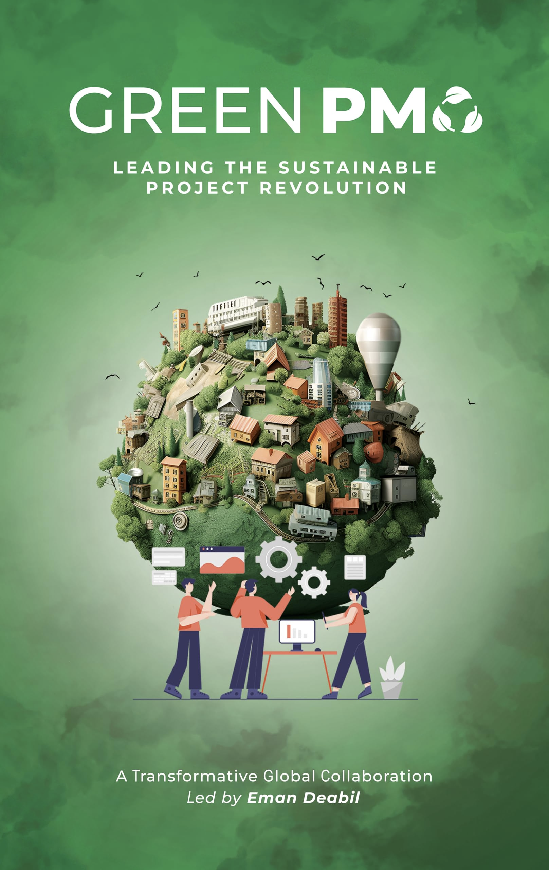
When I started out investigating and writing about the intersection of project management and sustainability, it was a bit of a desert. There were no references at all in project management standards, a few articles a book here or there, but it was a topic that project managers considered (ironically) out of scope. Some still do. But what I’ve found is an accelerated ‘take’ for the idea of considering a much broader set of aspects when planning a project, and a willingness to think past the end of the project – to a time when the project’s product (its outcome) in in use, and even (dare I say it) to that time when the project’s product is no longer needed and is being disassembled, made defunct, terminated, disposed of, jettisoned, ditched, scrapped… choose your own word here. As examples, I’d like to (again) mention the Green PMO book recently published by Sentiente and led so well by Eman Deabil, with 333 pages of articles by 37 authors covering a wide range of topics but all themed around holistic, thoughtful, long-range thinking in project management.
I also would point you to the APM’s recent post by Hugo Minney: Navigating the path to sustainability and regeneration: Tools, barriers and incentives. What I really like about this post and its ‘attitude’ is that it combines two of my favorite (and related, I assert) themes – the aforementioned sustainability thinking in PM, and the idea that PM is actually the wrong name for our profession. The “M” in PM is Management. Are we really ‘Managers’? Do we hire and fire employees? Do we monitor when they ‘punch in’ for work and ‘punch out’? Do we oversee their salaries and do performance reviews? Well, we may if it’s a heavily projectized organization but most likely our project team is made up of those NOT reporting to us. We’re not managing this (functionally-diverse) team, but we are leading them – inspiring and influencing them to do the work of the project and to bring business value to our organization. So that’s why I was happy to see how this blog post worked. It takes on a Servant Leader attitude. Servant leaders remove barriers. From the post: Barriers to including sustainability and regeneration in project success criteria Despite the clear benefits, several barriers often prevent organisations from fully integrating sustainability into their project success criteria:
Overcoming barriers: The role of soft skills (Comment from Rich: I would call these Power Skills) While technical knowledge is crucial, overcoming these barriers often requires well-developed soft skills:
That’s right! We are acting as Project Leaders when we bring sustainability thinking into the picture; and actually there is no way we will get buy-in to these ideas which are sometimes seen as ‘too much’ without the use of power skills and taking on the true role – I would argue the true title – of our profession. The desert is not so barren anymore. I see that it’s bearing fruit. Sustainability thinking has caught on, and hopefully so is the idea of Project Leadership. The blog post is so well-written that I will conclude mine with the conclusion of the post by Hugo Minney: “As project professionals, we have a unique opportunity — and responsibility — to drive sustainable and regenerative practices through our work. By understanding the complexities of the systems we operate in, developing our soft skills and leveraging available incentives and best practices, we can overcome barriers and make sustainability a core component of project success. The path to sustainability and regeneration is not always straightforward, but it’s undoubtedly necessary. By embracing this challenge, we not only contribute to a more sustainable future but also deliver more resilient, valuable and impactful projects.” |
|
Several things come together for this particular post. First, I’ve been a longtime fan of a ‘prog-rock’ group called Renaissance. They’ve been around since 1969 and are currently in their Farewell In Gratitude tour - and I went to see them in Boston. One of their most popular songs is Northern Lights. Here they are in their early days, performing this song – and I have to say that 45 years later they still perform it pretty well, with lead singer Annie Haslam still hitting those super-high notes.
Secondly, recent solar storms have triggered astounding Northern Lights in our area (New England, USA), making the sky bright magenta and aqua for a few nights in row. The blog feature image above is pretty much what many of us in New England were able to see (although our phone cameras did better than our eyes in capturing the images). And finally, I saw a news item regarding new funding for Arctic sustainable development – and that’s what put me ‘over the top’ to write this post. The news item, ’EU boosts innovation for Arctic sustainable development’ reviews results from the Arctic Circle Assembly 2024. Highlighted as results from this meeting was its focus on four main goals:
In turn, these goals serve as the basis for the launch of projects – some quite large – which will need project leaders. Billions of euros are involved in this funding program. Examples of projects, which will require a wide set of knowledge and skills, including, of course, project management skills, are:
Copernicus is particularly noteworthy. It’s worth a visit to its website. It’s the Earth observation component of the European Union’s Space program, “looking at our planet and its environment to benefit all European citizens. It offers information services that draw from satellite Earth Observation and in-situ (non-space) data. At the heart of Copernicus is a constellation of satellites – the Sentinels – that make a huge number of daily observations of the Earth ecosystem. The technological prowess of Copernicus, especially in terms of availability and accessibility, has made Copernicus the largest space data provider in the world. Anyone can access this data – it’s a free and open platform. You can find it here: https://dataspace.copernicus.eu/. Overall, Copernicus provides these features Health Hub - The Copernicus Health Hub brings together all the Copernicus environmental data and products pertinent to Health, including that related to physical health, mental health and well-being. Coastal Hub - The Copernicus Coastal Hub provides open and free access to a selection of coastal Earth observation data from the Copernicus Sentinel satellites and all Copernicus Services. Energy Hub - Copernicus Energy Hub: Connecting environmental data and Earth Observations to the green energy transition. Arctic Hub - The Copernicus Arctic Hub provides access to data and information in the Arctic. Explore interactive maps and thematic use cases and empower decision-making and sustainable practices. This video summarizes the data capabilities provided by Copernicus. So as you look up at the Northern Lights, know that a network of Sentinels is looking back at YOU. And perhaps that’s a reminder that project leadership opportunities abound above, below, and all around you! Being aware of and focused on the intersection of project management and sustainability may just be not only the right thing to do – but the right thing for you. |
|
"Words are the most powerful drug used by mankind." - Rudyard Kipling |