


What the @#&pH is Going On?


|
NOAA’s major concern is with the threat to U.S. fisheries in the region (The North West and Alaska) due to “human-generated carbon emissions” making the ocean’s waters more acidic. According to article, the oceans absorb about 30% of the carbon dioxide we put in the air. Presently, the sea is 30% more acidic that before the industrial revolution, and it is predicted that at the current rate of global carbon emissions, the oceans acidity could “double by 2100.” In other words, pH levels are dropping. The falling pH levels could affect the nervous systems of some species of fish making them more vulnerable to predation, and inhibit the growth of reefs, important nurseries. Some areas are more vulnerable than others. For instance, along the Pacific shelf, deeper water comes up and spills over the shelf. Increasing acidity levels in this water. That increased acidity is killing oyster larvae farmers are growing. Oyster farmers off the coasts of Washington and Oregon recognized this potential issue early and were able to institute projects to to time their intakes of water to reduce the results from this upwelling. As a result, and if we look at the cost-benefit for this project, “a $500,000 investment in pH monitoring equipment, saved the oyster industry $34 million in one year (2011).” That’s a ratio we can certainly live with. The domino effect of these issues is sometimes not so obvious. But in this case, the spat (the term for the oyster larvae) are used by oyster farmers as far away as Homer, Alaska. A loss of those spats has industry wide ramification. Another project spawned (excuse the pun) from the research is the placing of 4 pH monitoring buoys throughout the state of Alaska to study the pH along the Alaskan shoreline. However, it is a fair-and-balanced study. Scientists are also studying the effect of lower pH on surf smelt, a species particularly suited to thrive in lower pH environment, and the Dungeness crab that does not do well in low pH. The Commonwealth of Virginia has funded a project for six shellfish hatcheries to monitor the water chemistry of the Chesapeake Bay to study the effects of fertilizer runoff, another potential for contributing to water acidity. But we think that this statement brings it home, not only to business, but to the microcosm of business we call project management: “When you ask why does ocean acidification matters, often we’re interested because of the fish we eat and the things we make money off of,” said Shallin Busch, a research ecologist at the NOAA’s Northwest Fisheries Science Center in Seattle, Washington. |
 Ocean acidity may conjure up a scene from the Wizard of Oz, when Dorothy throws a bucket of water towards the burning scarecrow and accidently hits the witch, “I’m melting, I’m melting.” But ocean acidity is much more subtle than that. A recent article in the Washington Post on-line headline “
Successfully scoping success
|
One of the articles, "A perspective-based understanding of Project Success", covered the topic very well. But we couldn't leave well-enough alone. We think the authors did an outstanding job of capturing how we must, as a discipline, move from PROJECT to PRODUCT to ORGANIZATIONAL dimensions as we think about our work and our projects' successes. But we think we, as project managers, have to think even further. This is represented by the "breaking through" of the dotted line we show on the right of the diagram. The intent is to show that even if we think beyond the project, and to the product in steady-state, and the portfolio of projects, and the organization, we still need to think in terms of the overall environment, and long-term effects of the product of the project. We assert that this even-further-extended thinking will assist project teams in doing an even better job at identifying and handling environmental risks, amongst other things. At this point, we just would like your opinion(s) about this visualization of thie issue. What do you think? Is it a success? |

Reefs, Nets, Carpets, Oh My!
|
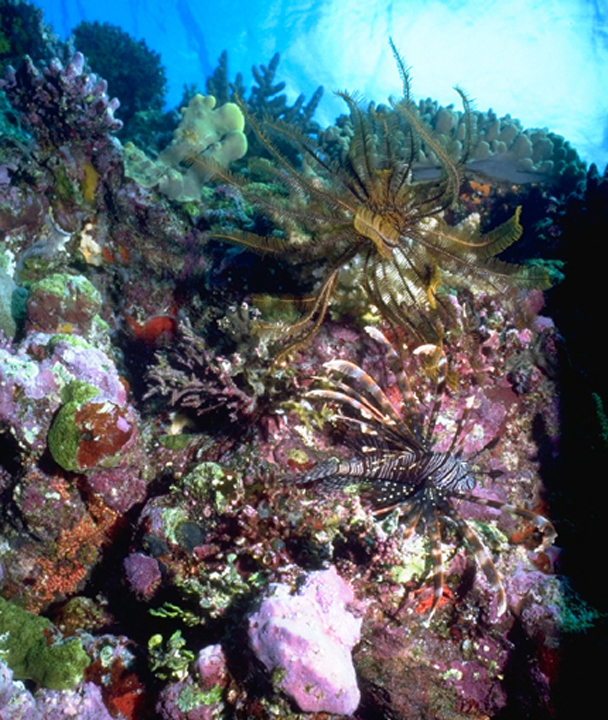
The article in GreenBiz is about Interface sharing some pointers on how they are achieving sustainability. Being fishermen, what caught our eye was their partnership the Zoological Society of London (ZSL) to address a major problem we’ve seen firsthand, the abundance of discarded fishing nets and nets affect on the oceans fish and wildlife. A couple of years ago, one of EarthPM founders was instrumental in the rescue of an injured Harp Seal that washed up on a beach in southern Maine. The conclusion by the fish and wildlife biologist involved in the rescue was that the seal had been caught in nylon net around its mouth and while it was now free of the net, the fabric caused some abrasions around the seal's mouth casuing an infection. The seal was taken to the Mammal Stranding Center in Woods Hole, MA and was successfully treated and released back into the wild. The problem is not only here in New England, but also worldwide, particularly in some of the poorest nations. Therefore, the Philippines was chosen for the site of the pilot project. From “Turning Old Fish Nets into New Carpet” by Julie Stein “This is a good place to begin since the Philippines is considered the centre of the centre of marine shore fish biodiversity, and Danajon Bank is in the centre of the Philippines. Formed over 6000 years ago, it is one of the few documented double barrier reefs in the world. The discarded fishing net problem is acute here. The Bank sprawls across nearly 130 kilometers and it is estimated that the nets discarded each year here could cover the length of the Danajon Bank 400 times over.” Interestingly enough, the nylon used to make some of the fishing nets is the same as the nylon used to make carpeting. It doesn’t seem to be much of a stretch to think that the net nylon can be recycled into carpet fiber. It might be that the original project, designing and manufacturing efficient and effective fishing nets, could have benefited from the long term approach we advocate. In other words, perhaps the project could have been made more successful by thinking of the ultimate disposal of the nets during the upfront planning, thereby having the recycling effort in place when needed. We know that is a little controversial as the traditional project management thinking is that once the project is handed over to operations (steady state) that the project manager’s job is done. We advocate a slightly different philosophy, one we believe is more sustainable, but that’s a discussion for another day. To return to “Net-Works,” as the pilot effort in the Philippines is called. It also addresses the triple bottom line: people, planet, profits in that the project seeks to protect the fragile reefs, provide local jobs during the cleanup effort and by using recycled material, help Interface’s bottom line. As we see it, it is a win-win! |
 A recent article on
 It's not sexy
|
A wind turbine whirrs wistfully, whispering eagerly and urgently of its unbridled energy. Sunlight glimmers off the sleek, shiny surface of a solar panel, as it emphatically sends surges of sustenance to energy-hungry inhabitants. A shapely new red Croatian electric vehicle veers vivaciously by a vineyard. These are the images we're presented with when the marketeers have their way in showing us what sustainability looks like and feels like. It reminds us of air travel. You don’t see (unless it’s depicting the ‘competition’) images of a paunchy, middle-aged man sitting in the middle seat, struggling to set up his laptop as the seat in front of him reclines fully, while a baby cries two seats ahead, and a rambunctious 2-year old is kicking the back of his seat, and… well you get the picture. It’s not sexy. What we see instead are happy people, relaxing with apparently unlimited legroom, headroom, in blissful relaxation as they are whisked promptly to their destination. Which brings us back to our shapely Croatian model. Our expectations in sustainability are set around the whirring wind turbine, the wave-action power generator, the biofuel facility, the winery that uses finches and bluebirds as a natural insecticide.
But as in air travel – it’s just not always that sexy. Most of you frequent flyers will agree, it’s rarely that ideal. Take the feature story in today’s Boston Globe. Titled “A Basic Approach”, it’s the story of Ameresco, a local company which does its work in sustainability by retrofitting companies to be more efficient in their energy use without up-front cost via the financing of these improvements from the expected future savings. It’s the ‘blocking and tackling’ of energy, as opposed to the quarterback, if you will allow us an American Football analogy. As an example, Ameresco has a US$21M project with the city of Lowell, Massachusetts, involving 47 buildings; this project is targeted to provide annual savings of $1.5M via upgraded equipment, weatherizing of buildings, new lighting, air conditioning, and boilers, and some solar installations. Ameresco averages about 35% savings on their projects, so clearly they will pay back. And their financial performance has reflected this success.
And so it is with project management's engagement with sustainbility. As authors of PMI's Cleland Award-winning book, Green Project Management, our pubisher asked us to pick between two covers, one of which had sunflowers, wind turbines and shimmering solar panels. We went for the other one - a picture of a tree yielding money. We knew back then that it is indeed the blocking and tackling - the integration of sustainbility thinking into our discipline that will make the difference. This is to take nothing away from shapely Croatian models - like the one we just blogged about. These will also contribute, and may represent huge leaps forward.
But it's going to be the focus on efficiency, removal of waste from projects, connecting the enterprise's long-term vision to your project vision that moves us forward consistently. And although it may not be as flashy, numbers like Ameresco is flashing, while not sexy, are at least...attractive, n'est pas? |


Cool Points
|
We know. We're at the intersection of sustainability and project management. We think it's pretty cool but...would the general population give us cool points for being at this particular intersection? I mean, really. We get it. No. Not at that intersection. Maybe we'd be cooler if we were standing on a corner in Winslow, Arizona... But today we'd like to share with you something that is at the corner of sustainability, projects, and very, very cool. No, it's not on a corner in Winslow, Arizona. It's more likely to be found at a corner in Croatia. In particular, you will find it precisely at 10431 Sveta Nedelja, Croatia. We're talking about the Concept_One car from Rimac Automobili. It's for sale, according to several stories breaking this week. And it's available for the low, low price of only $980,000. What caught our attention was the drive (excuse the pun) of the designer (Mate Rimac), as well as the performance achieved by the design. From the design perspective, it was developed over a two-year period after he converted his own BMW to an electric vehicle for racing. As he continued replacing components from the BMW, he realized that he had almost nothing left of the original. So he was pretty much starting from a blank piece of paper. Rimac says that the company will be making 88 versions of the car but already had pre-orders from "the Abu Dhabi royal family". The car is now officially on sale after its latest outing, this time at the Top Marques event in Monaco. The first shipments are expected to be next year, and we wonder how many other royals will now be raiding their coffers.
As to performance, this EV is capable of 0-60 mph acceleration in just 2.8 seconds and top speeds of 190 mph. The world-beating performance figures, for an electric car at least, are courtesy of Rimac’s innovative quad-motor design, which has a combined output of 1,088 horsepower and 2,800 pound-feet of torque. Below is a little video that explains a bit about how it works....
We share the automotive press world with Rimac this week, not because we've released our own vehicle - no, as we said, we just don't have those cool points. However, we did partner with EcoCar2, a great program to develop an electric car, sponsored in part by GM, Argonne National Laboratory of the US Department of Energy, and 15 university teams from all over North America. Our organization will be providing PM coaching for these teams of students, who have 3 years each to impress the heck out of judges and win the competition for the best design of an electric vehicle based on a 2013 Chevy Malibu. Our take on this: there are projects like the Rimac Concept_One, where everyone is focused on sustainability. But a project manager is a change agent wherever he or she is working. Think like Mate Rimac. Maybe you can rework - and rewire - your project for sustaianbility, no matter what type of project it is. At least consider it. Rimac's press releases can be found here: EarthPM's much less cool press release can be found here: |



