


At EarthPM, we generally stay away from politics. So – you may ask - why then is this blog post talking about votes?
The reason is that there was a quote in a recent radio interview which was so striking and poignant that we couldn’t help taking it as a title. It also makes the overall point of this post which is this: projects are about meeting objectives. Project success – and enterprise success – needs to be defined on value, not (only) on traditional cost, scope, and schedule attributes. This is reflected in the 4th Edition PMBOK® Guide (see page 6).
The message of providing value came to us in a strange way as we listened to a radio program called Science Friday.
Science Friday is a tremendous radio show on the US National Public Radio (NPR) network. Recently, Ira Flatow, the host of the show, brought in Rear Admiral David Titley of the US Navy, and director of the Navy’s Task force on Climate Change. You can hear the entire broadcast of the referenced show here.
We think of the value of a Navy as defending the seas. So why in the world would they be interested in global warming? It has to do with the net value that they bring. Whatever the cause, whatever the science, whatever one believes about climate change, if the geography of the arctic is changing,to allow open naval traffic where it wasn’t possible before – that’s something the Navy needs to know about. So indeed, the Navy’s value is enhanced by understanding how the geography and coastlines affect their ability to defend.
Take a look at this exchange from the broadcast:
FLATOW: I'm interested in reading your biography and notes about you that you confess to at one time being a global warming skeptic.
Rear Adm. TITLEY: Yes.
FLATOW: What changed your mind?
Rear Adm. TITLEY: What really changed my mind was when you go and look at all the evidence, I think to - at least to me - I think it really showed that the climate was changing.
I was, as you might know, I was trained as a meteorologist, and you see, of course, the day-to-day and sometimes even hour-by-hour changes and variations. I watched the computer models in the '70s and the '80s, and, you know, as we all do - you know, how many times have all shoveled six inches of partly cloudy off of our driveway?
(Soundbite of laughter)
Rear Adm. TITLEY: So how, you know, if that was the accuracy, how well could we really say what was going on? But as I learned more about the topic, you see that really the climate is controlled not so much by what the day-to-day weather started as but by what are the larger things doing - what is the ocean doing? What is the sun doing? And what's our atmosphere doing?
So that really was able to show me. And the other part that maybe even is more important was just taking a look at all the different changes. One of my first jobs in the Navy, I was a navigator, and this is well before we had the global positioning system. So I may be one of the few guys who actually still know how to use a sextant and all that sort of thing.
And we are able to - when you navigate a ship, you don't just use one source of information. You use everything you can. And I kind of look at the climate the same way. So we look at the changes in the Arctic. We look at the melting of the glaciers.
We look at what's going on with the ice fields, especially in Greenland but also West Antarctica, look at the changes of the temperature in the ocean, the changes of the ocean acidity, and all of that observations, all of that evidence, if you will, together, along with my now better understanding of what is driving the climate, has sort of taken me from the, hey, I'm not sure there's really anything here, to there really is, there really is some changes going on. And to make sure that our Navy is ready in the 21st century, we have to look at these changes just as we look at changes in the political spheres and the economic spheres and the demographic concepts.
Facts. Seek facts first. This should be the mantra of the project manager.
Rear Admiral Titley, now aware that there are changes in the Arctic ice, and unfettered by any other bias, is more clearly able to do his job. This is reinforced as he takes a question from a caller, “Andy”. Check this out:
ANDY (Caller): Hi, how are you doing today?
FLATOW: Hi there.
Rear Adm. TITLEY: Great.
ANDY: Great. Thanks for taking my call. Here in Oklahoma, we have a U.S. senator, Jim Inhofe, who seems to think that there's a lot of demagoguery and that global climate change is a hoax.
What - and if this isn't rehashing too much, but two questions. One is: What are the maybe top three or top five pieces of evidence that converted you as a meteorologist? And secondly: Do you in the Navy attribute any of the global climate change to human behavior, or are you all kind of staying out of that fray?
Rear Adm. TITLEY: Okay, well, thanks very much for the question. First, the types of evidence that at least I've looked at, and I've talked with our senior Navy leadership, is really the Arctic, is I think sort of a harbinger of the of some of the largest examples of climate change.
We have seen not only the extent of the ice in the summertime, or September, come down dramatically, but even more so the total amount of ice or how much thick ice and thin ice is up in the Arctic.
And we're seeing, really before our eyes, a very different system now in which - just 10 or 15 years ago, there was what people or scientists call multiyear ice, really thick ice last for years and years. It's probably five, 10, 15 or more feet thick. Almost all of that ice is now gone, maybe only 15, 20 percent - at the most - of the Arctic has that kind of very thick ice.
And now, the predominant kind of ice in the Arctic is single-year ice. So it melts in the summer, comes back in the winter, melts in the summer again. That's a very, very different regime.
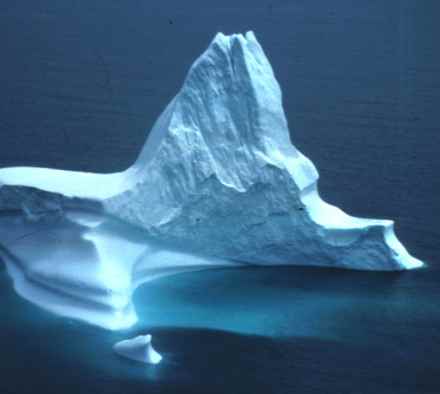
And I kind of like watching ice because, I mean, ice doesn't vote. Ice doesn't contribute to any political party. It doesn't caucus. It just melts. And the ice kind of tells a story. So there's just one piece of evidence, but as I mentioned before, I look at many pieces.
As to the causes of climate change, again, when you look at the physics, you know, about the only things you can really change is you can change the sun and how much energy's coming in. NASA's done a pretty good job of measuring that, and it shows that pretty much within a couple of tenths of 1 percent the energy from the sun over the last 50 years has been pretty constant. Or you can change the amount of greenhouse gases. You can change the aerosols.
So when you put all this together, it looks like the greenhouse gases have a significant impact. The details, of course, get very, very complicated. It's not for the Navy to say what the policies are going to be or what they should be. But, again, I'm interested in making sure our Navy and our chief of naval operations wants to keep our Navy ready for this coming century. So we need to understand these changes to the best we can and adapt to them.
Titley’s attitude is exemplary. Granted, he’s not a PM but he is setting a great precedent for all of us. Notice his laser-focus on objectives. “Keep our Navy ready for this coming century”. Not assess the validity of climate change, nor take to the table any views that may blind or disperse that focus.
Now we are quite aware that this post has quite a bit of information for you about the science of climate change, and that there is value in that (after all, even a blog post needs to produce value!). However, we hope that you also take away the main messages: work with facts, and keep a laser focus on project objectives. That’s the real intended value of this blog post, and we hope you enjoyed it.
If you found Rear Admiral Titley’s topic to be interesting, or just want to learn more about climate change from his perspective, we suggest this video (below) as a follow up.
Rear Admiral David Titley - Climate Change Adaptation Congress Opening Address from 3PillarsNetwork on Vimeo.


