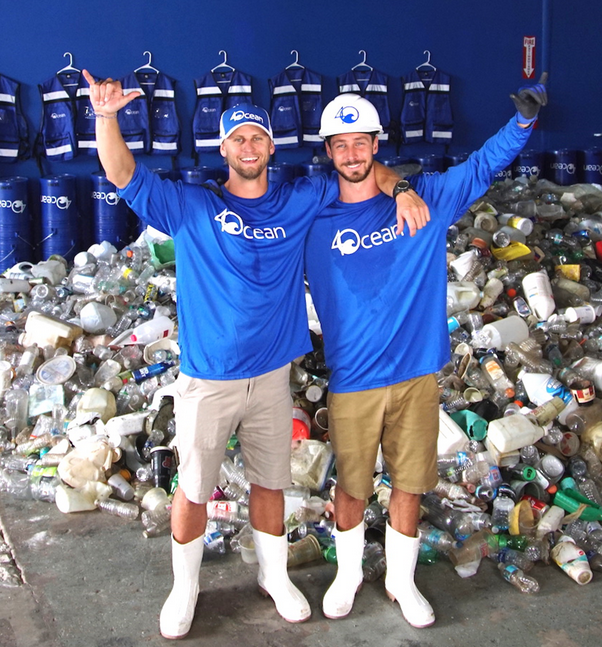
As promised in the last post, this is a follow-up about two other ocean cleanup projects.
4Ocean
The first has to do with a couple of young men (pictured above) – Andrew Cooper and Alex Shulze - who were inspired by the mounds of plastic they were finding on shorelines while surfing in Bali, Indonesia. They had the idea to convert the fishermen in the region to “fish” for plastic rather than, well, fish – and to convert the plastic and other materials into jewelry which they’d then sell.
They are not a non-profit, they are an LLC (Limited Liability Company) as spelled out on their website:
4ocean is a limited liability company (LLC) that is audited quarterly by the Better Business Bureau. Global cleanups are funded entirely through the sale of our products, where every item purchased funds the removal of at least one pound of trash from the ocean. By creating jobs, utilizing the latest technology and raising awareness about the impact of trash in the ocean, we are building the first economy for ocean plastic while creating a cleaner, more sustainable future for the ocean.100% of our sales are directly or indirectly invested in our global ocean cleanup operation. This includes our daily local and international cleanups, boats, employees, tools, equipment, Community Cleanup events, and large investments like the Ocean Plastic Recovery Vessel.
Still, they have a mission which is laudable. And they have some interesting accomplishments, including their Ocean Plastic Recovery program which involves stopping the plastic at the source – the mouths of rivers. They’re doing this with floating barricade systems. Each one not only collects tons of plastic, it employs 50-100 of local workers. Learn more about this here.
Also check out these videos about 4Ocean. They’ve also been covered in recent editions of Forbes and Newsweek.
The Holy Turtle is the name for a contraption which is a U-shaped floating collector, somewhat similar but not identical to the Ocean Cleanup covered in a prior post (see photo of the contraption below.
The Holy Turtle was designed to capture trash floating in the ocean through large holes on the bottom half of the contraption. Birnbaum told Business Insider that the design was inspired by oil spill containment systems, and SodaStream developed it in partnership with American Boon & Barrier Corporation, which specializes in oil spill containment. The device attaches to two boats and forms a U-shape as it moves across the water.
SodaStream did not patent its contraption, and SodaStream CEO Daniel Birnbaum said he views it as a public service to let other people use the design.
This connects to the mission and vision of SodaStream. You can find more about this in the Sustainability section of their site, where you will also find some of the basic problems presented by plastic bottles.
In the last decade, annual production of plastic bottles grew to over 300 million tons per year1. Today, an average person living in Western Europe or North America consumes 100 kilograms of plastic each year, mostly in the form of packaging2. Globally, people go through roughly 200 billion plastic water bottles annually .In the US alone, there are over 10,000 active landfills4 which contain over 2 million tons of water bottles alone5. Bottles used to package water take over 1,000 years to biodegrade and if incinerated, they produce toxic fumes. It is estimated that over 80% of all single-use water bottles used in the U.S. simply become litter6. There are 5 trillion pieces of plastic afloat in the world’s oceans7. Entanglement or ingestion of marine plastic debris affects 267 species worldwide. This included 86% of all sea turtles, 44% of all seabird species, 43% of all marine mammal species8.
At SodaStream we not only make great sparkling water; but we also help to save the planet from plastic waste. With one reusable bottle we can save a family up to 3000 disposable bottles every year.
SodaStream’s reusable carbonating bottles help to significantly reduce waste from store-bought bottles and cans, while simultaneously reducing the carbon footprint by up to 87% in comparison with generic PET-bottled sparkling water brands*. We have amazing fresh tap water in most parts of the world and it’s the natural, economic and sustainable thing to do.