Ammonia's Role in Renewable Energy
From the People, Planet, Profits & Projects Blog
by Richard Maltzman,
Dave Shirley

View Posts By:
Richard Maltzman
Dave Shirley
Recent Posts
What is AI doing to the sustainability of our profession???
Stepwells – Insight from a Particularly Valid Angle
Climb-it Change: Pre-Interview Connector
Climb-it Change: New Relevance for the Stepwells of India
A PATH to more equitable health - via AI project leadership
Categories
6th,
6th Edfition,
6th Edition PMBOK,
7th Edition,
7th Edition PMBOK,
8th Edition PMBOK,
8th Edition PMBOK Guide,
Activism,
actuarial,
actuary,
adapt,
addition by subtraction,
Africa,
africa,
agriculture,
airforce,
ajaita,
Alaska,
amazon,
analogous,
analytics,
ancient,
and more power,
antarctica,
anti-science,
apple,
apps,
architecture,
arctic,
arrakis,
Artificial Intelligence,
asch paradigm,
Assistant,
asthma,
astronomy,
automobile,
automotive,
autonomous cars,
b,
bankhar,
Banksy Crypto,
basalt,
baseball,
bats,
batter,
beauty products,
benefit,
benefits,
Benefits Realization,
beyond epica,
biases,
bicycle,
big data,
big dfata,
big dig,
bike,
biodiversity,
biomedicine,
birdhouse,
blockchain,
blood,
blue blood,
blue trees,
bluefin,
bluefin tuna,
book review,
boston,
boston university,
Boyce,
Brazil,
brazil,
Breakdown Structures,
BS,
building,
buildings,
built environment,
built environment,
bumblebee,
cake,
capacitor,
car,
Carbon,
carbon,
carbon capture,
carbon negative,
carbon neutral,
carbon pool,
carbon sequestration,
carbonate,
careers,
CEO,
ChatGPT,
chatGPT,
chatgpt,
chatgpt,
chess,
China,
china,
chopsticks,
citrus,
cli-fi,
climate,
climate change,
climate resilience,
climeworks,
Clumsy,
CO2,
co2,
CO2 Utilization,
coalition,
cobalt,
coffee pods,
cognition,
cognitive,
Collabortion,
colombia,
concrete,
Conflict,
construction 5.0,
cool projects xyloscope,
cooling,
coral,
corn,
cost of good quality,
cost of poor quality,
cost of quality,
crazy,
criticism of project management,
cryptocurrency,
CSR,
csr,
data,
data analytics,
data privacy,
datacenter,
dataset,
death spiral,
Decision Making,
decomposition,
Defense and Climate,
definition of a project,
deforestation,
dependencies,
dependency,
desert,
DIKW,
dikw,
dimopoulos,
disposal,
dna,
DOD,
dogs,
dolphins,
dream,
drilling,
drink,
dune,
dune,
dutch,
early start,
earth,
eatlocal,
eco-tourism,
ecological,
economic,
economics,
EKC,
electric grid,
electricity,
electronics,
elysis,
embodied carbon,
emerging technologies,
empower,
Energy,
energy efficiency,
environmental degradation,
escalate,
escalation,
ESG,
extreme weather,
fallacy,
FARC,
farming,
finance,
fish,
fish brains,
fishing,
fix,
fixing the earth,
flint water,
Flint Water Supply,
flood,
flooding,
Food supply chain,
food waste,
forest,
forest for the trees,
forestation,
forrestgump,
frank herbert,
Fruitcake,
fungus,
fusion,
Galvao,
garage,
gas,
gasoline,
geese,
gender equality,
gender partnerships,
generational differences,
Generative AI,
gladwell,
gold,
Goodness,
google,
Government,
GPT,
great pacific garbage patch,
green,
green building,
green buildings,
green energy,
green iguana,
green project,
green project management,
greening,
guest post,
gyre,
harkonnen,
Harvesting Benefits,
hawasina,
hedgehogs,
heursitics,
historical data,
hlb,
holitsic,
holland,
horseshoe crab,
human-caused climate change,
hydrogen,
hydrology,
ice,
iceland,
ignition,
iguana,
imagery,
impact,
india,
inequality,
information,
initiatives,
injection,
insurance,
intelligence,
interacting risk,
internal combustion engine,
invasive species,
investment,
isomer,
issue escalation,
issues,
ITER,
jobs,
Jupiter,
justification,
kids,
kill point,
knowledge,
koch brothers,
Kuznets,
laboratory,
LAL,
landscape mode,
lapampa,
launch,
LCA,
Leadership,
Leadership,
life cycle analyses,
life cycle analysis,
lifecycle,
Linkedin,
liquid,
lizard,
local,
long term,
long-term,
long-term thinking,
look up,
loud,
maintenance,
maker,
makermovement,
malcolm gladwell,
management,
marathon,
marine biology,
market,
mars,
Martin Luther King,
mean,
megawatt,
MeHg,
melting,
mercury,
metal,
Microgrid,
microplastics,
migration,
military,
millennial,
mindset,
minerals,
mission,
mitigate,
MLK,
mongolia,
museum,
museum of london,
nature,
nematodes,
net gain,
Net Project Success Score,
net zero,
netherlands,
network,
New book,
New Jersey,
New Practitioners,
new york,
NFT,
nitrogen,
noise,
noreaster,
norway,
nova,
NPSS,
NREL,
ocean,
ocean cleanup,
ocean life,
oil rig,
oil rigs,
oklahoma,
oman,
only murders in the building,
opportunity,
overall risk,
oxygen,
packaging,
pareto,
PBS,
permafrost,
persistence,
peru,
Pharmaceutical,
planet,
planet.com,
planning,
plant,
plasma,
plastic,
playground,
pm,
pm education,
pmbok,
pmbok guide,
pmnetwork,
PMXPO-2018,
podcast,
pollutants,
pollution,
poop,
poor,
portfolio,
power,
power skills,
privacy,
privacy concerns,
professors,
program,
Program Management,
project,
project leader,
project leadership,
project management,
project management 3.0,
project on fire,
project progress,
Project Success,
project success,
projecticity,
projectleadership,
projectmanagement,
projects,
psychology,
pulse of the profession,
purple bacteria,
purpose,
quiet,
rainforest,
rationale,
reef,
refugees,
renewable,
renewables,
Repair,
repair,
repeatable process,
repeatable processes,
repurpose,
research,
resource breakdown strucuture,
Resource Management,
reversing climate change,
revisionist history,
rich,
rigs2reefs,
ripe,
risk,
risk avoidance,
Risk Management,
risk mitigation,
risk response,
risk responses,
river,
robots,
rocks,
rules of thumb,
rural,
rural India,
russia,
Sarcasm/Irony,
satellite,
saudi,
schedule,
sci-fi,
Science,
science,
science-fiction,
scientific american,
screaming monkeys,
sea,
sea life,
Sea-Level Rise,
sea-level rise,
seagreens,
seawall,
seawater,
seawater temperature,
seaweed. beat;es. farming,
secondary risk,
selena gomez,
sequestration,
shipping,
skyscraper,
SLR,
smart cities,
smart city,
smelting,
social,
social pressure,
soil,
solar,
solar panels,
solar perovkites,
solar saheli,
sonic,
sponge cities,
SRI,
stage-gate,
stagegate,
stakeholder,
stakeholder management,
steward,
stewardship,
storage,
strategy,
stupid,
success,
suffer,
sulphur,
sunk cost,
supercapacitor,
supply chain,
survey,
Sustainability,
sustainability,
Sustainable Investing,
Sustainable Tourism,
sybiosis,
symbiosis,
system 03,
TBL,
temperature,
terraform,
terraforming,
test,
threat,
threats,
totem,
touchscreen,
tour,
tower,
Trains,
transparency,
transportation,
trash,
tree,
tree species,
trees,
trillion,
triple bottom line,
triple constraint,
truth to power,
UMass,
us army corps of engineers,
USDA,
vacuum,
value,
venus,
vision,
voice,
voltage optimization,
vw scandal,
washing machine,
waste,
wastewater,
water,
we mean business,
whales,
Whirlpool,
wind,
wisdom,
women,
Women in Project Management,
wood wide web,
woonerf,
Work Breakdown Structures (WBS),
world breakdown structure,
worms,
xian,
xylotron,
Yale
Date

I’ve been fascinated this week by the idea of ammonia (NH3) as a fuel, or as a means to store and transport renewable energy.
First, let me talk about that storage part. How can a household cleaner store energy???
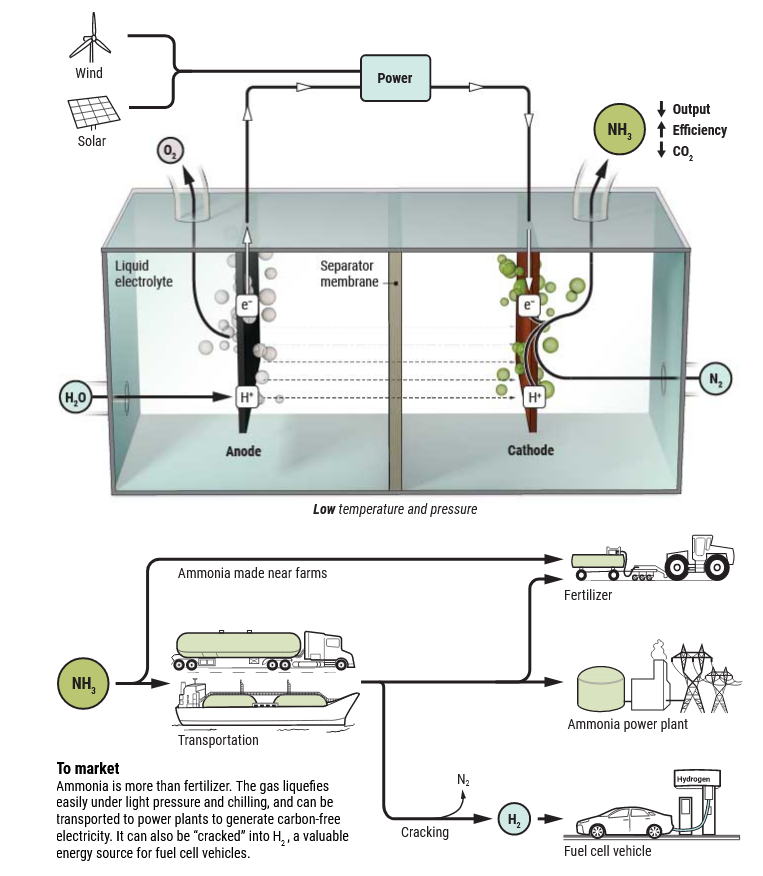
Ammonia fuel cells can convert renewable electricity into an energy-rich gas that can easily be cooled and squeezed into a liquid fuel, which effectively bottles sunshine and wind, turning them into a commodity that can be shipped anywhere in the world and converted back into electricity or hydrogen gas to power fuel cell vehicles.
This video from Science magazine tells the story (click on image to launch).

But the concerns of creating NH3 without its own problems needs to be solved.
The article from Science magazine has an excellent graphic (sample below) that shows not only the problems, but the way that NH3 fuel cells work, and how ammonia can ‘transport’ energy.
Here’s another recent story, from phys.org about NH3 as a form of ‘conveyance’ for renewable energy.
Now, how about even more science?
This comes from Science Daily:
Taking measures against climate change and converting into societies that use significant amounts of renewable energy for power are two of the most important issues common to developed countries today. One promising technology in those efforts uses hydrogen (H2) as a renewable energy source. Although it is a primary candidate for clean secondary energy, large amounts of H2 must be converted into liquid form, which is a difficult process, for easier storage and transportation. Among the possible forms of liquid H2, ammonia (NH3) is a promising carrier because it has high H2 density, is easily liquefied, and can be produced on a large-scale.
Researchers at the International Research Organization for Advanced Science and Technology (IROAST) in Kumamoto University, Japan focused on a "catalytic combustion method" to solve the NH3 fuel problems. This method adds substances that promote or suppress chemical reactions during fuel combustion. Recently, they succeeded in developing a new catalyst which improves NH3 combustibility and suppresses the generation of NOx. The novel catalyst (CuOx/3A2S) stayed highly active in the selective production of N2, meaning that it suppressed NOx formation, and the catalyst itself did not change even at high temperatures.
Since 3A2S is a commercially available material and CuOx can be produced by a method widely used in industry (wet impregnation method), this new catalyst can be manufactured easily and at low cost. Its use allows for the decomposition of NH3 into H2 with the heat from (low ignition temperature) NH3 fuel combustion, and the purification of NH3 through oxidation.
"Our catalyst appears to be a step in the right direction to fight anthropogenic climate change since it does not emit greenhouse gasses like CO2 and should improve the sophistication of renewable energy within our society," said study leader Dr. Satoshi Hinokuma of IROAST. "We are planning to conduct further research and development under more practical conditions in the future."
And there you go! That’s why I’m posting this here – the further research is a project.
And if you want projects on a smaller scale, how about converting your vehicle to run on ammonia? Here’s an article (fun to read) about a gentleman in Canada who has modified his Ford F-150 to run on NH3:
Posted
by
Richard Maltzman
on: March 23, 2019 10:58 PM |
Permalink
Comments (5)
Please login or join to subscribe to this item

Ashleigh Kennett-Smith
ICT Project Manager| Australian Red Cross Lifeblood
Adelaide, South Australia, Australia
Nice summary of a potential way of "storing sunlight".
Of course there are a heap of other projects (research or applied) to find ways to store renewable, because the the reality is the renewable storage is going to need a range of different technologies for different purposes eg batteries, pumped hydro, hydrogen, ammonia storage, from sunlight, waves, geothermal to name a few). And the scales can be quite different for different purposes eg motor vehicles to national electricity grids.
As an aside it's worth remembering that the although the process of producing electricity or motive power from fossil fuels is all based on essentially "burn it", there are many technologies that have had to be developed to produce direct power plants eg car engine, truck engine, ship engine; indirect power production eg electricity plant including steam to electricity with different furnace design depending on type of coal, or gas. You can even throw in diesel electric locomotives that "burn" diesel but essentially power by electricity (were these the first hybrids?). I wonder how many projects (large and small) were actually required to bring all the fossil fuel based technologies to fruition (and we've just not remembered)? It would have started before James Watt in the 1700s?

Vincent Guerard
Coach - Trainer - Speaker - Advisor| Freelance
Mont-Royal, Quebec, Canada
Thanks for Sharing,
Seems like one promising option in Renewable Energy.

RAJESH K L
Project Manager, PMP| Bharat Electronics, Bengaluru, India
Bengaluru, Karnataka, India
Thank you very much for your efforts and sharing
Great knowledge and insights on using ammonia as a fuel and as a means to store and transport renewable energy. Thanks for sharing.
Please Login/Register to leave a comment.
|
"The higher up you go, the more mistakes you are allowed. Right at the top, if you make enough of them, it's considered to be your style."
- Fred Astaire
|




