Stupid is as CO2 does
From the People, Planet, Profits & Projects Blog
by Richard Maltzman,
Dave Shirley

View Posts By:
Richard Maltzman
Dave Shirley
Recent Posts
What is AI doing to the sustainability of our profession???
Stepwells – Insight from a Particularly Valid Angle
Climb-it Change: Pre-Interview Connector
Climb-it Change: New Relevance for the Stepwells of India
A PATH to more equitable health - via AI project leadership
Categories
6th,
6th Edfition,
6th Edition PMBOK,
7th Edition,
7th Edition PMBOK,
8th Edition PMBOK,
8th Edition PMBOK Guide,
Activism,
actuarial,
actuary,
adapt,
addition by subtraction,
Africa,
africa,
agriculture,
airforce,
ajaita,
Alaska,
amazon,
analogous,
analytics,
ancient,
and more power,
antarctica,
anti-science,
apple,
apps,
architecture,
arctic,
arrakis,
Artificial Intelligence,
asch paradigm,
Assistant,
asthma,
astronomy,
automobile,
automotive,
autonomous cars,
b,
bankhar,
Banksy Crypto,
basalt,
baseball,
bats,
batter,
beauty products,
benefit,
benefits,
Benefits Realization,
beyond epica,
biases,
bicycle,
big data,
big dfata,
big dig,
bike,
biodiversity,
biomedicine,
birdhouse,
blockchain,
blood,
blue blood,
blue trees,
bluefin,
bluefin tuna,
book review,
boston,
boston university,
Boyce,
Brazil,
brazil,
Breakdown Structures,
BS,
building,
buildings,
built environment,
built environment,
bumblebee,
cake,
capacitor,
car,
Carbon,
carbon,
carbon capture,
carbon negative,
carbon neutral,
carbon pool,
carbon sequestration,
carbonate,
careers,
CEO,
ChatGPT,
chatGPT,
chatgpt,
chatgpt,
chess,
China,
china,
chopsticks,
citrus,
cli-fi,
climate,
climate change,
climate resilience,
climeworks,
Clumsy,
CO2,
co2,
CO2 Utilization,
coalition,
cobalt,
coffee pods,
cognition,
cognitive,
Collabortion,
colombia,
concrete,
Conflict,
construction 5.0,
cool projects xyloscope,
cooling,
coral,
corn,
cost of good quality,
cost of poor quality,
cost of quality,
crazy,
criticism of project management,
cryptocurrency,
CSR,
csr,
data,
data analytics,
data privacy,
datacenter,
dataset,
death spiral,
Decision Making,
decomposition,
Defense and Climate,
definition of a project,
deforestation,
dependencies,
dependency,
desert,
DIKW,
dikw,
dimopoulos,
disposal,
dna,
DOD,
dogs,
dolphins,
dream,
drilling,
drink,
dune,
dune,
dutch,
early start,
earth,
eatlocal,
eco-tourism,
ecological,
economic,
economics,
EKC,
electric grid,
electricity,
electronics,
elysis,
embodied carbon,
emerging technologies,
empower,
Energy,
energy efficiency,
environmental degradation,
escalate,
escalation,
ESG,
extreme weather,
fallacy,
FARC,
farming,
finance,
fish,
fish brains,
fishing,
fix,
fixing the earth,
flint water,
Flint Water Supply,
flood,
flooding,
Food supply chain,
food waste,
forest,
forest for the trees,
forestation,
forrestgump,
frank herbert,
Fruitcake,
fungus,
fusion,
Galvao,
garage,
gas,
gasoline,
geese,
gender equality,
gender partnerships,
generational differences,
Generative AI,
gladwell,
gold,
Goodness,
google,
Government,
GPT,
great pacific garbage patch,
green,
green building,
green buildings,
green energy,
green iguana,
green project,
green project management,
greening,
guest post,
gyre,
harkonnen,
Harvesting Benefits,
hawasina,
hedgehogs,
heursitics,
historical data,
hlb,
holitsic,
holland,
horseshoe crab,
human-caused climate change,
hydrogen,
hydrology,
ice,
iceland,
ignition,
iguana,
imagery,
impact,
india,
inequality,
information,
initiatives,
injection,
insurance,
intelligence,
interacting risk,
internal combustion engine,
invasive species,
investment,
isomer,
issue escalation,
issues,
ITER,
jobs,
Jupiter,
justification,
kids,
kill point,
knowledge,
koch brothers,
Kuznets,
laboratory,
LAL,
landscape mode,
lapampa,
launch,
LCA,
Leadership,
Leadership,
life cycle analyses,
life cycle analysis,
lifecycle,
Linkedin,
liquid,
lizard,
local,
long term,
long-term,
long-term thinking,
look up,
loud,
maintenance,
maker,
makermovement,
malcolm gladwell,
management,
marathon,
marine biology,
market,
mars,
Martin Luther King,
mean,
megawatt,
MeHg,
melting,
mercury,
metal,
Microgrid,
microplastics,
migration,
military,
millennial,
mindset,
minerals,
mission,
mitigate,
MLK,
mongolia,
museum,
museum of london,
nature,
nematodes,
net gain,
Net Project Success Score,
net zero,
netherlands,
network,
New book,
New Jersey,
New Practitioners,
new york,
NFT,
nitrogen,
noise,
noreaster,
norway,
nova,
NPSS,
NREL,
ocean,
ocean cleanup,
ocean life,
oil rig,
oil rigs,
oklahoma,
oman,
only murders in the building,
opportunity,
overall risk,
oxygen,
packaging,
pareto,
PBS,
permafrost,
persistence,
peru,
Pharmaceutical,
planet,
planet.com,
planning,
plant,
plasma,
plastic,
playground,
pm,
pm education,
pmbok,
pmbok guide,
pmnetwork,
PMXPO-2018,
podcast,
pollutants,
pollution,
poop,
poor,
portfolio,
power,
power skills,
privacy,
privacy concerns,
professors,
program,
Program Management,
project,
project leader,
project leadership,
project management,
project management 3.0,
project on fire,
project progress,
Project Success,
project success,
projecticity,
projectleadership,
projectmanagement,
projects,
psychology,
pulse of the profession,
purple bacteria,
purpose,
quiet,
rainforest,
rationale,
reef,
refugees,
renewable,
renewables,
Repair,
repair,
repeatable process,
repeatable processes,
repurpose,
research,
resource breakdown strucuture,
Resource Management,
reversing climate change,
revisionist history,
rich,
rigs2reefs,
ripe,
risk,
risk avoidance,
Risk Management,
risk mitigation,
risk response,
risk responses,
river,
robots,
rocks,
rules of thumb,
rural,
rural India,
russia,
Sarcasm/Irony,
satellite,
saudi,
schedule,
sci-fi,
Science,
science,
science-fiction,
scientific american,
screaming monkeys,
sea,
sea life,
Sea-Level Rise,
sea-level rise,
seagreens,
seawall,
seawater,
seawater temperature,
seaweed. beat;es. farming,
secondary risk,
selena gomez,
sequestration,
shipping,
skyscraper,
SLR,
smart cities,
smart city,
smelting,
social,
social pressure,
soil,
solar,
solar panels,
solar perovkites,
solar saheli,
sonic,
sponge cities,
SRI,
stage-gate,
stagegate,
stakeholder,
stakeholder management,
steward,
stewardship,
storage,
strategy,
stupid,
success,
suffer,
sulphur,
sunk cost,
supercapacitor,
supply chain,
survey,
Sustainability,
sustainability,
Sustainable Investing,
Sustainable Tourism,
sybiosis,
symbiosis,
system 03,
TBL,
temperature,
terraform,
terraforming,
test,
threat,
threats,
totem,
touchscreen,
tour,
tower,
Trains,
transparency,
transportation,
trash,
tree,
tree species,
trees,
trillion,
triple bottom line,
triple constraint,
truth to power,
UMass,
us army corps of engineers,
USDA,
vacuum,
value,
venus,
vision,
voice,
voltage optimization,
vw scandal,
washing machine,
waste,
wastewater,
water,
we mean business,
whales,
Whirlpool,
wind,
wisdom,
women,
Women in Project Management,
wood wide web,
woonerf,
Work Breakdown Structures (WBS),
world breakdown structure,
worms,
xian,
xylotron,
Yale
Date

First: an explainer of the title. Many of you have seen the terrific film, Forrest Gump, and if you haven’t, consider that homework (not work, really!) from this blog post. Watch it – or re-watch it if it’s been a while. One of the most memorable lines from the film is, “momma always said, ‘stupid is as stupid does’”, meaning that one should make judgements based on actions, not on appearance.
Well, CO2 is invisible, so we cannot judge it on appearance, but after reading this post, you will see that it does have an ability to act, and to act on humans – and unfortunately, that action is to make us stupider.
Some background first
It’s not really up for debate, or at least not the debate of this post – as to whether there is a significant rise in CO2 concentration in Earth’s atmosphere. And, there’s no longer much debate about the fact that human activities are the cause (that is, that the CO2 rise is anthropogenic).
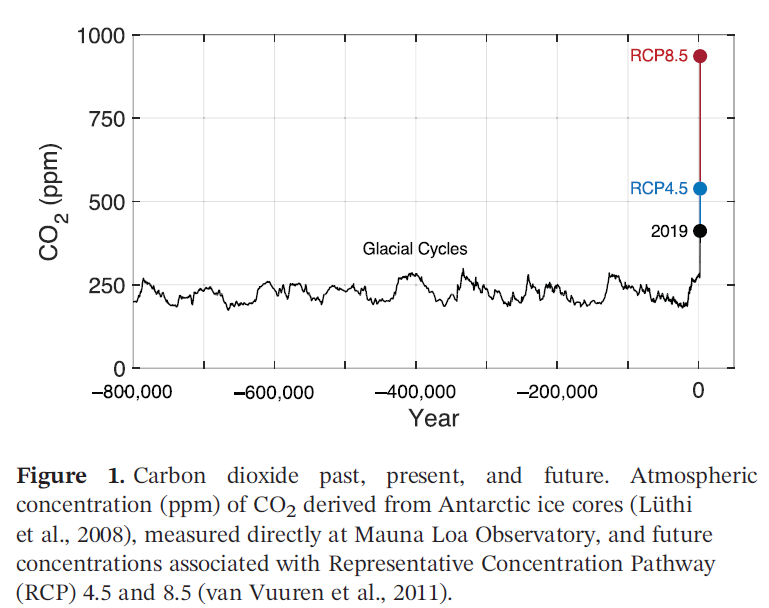
Figure 1 (above) shows the increase in CO2 in parts per million (PPM) from 800,000 years ago to today. Of course, there are glacial cycles*, but what you see is a recent, sudden, and meteoric rise – an increase of 50% between 1813 and 2019. The chart also projects what will happen depending on the mitigation strategies (called RCPs – Representative Concentration Pathways).
On to the main topic
Even if you debate the causes of the rise shown in the figure, the numbers are there. The CO2 is up. What would it mean – or better yet, what DOES it mean – if our CO2 levels are increased. What does it mean for humans, for projects, for work, if CO2 levels are elevated?
In this post, I am NOT talking about the other effects of CO2 and Greenhouse Gasses, such as:
- Ocean acidity
- Ocean level rise and glacial decay
- Species loss
- Climate change
All of those things are, of course, horrific, but here I want to focus only on one aspect of CO2 concentration increase that I’d never before considered, and one that may be of particular interest to project managers, so pay attention!
As you read this, keep in the forefront of your mind that project managers and team members require strategic decision making and higher-level cognitive skills.
I’m talking about the findings from a recently-published article from the American Geophysical Union’s publication GeoHealth called, “Fossil Fuel Combustion Is Driving Indoor CO2 toward Levels Harmful to Human Cognition”, by Karnauskas et al, which you will find posted on the US Government’s National Institutes of Health website.
Here is the abstract of that article:
Human activities are elevating atmospheric carbon dioxide concentrations to levels unprecedented in human history. The majority of anticipated impacts of anthropogenic CO2 emissions are mediated by climate warming. Recent experimental studies in the fields of indoor air quality and cognitive psychology and neuroscience, however, have revealed significant direct effects of indoor CO2 levels on cognitive function. Here, we shed light on this connection and estimate the impact of continued fossil fuel emissions on human cognition. We conclude that indoor CO2 levels may indeed reach levels harmful to cognition by the end of this century, and the best way to prevent this hidden consequence of climate change is to reduce fossil fuel emissions. Finally, we offer recommendations for a broad, interdisciplinary approach to improving such understanding and prediction.
Testing for the effects of indoor CO2 concentration on cognition is nothing new. As you would expect, military organizations are very interested to know how (for example) submarine crews are affected. That’s why these studies date back to the 1960s, and indicate that there are significant impacts on cognition if the CO2 levels rise, mainly in the area of:
- Responding to stimuli
- Reasoning
- Processing threats
From the article:
Early experimental studies testing for the influence of relatively high concentrations of CO2 (5–8%) that might be present in confined and enclosed spaces like submarines found significant impacts on ability to respond to a stimulus (Harter, 1967), reasoning (Sayers et al., 1987), and threat processing (Garner et al., 2011).
But submarine crews aren’t the only ones who have to respond to threats, use logic and reasoning, and make strategic decisions. You’ll recognize this as the stuff you need to do each week, maybe every day as a project manager.
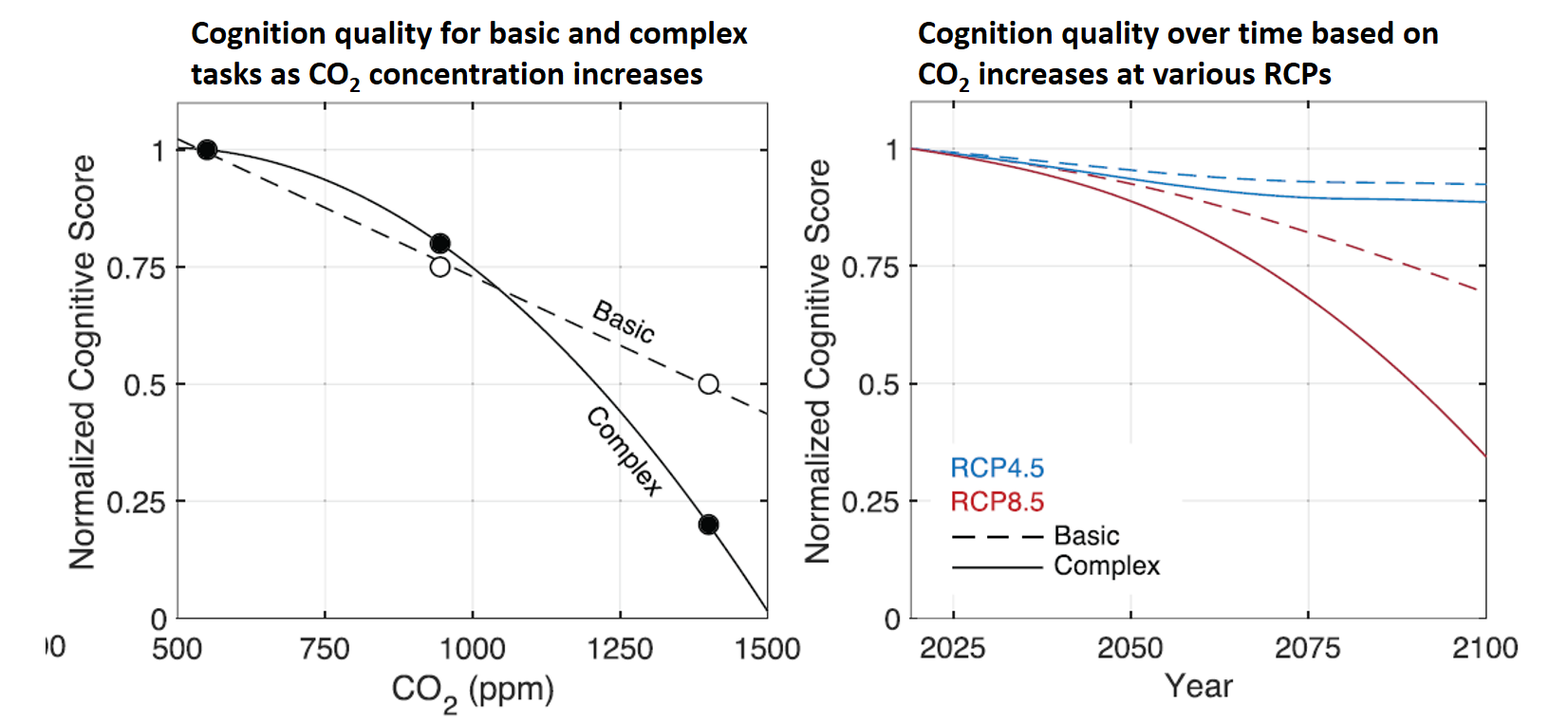
More recent studies have demonstrated a tens of percent decrease in cognitive function with increases of CO2 that would occur with double our current concentration of CO2. That doubling is not too hard to imagine with the current unmitigated strategy with respect to limiting emissions.
Of even more concern is the fact that the effect is stronger for higher-level cognition. From the article:
It may be that higher‐level, more cognitively demanding tasks are more likely to be sensitive to the effects of moderate levels of ambient CO2.
A study in juvenile rodents found that increased CO2 in the air reduced levels of a neuroprotective growth factor, severely harming brain development, increasing anxiety, and impairing learning and memory (Kiray et al., 2014).
I know that many of you will point out that your project team members are rarely juvenile rodents. And I know that some of you will point out that you often think of your project team members as juvenile rodents. Comedy aside, the point remains.
But these are all forecasts. What about now? We’re okay, right?
Nope.
According to the article, which I remind you, is on the US Government’s own NIH site:
On the unmitigated CO2 emission pathway (RCP8.5), we may be in for a ~25% reduction in our indoor basic decision‐making ability and a ~50% reduction in more complex strategic thinking, by the year 2100 relative to today. These results are almost entirely avoidable by reducing global CO2 emissions according to RCP4.5, which is tantamount to achieving the broad goals set forth under the Paris Agreement of the United Nations Framework Convention on Climate Change (UNFCCC).
...we estimate that our basic engagement and decision‐making ability should have (already) been reduced by about 8% (or 13%, if the urban CO2 dome effect is both entirely anthropogenic and developed over the same time period). It is important to note that this is an estimate of the influence specifically of the rise in CO2 concentration, all other factors being equal.
So our project teams are already likely affected by the increases in CO2. What can we do to prevent this from getting worse?
I’ll conclude the way the article concludes:
The best way to prevent indoor CO2 levels from reaching levels harmful to cognition is through reduced fossil fuel emissions.
*the CO2 level varies only between 172 and 300 in these cycles over hundreds of thousands of years.
Posted
by
Richard Maltzman
on: July 20, 2020 02:00 PM |
Permalink
Comments (3)
Please login or join to subscribe to this item
Very interesting., thanks for sharing
A very interesting piece, as always many thanks for sharing

Ashleigh Kennett-Smith
ICT Project Manager| Australian Red Cross Lifeblood
Adelaide, South Australia, Australia
Interesting and concerning.
Please Login/Register to leave a comment.
|
"The only way to keep your health is to eat what you don't want, drink what you don't like and do what you'd rather not."
- Mark Twain
|




