Driving Overoptimism - Part 2 of 2
From the People, Planet, Profits & Projects Blog
by Richard Maltzman,
Dave Shirley

View Posts By:
Richard Maltzman
Dave Shirley
Recent Posts
What is AI doing to the sustainability of our profession???
Stepwells – Insight from a Particularly Valid Angle
Climb-it Change: Pre-Interview Connector
Climb-it Change: New Relevance for the Stepwells of India
A PATH to more equitable health - via AI project leadership
Categories
6th,
6th Edfition,
6th Edition PMBOK,
7th Edition,
7th Edition PMBOK,
8th Edition PMBOK,
8th Edition PMBOK Guide,
Activism,
actuarial,
actuary,
adapt,
addition by subtraction,
Africa,
africa,
agriculture,
airforce,
ajaita,
Alaska,
amazon,
analogous,
analytics,
ancient,
and more power,
antarctica,
anti-science,
apple,
apps,
architecture,
arctic,
arrakis,
Artificial Intelligence,
asch paradigm,
Assistant,
asthma,
astronomy,
automobile,
automotive,
autonomous cars,
b,
bankhar,
Banksy Crypto,
basalt,
baseball,
bats,
batter,
beauty products,
benefit,
benefits,
Benefits Realization,
beyond epica,
biases,
bicycle,
big data,
big dfata,
big dig,
bike,
biodiversity,
biomedicine,
birdhouse,
blockchain,
blood,
blue blood,
blue trees,
bluefin,
bluefin tuna,
book review,
boston,
boston university,
Boyce,
Brazil,
brazil,
Breakdown Structures,
BS,
building,
buildings,
built environment,
built environment,
bumblebee,
cake,
capacitor,
car,
Carbon,
carbon,
carbon capture,
carbon negative,
carbon neutral,
carbon pool,
carbon sequestration,
carbonate,
careers,
CEO,
ChatGPT,
chatGPT,
chatgpt,
chatgpt,
chess,
China,
china,
chopsticks,
citrus,
cli-fi,
climate,
climate change,
climate resilience,
climeworks,
Clumsy,
CO2,
co2,
CO2 Utilization,
coalition,
cobalt,
coffee pods,
cognition,
cognitive,
Collabortion,
colombia,
concrete,
Conflict,
construction 5.0,
cool projects xyloscope,
cooling,
coral,
corn,
cost of good quality,
cost of poor quality,
cost of quality,
crazy,
criticism of project management,
cryptocurrency,
CSR,
csr,
data,
data analytics,
data privacy,
datacenter,
dataset,
death spiral,
Decision Making,
decomposition,
Defense and Climate,
definition of a project,
deforestation,
dependencies,
dependency,
desert,
DIKW,
dikw,
dimopoulos,
disposal,
dna,
DOD,
dogs,
dolphins,
dream,
drilling,
drink,
dune,
dune,
dutch,
early start,
earth,
eatlocal,
eco-tourism,
ecological,
economic,
economics,
EKC,
electric grid,
electricity,
electronics,
elysis,
embodied carbon,
emerging technologies,
empower,
Energy,
energy efficiency,
environmental degradation,
escalate,
escalation,
ESG,
extreme weather,
fallacy,
FARC,
farming,
finance,
fish,
fish brains,
fishing,
fix,
fixing the earth,
flint water,
Flint Water Supply,
flood,
flooding,
Food supply chain,
food waste,
forest,
forest for the trees,
forestation,
forrestgump,
frank herbert,
Fruitcake,
fungus,
fusion,
Galvao,
garage,
gas,
gasoline,
geese,
gender equality,
gender partnerships,
generational differences,
Generative AI,
gladwell,
gold,
Goodness,
google,
Government,
GPT,
great pacific garbage patch,
green,
green building,
green buildings,
green energy,
green iguana,
green project,
green project management,
greening,
guest post,
gyre,
harkonnen,
Harvesting Benefits,
hawasina,
hedgehogs,
heursitics,
historical data,
hlb,
holitsic,
holland,
horseshoe crab,
human-caused climate change,
hydrogen,
hydrology,
ice,
iceland,
ignition,
iguana,
imagery,
impact,
india,
inequality,
information,
initiatives,
injection,
insurance,
intelligence,
interacting risk,
internal combustion engine,
invasive species,
investment,
isomer,
issue escalation,
issues,
ITER,
jobs,
Jupiter,
justification,
kids,
kill point,
knowledge,
koch brothers,
Kuznets,
laboratory,
LAL,
landscape mode,
lapampa,
launch,
LCA,
Leadership,
Leadership,
life cycle analyses,
life cycle analysis,
lifecycle,
Linkedin,
liquid,
lizard,
local,
long term,
long-term,
long-term thinking,
look up,
loud,
maintenance,
maker,
makermovement,
malcolm gladwell,
management,
marathon,
marine biology,
market,
mars,
Martin Luther King,
mean,
megawatt,
MeHg,
melting,
mercury,
metal,
Microgrid,
microplastics,
migration,
military,
millennial,
mindset,
minerals,
mission,
mitigate,
MLK,
mongolia,
museum,
museum of london,
nature,
nematodes,
net gain,
Net Project Success Score,
net zero,
netherlands,
network,
New book,
New Jersey,
New Practitioners,
new york,
NFT,
nitrogen,
noise,
noreaster,
norway,
nova,
NPSS,
NREL,
ocean,
ocean cleanup,
ocean life,
oil rig,
oil rigs,
oklahoma,
oman,
only murders in the building,
opportunity,
overall risk,
oxygen,
packaging,
pareto,
PBS,
permafrost,
persistence,
peru,
Pharmaceutical,
planet,
planet.com,
planning,
plant,
plasma,
plastic,
playground,
pm,
pm education,
pmbok,
pmbok guide,
pmnetwork,
PMXPO-2018,
podcast,
pollutants,
pollution,
poop,
poor,
portfolio,
power,
power skills,
privacy,
privacy concerns,
professors,
program,
Program Management,
project,
project leader,
project leadership,
project management,
project management 3.0,
project on fire,
project progress,
Project Success,
project success,
projecticity,
projectleadership,
projectmanagement,
projects,
psychology,
pulse of the profession,
purple bacteria,
purpose,
quiet,
rainforest,
rationale,
reef,
refugees,
renewable,
renewables,
Repair,
repair,
repeatable process,
repeatable processes,
repurpose,
research,
resource breakdown strucuture,
Resource Management,
reversing climate change,
revisionist history,
rich,
rigs2reefs,
ripe,
risk,
risk avoidance,
Risk Management,
risk mitigation,
risk response,
risk responses,
river,
robots,
rocks,
rules of thumb,
rural,
rural India,
russia,
Sarcasm/Irony,
satellite,
saudi,
schedule,
sci-fi,
Science,
science,
science-fiction,
scientific american,
screaming monkeys,
sea,
sea life,
Sea-Level Rise,
sea-level rise,
seagreens,
seawall,
seawater,
seawater temperature,
seaweed. beat;es. farming,
secondary risk,
selena gomez,
sequestration,
shipping,
skyscraper,
SLR,
smart cities,
smart city,
smelting,
social,
social pressure,
soil,
solar,
solar panels,
solar perovkites,
solar saheli,
sonic,
sponge cities,
SRI,
stage-gate,
stagegate,
stakeholder,
stakeholder management,
steward,
stewardship,
storage,
strategy,
stupid,
success,
suffer,
sulphur,
sunk cost,
supercapacitor,
supply chain,
survey,
Sustainability,
sustainability,
Sustainable Investing,
Sustainable Tourism,
sybiosis,
symbiosis,
system 03,
TBL,
temperature,
terraform,
terraforming,
test,
threat,
threats,
totem,
touchscreen,
tour,
tower,
Trains,
transparency,
transportation,
trash,
tree,
tree species,
trees,
trillion,
triple bottom line,
triple constraint,
truth to power,
UMass,
us army corps of engineers,
USDA,
vacuum,
value,
venus,
vision,
voice,
voltage optimization,
vw scandal,
washing machine,
waste,
wastewater,
water,
we mean business,
whales,
Whirlpool,
wind,
wisdom,
women,
Women in Project Management,
wood wide web,
woonerf,
Work Breakdown Structures (WBS),
world breakdown structure,
worms,
xian,
xylotron,
Yale
Date

In Part 1 of this brief series, I discussed optimism bias and how it applies to projects, and to us as project managers. I referred to this article in Nature magazine and focused on this key point:
Consumers decide whether to own a vehicle on the basis of considerations such as where they live and the vehicle’s upfront and lifetime costs. If they systematically underestimate total costs, this could increase car ownership and its associated emissions. It could also make alternative forms of transport – car sharing, alternative-fuel vehicles, public transport, biking or waking – seem less attractive.
Next, I asserted that the question now becomes: would individuals gasp the idea of a broader “total cost of ownership” ? And, armed with this better-quality information and knowledge, would they make a different choice?
Indeed, that’s what I will close with in this Part 2 of 2.
The authors of the article surveyed over 6,000 citizens across Germany, aiming to find out what the implications of an expanded (and less optimistically-biased) understanding of vehicle cost would mean to the number of cars on the road.
This is Nature magazine, after all, a respected scientific journal, so they were very careful about their data set and their methods:
- They focused on head-of-household, those who made the financial decisions
- They noted the individuals’ car type, driving behavior, socio-economic characteristics
- They worked with the Forsa survey institute
6,233 surveys were completed by car-owning individuals and about 5,500 stated their opinions of what the true monthly costs of ownership were.
Then, they went to the German Automobile Club (similar in nature to the USA’s AAA) and other sources to validate the actual monthly costs of car ownership including depreciation, fuel, taxes, insurance, and repair.
The results
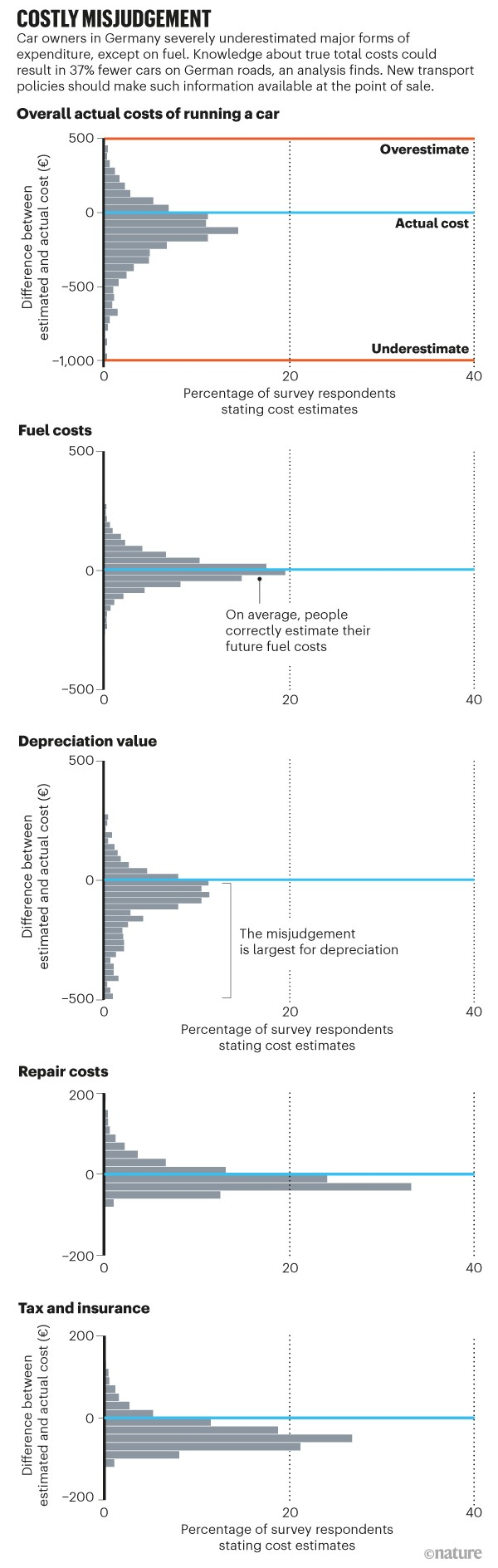
Consumers underestimate the total cost of vehicle ownership by an average of about $240 per month. For many people, that number is a car payment. The total actual cost is nearly double what people estimate. There it is: optimism bias in action. In motion. In their cars.
Even when respondents took all cost factors into account, the underestimation was over $190 per month. See the data in the figure at the bottom of this post.
Interestingly, respondents were fairly accurate when it came to fuel, but when it came to financial measures such as depreciation, this was the largest underestimation by far. Why? It’s information that is seemingly unrelated to driving. Fuel, maintenance, purchase price (or leasing costs) – these “fit” in the mindset of drivers. Depreciation – not so much appreciation for depreciation!
So next comes the hypothesis: what would happen if we completely eliminate the degree to which people underestimate the total cost of owning a car? If people really “got” that they were paying about twice as much (on average) as they thought, would more cars ‘vanish’ from the road?
The authors modeled how vehicle ownership costs changes, when the associated costs change. Their conclusion? More than 1/3 (in fact 37%) of the vehicles in Germany would be removed from the road. What does this mean? In terms of CO2 emissions, this is about 23% of Germany’s entire transportation sector, and in real terms, 37 million tonnes per year!
What are the recommendations and next steps?
The authors recognize that nothing will likely ‘entirely stop people from underestimating the total cost of owning a car’. But they do believe that they can close the awareness gap in the following ways:
- Automobile manufactures should label their vehicles with the real estimated total costs at point of sale
- Provide average future fuel cost of driving the vehicle (already done in many countries)
- Assure that independent agencies provide the total cost information
- Empower ride-sharing and public transportation agencies to advertise these total costs (with certification that the data is valid, per the above)
- Continue research in this area, answering questions like:
- Why do consumers underestimate total cost?
- Is this a local phenomenon to Germany? Replicate this in Japan, the US, Brazil, and elsewhere
- Inform policymakers of these findings
I found this to be a fascinating story – I hope it helps you when making a purchase decision, and in your day-to-day project management role.
I’m optimistic about it. Don’t let me down.
Posted
by
Richard Maltzman
on: July 29, 2020 03:18 PM |
Permalink
Comments (2)
Please login or join to subscribe to this item
Thanks, very informative and interesting
Please Login/Register to leave a comment.
|
"I'm glad I did it, partly because it was worth it, but mostly because I shall never have to do it again."
- Mark Twain
|




